Aryabhata's Number System: Verses That Encode Values

The alphabetic notation that compressed astronomical data into poetry

Learn Aryabhata's unique alphabetic number system that allowed him to express large astronomical values in compact, memorable verses.

The Astronomer's Code

In 499 CE, a twenty-three-year-old named Āryabhaṭa sat in Kusumapura, the scholarly quarter of Pāṭaliputra near the Ganges, and faced a problem that has no easy solution in any era. He needed to fit nine-digit numbers into a 121-verse book written in strict Sanskrit meter. The Moon's count of revolutions in a cosmic cycle was 57,753,336. Jupiter's was 364,224. Saturn's was 146,564. Each planet needed its own parameter, and each one had to survive centuries of oral transmission without a digit going wrong. The book would be memorized and recited aloud. There was no space for numbers written out in full.

Āryabhaṭa built a code from the Sanskrit alphabet. Each consonant carried a value. Each vowel attached a power of ten. A nine-digit constant collapsed into a cluster of two or three syllables that fit neatly into a line of āryā meter. When a URL shortener turns a long web address into a seven-character link, or when Git prints a short hash for thousands of files, the same instinct is at work. Āryabhaṭa had it fifteen centuries earlier. His code is called the varṇasaṃjñā, the letter-designation system, and it is the oldest surviving compression scheme in the history of mathematics.
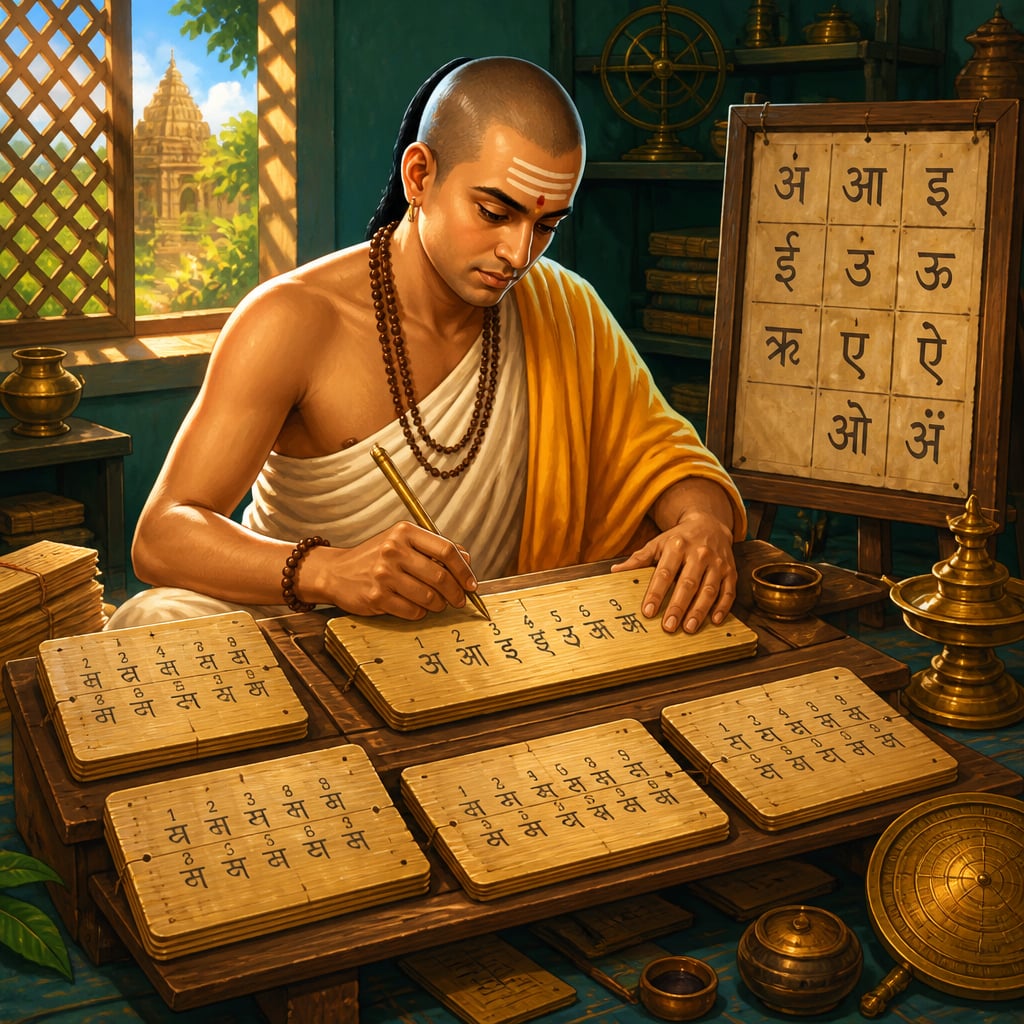
Aryabhata writing the letter-numeral cipher on palm leaf

Why a Mathematical Book Needed a Compression Scheme

To understand why Āryabhaṭa invented the system, you have to understand what his medium demanded. The Āryabhaṭīya is only 121 verses long. In those 121 verses it compresses the entire working apparatus of mathematical astronomy: a theory of place value, a sine table, rules for areas and volumes, methods for solving indeterminate equations, a model of planetary motion, and a set of astronomical constants precise enough to predict eclipses. The constants are huge. The number of revolutions the Sun makes in a mahāyuga of 4,320,000 years is itself 4,320,000. The number of revolutions of the Moon in the same period is 57,753,336. Jupiter, Saturn, Mars, Mercury, and Venus each have their own nine- or ten-digit parameter. A mathematical astronomer needed every one of these numbers as raw input to every calculation.

But the Āryabhaṭīya was written on palm leaf, recited aloud, memorized by students, and copied by scribes who could not afford to waste a line. It is composed in Sanskrit āryā meter, which dictates the exact rhythmic length of each quarter-verse. Writing 'four million three hundred twenty thousand' in any natural form would have blown the meter and buried the student under digits. Āryabhaṭa needed a way to put a nine-digit number inside a single cluster of syllables that would fit the rhythm and could be learned by heart.

The System Itself

He built it out of the Sanskrit alphabet. The twenty-five mute consonants k through m, which the grammarians already called the varga (square) letters, he assigned the values 1 through 25 in order: k is 1, kh is 2, g is 3, gh is 4, and so on through m at 25. The eight consonants y through h, which the grammarians called avarga (non-square), he assigned the values 30, 40, 50, 60, 70, 80, 90, and 100. These avarga values already have a factor of ten baked in, which means the varga letters naturally occupy even decimal positions and the avarga letters occupy the odd positions one step higher.

The nine Sanskrit vowels a, i, u, , , e, ai, o, au are used as joint multipliers that lift both groups together by two decimal places at a time. The vowel a keeps a varga letter at 10 to the power 0 and an avarga letter at 10 to the power 1. The vowel i lifts them to 10 to the power 2 and 10 to the power 3. The vowel u lifts them to 10 to the power 4 and 10 to the power 5. The vowel lifts them to 10 to the power 6 and 10 to the power 7. The pattern continues up through au at 10 to the power 16 and 10 to the power 17. The rules are laid down in a single crisp verse, Āryabhaṭīya Gītikapāda 2, in sixty syllables.

The effect is that every syllable carries its own place-value coordinate, baked into the vowel, and a single cluster of two or three syllables can encode a number as large as a hundred billion. It is the oldest positional code in which a letter contains not just a digit but also the exponent of ten at which that digit lives. Each syllable is self-addressed.

Watching the System Work

Khyughri decoded into 4,320,000 on palm leaf

In Āryabhaṭīya Gītikapāda 3, Āryabhaṭa writes a single compressed phrase: yuga-ravi-bhagaṇāḥ khyughṛ. Translated word for word, it reads 'in a yuga, the Sun's revolutions are khyughṛ'. The cluster khyughṛ is the number. To decode it, take the first syllable, khyu. It contains two consonants, kh and y, sharing one vowel, u. The vowel u places both letters at the 10 to the power 4 to 10 to the power 5 level. The varga letter kh, value 2, sits at 10 to the power 4, contributing 20,000. The avarga letter y, value 30, sits at 10 to the power 5, contributing 300,000. Added together, the syllable khyu is 320,000. The second syllable, ghṛ, is a single consonant, gh, with the vowel . The vowel lifts it to 10 to the power 6. The varga letter gh, value 4, contributes 4,000,000. Sum the two syllables and you have 320,000 plus 4,000,000, which is 4,320,000. That number is the count of revolutions the Sun completes in a mahāyuga, and it is also the number of solar years in one mahāyuga. Āryabhaṭa has just laid down one of the most culturally loaded numbers in the entire Indian tradition, in six letters, inside a single foot of meter.

The other planets get the same treatment. The Moon's 57,753,336 revolutions per mahāyuga collapse into the cluster cayagiyaṅuśuclṛ. The rotations of the Earth (Āryabhaṭa, almost alone among classical astronomers, teaches that the Earth spins on its axis) are encoded as another cluster in the same line. Jupiter, Saturn, Mars, Mercury, and Venus each get their own compressed string. Every one of these numbers parses the same way once the student has internalized the key.

Reception, Resistance, and Rediscovery

Later Indian mathematicians admired the system but did not always adopt it. The bhūtasaṃkhyā system, in which words like candra (moon) meant 1 and veda meant 4, was easier to weave into devotional poetry and became the more common notation in later Sanskrit mathematical verses. Āryabhaṭa's varṇasaṃjñā, which was essentially a technical notation for specialists, remained the notation of the Āryabhaṭīya itself and of the tight circle of commentators who worked on it. Bhāskara I, his first great commentator in 629 CE, wrote an entire manual explaining how to decode it. A thousand years later, in Kerala, Nīlakaṇṭha Somayājī was still teaching it to his students.

Walter Clark decoding Aryabhatiya at Harvard

The system then passed, for a time, almost out of memory. When European and Indian scholars returned to the Āryabhaṭīya in the nineteenth century, the meaning of the compressed syllables was no longer obvious to anyone outside a narrow teaching lineage. It took Walter Eugene Clark, Wales Professor of Sanskrit at Harvard, to publish a full modern edition and translation in 1930 with a clean tabulation of the rules. Later K. S. Shukla and K. V. Sarma refined the reconstruction in the 1976 critical edition. Once the key was recovered, the Āryabhaṭīya became legible again, and the numbers fell back into place in the verses where Āryabhaṭa had hidden them.

Why It Still Matters

Every modern encoding scheme that packs a large integer into a short string of characters is a descendant of the same instinct. Base-64 encoding, which squeezes three bytes into four printable characters, uses the same trick: a fixed alphabet, tokens with positional meaning, a rule table for decoding. Git commit identifiers, Two-Line Element sets for satellite orbits, URL shorteners, and barcode standards are playing the same game. Āryabhaṭa's innovation was to recognize that the key is not how you write the digit. The key is how you attach the place value to the digit itself, so that the ordering of the symbols does not have to carry the information. It is the idea that every symbol should be self-addressed. Fifteen centuries before the first computer, that idea was already alive in a single compressed cluster that meant, all by itself, 4,320,000.

In Kusumapura in 499 CE, Āryabhaṭa wrote the cluster khyughṛ and moved on to the next verse. The six letters encoded 4,320,000. His students memorized them. Fifteen centuries later, those six letters are still in the Āryabhaṭīya, readable by anyone who knows the key.

Key figures

Āryabhaṭa

476 to c. 550 CE, Kusumapura (scholarly quarter of Pāṭaliputra, modern Patna)

Bhāskara I

c. 600 to 680 CE, Valabhī (modern Saurashtra) and Aśmaka

Walter Eugene Clark

1881 to 1960, Wales Professor of Sanskrit at Harvard University

Case studies

Decoding khyughṛ: Six Letters for 4,320,000

Open the third verse of Āryabhaṭīya Gītikapāda and you meet a string of letters that looks like an accidental mouthful: yuga-ravi-bhagaṇāḥ khyughṛ. Translated literally it reads 'in a yuga, the Sun's revolutions are khyughṛ'. Āryabhaṭa does not then write down what khyughṛ means as a number. He does not need to. A student who has learned the rules of Gītikapāda 2 the night before will already know. The cluster has two syllables. The first syllable, khyu, contains two consonants (kh, valued 2, and y, valued 30, which is really the digit 3 at the tens place) sharing the vowel u, which lifts them to the 10 to the power 4 and 10 to the power 5 level. Together they contribute 20,000 from kh and 300,000 from y, for a syllable total of 320,000. The second syllable, ghṛ, is the consonant gh (valued 4) with the vowel ṛ, which lifts it to 10 to the power 6, contributing 4,000,000. Sum the two syllables and you have 4,320,000. That is the number of revolutions the Sun completes in a mahāyuga in Āryabhaṭa's astronomy, and it is also the number of solar years in a mahāyuga. Six letters. Nine digits. One foot of āryā meter.

The genius of the system is that the syllable is the unit of meaning, not the individual letter. Every syllable carries both a digit value (from its consonants) and a place value (from its vowel), so the reader never has to count positions to know where a number sits. The code is self-addressing. Āryabhaṭa inherited a long Indian tradition of treating language as a formal computational system. The Paninian grammatical sutras of the 5th century BCE had already compressed infinite grammatical structure into finite notation. Āryabhaṭa applied the same instinct to number. He compressed infinite astronomical data into finite, chantable verse.

Gītikapāda 3 goes on from khyughṛ to encode the revolutions of the Moon (cayagiyaṅuśuclṛ = 57,753,336), the Earth's eastward rotations (Āryabhaṭa, almost alone among classical astronomers, teaches that the Earth spins on its axis), and the full set of Mars, Mercury, Jupiter, Venus, and Saturn parameters in successive clusters. Every one of these is a nine- or ten-digit integer. Every one of them fits inside a single foot of āryā meter. The entire planetary parameter set of Indian mathematical astronomy for the next thousand years is laid down in fewer than one hundred syllables.

The tightest notation is the one whose symbols carry their own position. Specify the address with the data, not alongside it, and you will never lose your place. That instinct, fifteen centuries old, is still the right way to design any encoding that has to survive transmission.

The cluster khyughṛ encodes 4,320,000 in six Sanskrit letters. In decimal notation the same number takes seven digits. In Roman numerals it would take well over twenty characters. In fully spelled English it takes more than thirty letters. Āryabhaṭa's notation is the densest of the four by a factor of five.

Clark's 1930 Rediscovery: Rebuilding the Decoder at Harvard

When Walter Eugene Clark, Wales Professor of Sanskrit at Harvard, published his translation of the Āryabhaṭīya in 1930, he was publishing a text that had been technically available in India without ever having been truly readable in the West. European Sanskritists had known the Āryabhaṭīya existed since the 19th century, but the first verses of Gītikapāda had stopped them cold. Those verses contain numerical constants, but the numerical constants appear as strings of Sanskrit syllables that seem to make no sense as words and no sense as numbers. Bhāskara I had explained how to decode them in 629 CE, and Nīlakaṇṭha Somayājī had taught the rules in Kerala a thousand years later, but the Kerala teaching tradition had grown narrow and the rules had not crossed into readable modern Western literature. Clark brought the text, the classical commentaries, and the reconstructed rules together in one volume, the first full English translation with a mathematical appendix that laid out the varṇasaṃjñā decoding table. A generation of Indian scholars including P. C. Sengupta, K. S. Shukla, K. V. Sarma, and T. S. Kuppanna Sastri then refined and extended Clark's work across the next fifty years.

The story of the Āryabhaṭīya's rediscovery is really a story about the fragility of compressed knowledge. A compression scheme is only as durable as its decoder. When the living teaching line that transmitted the decoder thinned out, the compressed text turned into opaque syllables. The same is true of every code ever devised. A library of Git commits without the SHA-1 algorithm is a pile of unintelligible strings. A set of base-64 encoded documents without the decoding table is random printable ASCII. Āryabhaṭa's verses survived, but for a time the key that unlocked them did not, and the numbers in the verses had to be rebuilt from the outside. The fact that they could be rebuilt at all is a quiet tribute to the system's internal consistency. A less mathematically regular scheme would not have been recoverable.

Clark's 1930 edition is still in print and still the gateway through which most non-Sanskrit readers encounter the Āryabhaṭīya. The Shukla and Sarma critical edition of 1976, prepared under the Indian National Science Academy, remains the scholarly reference. Modern introductions such as Kim Plofker's Mathematics in India now treat the varṇasaṃjñā system as a standard and live notation that any serious student of Indian mathematics can read fluently on the first page.

When you build a code, build it consistently enough that the rule can be reconstructed from the encoded data itself if the rule ever gets lost. A mathematically regular scheme can be recovered from enough instances of its output. An ad-hoc scheme cannot. Āryabhaṭa's verses held their own answers for fifteen hundred years and handed them over, intact, to the scholar who was patient enough to ask.

Clark's 1930 edition was published 1,431 years after Āryabhaṭa wrote the Āryabhaṭīya in 499 CE. The gap between the original composition and the first full modern Western edition is roughly the same as the gap between the fall of the Western Roman Empire and the invention of the smartphone.

Base-64 and Modern Compression: The Same Move, Fifteen Centuries Later

In 1982, the Internet Engineering Task Force published RFC 989, the first specification of the Privacy-Enhanced Mail standard. PEM needed a way to carry binary data (encryption keys, signatures, ciphertext) through email systems that only understood printable ASCII characters. The solution was a compact mapping that took groups of three bytes (24 bits) and re-encoded them as four printable characters drawn from a fixed alphabet of 64 symbols: the 26 uppercase letters, the 26 lowercase letters, the 10 digits, and two punctuation marks. The scheme was called base-64, and it is now the default way most software moves binary blobs through text channels. Every embedded image in an HTML email, every JSON Web Token, every data URI in a browser, and every Git commit identifier is a descendant of the same basic idea. Take a large number, represent it in a compact alphabet, and make the symbols carry their own position so that decoding requires only the table.

Āryabhaṭa's varṇasaṃjñā is the oldest surviving example of this pattern. Fix an alphabet (in his case the Sanskrit consonants and vowels), assign each symbol both a digit value and a position value, and write numbers as short strings whose length is determined by the logarithm of the number rather than by its natural magnitude. The design instinct is identical across fifteen centuries. The constraints that forced Āryabhaṭa into compression (palm-leaf economy, memorizability, strict āryā meter) are different from the constraints that forced the IETF into base-64 (7-bit ASCII email, line length, human-copyability), but the response is structurally the same. When your channel is narrow, you shrink the payload by making every symbol carry more information.

Base-64 and its cousins now move trillions of characters of encoded data per day across the global internet. Every satellite in orbit, every committed line of source code, every authentication token, and every emoji shipped inside a JSON body is traveling through a descendant of the same compression instinct. The surface forms differ wildly, but the underlying idea, that each symbol should carry both value and position, is the same one Āryabhaṭa laid down in Gītikapāda 2.

When you design a notation for a narrow channel, do not ask 'how can I compress the data'. Ask 'how can I make the symbols themselves carry more structure'. Āryabhaṭa built this idea into a line of Sanskrit meter. Base-64 built it into a 64-character alphabet. The problem recurs in every generation, and the solution, each time, looks like a rediscovery of a move that was already ancient when it was first written down in 499 CE.

Base-64 encoded data adds about 33 percent overhead compared to the raw bytes and is still one of the most space-efficient printable-ASCII encodings in common use. Āryabhaṭa's varṇasaṃjñā, measured against spelled-out Sanskrit numerals, compresses by factors of four to seven depending on the size of the number.

Historical context

Late Gupta period, Classical Indian Mathematical Astronomy (c. 499 CE)

The Gupta empire in 499 CE was past the high point of its political strength but still presided over the greatest concentration of intellectual and artistic achievement the Indian subcontinent had ever seen. Āryabhaṭa's home city, Kusumapura (the scholarly quarter of Pāṭaliputra, modern Patna), was an active center of mathematical astronomy with a lineage stretching back at least to the older Sūryasiddhānta tradition. Buddhist, Jain, and Brahmanical scholars worked side by side in the same university town, sharing vocabulary and techniques freely. Ujjain, further west, was the other principal center and the notional prime meridian of Indian astronomy.

Every later Indian school of mathematical astronomy grew out of the Āryabhaṭīya. Bhāskara I, writing in 629 CE, treated it as the canonical textbook. Brahmagupta in 628 CE, Bhāskara II in 1150 CE, and the entire Kerala school from the 14th century onward inherited both its parameters and its compression instinct. The verses that encode planetary constants in Gītikapāda 3 are in this sense the DNA of Indian mathematical astronomy, carried forward in the memory of every student who learned the text by heart. The kaṭapayādi letter-code that Kerala mathematicians refined in the centuries after Āryabhaṭa is a direct descendant of his varṇasaṃjñā, and it is still used in Carnatic music today to name the 72 melakarta rāgas.

Living traditions

India's first satellite, launched on 19 April 1975 from Kapustin Yar cosmodrome under an ISRO-Soviet arrangement, was named Āryabhaṭa in his honor, and the satellite appeared on the reverse of the old Indian 2 rupee note for decades. NCERT mathematics textbooks in Class 7 introduce Āryabhaṭa by name as the founder of Indian mathematical astronomy. The varṇasaṃjñā system itself is not in daily use, but its direct descendant, the kaṭapayādi system, is still the way Carnatic musicians name the 72 melakarta rāgas: each rāga's first two syllables encode its place in the melakarta list, which means any trained musician can read the rāga's number directly from its name. Āryabhaṭa Knowledge University in Patna, founded in 2010, carries his name into the administration of modern Indian higher education in Bihar.

Reflection

More in Dashamana: The Decimal Place Value System

All lessons in Dashamana: The Decimal Place Value System · Indian Mathematics: Ancient Genius, Modern Foundations course