From Words to Numbers: Bhutasamkhya System

How Sanskrit poetry encoded mathematical values

Discover the ingenious Bhutasamkhya system where words like 'moon' (1), 'eyes' (2), and 'Vedas' (4) represented numbers in memorable verse.

The Verse That Hid Eleven Digits

Sometime in the fourteenth century CE, a mathematician named Mādhava sat in the small village of Saṅgamagrāma, near the Periyar river in Kerala, and faced a problem. He had computed the value of π to eleven decimal places. He needed his students to carry this number across generations without losing a single digit. Palm-leaf manuscripts rotted in Kerala's humidity within a century or two. The only medium that lasted was the human voice, and the voice held onto melody far longer than it held onto a string of numbers.

Mādhava composed a Sanskrit verse. Inside it, woven into the names of objects every student already knew, were twelve words that encoded the digits of π in sequence from smallest to largest. To decode them, a student read from right to left and divided the result by nine hundred billion. The answer was 3.14159265359, correct to eleven decimal places. Eleven digits of π, stored inside a song.
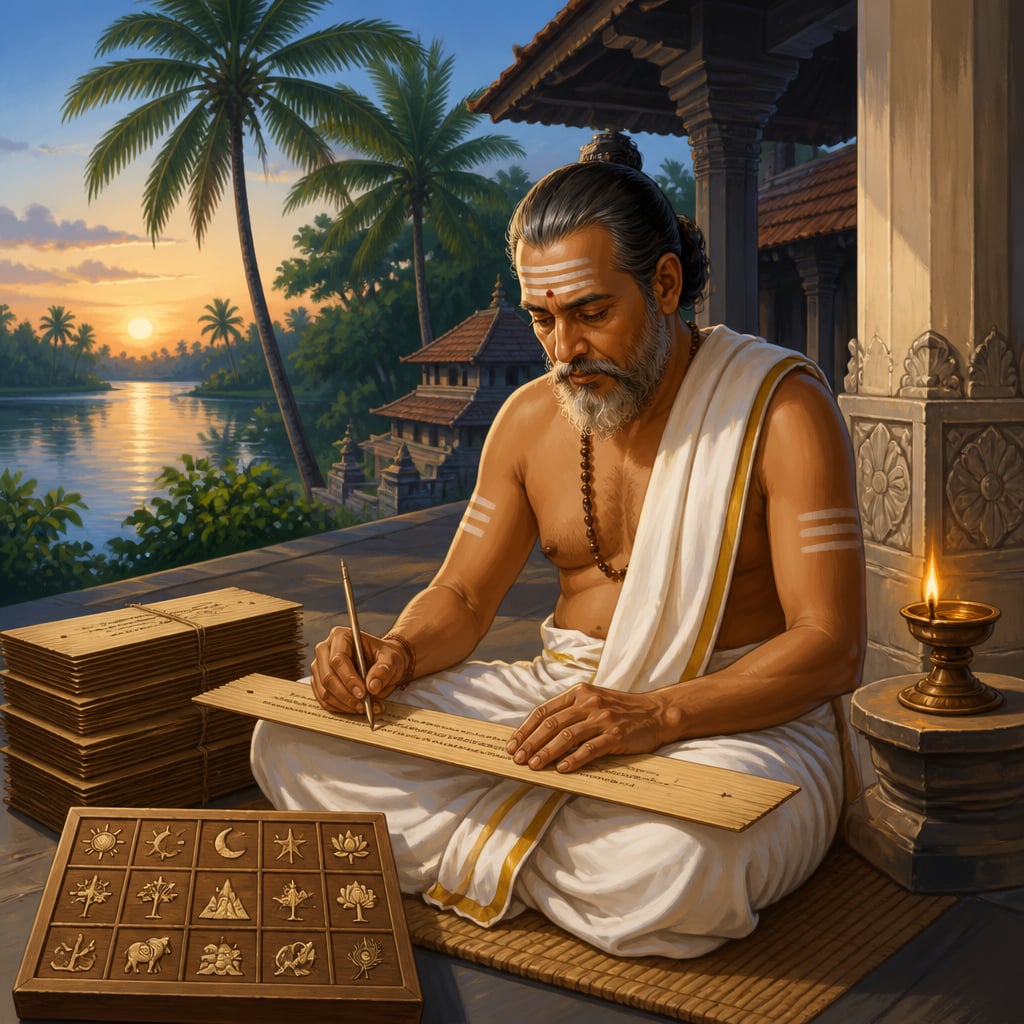
Madhava composing a Sanskrit verse that encodes pi

The technique he used was called bhūtasaṃkhyā, literally 'object numbers'. For more than a thousand years, it let mathematical knowledge travel through the mouths of students who had never seen a numeral written down.

The Trick: Objects That Everybody Counts
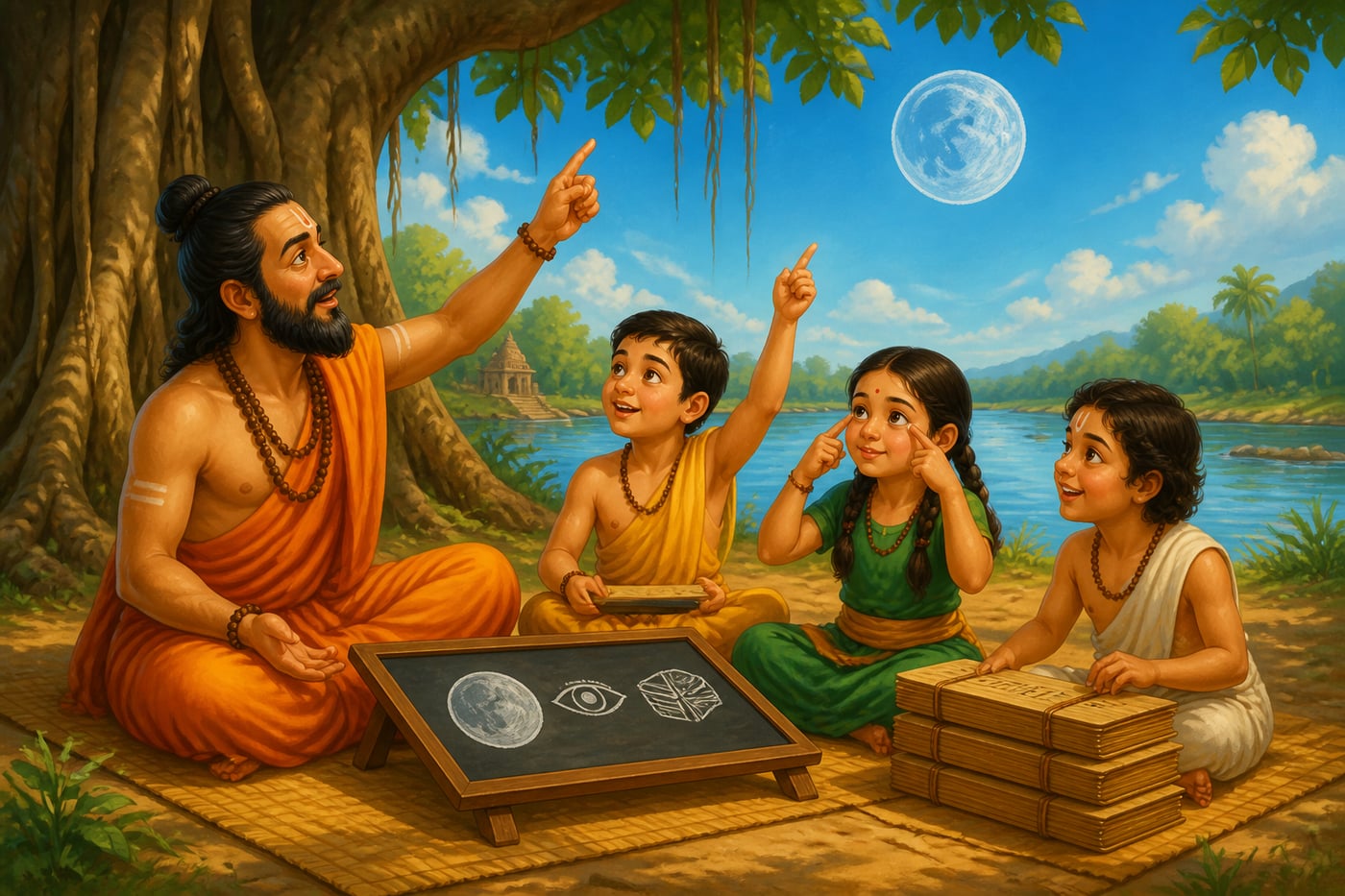
Sanskrit teacher and students naming object-numbers

The basic idea is disarmingly simple. Pick an object that everybody in the culture knows to come in a specific number. Then use the name of that object to mean that number.

How many moons are there in the sky? One. So candra (moon), indu (moon), bhū (earth), and rūpa (form, the one Brahman) all mean 1.

How many eyes does a human have? Two. So netra (eye), akṣi (eye), locana (eye), bāhu (arm), pakṣa (wing), and yama (the twins) all mean 2.

The three sacrificial fires of Vedic ritual give agni, pāvaka, and hutāśana for 3. The four Vedas give veda and śruti, and the four oceans of classical cosmology give samudra for 4. The five senses give indriya, the five arrows of Kāma give bāṇa, and the five mahābhūtas give bhūta for 5. The six seasons give ṛtu, and the six flavors of Ayurveda give rasa for 6. The seven sages give ṛṣi, and the seven horses of Sūrya's chariot give aśva for 7. The eight Vasus give vasu, and the eight directional elephants give gaja for 8. The nine openings of the body give nanda, and the nine planets including Rāhu and Ketu give graha for 9. Zero is śūnya, kha (sky), ākāśa (space), and bindu (dot).

A mathematician who wanted to write the number 234 could choose from a vast palette of word-combinations that all encoded the same value. Veda-netra-hutāśana would do. Samudra-yama-agni would do. Any ordered triplet whose values read 2, 3, 4 would do. The system was redundant on purpose. Redundancy gave poets the freedom to pick words that fit the meter of the verse they were composing.

The Rule That Tripped Everyone: Right to Left

There was one rule you had to know. In bhūtasaṃkhyā, the digits are read from right to left. The convention is stated in classical commentaries as aṅkānāṃ vāmato gatiḥ, 'the movement of digits is from the left', where 'from the left' describes the composer's direction: the smallest-place digit is named first, then the next-larger place, then the next. If a verse says indu-veda, a novice reads 'one, four' and gets fourteen. A trained reader reverses the order and gets forty-one.

Why right to left? Because Sanskrit verse flows left to right, and the composer wanted the smallest, easiest word-numeral to land on the first syllable, where the metric constraints are loosest. The rule was not arbitrary. It was a concession from arithmetic to the pressure of prosody.

Why Not Just Use Digits?

A reasonable modern question is why anyone bothered. The decimal digits 0 through 9 were already circulating by the 5th century CE, and the Āryabhaṭīya itself establishes the place-value rule that each position is ten times the previous one, sthānāt sthānaṃ daśaguṇaṃ syāt. If you can write '41', why would you prefer indu-veda?

The answer is that writing, for most of this history, was not the primary storage medium for mathematical knowledge. Palm-leaf manuscripts rotted in the humidity of Kerala and Bengal within a century or two. Birch bark cracked. Copper plates were expensive and reserved for royal grants. The durable medium was the human voice, and the human voice preferred verse. Every major text of Indian mathematics and astronomy, from the Āryabhaṭīya to Bhāskara II's Līlāvatī to Nīlakaṇṭha's Tantrasaṅgraha, was composed in meter. Students learned them by chanting, not by reading. A constant encoded as a forgettable string of digits would be lost within a generation. A constant encoded as a memorable line of Sanskrit poetry could survive for centuries.

This is the cultural genius of the system. Bhūtasaṃkhyā was not a notation for writing numbers down. It was a notation for carrying numbers inside a living human, across time, through drought and invasion and manuscript decay. Its design constraint was memory, not ink.

The Peak: Mādhava's Eleven-Digit π

The system's peak achievement is a single verse from the Kerala school, preserved in the Sadratnamālā and attributed by tradition to Mādhava of Saṅgamagrāma in the 14th century. It encodes the value of π to eleven decimal places in a single Sanskrit couplet.

The verse names the circumference of a circle whose diameter is nine nikharvas, which is 9 × 10¹¹. Read right to left, the chain of word-numerals gives the number 2,827,433,388,233. Divide that by 900,000,000,000, and you get 3.14159265359, which agrees with the true value of π through the first eleven decimal places. A European computer of 1500 CE would have been extraordinarily proud to have produced this number. Mādhava's students in Kerala chanted it.

This is the moment bhūtasaṃkhyā became indistinguishable from genius. A system that started as a memory aid ended as the storage medium for some of the most precise mathematical results human beings had produced anywhere in the world.

The System's Afterlife

Nilakantha at Kerala observatory at twilight

When the Kerala school's work was slowly absorbed into European mathematics through transmission routes that historians are still mapping, the verses were translated into prose, the prose into tables, and the tables into the standard notation that computing inherits today. The bhūtasaṃkhyā system faded from active mathematical use by the 19th century. Its last working domain is traditional Indian astronomy, where pañcāṅga compilers still recognize the conventions, and a handful of Sanskrit pandits can still decode a mangala-śloka chronogram on sight.

But the cultural fingerprint remains. Every time an Indian student is delighted to learn that 'candra means one because there is only one moon', that student is touching the edge of a tradition that made mathematics singable, memorizable, and durable enough to survive a thousand years of manuscript decay. Bhūtasaṃkhyā is the proof that form and content need not be enemies. The most precise science of a civilization can live inside its most beautiful poetry, and be the better for it.

In Saṅgamagrāma, Mādhava's students learned the verse and passed it on. The number 3.14159265359 is still inside it, waiting for whoever knows the key to read it back out.

Key figures

Varāhamihira

c. 505 CE, Avanti (Ujjain)

Mādhava of Saṅgamagrāma

c. 1340 to 1425 CE, Kerala

Nīlakaṇṭha Somayājī

1444 to 1545 CE, Kerala

Case studies

Varāhamihira's Pañcasiddhāntikā: Word-Numerals Become Standard Practice

Around 505 CE, the astronomer Varāhamihira working at Ujjain produced the Pañcasiddhāntikā, a synthesis of five competing astronomical traditions: Pauliśa, Romaka, Vāsiṣṭha, Sūrya, and Paitāmaha. Each tradition had its own planetary constants: revolutions per yuga, lengths of the year, sizes of epicycles. Varāhamihira's task was to make these constants teachable to students who would learn the text as chanted poetry, not as written tables. He reached for bhūtasaṃkhyā and used it systematically throughout. Where an earlier text might have written a constant as a decimal numeral, Varāhamihira wrote it as a line of word-numerals that could be absorbed into a metrical verse.

What Varāhamihira did with bhūtasaṃkhyā is exactly what a modern textbook does when it turns a raw equation into a worked example. The underlying mathematics was unchanged. What changed was the delivery medium. A student chanting a metrical verse is using prosody, rhythm, and phonological memory to hold a value in mind, and the cognitive load of that kind of memorization is a tiny fraction of what it takes to memorize a plain string of digits. Varāhamihira was not decorating mathematics with poetry. He was discovering, centuries before cognitive psychology named the effect, that music and rhythm are a much better storage medium than written numerals for people without paper.

By the time the Pañcasiddhāntikā circulated widely, bhūtasaṃkhyā had become a default convention in Indian astronomical verse. Later mathematicians, from Bhāskara I in the 7th century to Nīlakaṇṭha in the 16th, could assume their readers already understood the system and compose in it without introduction. Varāhamihira's text is one of the earliest reasons this assumption was safe.

Conventions that look arbitrary are often solving real problems about the medium in which knowledge travels. Before criticizing a tradition's notation as 'strange' or 'inefficient', ask what storage and transmission problem it was actually designed to solve. Bhūtasaṃkhyā was optimized for human memory without paper, and on that metric it is still competitive.

Varāhamihira's Pañcasiddhāntikā synthesizes five earlier astronomical systems into a single teachable text, and encodes roughly a hundred distinct astronomical constants in bhūtasaṃkhyā verse. No comparable Greek or Roman text of the period made such a systematic commitment to encoding numerical values for oral transmission.

Mādhava's Eleven-Digit π: The Peak of the Word-Numeral System

In the 14th century, in a forest village in central Kerala called Saṅgamagrāma, the mathematician Mādhava discovered the infinite series that would later be credited in Europe to Gregory and Leibniz: π equals 4 times (1 minus 1/3 plus 1/5 minus 1/7 plus ...). Using this series, and a clever convergence-acceleration trick his own school developed, Mādhava computed π to eleven decimal places. He then faced a very Indian problem. His students learned mathematics by chanting. How do you chant a number like 3.14159265359? Mādhava's answer was bhūtasaṃkhyā. He composed a single Sanskrit couplet whose word-numerals, read right to left, gave the number 2827433388233, and whose stated diameter of nine nikharvas gave the denominator 900000000000. The ratio is π to eleven places, preserved in verse.

The couplet is preserved in the nineteenth-century Sadratnamālā of Śaṅkara Varman, who attributes it to the Mādhava tradition. What the verse demonstrates is that bhūtasaṃkhyā was not merely a pedagogical toy. At its peak it was a serious numerical notation capable of preserving state-of-the-art scientific results. Mādhava's π was more accurate than any value known in Europe at the time of his death, and his school used word-numeral verse as its canonical archival medium. The same system that novices used to remember veda (4) and indu (1) was trusted by the most advanced mathematicians of the civilization to hold their hardest-won constants.

Mādhava's π value remained the most precise computation of π in the world until the 16th century, when European mathematicians independently began producing comparable results. The Kerala school continued to use bhūtasaṃkhyā for high-precision astronomical constants into the 18th century. When C.K. Raju, George Gheverghese Joseph, and other modern historians reconstructed the school's work, they had to first learn to read bhūtasaṃkhyā, because the manuscripts they were decoding expected the reader to already know it.

Notations age, but the problems they solve persist. When your working environment lacks the tools you take for granted (paper, printer, copier, cloud storage), the constraint changes your solution. The Kerala school's solution was to turn poetry into an archive. Modern knowledge-preservation problems are different, but the principle is the same: match your encoding to your survival medium.

Mādhava's bhūtasaṃkhyā verse gives π as 2827433388233 divided by 900000000000, which equals 3.14159265359. The true value of π begins 3.14159265358979... Mādhava's value is correct to the first eleven decimal places, an accuracy not matched in Europe until the late sixteenth century.

Nīlakaṇṭha's Tantrasaṅgraha: Encoding a Partially Heliocentric Model in Verse

In 1500 CE, the Kerala school astronomer Nīlakaṇṭha Somayājī completed the Tantrasaṅgraha, a technical treatise refining the models of the previous generation. Nīlakaṇṭha proposed that Mercury and Venus orbit the Sun, not the Earth, a partially heliocentric model that predates Tycho Brahe's similar proposal by almost a century. The text encodes its refined sine tables, planetary constants, and the date of composition itself in bhūtasaṃkhyā. The opening mangala verses contain a chronogram that gives the kali-ahargaṇa (days since the start of Kali Yuga) on which Nīlakaṇṭha finished the text, allowing modern historians to date it with confidence to 1500 CE even though no other colophon survives.

Nīlakaṇṭha's use of bhūtasaṃkhyā shows two things at once. First, the system scaled. A mathematician producing state-of-the-art results in 1500 CE could still rely on word-numerals to carry his precision into verse. Second, the system archived. Nīlakaṇṭha's dating chronogram let him embed a timestamp inside his own opening prayer, so that even if the text traveled for centuries without a cover page, its date of composition would travel with it, encoded in the mangala itself. This is the same trick modern software engineers use when they embed a build-timestamp inside a binary. Nīlakaṇṭha was doing it with Sanskrit poetry five hundred years earlier.

The Tantrasaṅgraha became one of the most technically advanced astronomical texts of pre-modern India, and its bhūtasaṃkhyā-encoded constants were used by Kerala astronomers for generations. When its partially heliocentric claims were finally studied by historians in the 20th century, the embedded chronogram proved decisive in placing the text before comparable European work.

Embedded metadata is not a modern invention. Nīlakaṇṭha put his version information in the mangala verse the way a programmer puts it in a build banner. When you want a piece of knowledge to survive transmission, travel with its own self-describing header. Bhūtasaṃkhyā chronograms are the Sanskrit version of that principle, and they worked for half a millennium.

Sūryasiddhānta's Yuga Counts: Cosmological Scale in Word-Numerals

The Sūryasiddhānta, one of the oldest and most widely copied astronomical texts of the classical period, encodes the fundamental time units of Hindu cosmology in bhūtasaṃkhyā verse. A mahāyuga is 4,320,000 years. A kalpa of 1,000 mahāyugas is 4,320,000,000 years. The planetary revolutions per mahāyuga are given for each of the five naked-eye planets, the Sun, the Moon, and the Moon's ascending and descending nodes, in chains of word-numerals that could be learned by heart. A student reciting the Sūryasiddhānta could produce, from memory, the number of sidereal rotations the Moon is said to complete in 4,320,000 years: 57,753,336. The digits of that number were encoded as Sanskrit object-words and sung into metric verse.

What the Sūryasiddhānta demonstrates is that bhūtasaṃkhyā scales to cosmological magnitude without breaking. A nine-digit integer like 4,320,000,000 is not a casual constant. It is the kind of number modern science writes in scientific notation and never asks anyone to remember. The Indian astronomical tradition considered it a basic fact that every trained student should be able to chant from memory. Bhūtasaṃkhyā made that possible. The trick was that each digit became a familiar concrete image (elephants, Vedas, sages, planets), and the verse that wrapped them became a piece of poetry worth memorizing for its own sake. Magnitude stopped being a barrier to memorization.

The yuga counts encoded in the Sūryasiddhānta passed through more than a thousand years of manuscript copying without losing precision. When Al-Biruni studied Indian astronomy in the 11th century and wrote his India treatise in Ghazni, he recorded these same numbers accurately, preserved by a memory discipline he had observed and admired during his time in the subcontinent. The Sūryasiddhānta's constants still underpin the calculation of Hindu calendars today, propagated across a millennium by the mnemonic power of bhūtasaṃkhyā verse.

Large numbers are not intrinsically harder to remember than small ones. What makes them hard is the absence of structure the brain can hook onto. Bhūtasaṃkhyā supplies that structure by turning every digit into a concrete image embedded in a larger narrative. If you need to remember something long, don't try to memorize it in its raw form. Transform it into a sequence of vivid images wrapped in a story. This is the memory-palace technique that modern champions of memory use, rediscovered from a different direction by Indian astronomers fifteen hundred years ago.

The Sūryasiddhānta gives the Moon's sidereal revolutions per mahāyuga as 57,753,336. The modern value, derived from laser ranging of retroreflectors left on the Moon by Apollo astronauts, is 57,753,320. The classical Indian number is accurate to within five parts per million, and it survived in bhūtasaṃkhyā verse for more than a thousand years.

Historical context

Bhūtasaṃkhyā in Active Use (c. 5th century CE to 18th century CE)

The core period of bhūtasaṃkhyā use spans the late Gupta era, the post-Gupta regional kingdoms, the classical siddhāntic schools of Ujjain and Pāṭaliputra, and finally the Kerala school of astronomy and mathematics from the 14th to the 17th centuries. Sanskrit remained the undisputed medium of scholarly communication across this entire period, and oral transmission remained primary even as palm-leaf manuscripts circulated alongside it.

Without bhūtasaṃkhyā, much of what we now know about classical Indian mathematics and astronomy would have been lost. Palm-leaf manuscripts decay within a century or two in the Indian climate, and the texts that survive did so mainly because students chanted them aloud and re-copied them from memory as old manuscripts crumbled. Bhūtasaṃkhyā is not a quirky notational curiosity. It is the reason the Kerala school's π, Varāhamihira's constants, and the yuga counts of the Sūryasiddhānta are still legible to us today.

Living traditions

The Kerala school's bhūtasaṃkhyā-encoded manuscripts are the core evidence in the modern historical argument that calculus did not begin in 17th-century Europe but in 14th-century India. When C.K. Raju, Roddam Narasimha, and George Gheverghese Joseph re-examined the Yuktibhāṣā and Tantrasaṅgraha in the late 20th century, they had to learn to read bhūtasaṃkhyā verse because the manuscripts assumed the reader already could. Every modern textbook that credits the Mādhava-Leibniz series to Mādhava, or places the Kerala school in the history of calculus, is ultimately depending on someone having successfully decoded bhūtasaṃkhyā. The system is also the ancestor of the kaṭapayādi tradition still used in Carnatic music, where ragas and talas are named by words whose consonants encode their parent scale numbers. Word-numeral notation never fully died. It just changed domains.

Reflection

More in Dashamana: The Decimal Place Value System

All lessons in Dashamana: The Decimal Place Value System · Indian Mathematics: Ancient Genius, Modern Foundations course