Fibonacci's Acknowledgment: Modus Indorum
How Europe finally adopted the 'Indian method'
Learn how Fibonacci's Liber Abaci explicitly credited India for the numerals that transformed European commerce and science.
The Book That Named Its Source
In the year 1202 CE, in the Italian port city of Pisa, a merchant's son in his early thirties finished writing a book that would teach Europe to count. The manuscript was dense: six hundred pages on vellum, thick with currency tables, worked examples, and the scratch-marks of calculation in a system his city had never seen before. Its title was Liber Abaci, the Book of the Calculation Board. In its preface, before he taught a single rule of arithmetic, he named his sources. The system he was about to describe, with its nine digits and its zero, its place value and its rules of operation, was not Italian, not Greek, not Roman, and not Arab. He called it the modus Indorum, the method of the Indians.

His name, in his own time, was Leonardo Pisano, Leonardo of Pisa. Six and a half centuries after his death, an Italian historian would coin the nickname Fibonacci, son of Bonacci, by which he is now universally known. His book is one of the most consequential mathematical texts ever written in Europe, and the credit it gives to India is the most honest acknowledgment any European writer would offer for the next eight hundred years.
A Boy at the Customs House
In the late 1180s CE, a Pisan customs official named Guglielmo Bonacci was posted to Bugia (modern Béjaïa, Algeria), a major Almohad port that handled trade between Italy, North Africa, and the Islamic Mediterranean world. He took his teenage son Leonardo with him so the boy could learn the merchant trade. Leonardo went to a writing school there, expecting to learn the kind of arithmetic Pisan merchants used. He encountered something else.
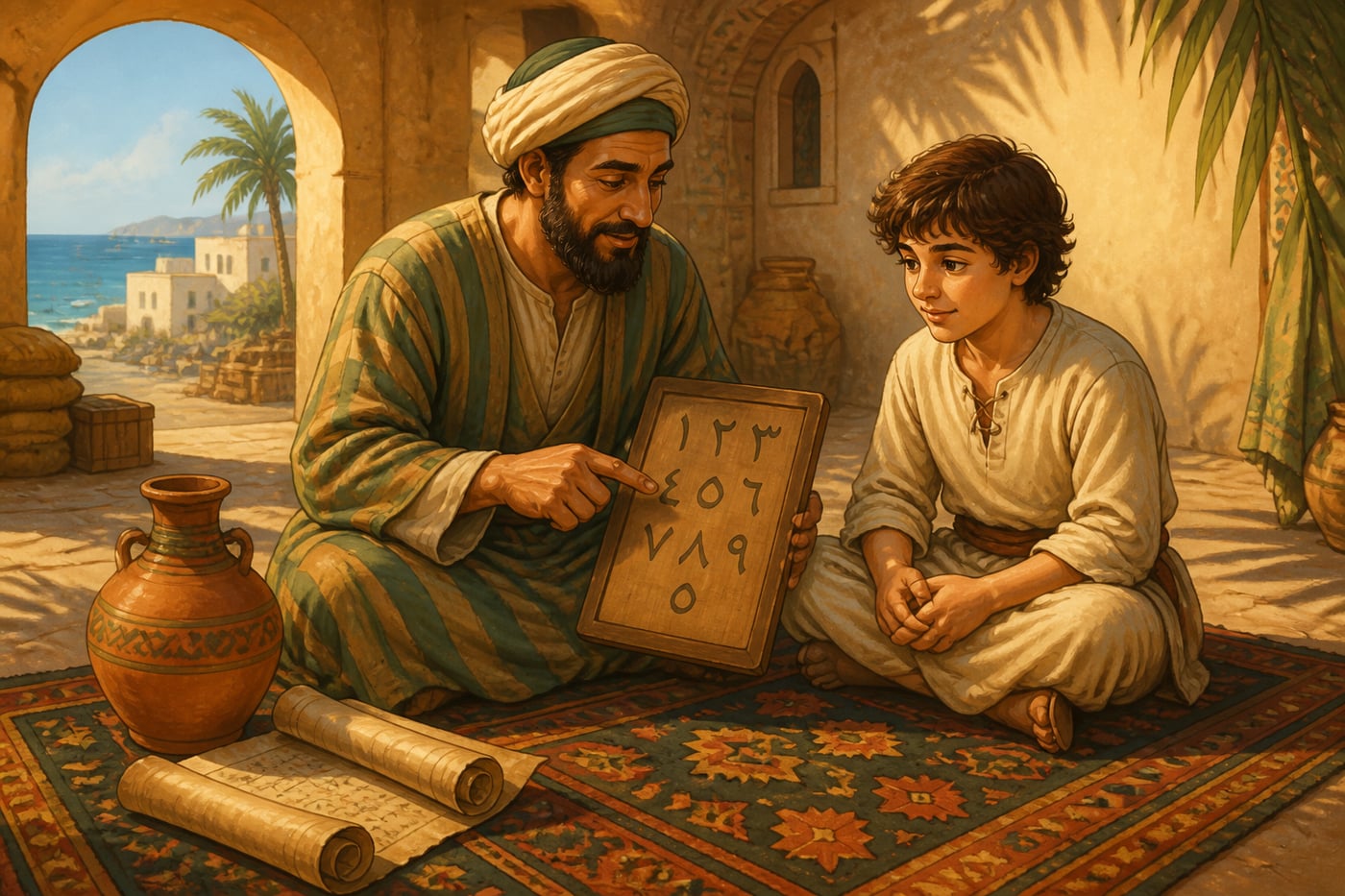
His Arab teachers were using the decimal place value system: nine digits and a zero, written from left to right, with each position worth ten times the one before it. They could add, subtract, multiply, and divide huge numbers on a single sheet of paper, in a fraction of the time it took a Roman-numeral calculator to do the same work with counters on an abacus board. The system was alien to Leonardo and obviously, instantly, more powerful than anything he had grown up with. He did not just learn it. He spent the next two decades traveling through Egypt, Syria, Sicily, Provence, and Constantinople, comparing different versions of the same arithmetic and assembling everything he had found into a single comprehensive treatise. That treatise, finished in 1202 CE, was Liber Abaci.
What the Liber Abaci Actually Taught

The book runs to roughly six hundred pages in modern editions and is divided into fifteen chapters. The first chapter introduces the nine Indian digits and the symbol 0. The next several chapters teach addition, subtraction, multiplication, and division of integers and fractions in the new system. The middle chapters work through the kind of practical problems that medieval merchants actually had to solve: rule of three, currency exchange, partnership shares, weights and measures, profit and loss, simple and compound interest. Buried in chapter twelve is the rabbit-breeding problem that gives the modern world the Fibonacci sequence. The later chapters move into algebra.
Fibonacci was not inventing this material. He was importing it. The arithmetic of integers came, ultimately, from Brahmagupta's Brāhmasphuṭasiddhānta of 628 CE. The rule of three and the commercial computation methods came from Mahāvīra's Gaṇitasārasaṃgraha of about 850 CE and from the broader Indian vyavahāra-gaṇita tradition. The algebra came from Brahmagupta and from Al-Khwārizmī's Hisab al-jabr, which was itself a transmission of Indian methods. Even the rabbit-breeding sequence had been described, six hundred years earlier, by Indian Sanskrit prosodists working on the rhythms of Sanskrit metrics. Fibonacci's contribution was not invention. It was the act of translation, organization, and credit.
The Long Chain
The path the modus Indorum took to reach Pisa is one of the longest documented transmissions of a scientific idea in world history. Brahmagupta wrote in Sanskrit in Bhillamāla in 628 CE. His text was carried by Indian astronomers to Baghdad in the 770s CE, where it was translated into Arabic at the court of the Abbasid caliph al-Manṣūr under the title Sindhind. Al-Khwārizmī absorbed its arithmetic in Baghdad in the early 9th century and wrote his own treatises on what he called al-ḥisāb al-hindī, the Indian computation. Those Arabic treatises crossed into Spain through the Islamic universities of Córdoba and Toledo. In the 12th century, the bishop of Toledo organized a sustained translation program that converted Arabic mathematical and scientific texts into Latin. Those Latin translations reached Italy through Sicily and through merchant cities like Pisa. And in 1202 CE, a Pisan merchant's son who had also learned the system directly from Arab teachers in Bugia put it all together into one book.
The Indian text from 628 CE reached Latin Europe in 1202 CE. The lag was 574 years. The chain was unbroken.
The Erasure and the Recovery
Fibonacci's preface was unambiguous. He called the system the modus Indorum and he called the digits the novem figurae Indorum, the nine figures of the Indians. Al-Khwārizmī, three and a half centuries earlier, had been equally unambiguous. For the first five hundred years after Liber Abaci, European writers continued to call the new system Indian. Then, slowly, the attribution drifted. By the 18th and 19th centuries, the digits had been rebranded as Arabic numerals in popular usage and in school textbooks across Europe and colonial India. The Indian credit Fibonacci had given openly was quietly dropped.
The restoration of the original attribution began in the 20th century, slowly, through the work of mathematical historians. Bibhutibhushan Datta and Avadhesh Narayan Singh published their History of Hindu Mathematics in 1935. George Gheverghese Joseph published The Crest of the Peacock in 1991. Kim Plofker published Mathematics in India in 2009. C.K. Raju documented the transmission routes for both decimal arithmetic and calculus from the early 2000s onward. The phrase Hindu-Arabic numerals is now once again the standard term in serious mathematical history. It took eight hundred years to restore the credit Fibonacci had openly given in his preface.
The lesson of Liber Abaci is not, in the end, about Fibonacci. It is about what happens when a culture inherits a tool and forgets to ask where the tool came from. The arithmetic that runs every smartphone, every spreadsheet, every banking transaction, and every scientific calculation on earth is the operational descendant of rules first written down in Sanskrit in 628 CE. Fibonacci named the source. Eight hundred years of European education forgot it. The recovery is still in progress.
In Pisa in 1202 CE, Leonardo Pisano wrote the preface and named the Indians. He thought he was being straightforward. He had no way to know it would take eight hundred years for the world to finish reading the page he opened.
Key figures
Leonardo of Pisa (Fibonacci)
c. 1170 to c. 1245 CE, Pisa, Republic of Pisa (modern Italy)
Gerbert of Aurillac (Pope Sylvester II)
c. 946 to 1003 CE, Aurillac (France) and Rome
Frederick II of Hohenstaufen
1194 to 1250 CE, Sicily and the Holy Roman Empire
Case studies
Bugia, c. 1185 CE: A Pisan Boy Meets the Modus Indorum
In the late 1180s CE, a Pisan customs official named Guglielmo Bonacci was posted to Bugia, a port city on the coast of what is now Algeria, to manage the trading desk of the Republic of Pisa. Bugia was then a major Almohad port, deeply connected to the Islamic mathematical world that had absorbed Indian arithmetic four centuries earlier. Bonacci took his teenage son Leonardo with him so the boy could learn the merchant trade. Instead, the boy fell into the hands of an Arab arithmetic teacher who introduced him to the modus Indorum: nine Indian numerals plus zero, decimal place value, and the operational rules first written down in Brahmagupta's Brāhmasphuṭasiddhānta in 628 CE. Leonardo later wrote that he found the system so much more powerful than the Roman numerals he had grown up with that he traveled extensively, to Egypt, Syria, Provence, Sicily, and Constantinople, comparing different versions of the Indian arithmetic until he had assembled a comprehensive treatise. That treatise, finished in 1202 CE in Pisa, was the Liber Abaci.
Brahmagupta in 628 CE had treated his arithmetic as universal, applicable to any kind of quantity, expressible in any language, transmittable to any reader. Mahāvīra in 850 CE had said the same thing more bluntly: nothing in the three worlds can be understood without gaṇita. The Indian tradition had been confident in the universality of its arithmetic for almost six centuries before a teenage Italian boy in a North African port stumbled into it. The transmission worked because the system was already structured to travel. Place value, signed numbers, and the decimal digits did not depend on Sanskrit or on Hindu cosmology to function. They worked on paper, in any script. This is the discipline of a method that has been refined for export without anyone planning the export.
Liber Abaci became the most influential mathematical book in medieval Europe. Within three centuries, the Indian arithmetic it described had displaced Roman numerals across European commerce and was on its way to displacing them in scholarship as well. The chain of transmission from Bhillamāla in 628 CE to Pisa in 1202 CE, by way of Baghdad, Toledo, and Bugia, took 574 years and at least four languages.
The chain that carried the modus Indorum to Europe ran through individual moments of contact, a teenage boy at his father's customs desk being one of them. Significant transmissions of knowledge often look, up close, like an accident of biography. They are usually riding on a much larger structural readiness, in this case the fact that the Indian arithmetic had been built in a form designed to survive translation.
Fibonacci was approximately fifteen years old when his father took him to Bugia. He was in his early thirties when Liber Abaci was published in 1202 CE. The interval between his first encounter with the modus Indorum and his book that taught Europe to use it was roughly seventeen years.
Pacioli, 1494 CE: Double-Entry Bookkeeping as Liber Abaci's Heir
In 1494 CE, almost three centuries after Fibonacci's Liber Abaci, a Franciscan friar named Luca Pacioli published a vast mathematical encyclopedia in Venice called the Summa de Arithmetica, Geometria, Proportioni et Proportionalita. The Summa drew heavily on Liber Abaci, repeating its decimal arithmetic, its rule of three, its proportion problems, and its commercial computation methods. Buried in Tractatus XI of the Summa was a chapter titled De Computis et Scripturis, On Reckonings and Writings. In just twenty-seven pages, Pacioli described the system that Venetian merchants had been quietly developing for at least two hundred years: double-entry bookkeeping. Every transaction recorded twice, once as a debit and once as a credit, with the books always balanced. Pacioli did not invent the method. He codified what Italian merchants had been doing for generations on top of the modus Indorum that Fibonacci had taught them. Without Indian decimal arithmetic, with its place value, its signed numbers, and its operational rules for zero, double-entry bookkeeping would have been impossible to execute, let alone teach.
Brahmagupta had named positives dhana (wealth) and negatives ṛṇa (debt) and treated them as full citizens of arithmetic. Eight centuries later, Italian merchants used the same logical structure under different names, debits and credits, to track commercial transactions on a balanced ledger. Pacioli's debits and credits are the descendants, by way of Liber Abaci, of Brahmagupta's dhana and ṛṇa. The Indian tradition's confidence in the formal symmetry of wealth and debt is the reason Pacioli's chapter could be written at all. A culture that resisted negative numbers, as European mathematics had until the 17th century, could not have sustained a system of double-entry bookkeeping. The Indian arithmetic had quietly settled the conceptual question that Europe was still officially debating.
Double-entry bookkeeping became the foundation of modern accounting, modern banking, modern corporate governance, and modern capitalism. Almost every business on earth, public or private, runs on a ledger system that traces back through Pacioli to Fibonacci to Al-Khwārizmī to Brahmagupta. The German economic historian Werner Sombart argued in 1902 that the rise of capitalism would have been impossible without double-entry bookkeeping. If he was right, the rise of capitalism was downstream of the Brāhmasphuṭasiddhānta in a chain of transmission that nobody at the time, Pacioli included, fully traced.
A foundational technique often hides inside a larger book and waits centuries for someone to notice how much it can carry. Twenty-seven pages in Pacioli's Summa became the operating system of global commerce. The capacity of those pages to do that work depended entirely on a numerical system that India had refined and exported a thousand years before Pacioli was born. When you build something powerful, write down the parts that look small. They are often the parts that travel furthest.
Pacioli's chapter on double-entry bookkeeping was 27 pages long. The Summa de Arithmetica as a whole was 615 pages. The 4.4 percent of the book that handled bookkeeping became the operational backbone of every accounting system in use today.
Hindu-Arabic to Arabic: The Slow Erasure of Fibonacci's Acknowledgment
Fibonacci was unambiguous in 1202 CE. He called the new arithmetic the modus Indorum and the digits the novem figurae Indorum, the nine figures of the Indians. Al-Khwārizmī had been equally unambiguous in the 9th century, calling his arithmetic al-ḥisāb al-hindī, the Indian computation. For roughly five hundred years after Liber Abaci, European writers continued to call the system Indian. Then, in the 18th and 19th centuries, the attribution slowly drifted. The numerals became 'Arabic' in popular usage. School textbooks in Europe and later in colonial India taught children that mathematics had two sources, Greek geometry and Arabic arithmetic, with India erased from the lineage entirely. The drift was helped by colonial historiography that needed to present pre-colonial India as scientifically static. By the early 20th century, even Indian children educated in the British system were being taught that the numerals they used every day were Arabic. Then, slowly, mathematical historians began to push back. Bibhutibhushan Datta and Avadhesh Narayan Singh published their History of Hindu Mathematics in 1935. George Gheverghese Joseph published The Crest of the Peacock in 1991. Kim Plofker published Mathematics in India in 2009. C.K. Raju documented the transmission routes for both decimal arithmetic and calculus across multiple books from the early 2000s onward. The Indian attribution that Fibonacci had given openly in 1202 CE was, by the early 21st century, being slowly restored.
The Indian mathematical tradition had always cited its predecessors carefully. Bhāskara II names Brahmagupta. Brahmagupta names earlier siddhāntas. Mahāvīra names his Jain forerunners. The lineage of mathematical paramparā depends on naming the source. Fibonacci, when he wrote his preface, was working in this same spirit of attribution, even though he was European and writing in Latin. The drift toward 'Arabic numerals' is what happens when attribution stops being a conscious discipline and is allowed to decay into convenience. It is a failure of the receiving culture, not the transmitting one. The recovery work done by Datta, Singh, Joseph, Plofker, and Raju is the discipline of paramparā being applied across cultures, by historians, after a five-hundred-year lapse.
As of the 2020s, the term Hindu-Arabic numerals is once again standard in serious mathematical history, NCERT textbooks in India, and many international curricula. The phrase Arabic numerals, though still common in casual usage, is increasingly recognized as historically misleading. Fibonacci's own preface is now routinely quoted in mathematical history surveys precisely because he gave the credit Europe later forgot.
Attribution is not a courtesy, it is a piece of intellectual infrastructure. When attribution decays, the lineage that produced an idea becomes invisible, and the receiving culture starts to imagine that the idea was its own. The repair takes much longer than the erasure. Be careful, in your own work, to name your sources by their first author, not your most recent middleman.
From the publication of Liber Abaci (1202 CE) to the modern restoration of the Hindu-Arabic attribution in mainstream Western history (roughly the 1990s onward), the chain of attribution lapse and recovery spans approximately 800 years, of which roughly the middle 200 years (early 18th century to early 20th century) were the period of strongest erasure.
Historical context
High Medieval Period (c. 1180 to 1230 CE), the era of Fibonacci's life and the publication of Liber Abaci
India in 1202 CE was undergoing political reorganization in the north under the new Ghurid and early Sultanate powers, while the south remained dominated by the Cholas, the Hoysalas, and the early Pandyas. Bhāskara II had died about seventeen years earlier in 1185 CE, and his Līlāvatī and Bījagaṇita were already standard textbooks across Indian astronomical schools. The mathematical tradition Fibonacci was transmitting to Europe was, at the very moment of transmission, still actively alive and being refined inside India. The Kerala school of Mādhava, which would soon develop infinite series and the foundations of calculus two centuries before Newton, was about a century and a half away from beginning its work.
1202 CE is the documented moment when the Indian decimal arithmetic of 628 CE finally arrived in mainstream Latin Europe with explicit attribution. Every later development of European mathematics, from Cardano's algebra to Newton's calculus to the modern computer, sits on top of the foundation Fibonacci transmitted in this single book. The lesson on Liber Abaci is, in other words, the lesson on the longest documented import of a mathematical operating system in world history, and on the moment of explicit credit that the receiving culture would later forget.
Living traditions
The decimal arithmetic Fibonacci called modus Indorum is now the operational basis of every smartphone, calculator, financial market, and computer in the world. The Fibonacci sequence introduced in chapter twelve of Liber Abaci, originally a problem about breeding rabbits, appears in modern computer science (in algorithms and data structures), in financial trading (in technical analysis), and in the structural patterns of natural growth. Pacioli's chapter on double-entry bookkeeping, written into the Summa of 1494 on top of Fibonacci's foundation, is still the operating system of every accounting department on earth. Fibonacci's preface, in which he openly credited India, is now standard reading in mathematical history courses from Cambridge to IIT, as the canonical example of attribution given honestly at the moment of transmission and then forgotten by the receiving culture for eight hundred years.
- Camposanto Monumentale and Piazza dei Miracoli, Pisa: The historic cathedral complex of Pisa, including the Leaning Tower, the Duomo, the Baptistery, and the Camposanto Monumentale, the medieval cemetery where Fibonacci is traditionally believed to be buried. A 19th century statue of Fibonacci stands in the Camposanto, and the city of Pisa preserves several smaller memorials to him in nearby streets and squares. The complex as a whole is the western terminus of the chain of transmission that carried the modus Indorum from Bhillamāla to Europe, and it is also a working monument to the moment medieval Pisa was wealthy enough, and curious enough, to give a merchant's son the leisure to write a book.
- Bhinmal (ancient Bhillamāla): The town where Brahmagupta wrote the Brāhmasphuṭasiddhānta in 628 CE, the original source of the arithmetic that Fibonacci eventually transmitted to Europe under the name modus Indorum. Bhinmal was a thriving capital of the Gurjara kingdom and a Jain and Hindu learning center on the western Indian trade routes. The town is the eastern terminus of the long transmission chain that ran Bhinmal to Baghdad to Toledo to Bugia to Pisa, and a quiet but real site of pilgrimage for anyone interested in the origin of global decimal arithmetic. Several medieval Jain and Hindu temples still stand, along with a modest statue of Brahmagupta.
Reflection
- Pick one tool, technique, or framework you use every day at work. Without looking it up, can you name the first person who actually wrote it down? If you cannot, who is the most recent middleman you have been crediting in its place?
- Why do you think Fibonacci, writing in Latin in 1202 CE, was so explicit about crediting India, while European authors in the centuries after him slowly let that attribution decay into 'Arabic numerals'?
- What is the difference between a tool that travels well across cultures and a tool that does not, and what does the modus Indorum teach you about how to design your own work for transmission?