Kuttaka: The Pulverizer Algorithm

Aryabhata's elegant method for linear indeterminate equations

Learn the kuttaka method, an algorithm for solving linear indeterminate equations that Aryabhata developed for astronomical calculations.

The Pulverizer at Kusumapura

In the year 499 CE, in the city of Kusumapura on the banks of the Ganga (the modern Patna), a twenty-three-year-old astronomer named Āryabhaṭa finishes the fourth and final pāda of his treatise the Āryabhaṭīya. He works by oil-lamp light at a low wooden desk, on palm-leaf folios bound with cotton thread. He has spent the last several months on a single problem.
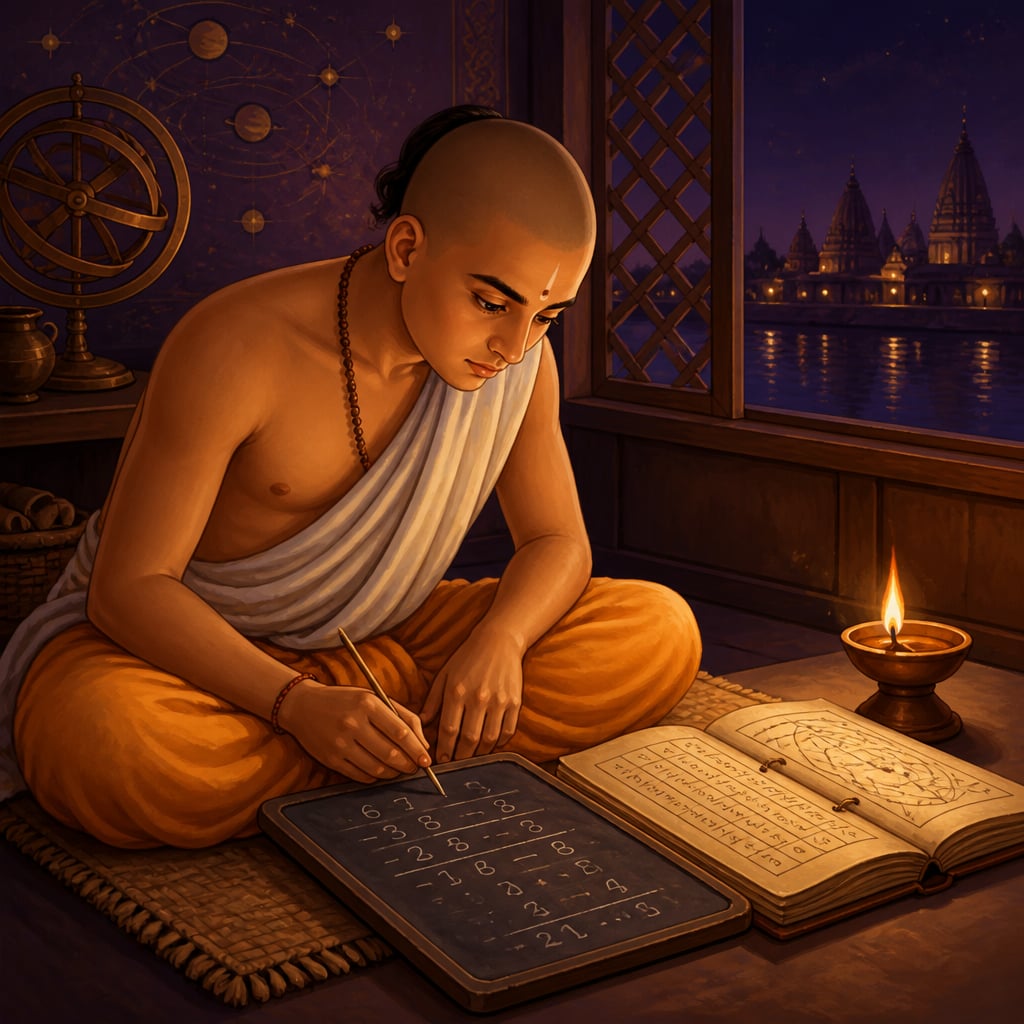

Aryabhata composing the kuttaka verses by oil lamp at Kusumapura on the Ganga

A planetary conjunction over the Ganga at Kusumapura

The problem is this. Two planets, say Jupiter and Saturn, orbit on different cycles. Today they sit at specific offsets from a reference point in the sky. On what future day will they line up in a given configuration?

Strip the astronomy away and the question becomes arithmetic. Āryabhaṭa is looking for a number N such that N divided by one period leaves one remainder, and N divided by another period leaves another remainder. Two constraints, one unknown, and the unknown must be a whole number, because days are whole and planetary cycles do not land on fractions. This is the oldest form of what modern mathematicians call a linear indeterminate equation.

Diophantus of Alexandria, writing two and a half centuries earlier in Greek, had stared at problems of this shape and worked them out one by one with no general method. Āryabhaṭa, in the verses he is composing tonight, will give the world its first general algorithm. He calls it kuṭṭaka, from the Sanskrit root kuṭṭ, meaning 'to crush' or 'to pulverize'. The name is literal. The algorithm takes the numbers involved and grinds them down into smaller ones, until the remaining problem is small enough to solve by inspection. Then it reassembles the answer by working backwards through the grinding. It is not merely clever. It is the first documented general algorithm for solving linear indeterminate equations in any tradition on Earth.

The Problem Kuttaka Solves

Consider a concrete version of the ancient question. You want a number that leaves a remainder of 5 when divided by 8, and a remainder of 7 when divided by 11. Written as equations: N = 8x + 5 and N = 11y + 7. Setting them equal gives 8x + 5 = 11y + 7, which rearranges to 8x - 11y = 2.

This is a linear equation in two unknowns. If x and y could be any real numbers, there would be infinitely many solutions lying along a straight line. The catch is that x and y must be integers, because you are counting planetary orbits or days, and half an orbit is not a meaningful answer. Suddenly the infinite line is punctured down to a handful of valid lattice points. Finding one such point, and describing all of them, is exactly what Aryabhata's kuttaka does.

Modern mathematics calls these linear Diophantine equations, named after Diophantus of Alexandria, a Greek mathematician of the 3rd century CE. Diophantus had studied such equations but produced no general algorithm. He worked them out case by case. Aryabhata produced the recipe.

How the Pulverizer Works

The method is short enough to state. Take the two coefficients, say 8 and 11, and compute their greatest common divisor the way a modern student does it: divide the larger by the smaller, keep the remainder, divide the old divisor by the new remainder, and continue. 11 divided by 8 leaves 3. 8 divided by 3 leaves 2. 3 divided by 2 leaves 1. 2 divided by 1 leaves 0. The last nonzero remainder is 1, the greatest common divisor.

This forward sweep is the Euclidean algorithm, which Euclid had written down around 300 BCE. Aryabhata's insight was that the same process can be reversed. Each division in the forward sweep can be read as an equation expressing one remainder in terms of the previous ones. Walking back through those equations, substituting each into the next, lets you write the final gcd as a specific integer combination of the original two coefficients. That integer combination is the answer to the indeterminate equation.

This is exactly what modern computer science calls the extended Euclidean algorithm. Aryabhata did not phrase it in modern notation, but the logic is identical, and his verses in the Aryabhatiya Ganitapada 32 and 33 contain every step. He compressed it into terse Sanskrit because the Aryabhatiya is poetry, not prose, and his students were expected to memorize it before they applied it.

A distinctive step in Aryabhata's version is what he calls mati, the 'chosen' or 'intuited' number. At one point in the reverse sweep, the practitioner picks a small integer by inspection. Indian mathematics, unlike later European formalism, treated informed guessing as a legitimate component of a rigorous procedure. The mati step is quality-controlled by the verification that follows it. If the guess works, the algorithm completes; if not, the practitioner adjusts and continues. This blend of intuition and verification is how kuttaka was actually taught for a thousand years.

Brahmagupta and Bhaskara Extend the Method

A hundred and thirty years after Aryabhata, Brahmagupta revisited the pulverizer in his Brahmasphutasiddhanta of 628 CE. He clarified the edge cases, treated signed coefficients, and set it within a larger theory of operations on what he called dhana and rna, wealth and debt, which is to say positive and negative numbers. Five centuries after that, Bhaskara II worked through it again in the Bijaganita of 1150 CE, with worked examples and teaching commentary aimed at students. Bhaskara's treatment is the reason medieval Indian astronomy could be taught efficiently across generations. It packaged the method as a teachable craft rather than an arcane trick.

By the time the Islamic mathematical world began borrowing Indian methods through scholars like al-Khwarizmi and al-Biruni, kuttaka had become a standard tool of the Indian curriculum. Through transmission routes that ran from Ujjain to Baghdad and onward to Toledo and Pisa, the logic of the pulverizer reached medieval Europe. But a general European account of linear Diophantine equations did not appear until 1624 CE, when Claude Gaspar Bachet de Meziriac published his Problemes plaisants et delectables. That was eleven hundred twenty five years after Aryabhata.

Why This Still Matters

The pulverizer is not a historical curiosity. Every secure banking session, every HTTPS handshake, every encrypted message you send relies on computing something called a modular inverse, the arithmetic problem of finding a number that multiplies a given input back to one under a given modulus. Modular inverses are exactly what Āryabhaṭa's algorithm computes.

When Ron Rivest, Adi Shamir, and Leonard Adleman invented the RSA cryptosystem at MIT in 1977, the algorithm at the heart of their key-generation step was the extended Euclidean algorithm. Donald Knuth, in volume 2 of The Art of Computer Programming, traces the method's earliest known statement to Āryabhaṭa's verses of 499 CE. The OpenSSL library, which protects most internet traffic in the world today, implements the same algorithm in optimised C. Change the notation, and the code running inside your phone is executing the same sequence of steps Āryabhaṭa wrote into verse fifteen centuries ago.

When Indian mathematics teaches bījagaṇita, 'seed mathematics', the seed is not just the unknown. It is also a procedure. A method that is planted, grows through repetition, and yields a definite answer. Kuṭṭaka is the clearest example in the tradition of a seed that is itself an algorithm, a sequence of mechanical steps the mind can trust. Fifteen centuries before computer science named them, the pulverizer was already one.

Back at the desk in Kusumapura, the oil lamp burns low. Āryabhaṭa sets down the verses for the day. He cannot know that his pulverizer will, fifteen hundred years later, be running several billion times a second on every continent. He only knows that tomorrow's planetary computation can now be done by anyone who has memorised his rule.

Key figures

Āryabhaṭa

476 to c. 550 CE, Kusumapura (near Patna, Bihar)

Brahmagupta

598 to 668 CE, Bhillamāla and Ujjain

Bhāskara II (Bhāskarācārya)

1114 to c. 1185 CE, Bijapur, Karnataka

Case studies

The Planet Problem: Why Āryabhaṭa Invented the Pulverizer

A 5th century Indian astronomer had a practical problem that sounds abstract but was desperately concrete. Jupiter takes roughly 4332 days to return to the same position against the stars. Saturn takes roughly 10759 days. At any given moment, each planet is at some offset from a conventional reference point, its 'residue' in kuṭṭaka language. The astronomer needed to predict future conjunctions, eclipses, and planetary configurations for the pañcāṅga, the traditional calendar that governed ritual dates, agricultural timing, and royal astrology. This reduced to a specific arithmetic problem: find the smallest positive integer N such that N, divided by Jupiter's period, leaves one known remainder, and N, divided by Saturn's period, leaves another. With two constraints and one integer unknown, no existing method could solve it systematically. Aryabhata was confronted with this class of problem as a working astronomer, not a pure mathematician. He needed an algorithm that could be applied repeatedly, with confidence, to whatever periods and residues his observations produced.

In the Indian tradition, astronomy was not separate from mathematics or from religion. The calendar determined when festivals were celebrated, when sacrifices were performed, and when auspicious times fell. A miscalculated conjunction date was not just a mathematical error; it was a ritual error, a political error, and a reputational one for the astronomer. Aryabhata's Āryabhaṭīya therefore treats gaṇita (pure mathematics), kālakriyā (time calculation), and gola (spherical astronomy) as three facets of one enterprise. The pulverizer emerged at the seam between gaṇita and kālakriyā: a purely arithmetic tool that existed because timekeeping demanded it. This is the opposite of how European mathematics developed, where pure and applied branches were often separated and sometimes disdainful of one another. Indian mathematicians built their algorithms because someone needed them tomorrow.

Kuṭṭaka became the standard tool for every Indian astronomer after Aryabhata. The Sūryasiddhānta, the Śiṣyadhīvṛddhidatantra, the Siddhāntaśiromaṇi, and the Tantrasaṅgraha all assume the reader knows the pulverizer and invoke it for problems of planetary position, eclipse timing, and the reckoning of intercalary months. It remained a working tool, not a museum piece, into the 19th century, when traditional Sanskrit pundits still used it for calendar computation before mechanical calculation and then computers took over.

The best algorithms often come from people with real problems, not from abstract theorists. Aryabhata did not sit down to invent linear Diophantine solvers for their own sake. He needed a tool to get through the week, and the tool turned out to be one of the most important procedures in the history of mathematics. If you are stuck on a theoretical question, notice what practitioners in your field actually need and work backwards from there.

Aryabhata's kuṭṭaka, written in 499 CE, was used continuously in Indian observatories for over fourteen centuries. No other algorithm in the history of mathematics has a longer unbroken record of practical daily use in its original form.

Bachet 1624: How Long It Took Europe to Catch Up

In 1624, the French Jesuit mathematician Claude Gaspar Bachet de Méziriac published a small book with a modest title: Problèmes plaisants et délectables qui se font par les nombres, 'Pleasant and delightful problems which are done through numbers'. Buried inside was a general method for solving ax + by = 1 in integers when a and b are coprime. European mathematical historians have long praised Bachet's result as the birth of the extended Euclidean algorithm in Western mathematics. The uncomfortable detail is that Aryabhata had published the same method, in the same essential form, in the Āryabhaṭīya of 499 CE. The gap is eleven hundred and twenty five years. Even more pointed: between 499 CE and 1624 CE, Indian mathematicians, Arab mathematicians, and Persian mathematicians all used kuṭṭaka, wrote about it, and taught it. The knowledge was not lost. It simply had not yet arrived, in a form Europe recognized, at a European printing press.

The European story of mathematics as told in most textbooks runs from Greece to Rome to the medieval Latin West to the Renaissance, with perhaps a polite nod to 'Arab preservation'. In this telling, the extended Euclidean algorithm is a 17th century French discovery. Indian sources are either absent or treated as exotic footnotes. The Bachet case is a useful corrective because the documentary trail is clean. Aryabhata's verses survive in hundreds of manuscripts. Commentaries by Bhāskara I, Brahmagupta, and Bhāskara II all repeat and refine the method. The Arabic mathematical tradition, through al-Khwarizmi and al-Biruni, transmitted Indian arithmetic and algebra to Baghdad, then to Andalusia, then to Latin translators at Toledo. The fact that Bachet presents the method without crediting this chain is itself a historical fact, one worth naming rather than glossing over.

Once Bachet published his method, European number theory advanced quickly. Pierre de Fermat, Leonhard Euler, and Carl Friedrich Gauss built their work on this foundation. Modern number theory and modern cryptography both rest on the extended Euclidean algorithm as a routine tool. The lineage is unbroken. Every modern implementation traces, in principle, to Bachet's 1624 book, and every copy of Bachet's book rests, historically, on the conceptual work done by Āryabhaṭa in the 6th century and refined continuously in India for over a thousand years.

Priority in science depends on who publishes in a language your audience reads, not on who knows the answer first. Indian mathematics was running a century ahead of Europe on many questions for a thousand years, but because the main European mathematical conversation was conducted in Latin and then French, the Indian priority was invisible until modern historians of mathematics went back to read the Sanskrit sources. Be careful whose 'first' you cite.

Gap between Aryabhata's Āryabhaṭīya (499 CE) and Bachet's Problèmes plaisants (1624 CE): 1125 years. In those 1125 years, the extended Euclidean algorithm was taught continuously in Indian observatories.

The Hundred Fowls Problem: Kuttaka Meets a Global Puzzle

A puzzle appears across multiple ancient mathematical traditions in remarkably similar form. A Chinese version from the 5th century: 'A rooster costs five coins, a hen three coins, and three chicks cost one coin. With one hundred coins, I buy one hundred birds. How many of each?' A medieval European version, a 9th century Indian version in Mahāvīra's Gaṇitasārasaṅgraha, and a later version in Bhāskara II's Līlāvatī all feature variants of the same structure: multiple types of items, a fixed total count, a fixed total cost, and the constraint that the number of each item must be a non-negative integer. The number of unknowns exceeds the number of equations, so there are either no solutions, one solution, or a small discrete family of them. Finding the family by trial and error is tedious and error-prone. Finding it by a principled method is exactly what kuṭṭaka was designed for.

Mahāvīra, a 9th century Jain mathematician from Karnataka, treats the hundred-fowls type problem in his Gaṇitasārasaṅgraha (c. 850 CE) and solves it using kuṭṭaka-style reasoning. Bhāskara II in the 12th century refines the solution method in the Līlāvatī, adding worked examples and showing students how to enumerate all valid solutions, not just one. The Indian tradition treats these puzzles as applications of a general theory, not as one-off tricks. The Chinese tradition, represented by Zhang Qiujian in the 5th century, solves the problem through ingenious case analysis but never lifts it to a general method. The European tradition, through Alcuin of York in the 8th century, treats it as a recreational curiosity. Only in India is the puzzle connected to the pulverizer and thereby to a larger mathematical program.

The hundred-fowls problem is one of the cleanest historical examples of parallel mathematical encounter across civilizations. Three traditions meet the same puzzle; one of them, India, already has a general tool for it. The others solve the specific instance and move on. The consequence is that Indian algebra, by the time of Bhāskara II, has a unified theory of linear indeterminate equations, while Chinese mathematics remains brilliant in its case analysis but never develops the same systematic frame. This is one of several places where the generalizing instinct of Indian mathematics, rooted in its taste for abstract procedures, produced lasting conceptual mileage.

When you meet a new problem, the first question is not 'can I solve this?' but 'is this a special case of something I already know?' Indian mathematicians saw the hundred-fowls problem as an instance of the pulverizer. Chinese mathematicians saw it as a standalone puzzle. Both solved it; only the Indian tradition gained anything for its trouble. The habit of asking 'what is this a case of' is the quiet difference between ad hoc cleverness and building a toolkit.

RSA Cryptography: Your Banking App Runs on Kuṭṭaka

In 1977, three computer scientists at MIT, Ronald Rivest, Adi Shamir, and Leonard Adleman, published a public-key cryptosystem that became the backbone of secure communication on the internet. The algorithm, RSA, lets two strangers exchange encrypted messages without having first shared a secret. The core of RSA is a piece of arithmetic: given two large prime numbers p and q, and a public exponent e, the system needs to compute a private exponent d such that (e × d) leaves remainder 1 when divided by (p-1)(q-1). This is the modular inverse problem. Finding d is the entire secret behind RSA's mathematical security. Without an efficient way to compute modular inverses, RSA would not be practical. With one, it runs on every smartphone, every web browser, every banking app. The efficient method is the extended Euclidean algorithm, which is kuṭṭaka.

The sacred and the practical were never separate in Indian mathematics. Aryabhata wrote the pulverizer as a tool for calculating the movements of planets, which was itself considered a sacred responsibility. Fifteen centuries later, the same procedure underpins the privacy of every encrypted message sent on Earth. The algorithm did not know it would one day secure bank transactions. Aryabhata did not know his procedure would outlive his civilization's astronomical tradition and resurface in the era of silicon. What the tradition did know was that a genuine general method, once discovered, never dies. It sinks into the toolkit of mathematics, where it waits, patiently, for whoever next needs it. The RSA designers did not borrow from Aryabhata consciously, but the logical object they reached for had been sitting in the shared human toolkit since 499 CE, placed there by a 23-year-old astronomer in Kusumapura.

Every HTTPS connection, every secure email, every end-to-end encrypted chat, and every digital signature uses the extended Euclidean algorithm as a core primitive. OpenSSL, BoringSSL, and the cryptographic libraries built into iOS and Android all implement it. The number of times Aryabhata's procedure is executed globally per day is conservatively in the trillions. No other piece of mathematics from the 1st millennium CE comes close to this level of live contemporary use. A Sanskrit verse from 499 CE describes an algorithm that runs in the silicon of three billion phones.

The most durable contributions are rarely the flashiest. Aryabhata's pulverizer was a two-verse technical aside inside a larger astronomical work. It did not make him famous in his own time the way his heliocentric hint or his sine table did. Fifteen hundred years later, it turns out to be the piece of his work that every smartphone on Earth depends on. Build real tools, not just spectacles. The tools will still be working when the spectacles are forgotten.

Estimated daily executions of the extended Euclidean algorithm worldwide, across TLS handshakes, RSA key generation, digital signatures, and cryptographic verifications: in the trillions. The same logical procedure Aryabhata wrote into verse 32 of the Āryabhaṭīya Gaṇitapāda in 499 CE.

Historical context

Classical Indian Mathematics, Gupta period through the late classical era (5th to 12th century CE)

The pulverizer was born inside the Gupta-era intellectual ferment at Kusumapura and Ujjain, when Indian astronomy was moving from Vedic star-observation to a mathematically rigorous siddhānta tradition. Each successive generation of mathematicians inherited the text of the Āryabhaṭīya, produced a commentary that expanded its compressed verses into a teaching manual, and applied the methods to the practical work of calendar computation and eclipse prediction. The Kuṭṭaka was passed from Āryabhaṭa to Bhāskara I to Brahmagupta to Mahāvīra to Śrīpati to Bhāskara II in an unbroken chain of commentary and refinement spanning seven centuries.

Kuṭṭaka is the earliest known general algorithm for a non-trivial number-theoretic problem in any civilization. It pioneered the algorithmic style of thinking that would eventually become computer science, treating mathematics as the execution of a definite procedure that any trained practitioner can reproduce. The direct line from verse 32 of the Āryabhaṭīya Gaṇitapāda to the cryptographic libraries running in every modern smartphone is one of the longest continuous chains of influence in the history of ideas.

Living traditions

The kuṭṭaka is now taught in every undergraduate number theory course on Earth, under the name 'extended Euclidean algorithm'. It is implemented in every major cryptographic library (OpenSSL, libgcrypt, BoringSSL, NaCl) and executes inside the TLS handshake that begins every HTTPS connection. Computer science textbooks like Knuth's The Art of Computer Programming and Cormen et al.'s Introduction to Algorithms discuss it at length, though they rarely credit Āryabhaṭa. India's first satellite, launched in 1975, was named Āryabhaṭa in his honor, and ISRO's current astronomy research hub at Nainital carries the name as well. The pulverizer has outlived the civilization that created it and is now part of the common toolkit of the species.

Reflection

More in Bijaganita: The Seed of Algebra

All lessons in Bijaganita: The Seed of Algebra · Indian Mathematics: Ancient Genius, Modern Foundations course