Bija: Seeds of the Unknown
Why Indians called algebra 'seed mathematics' and what the metaphor still teaches us
Long before Europe had a word for algebra, Indian mathematicians called it bijaganita, the mathematics of seeds. This lesson unpacks the metaphor and shows how treating the unknown as a seed shaped how India did algebra for a thousand years.
The Swan Problem at the Slate
In a stone-floored room at the Ujjain observatory, sometime around 1150 CE, the astronomer Bhāskara II sets down his pen, turns to his daughter, and asks her a question about a flock of swans.
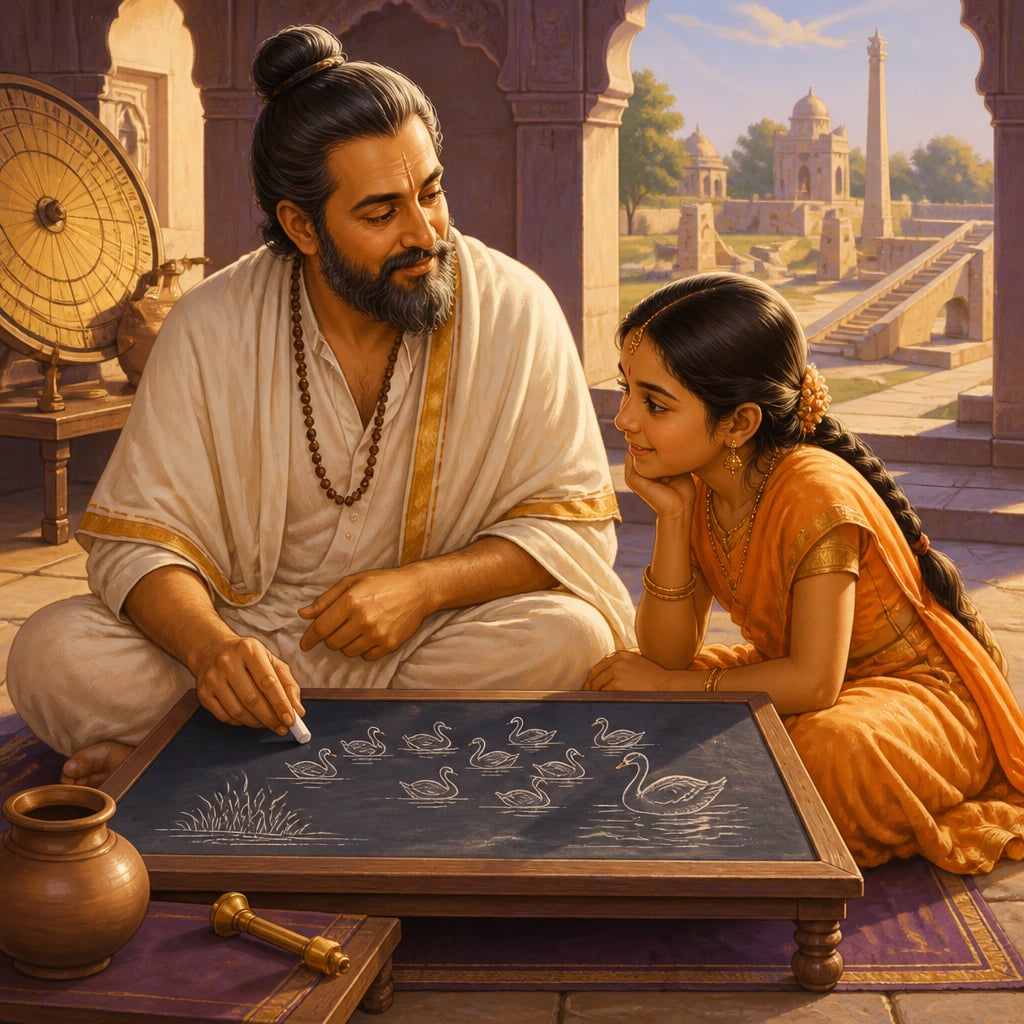
A flock is resting on a lake, he tells her. Ten times the square root of the flock has flown off to a lotus cluster. An eighth has wandered to a hillside. Three couples remain on the water. How many swans were there?
Līlāvatī is perhaps twelve. The slate in front of her is a thin board of dark wood, dusted with chalk. She has chalk on her fingers and ink on her sleeve. She has been working through her father's verses for months, and the swans are not the hardest problem he has set her. But the move he wants her to make next is the one that matters. He wants her to give the unknown flock a name. He wants her to call it something, write that name on her slate, and start computing with it as if she already knew the answer.
If you are inclined to write the swan problem down yourself, you will reach for the same move. You will write √x flying off, x/8 wandering away, 6 remaining, and arrange these into an equation. You have not been trained in the Bhāskarīya tradition and yet, twelve seconds in, you have already done the one thing that makes algebra algebra. You named the unknown. You called it x. You agreed it stood for a number you did not yet know, and you started to compute with it as if you did.
The Indian name for this move is bīja. Seed.
What the Metaphor Is Actually Saying

A seed is a thing that is not yet what it will become. It is a full acorn in the sense that the whole oak is implicit in it, but it is not an oak. You cannot stand under a seed. You cannot climb a seed. And yet every oak was once exactly this, because the tree was folded inside the seed the whole time, waiting for soil and water and time.
An unknown in an equation is exactly this kind of object. The quantity x in 2x + 5 = 15 is not yet a number in the sense that 4 is a number. You cannot count four apples on the table and say 'these are x apples'. And yet the whole answer, x = 5, is folded inside the equation from the moment you write it. All the operations of algebra are just the soil and water that let that seed germinate into its definite value.
The Indian mathematicians chose this word deliberately. They did not call algebra 'the mathematics of letters', the way the Greeks eventually would with Diophantus, because the point was not that the unknown was a letter. They did not call it 'the art of restoration', the way the Arabic al-jabr would, because the point was not that you were moving terms around. They called it bīja-gaṇita, the mathematics of the latent thing that becomes definite when conditions are met. The metaphor is biological. The quantity is alive. You tend to it, and it unfolds.
This is not just a poetic flourish. The metaphor governs how the Indians actually did the math.
From Brahmagupta to Bhāskara

The first Indian mathematician to write out a formal, systematic treatment of equations with unknowns was Brahmagupta in 628 CE, in the eighteenth chapter of his Brāhmasphuṭasiddhānta, a chapter he titled Kuṭṭakādhyāya. The chapter handled linear and quadratic equations, simultaneous equations, and the extraordinary method of the kuṭṭaka, the 'pulverizer', for finding integer solutions to indeterminate equations. Brahmagupta's notation was still terse. He used the word yāvat-tāvat ('as much as, so much'), abbreviated yā, to denote the first unknown.
Five hundred years later, Bhāskara II (1114 to 1185 CE), working at the Ujjain observatory, gathered the entire tradition into a book and named it after its central metaphor: Bījagaṇita. Seed-mathematics. This was the first time anywhere in the world that algebra had a name of its own. And Bhāskara did something Brahmagupta had not: he extended the color system. When a problem had more than one unknown, Bhāskara ran out of yāvat-tāvat and named the second unknown kālaka (black), the third nīlaka (blue), the fourth pītaka (yellow), then lohita (red), harita (green), śveta (white), citraka (variegated). The operations on these were defined unambiguously. A black multiplied by a yellow was a black-yellow. A blue added to a blue was two blues.
This is symbolic algebra. The symbols happen to be colors rather than letters, but the conceptual move is identical to what François Viète would be celebrated for in 1591 CE, four and a half centuries later.
Why the Seed Matters
The Bhāskarīya tradition treated the unknown as a quantity you could already operate on, not as a blank to be filled in at the end. This is the difference that matters. The Greek mathematician Diophantus, writing in Alexandria around 250 CE, had names for unknown quantities but he treated problems one at a time, each with its own ad hoc method. He did not build a general theory. Indian mathematicians, starting with Brahmagupta, built a general theory because the seed metaphor demanded it. If every unknown is a bīja, then the same set of operations must work on all of them, the same way soil and water work on every acorn regardless of which oak it will become.
This is why the Arabic tradition, when it began its great borrowing from Indian mathematics in the ninth century, treated Indian algebra as a separate discipline rather than a mystical footnote to arithmetic. Al-Khwārizmī's famous book of 820 CE, which gave Europe the word 'algebra' (from al-jabr, restoration), is in direct conversation with Brahmagupta. His methods, his equation types, his treatment of negative quantities, all descend from the Indian tradition. The transmission route is well documented. The vocabulary shifted. The seed metaphor dropped out. The mathematics did not.
Modern Echoes
Donald Knuth's The Art of Computer Programming, the foundational textbook of modern algorithm design, traces the kuṭṭaka of the Indian tradition as a direct ancestor of the extended Euclidean algorithm that secures every internet connection in use today. The Fields Medalist Manjul Bhargava has built much of his prize-winning research, including his higher composition laws of 2004, on a direct reading of Brahmagupta's seventh-century bhāvanā rule. Every spreadsheet cell that holds a formula, every variable in every Python program, every solver inside a self-driving car, performs Bhāskara's move. You name the thing you do not yet know. You treat it as if you do. You let the rules of the system grow it into its definite value.
The next six lessons unfold this tradition in detail. Brahmagupta's rules for negative numbers, the vargaprakṛti method for indeterminate equations, the Līlāvatī as poetry, the kuṭṭaka algorithm, and the Arabic transmission that carried bīja westward and turned it into algebra. But the foundation is this one simple move. Name the unknown. Treat it as a seed. Let the conditions grow it into its definite value. Everything else in algebra is commentary on that sentence.
Back at the slate in Ujjain, Līlāvatī finishes her calculation. The flock had 144 swans. She wipes the chalk from her fingers, and turns the slate over for the next problem her father will set.
Key figures
Brahmagupta
598 to 668 CE, Bhillamāla (Bhinmal, Rajasthan) and Ujjain
Bhāskara II (Bhāskarācārya)
1114 to 1185 CE, Bijjala Bida (Bijapur district, Karnataka) and Ujjain
Pṛthūdakasvāmī
c. 830 to 890 CE, North India
Case studies
Kauṭilya's Treasury and the Accountant Who Needed the Unknown
In the fourth century BCE, the Mauryan empire ran one of the most elaborate bureaucracies in the ancient world. Kauṭilya's Arthaśāstra prescribes that every state department maintain books showing revenue received, expenditure incurred, balance in hand, and expected income against each head of account. The samāhartṛ (chief collector) was required to reconcile partial reports arriving from provincial officers with the treasury balance at the capital. A typical problem looked like this. A district submits a report showing total revenue, total outflow, and a balance, but the record of outflow is damaged and only the total and the balance are legible. Recover the missing outflow, then verify that it matches the sum of the itemized expenses the district's sub-officers have reported separately. This is, in modern language, a two-step linear problem in a single unknown. The district accountant had no algebraic notation to write it in. He had to solve it in prose, in the head, with the stakes of a royal audit and the sentence for mis-accounting being, in Kauṭilya's words, severe.
Kauṭilya's treasury officials were solving bīja problems eight hundred years before Brahmagupta gave them a name and a notation. The Arthaśāstra's reconciliation procedures are, in structure, linear equations in one unknown. What Brahmagupta did in 628 CE was not invent the problem. He formalized the method that Kauṭilyan accountants had been forced to reinvent every audit. The history of Indian algebra is in part the history of turning a piece of tacit bureaucratic craft into a named, teachable, general technique. Once bīja-gaṇita existed as a discipline, a district clerk could study it as a subject rather than fumbling his way through each individual audit.
Kauṭilya's auditing system is one of the earliest documented examples in any civilization of a bureaucracy that required routine work with unknowns. It predates Brahmagupta's formalization by roughly a millennium. When Indian algebra finally emerged as an explicit subject, it had eight centuries of administrative use-cases waiting for it, which is part of why it was treated as a general theory rather than a curiosity. The state needed the theory, so the theory got built.
A discipline is often formalized long after practitioners have been doing it in private. The Kauṭilyan accountant and the Brahmagupta algebraist are the same person, five hundred years apart, one working with language and one with notation. Pay attention to what your field is already quietly doing without a name. That is the shape of its next formalization.
The Arthaśāstra, compiled in the fourth century BCE, specifies fifteen distinct heads of state revenue that had to be separately audited against expenditure. Brahmagupta's 628 CE formalization of linear equations arrived roughly a thousand years after the problem domain had been waiting for it.
GPS and the Four Unknowns in Your Pocket
Every time you open a map application on your phone and it tells you where you are, a small miracle of bīja-gaṇita has happened in the background. The phone receives a timing signal from at least four GPS satellites. Each signal arrives slightly delayed from the moment it was broadcast, and the delay times distance. The unknowns are four: your three spatial coordinates (latitude, longitude, altitude) and the exact offset between your phone's clock and the satellites' atomic clocks. Four unknowns require four equations. Each satellite gives you one. The system is solved in a few milliseconds, every second, in your pocket. The phone is, without any metaphor, doing exactly what Bhāskara II did with his palette of colored unknowns. It is naming four quantities that are not yet known, treating them as bījas, and letting the conditions (the satellite signals) grow them into definite values.
In Bhāskara's notation, the three spatial unknowns might be yāvat-tāvat, kālaka, and nīlaka. The clock offset might be pītaka. Each satellite equation mixes the four colors in a specific way determined by the satellite's position and the measured travel time. Bhāskara's Bījagaṇita explicitly describes how to set up and solve systems with multiple colored unknowns, including the simultaneous linear case that GPS reduces to after linearization. If you dropped a modern GPS receiver's internal math onto Bhāskara's desk, he would recognize what it was doing within minutes. He might quibble with the notation, but the procedure is the one he taught his daughter Līlāvatī eight hundred and fifty years ago.
GPS, the signature technology of modern positional awareness, is applied bīja-gaṇita running at hardware speed. Roughly four billion devices on earth perform Bhāskara's procedure in their sleep. The method that Brahmagupta formalized in 628 CE and Bhāskara II named in 1150 CE turns out to be the computational backbone of every map, every delivery tracker, every ride-hail service, and every agricultural precision tool in the twenty-first century.
The seed metaphor was not picturesque. It was correct. The bījas Brahmagupta planted in 628 CE are still germinating into definite values, several billion times a second, inside the phone in your hand. Ancient algebra is not a museum piece. It is a daily dependency.
A modern smartphone GPS chip solves a system of at least four simultaneous equations in four unknowns roughly once per second while tracking. That is, in purely mathematical terms, several billion applications per second worldwide of the method Bhāskara II set down in his Bījagaṇita in 1150 CE.
Historical context
The Ujjain Tradition of Classical Indian Algebra (7th to 12th century CE)
The period from the Gupta collapse through the early Delhi Sultanate saw Indian mathematics concentrated at a few great observatory-universities. Ujjain, on the Tropic of Cancer, had been the prime meridian of Indian astronomy since Āryabhaṭa's time and remained the capital of mathematical work for six centuries. Nālandā, Vikramaśīla, and the regional courts of the Cāḷukyas and Yādavas also supported mathematical scholarship. Brahmagupta, writing under the patronage of the Cāpa king Vyāghramukha, was the first major Ujjain mathematician to treat algebra as a chapter worth naming. Bhāskara II, under the later Yādava dynasty, consolidated the tradition into the Siddhānta-śiromaṇi, which would be copied, commented on, and taught across India for the next seven hundred years.
The Indian tradition treated algebra as its own discipline, with its own name and its own metaphor, seven centuries before Europe did the same. The word bīja records this priority. When you use the quadratic formula or solve for x in a linear system, you are performing operations that were first given a general theory in Bhillamāla in 628 CE and a book-length treatment at Ujjain in 1150 CE.
Living traditions
Every time a student writes 'let x equal the number we are looking for', they are using the move that Brahmagupta and Bhāskara II called bīja. Every chip that solves a system of equations, whether to place a phone on a map or train a neural network, is running procedures whose general theory was first stated in the Kuṭṭakādhyāya in 628 CE. The Indian term bīja did not survive into modern global vocabulary. The Arabic al-jabr displaced it on the route through Baghdad to Cordoba to Pisa. But the mathematical content is the same, and it is one of the most heavily used intellectual artifacts in human history. Bījagaṇita is applied, silently, several billion times a second across the device layer of the modern world.
- Jantar Mantar, Ujjain: Ujjain was the astronomical and mathematical capital of classical India and the working home of Brahmagupta and Bhāskara II. The eighteenth-century Jantar Mantar observatory built by Maharaja Jai Singh II preserves the site's continuous identity as a place where India has watched the sky and counted its motions. Ujjain is also the traditional prime meridian of Indian geography, from which longitudes were once measured.
- Bhinmal (Bhillamāla), Rajasthan: The town where Brahmagupta composed the Brāhmasphuṭasiddhānta in 628 CE. Bhinmal was the capital of the Cāpa dynasty in the seventh century and a major center of learning in the Gurjara region. Little of the medieval mathematical infrastructure survives, but the town retains a rich Jain temple tradition and a local memory of being the home of the mathematician who first wrote the rules for zero and negative numbers.
Reflection
- Think of a decision in your own life where you are waiting for a missing piece of information before acting. Can you name that missing piece the way Bhāskara II names an unknown, give it a color, and start reasoning with it as if it were already known?
- Bhāskara II called algebra the mathematics of the avyakta, the unmanifest. Is there a difference between 'the not yet known' and 'the unknowable', and does your tradition, whatever it is, respect that difference?
- Why do metaphors matter in mathematics? If the Greek tradition had named algebra 'the art of the letter' and the Arabic tradition called it 'the art of restoration', what specifically did the Indian tradition gain by calling it 'the art of the seed'?