From Bija to Algebra: The Arabic Transmission

How Indian algebra traveled to become 'al-jabr'

Trace how Indian algebraic methods were transmitted to the Arab world and eventually to Europe, becoming 'algebra' in the process.

A Persian at the House of Wisdom

In or around the year 820 CE, in a courtyard at the Bayt al-Ḥikma, the House of Wisdom, in the new Abbasid capital of Baghdad on the banks of the Tigris, a Persian mathematician named Muḥammad ibn Mūsā al-Khwārizmī sets down his pen and looks at what he has just finished writing.
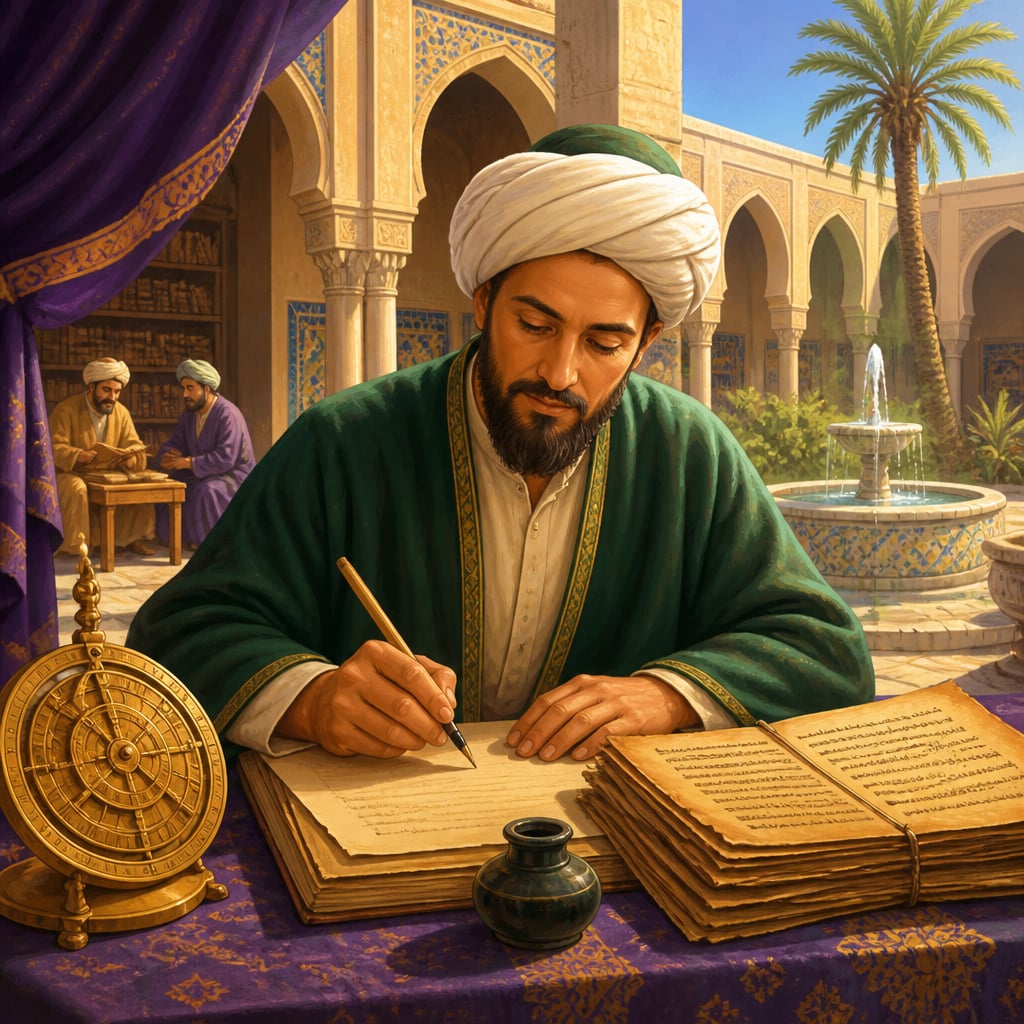
Al-Khwarizmi in a Baghdad courtyard at the Bayt al-Hikma translating Indian mathematical texts

The book is short. Its title is Kitāb al-Mukhtaṣar fī Ḥisāb al-Jabr wa-l-Muqābala, the Compendious Book on Calculation by Restoration and Balancing. Five centuries from now, in a Latin translation prepared at Toledo, this title will give the European languages the word algebra. The room around al-Khwārizmī smells of lamp oil and paper. (Baghdad has paper now. The technology came through Samarkand from China seventy years earlier, and the city's scribes have stopped using parchment.) Through the courtyard window the Tigris moves past in the dusk.

Al-Khwārizmī is not inventing the methods in the book he has just finished. He says so himself. In the preface to his companion treatise on arithmetic, Kitāb al-Jamʿ wa-l-Tafrīq bi-Ḥisāb al-Hind, On Addition and Subtraction After the Method of the Indians, he names his sources directly. The methods come from al-Hind, India. They were carried to Baghdad two generations earlier by an Indian embassy that arrived at the court of Caliph al-Manṣūr in 771 CE, and they have been circulating in Arabic ever since. What al-Khwārizmī has done is package them as a clear, teachable Arabic discipline.

He is honest about the lineage. The Arab scholars who follow him will be honest in turn. The break in attribution will not happen in Baghdad. It will happen later, in Latin Europe, where the Arab citations to India will be quietly dropped. By the time the chain reaches the modern textbook, only the most recent links will have names attached.

Open any modern algebra textbook and the etymology note is almost always the same. The word algebra, it says, comes from the Arabic al-jabr, from the title of a book written by the ninth-century mathematician al-Khwārizmī. Stated like that, the sentence is perfectly accurate and almost perfectly misleading. It is misleading because it leaves out the step before. The step before is India.

This lesson puts it back.

What the Indians Had by 800 CE

By the time an Indian mathematical text reached Baghdad, bijagaṇita was already a mature discipline. Brahmagupta, writing in 628 CE in his Brāhmasphuṭasiddhānta, had given complete rules for computing with negative numbers and zero, quadratic equations solved by completing the square, a general solution to linear indeterminate equations called the kuṭṭaka or pulverizer, and the first recorded systematic treatment of the equation Nx squared plus one equals y squared, the so-called vargaprakṛti. Mahāvīra, writing his Gaṇitasārasaṅgraha around 850 CE, extended these methods to permutations, combinations, and a wider class of algebraic problems. Śrīdhara, in the same century, had written on quadratic equations with a completed-square method that is mathematically identical to the one attributed to al-Khwarizmi a few decades later. This is not the prehistory of algebra. It is algebra itself, already in possession of its central techniques.

The word the Indians used for the subject was bīja-gaṇita, seed counting or seed reckoning. A bīja was the unknown quantity. The equation was the soil. The method was the cultivation. The metaphor is worth keeping, because when the same discipline reappears in Arabic a few generations later it also keeps a gardening word. Al-jabr means restoration, the act of putting something back into its proper place. Muqābala, the other word in al-Khwarizmi's title, means balancing. Restoration and balancing are exactly the two operations an Indian student of the seventh century would have recognized from any treatise on the unknown.

The Baghdad Transfer

Indian scholars arriving at the gates of Baghdad in 771 CE

In 771 CE, according to the historian al-Ya'qūbī and later Ibn al-Adamī, an Indian embassy arrived in Baghdad at the court of the Abbasid Caliph al-Manṣūr. Among the gifts was a Sanskrit astronomical work, most likely the Brāhmasphuṭasiddhānta of Brahmagupta or a closely related text. A scholar named Yaʿqūb ibn Ṭāriq, working with an Indian assistant, translated it into Arabic under the title Zīj al-Sindhind. For the next sixty years, the mathematics of India circulated through the House of Wisdom in Baghdad in Arabic dress, and generations of Arab scholars absorbed it. Al-Khwarizmi himself wrote a revision of the Zīj al-Sindhind alongside his book on al-jabr.

It was in the House of Wisdom, perhaps around 820 CE, that al-Khwarizmi composed Kitāb al-Mukhtaṣar fī Ḥisāb al-Jabr wa-l-Muqābala, the Compendious Book on Calculation by Restoration and Balancing. In its preface he acknowledges that the techniques of reducing an equation, completing the square, and systematically solving for the unknown were already known. His contribution was to present them in a clear, teachable form in Arabic, and to codify the procedure for linear and quadratic equations into a single coherent discipline. He also wrote a second book on Indian arithmetic, Kitāb al-Jamʿ wa-l-Tafrīq bi-Ḥisāb al-Hind, On Addition and Subtraction After the Method of the Indians, whose Latin translation would later give Europe the word algorism and then algorithm. The acknowledgment to India is in the title.

Fibonacci and the Modus Indorum

Fibonacci learning Hindu-Arabic numerals in a Bugia counting-house

Three and a half centuries after al-Khwarizmi, an Italian merchant's son named Leonardo of Pisa travelled through Bugia on the North African coast, Cairo, Alexandria, Damascus, and Constantinople, learning the mathematics that the Arabs had preserved and refined. In 1202 he published the Liber Abaci, the Book of Calculation, and with it single-handedly brought the Indian-Arabic system of computation into Latin Europe. The preface of the Liber Abaci says, in plain words, that the author learned the modus Indorum, the method of the Indians, and judged it so far superior to the Roman and abacus based methods that he felt compelled to write it out for his countrymen. Fibonacci's algebra, including the treatment of quadratic equations and the manipulation of unknowns, is essentially a restatement of the bijagaṇita tradition, routed through al-Khwarizmi and his Arab successors. The chain is unbroken from Brahmagupta to Pisa.

By the sixteenth century, Latin translations of al-Khwarizmi's al-Jabr had produced the word algebra in Italian, French, English, and Spanish. The word algorismus had yielded algorithm. The decimal numerals that the Arabs called al-arqām al-hindiyya, the Indian numerals, reached Europe as Arabic numerals and are now simply numbers. Each rename was a small act of credit shifted one step west. Each one was also a clue still legible to anyone who bothered to trace the etymology back two steps instead of one.

A Long Loop That Closed Late

There is an irony in the full arc that should not be missed. The Indian tradition of bijagaṇita was not interrupted by the transmission. Bhāskara II wrote his Bījagaṇita around 1150 CE, almost contemporary with Fibonacci, without any knowledge that his grandfather's mathematics had become the foundation of an Arabic and then Latin discipline. Madhava and the Kerala school, in the fourteenth and fifteenth centuries, extended the tradition into the beginnings of calculus, again entirely independently. For almost a thousand years Indian bijagaṇita and European algebra were the same discipline in different linguistic wrappers, and neither side knew the other existed in any serious way. The wrapper was mistaken for the content, and the content was credited to whoever was holding the wrapper at the moment.

It took until the twentieth century for historians of mathematics, working first from Arabic manuscripts and then from Sanskrit ones, to reconstruct the full chain. Scholars like Bibhutibhushan Datta, Avadhesh Narayan Singh, George Gheverghese Joseph, Kim Plofker, Roshdi Rashed, and C. K. Raju documented the transmission with the care of lawyers building a case. NCERT mathematics textbooks in India began teaching the full story in the 2000s. European and American textbooks are starting, slowly, to catch up. The etymology note now reads a little longer, as it should, because the step before al-Khwarizmi is finally being written back in.

Why It Matters

The point of reclaiming this lineage is not national pride. The point is that mathematics, like every other long human discipline, is a conversation across centuries and continents, and a conversation that loses half its speakers loses half its meaning. When a modern student learns algebra from a book whose preface credits only al-Khwarizmi, they have been handed a truth with the front half torn off. When they learn the full story, from Brahmagupta's negative numbers through Śrīdhara's quadratic and Mahāvīra's permutations through the Baghdad translation and Fibonacci's Pisa, they understand that the methods in their notebook are the end of a very long relay race, and that the first runner ran in Sanskrit. That understanding is not an extra. It is the subject.

Back at the courtyard in Baghdad, the dusk has fallen. Al-Khwārizmī blows out the lamp. The book he has just finished will travel west under his name, then under translators' names, then under no name at all. He has written his sources into the preface as honestly as he can. The rest, he cannot help.

Key figures

Muhammad ibn Mūsā al-Khwārizmī

c. 780 to c. 850 CE; House of Wisdom, Baghdad

Leonardo of Pisa (Fibonacci)

c. 1170 to c. 1250 CE; Pisa, Bugia (modern Béjaïa, Algeria), and the Mediterranean

Bibhutibhushan Datta

1888 to 1958; Calcutta and Pushkar

Case studies

Al-Khwarizmi's Debt: How an Abbasid Scholar Named His Sources

Around 825 CE, in the House of Wisdom in Baghdad, Muhammad ibn Mūsā al-Khwārizmī sat down to write what would become two of the most influential mathematical books in human history. One was Kitāb al-Jabr wa-l-Muqābala, the treatise whose title would give Europe the word algebra. The other was Kitāb al-Jamʿ wa-l-Tafrīq bi-Ḥisāb al-Hind, On Addition and Subtraction After the Method of the Indians, which would teach the Islamic and then the European world to compute with decimal numerals. Al-Khwarizmi did something that later retellings of the algebra story have often forgotten. In the title and preface of his second book, and again in references inside the first, he openly named his source. The methods, he said, came from al-Hind, India. The decimal numerals were al-arqām al-hindiyya, the Indian numerals. The arithmetic was al-ḥisāb al-hindī, Indian calculation. He was not inventing a new science. He was translating, clarifying, and passing on the methods that had arrived in Baghdad a half century earlier with an Indian embassy and a Sanskrit astronomical text.

Al-Khwarizmi's intellectual honesty is itself a dharmic value. Indian learning traditions had long insisted on the guru paramparā, the unbroken chain of teachers, in which every student names the one who taught him and every teacher names the one who taught her. The Sanskrit phrase for this, paramparā vidyā, is not a formality. It is a claim that knowledge is a relay, not a possession, and that the act of acknowledging one's sources is itself part of what makes the knowledge valid. When al-Khwarizmi titled his second book after the method of the Indians, he was behaving exactly as a student in an Indian paraṃparā was expected to behave. The irony is that later Latin translations began to drop the word hindī from the title, and the word al-Khwarizmī itself became Algorismi, and the chain of credit fell silent one link at a time.

Al-Khwarizmi's books were translated into Latin in the twelfth century and became the standard textbooks for European mathematics for four hundred years. The word algebra entered every European language. The word algorithm followed. The Indian decimal numerals, renamed as Arabic numerals in Europe, replaced Roman numerals and made modern commerce, science, and engineering possible. Al-Khwarizmi's original acknowledgment to India was preserved in the manuscript tradition but dropped from most textbook summaries until twentieth century historians restored it.

Honest attribution is not a decorative courtesy. It is part of how knowledge survives intact across long distances and long times. When you teach or transmit something, name the source in the same breath. Future readers will thank you, and so will the people you learned from.

The title of al-Khwarizmi's arithmetic book literally contains the word Hind (India). The Latin translation is titled Liber Algorismi, in which the Indian reference is replaced with al-Khwarizmi's own name, and no trace of India remains.

Fibonacci's Preface: A Pisan Merchant Credits the Modus Indorum

In 1202 CE, Leonardo of Pisa, known to history as Fibonacci, published a book he called Liber Abaci, the Book of Calculation. Its opening pages are one of the most important paragraphs in the history of European mathematics. Fibonacci explains that his father, a Pisan customs official, had been posted to Bugia on the North African coast, and that as a boy Leonardo was enrolled in a local school where he learned Arabic mathematics. He then travelled through Egypt, Syria, Greece, Sicily, and Provence, studying with mathematicians in every port. The method he learned, he writes, was the modus Indorum, the method of the Indians. He judged it so superior to the Roman and abacus based methods then used in Italy that he felt obligated to translate it into Latin for his countrymen. The Liber Abaci proceeds to teach decimal positional arithmetic, algebra of the unknown, and a large catalogue of problems, all derived directly from the Arabic tradition that had in turn derived from Sanskrit sources. The book is dedicated to Scottish nobleman Michael Scot and to the scholar community of his native Pisa.

The Indian tradition of mathematics had always insisted, through Brahmagupta, Mahāvīra, Śrīdhara, and Bhāskara, that bijagaṇita is the seed of all higher calculation. Fibonacci, without knowing any Sanskrit text and without having met any Indian teacher, received that same claim through an Arabic intermediary and found it self evidently true. When he writes that the modus Indorum is 'more sublime' than any other, he is repeating, in medieval Latin, the judgment that Mahāvīra made in ninth century Sanskrit when he declared that nothing in the three worlds is real without gaṇita. The continuity of mathematical self confidence across the Baghdad bridge is evidence of something real. A method that survives translation into three languages without losing its coherence is a method that was built for universality from the start.

The Liber Abaci was copied, excerpted, and imitated across Europe for the next three centuries. Every major European arithmetic textbook of the fourteenth, fifteenth, and sixteenth centuries traces, directly or at one remove, to Fibonacci. The decimal numerals replaced Roman numerals. The abacus receded from serious use and became a counting toy. European merchants, bankers, and scientists began computing in a way that ancient Indian shopkeepers had already been computing for a thousand years. The seed that Brahmagupta had planted in 628 CE flowered in Pisa in 1202 CE.

A good method travels better than a good marketing campaign. Indian algebra was not spread by conquest or missionary effort. It spread because anyone who actually used it saw that it was better, and because merchants, astronomers, and tax officials cannot afford the luxury of inferior tools. If your work is solid, it will find its readers across any border you can imagine.

The Liber Abaci is 459 folios long in its standard manuscript form and contains over 800 worked problems, almost all of them descended from Arabic sources that in turn descend from Sanskrit sources. Fibonacci is credited in European histories as the father of European mathematics, and by his own account he learned everything he knew from the modus Indorum.

Rewriting the Textbook: NCERT and the Restoration of Indian Credit

For most of the twentieth century, school mathematics textbooks around the world, including those used in India, taught that algebra originated with al-Khwarizmi in ninth century Baghdad and was developed into its modern form by European mathematicians from Fibonacci through Cardano, Viète, and Descartes. The Indian contribution was usually reduced to a single sentence about the invention of zero, often placed in a decorative sidebar. Beginning in the 1990s, and accelerating after the 2000s, Indian scholars and textbook reformers began pushing for a more accurate account. The NCERT, the National Council of Educational Research and Training that produces India's central mathematics textbooks, began including chapters on Aryabhata, Brahmagupta, Mahāvīra, Śrīdhara, Bhāskara II, and Madhava, with direct citation from their texts. Their contributions to algebra, trigonometry, calculus, and number theory were placed not as sidebars but as part of the main narrative. Outside India, George Gheverghese Joseph's book The Crest of the Peacock, first published in 1991 and now in its third edition, did similar work for the English language academic audience. Roshdi Rashed, working in France, produced critical editions and translations of Arabic mathematical texts that documented the Indian sources al-Khwarizmi had cited. C. K. Raju, working from both Sanskrit and Arabic manuscripts, made the even stronger claim that the transmission continued through the Kerala school into the European calculus tradition. The textbooks are finally catching up to the manuscripts.

The Indian tradition had always expected that its knowledge would be preserved through paramparā, the living chain of teachers and students. What colonial education severed was not the content of the tradition, much of which continued in Sanskrit commentaries and regional mathematical schools, but the chain of public credit. The twenty first century revision of textbooks is, in dharmic terms, an act of paraṃparā repair. It is not nationalism. It is the restoration of the ordinary scholarly courtesy that al-Khwarizmi himself observed when he titled his book after the method of the Indians. A tradition that names its sources is a tradition that can still grow. A tradition that forgets them becomes a museum.

By 2020, a student studying mathematics in an NCERT classroom learns the story of Indian algebra from Brahmagupta through Bhāskara II as part of the main syllabus, not as a cultural add-on. International scholarship has shifted decisively, with historians of mathematics such as Kim Plofker at Union College, Clemency Montelle at Canterbury, and Karine Chemla in Paris producing detailed studies of the Sanskrit mathematical tradition. European and American textbooks have been slower to update, but the pressure is now steady and the old one sentence summary of Indian mathematics is no longer defensible. The etymology note at the front of every algebra textbook is slowly growing the Indian half back.

History is not fixed. When new evidence emerges, or when old evidence is finally read honestly, the textbook can and should be rewritten. If you find that the standard story in your own field leaves out an entire contributor, you have more than permission to correct it. You have an obligation. The ninth century scholar al-Khwarizmi was willing to name his Indian sources. Any modern textbook author ought to be willing to do the same.

The first Indian NCERT mathematics textbook to dedicate a full chapter to the history of Indian mathematics was introduced in the late 2000s. George Gheverghese Joseph's The Crest of the Peacock is now in its third edition and has sold tens of thousands of copies worldwide. C. K. Raju's Cultural Foundations of Mathematics, published in 2007, runs to over five hundred pages of documented argument for the Indian origin and Arabic transmission of calculus.

Historical context

The classical and medieval transmission period, c. 628 to 1202 CE, from Brahmagupta's Brāhmasphuṭasiddhānta to Fibonacci's Liber Abaci

This was a period when Indian mathematics was flourishing in multiple regional centres. Brahmagupta at Bhillamāla, Mahāvīra in Rāṣṭrakūṭa Karnataka, Śrīdhara in Bengal, Bhāskara II at Ujjain, and later the Kerala school around Saṅgamagrāma, all worked in an unbroken Sanskrit tradition that treated bijagaṇita as a mature and evolving discipline. At the same time, Indian merchants, astronomers, and diplomats were carrying the methods abroad through trade routes to Southeast Asia, Arabia, and Central Asia. The transmission to Baghdad in 771 CE was not an accident. It was one instance of a wider diplomatic and scholarly exchange between Indian courts and the newly ascendant Abbasid caliphate.

This lesson closes the chapter on bijagaṇita by showing that Indian algebra did not stay in India. It became, through a documented chain of translation and teaching, the foundation of the algebra that is now taught in every school on earth. Understanding this history matters for two reasons. First, it restores intellectual credit to a tradition that has been underacknowledged in standard histories of mathematics. Second, it reminds the modern student that the algebra in their notebook is not a Western invention. It is a long paraṃparā that began in Sanskrit, passed through Arabic, and arrived in European languages only in its third or fourth century of existence.

Living traditions

The living legacy of this transmission is, in the most literal sense, every piece of software ever written and every financial transaction ever recorded. The word algorithm, which names the basic unit of computer science, is a corrupted form of al-Khwarizmi, who was transmitting al-ḥisāb al-hindī, Indian calculation. The word algebra names the discipline that begins with Brahmagupta's bijagaṇita. The decimal digits that you type on any phone or keyboard are the Indian numerals that reached Europe through Arabic intermediaries. NCERT textbooks in India now teach this history explicitly. International scholarship, led by figures like George Gheverghese Joseph, Kim Plofker, Roshdi Rashed, and C. K. Raju, continues to document the full chain. The Chennai Mathematical Institute, IIT Bombay, and IIT Gandhinagar run active research programmes on the history of Indian mathematics. The restoration of this credit is not an exercise in pride. It is an exercise in seeing the whole of a discipline that has always been a global relay, and that is only now learning again how to name its first runners.

Reflection

More in Bijaganita: The Seed of Algebra

All lessons in Bijaganita: The Seed of Algebra · Indian Mathematics: Ancient Genius, Modern Foundations course