Bhaskara's Lilavati: Mathematics as Poetry

The beautiful treatise written for a daughter

Explore the Lilavati, Bhaskara II's charming mathematical text that presents complex problems through poetic verses and story problems.

The Pearl in the Water Clock

In or around 1150 CE, in the courtyard of his home in present-day Karnataka, the astronomer Bhāskara II is preparing for his daughter's wedding. The girl's name is Līlāvatī, which in Sanskrit means 'the playful one' or 'she who delights'. Bhāskara is not only a mathematician but also an astrologer, and he has cast her horoscope with the care of a man who counts on the heavens. He has calculated to the minute the auspicious muhūrta at which the marriage may take place. A water clock, a hollow cup with a small hole drilled in its base, has been set floating in a basin to mark the moment. When the cup sinks, the muhūrta has arrived.

Līlāvatī leans forward to watch. A pearl from her hair ornament slips loose and falls, unnoticed, into the rim of the cup. The pearl blocks the hole. The water does not enter. The cup does not sink. The auspicious moment passes in silence, and by the time anyone realises what has happened, the marriage cannot proceed.
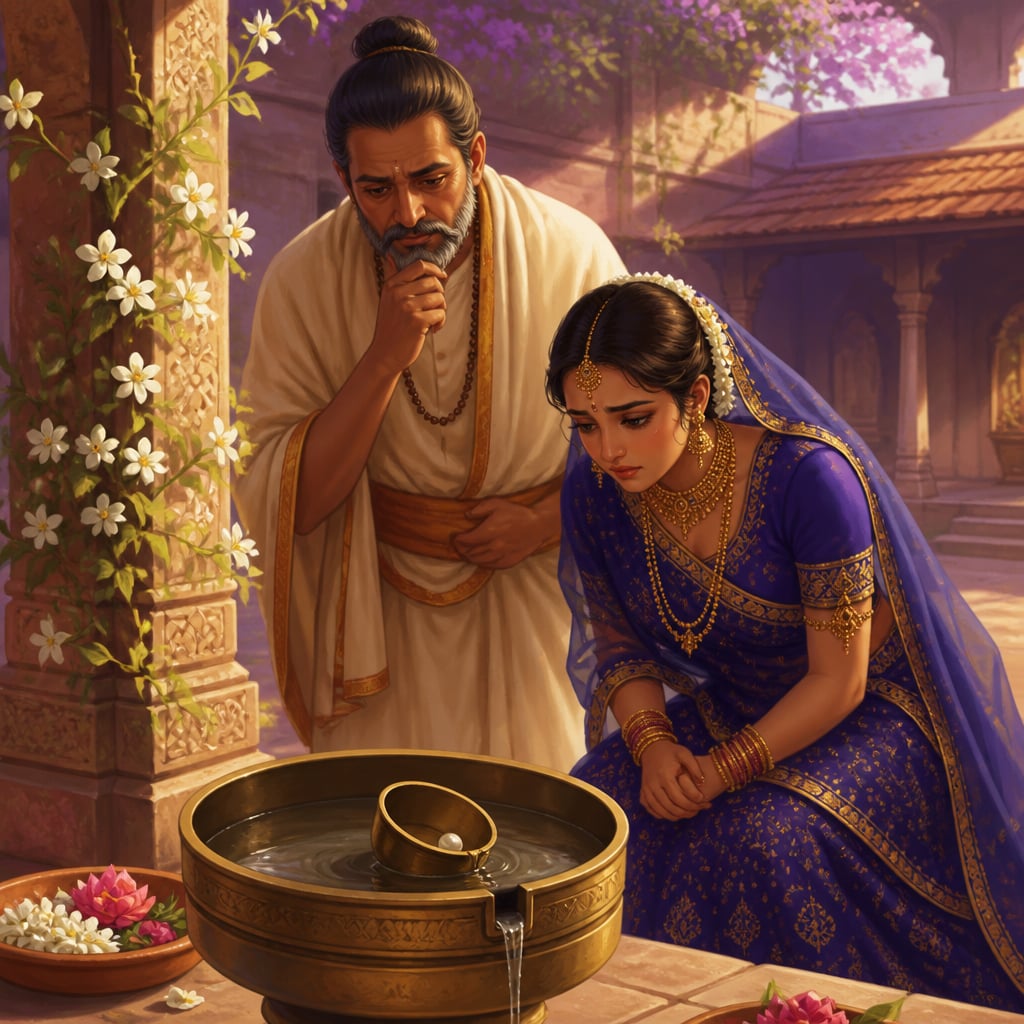
A pearl from Lilavati's hair ornament blocking the floating water clock on her wedding day

To console his daughter, the legend says, Bhāskara composes an entire mathematics textbook in her name, framing every problem as a question addressed to her. So that her name, denied a husband by a single misplaced pearl, will be remembered by every student of arithmetic for as long as Sanskrit is read.

The story was first set down in Persian by the sixteenth-century historian Fayzī at the Mughal court of Akbar. Whether the legend is literally true matters less than what it preserves. The book is genuinely addressed to a young woman, and the tone of the text matches the name. A bee flies past. A peacock pounces on a cobra. Swans circle a pond. Fractions turn into fawns. Quadratic equations arrive disguised as riddles about pearl necklaces slipping from the throats of dancing girls. This is the Līlāvatī: the most widely copied mathematics textbook in premodern Asia, and it is written in verse. For seven hundred years it was the standard arithmetic manual of the subcontinent. Its survival is not an accident of nostalgia. It is the consequence of a set of pedagogical choices so strong they still work.

What the Līlāvatī Actually Contains

The Līlāvatī is the first of four sections of Bhāskara's larger treatise, the Siddhānta Śiromaṇi, the crown jewel of astronomy. It covers arithmetic, mensuration, and elementary algebra in roughly two hundred seventy eight verses. It opens with definitions of units, moves through the four fundamental operations, handles fractions, square roots, cube roots, the rule of three, simple and compound interest, mixtures, permutations and combinations, plane geometry, and the volumes of solids, and closes with an elegant treatment of Pythagorean triples and practical area computations. There is almost nothing a twelfth century Indian merchant, astronomer, surveyor, or schoolteacher would need that the Līlāvatī does not teach. It is the Swiss army knife of premodern Indian arithmetic.

What sets it apart is the presentation. Almost every rule is stated briefly as a karaṇa-sūtra, a verse of procedure, and almost every rule is then demonstrated with a problem framed as a small story. The bee problem, probably the most famous, runs this way. A group of bees, equal to the square root of half their total number, flew off to a jasmine bush. Eight ninths of the remainder went to a pandanus flower. Two bees, a male and his beloved, hovered together trapped inside a closing lotus. Tell me, Līlāvatī, how many bees were in the swarm. The equation underneath is a clean quadratic with an integer answer of seventy two. The difficulty is not the algebra. The difficulty is pulling the algebra out of the image. That is, of course, the entire point.

Poetry as Pedagogy

A bee hovering over jasmine blossoms at dawn

Sanskrit verse is built around metrical patterns and fixed syllable counts, and Bhāskara uses them with the ease a good novelist uses sentence rhythm. Why choose verse at all? Because the Indian educational tradition of the period was primarily oral. Students memorized their textbooks by chanting them, teacher to student, every morning and evening. A treatise composed in memorable verse was a treatise that actually survived multiple generations of hand copying and recitation. Bhāskara's choice of poetic form was not decoration. It was an engineering decision. The Līlāvatī could be carried in a student's head the way a mason carries a tape measure, pulled out and consulted at need. Modern educators speak of 'retrieval practice' and 'spaced repetition'. Bhāskara built both into the grammar of his sentences nine centuries ahead of schedule.

The emotional register of the verses matters too. A child taught that fractions belong to fawns and quadratics belong to lovesick bees is likely to approach harder mathematics with less fear than a child handed a clean page of symbols. The Līlāvatī is, by any fair measure, one of the most successful pieces of mathematics education ever produced. Its charm is functional.

From Ujjain to Agra to London

Abū al Fazl translating the Līlāvatī at Akbar's court

Bhāskara almost certainly composed the Līlāvatī in Ujjain, where he headed the famous astronomical observatory that had passed through several generations of siddhāntic astronomers before him. Within a century the book had spread across the subcontinent and was being taught from Kashmir to Kerala. In 1587, at the court of the Mughal emperor Akbar, the scholar Abū al Fazl completed a Persian translation on Akbar's personal order, and the Līlāvatī became, for two centuries, the standard arithmetic textbook of Mughal administration. Akbar himself is said to have enjoyed setting its problems as riddles at court. In 1817, the British orientalist Henry Thomas Colebrooke published a careful English translation of the Līlāvatī alongside Brahmagupta's and Bhāskara's algebra, and for the first time European mathematicians encountered a twelfth century Indian text that could quietly embarrass many of their own standard arithmetic manuals. Augustus de Morgan, reading Colebrooke in London, remarked that he could not understand why Indian schoolmasters of his own century had ever abandoned it.

Why It Still Matters

The Līlāvatī is older than almost every European textbook a modern student has ever read, and it is more readable than most of them. Salman Khan, the founder of Khan Academy, has spoken in his lectures about how story-framing dissolves the dread of a maths problem and lets a struggling student stay in the seat long enough to learn. Carol Dweck of Stanford, whose research on the growth mindset reshaped global mathematics pedagogy in the 2000s, has documented how problems framed in narrative reach students that abstract drill leaves behind. Both of them are recovering, in modern language, what Bhāskara already knew in 1150 CE.

Its survival from then into the age of the laptop is not an accident. It is the durable consequence of a set of deliberate choices. Teach in verse. Frame problems as stories. Address the student by name. Make every rule immediately demonstrable. Those choices add up to a pedagogy that travels across cultures and centuries without distortion. The Līlāvatī teaches us something about mathematics. It also teaches us something about teaching. The subject is hard enough on its own. The writing does not have to be.

Back in the courtyard, the pearl is still in the cup. The wedding never happens. But the book that was written to console the bride has outlived eight hundred years of empires, and the name Līlāvatī, the playful one, is now spoken in every classroom in India by students who do not even know whose daughter she was.

Key figures

Bhāskara II (Bhāskarācārya)

1114 to 1185 CE, Karnataka region, India

Abū al Fazl ibn Mubārak

1551 to 1602 CE, Mughal India

Henry Thomas Colebrooke

1765 to 1837 CE, England and British India

Case studies

The Bee Problem: A Quadratic Hidden in a Jasmine Flower

In a palm leaf manuscript copied somewhere in twelfth century India, a young student opens the Līlāvatī and reads a verse about bees. A swarm, the text says, has gone different ways on a summer afternoon. The square root of half the swarm has flown to a jasmine bush. Eight ninths of the whole swarm has settled on a pandanus tree. A single she-bee, a messenger of fragrance, has been caught inside a closing lotus at nightfall. The student is asked, directly and by name, how many bees were in the swarm. There is no equation on the page. There is no diagram. There is only the scene and the question.

The verse is Līlāvatī 54, one of the most widely memorized problems in premodern Indian mathematics. Bhāskara is training the student to do something mathematically subtle. First, read the image. Second, translate each image element into a symbolic quantity. Third, recognize the resulting equation, in this case √(x/2) plus 8x/9 plus 1 equals x, as a standard quadratic and solve it by the rules taught earlier in the book. The answer is x equals seventy two. The work required is not algebraically hard. What is hard is the act of translation, the discipline of seeing algebra behind description. Indian mathematical pedagogy treats this act as the most difficult and most important skill a student can learn. Bhāskara believes that charm makes the act possible. A student who is amused by the jasmine and the lotus is a student who will bother to do the translation at all.

The bee verse became a canonical teaching example across the Indian subcontinent for the next seven centuries. It passed into the Persian tradition with Abū al Fazl's translation in 1587 and into the English tradition with Colebrooke's translation in 1817. It is still quoted in Indian classrooms today as a small demonstration that mathematics and poetry can share a single sentence without either giving ground. Generations of students who have never otherwise read Sanskrit can recite it from memory.

A problem does not become easier by being stripped of its poetry. It becomes less memorable. Bhāskara understood that the imagination is not an enemy of mathematics but one of its most powerful allies. The bee verse is both a quadratic and a small piece of garden writing, and it is stronger as pedagogy because it is both.

Līlāvatī verse 54 appears in every major manuscript tradition of the book, including Sanskrit, Persian, Telugu, Kannada, Marathi, and English, unbroken from the twelfth century to the present.

Peacock and Snake: The Pythagorean Theorem Told as a Garden Drama

Another verse in the Līlāvatī presents a peacock perched on a pillar of given height, watching a snake glide along the ground toward its hole at the pillar's base. The snake is moving at a steady speed. The peacock, seeing the prey, launches itself and strikes the snake along the straight line of its dive, reaching the ground at the exact instant the snake would otherwise have reached its hole. The student is given the height of the pillar, the distance from the pillar at which the peacock strikes, and is asked to compute that distance directly without algebraic symbols, using only the image in front of them.

Underneath the drama is a plain application of the right triangle identity. The pillar is one leg, the horizontal distance the snake has crossed is a second leg, and the peacock's dive is the hypotenuse. Because the peacock and the snake travel equal distances in equal time, the problem reduces to solving for the foot of the perpendicular on the hypotenuse. Bhāskara, of course, never uses the word Pythagoras. The theorem had been known in India as Baudhāyana's result for almost two millennia before the Līlāvatī was written, and Bhāskara simply expected his student to recognize the configuration. The peacock and snake verse is the theorem dressed up as a garden drama. The student learns both the mathematics and the habit of looking at the world with a geometrical eye.

The peacock and snake problem is still taught in Indian schools nine centuries later, often in Hindi, Marathi, or regional language versions of the original Sanskrit verse. It is one of a small handful of problems from the Līlāvatī that has entered popular Indian mathematical culture, appearing in riddle books, magazine puzzles, and textbooks aimed at high school students. Its charm has allowed it to survive into contexts where the rest of Bhāskara's book has not.

A geometric truth that is taught as a scene remembered, rather than as a formula memorized, passes more easily from one generation to the next. The peacock and the snake have carried the Pythagorean identity into a thousand Indian classrooms without the identity ever being named. That is transmission working at its best.

The peacock and snake verse is frequently cited in Indian textbooks and puzzle collections as the most recognizable geometric problem from Bhāskara's Līlāvatī. Its survival outside specialist circles is unusually robust for a twelfth century Sanskrit text.

Abū al Fazl at Akbar's Court: The Līlāvatī Becomes a Persian Classic

In the late sixteenth century, the Mughal emperor Akbar assembles a circle of scholars at his capital and asks them to translate the best works of Sanskrit learning into Persian, the administrative language of his empire. Among the scholars is his closest adviser, Abū al Fazl, already deep in the composition of the Akbarnāma and the Āīn-i Akbarī. Akbar's command is practical as well as intellectual. The Mughal administration runs on arithmetic, revenue computation, land measurement, and the calculation of taxes and grain shares, and a first class mathematics textbook in Persian would be immediately useful. Akbar has heard of the Līlāvatī, the twelfth century Sanskrit manual said to teach arithmetic in poetry. He asks for it to be rendered into Persian. Abū al Fazl accepts the commission and completes the translation in 1587.

The choice of the Līlāvatī as the text to translate is not accidental. Akbar's court was not simply interested in the prestige of Sanskrit learning. It needed working tools for a working empire. The Līlāvatī was, among the known Sanskrit texts, the most practical and the most approachable. Its combination of clear rules and vivid worked examples made it ideal for training Mughal revenue officers and court mathematicians. Abū al Fazl's translation preserved Bhāskara's examples wherever possible, translating the bees and peacocks and pearl necklaces into Persian with surprising fidelity. The Mughal edition is not a translation into a different scientific register. It is the same book in a second language.

The Persian Līlāvatī became a standard arithmetic reference for Mughal scribes and administrators for the next two centuries. It circulated in manuscript form across the subcontinent, was copied and taught in madrasas alongside works of Persian literature, and shaped the numerical habits of the Mughal revenue system. Akbar himself is said to have enjoyed setting Līlāvatī problems as riddles at court. The translation also preserved the book for a period when Sanskrit learning was contracting in several regions, and when Colebrooke began his English translation in the early nineteenth century, surviving Persian copies were among his important cross references.

A good textbook outlives the language it was born in. The Līlāvatī survived not only because Sanskrit pandits continued to copy it, but because a Mughal emperor and his vizier recognized that a twelfth century Hindu mathematics manual was genuinely useful to a sixteenth century Muslim administration. Intellectual traditions travel on merit. The Līlāvatī traveled on its own.

Abū al Fazl completed his Persian Līlāvatī in 1587 CE on Akbar's personal command. Persian language manuscripts of the text continued to be copied and taught across Mughal India until the early nineteenth century.

Colebrooke in London: Europe Encounters a 1150 Textbook It Cannot Match

In 1817, Henry Thomas Colebrooke, newly retired from a long career as an East India Company judge and administrator in Bengal, published a single volume in London titled Algebra, with Arithmetic and Mensuration, from the Sanscrit of Brahmegupta and Bhascara. The book contained his English translations of Brahmagupta's Brāhmasphuṭasiddhānta, Bhāskara's Līlāvatī, and Bhāskara's Bījagaṇita. Colebrooke, a self taught Sanskritist of extraordinary rigor, had spent years on the work. The translations were careful, the notes were extensive, and the cross references to then current European mathematics were pointed. European mathematicians opened the book and met a twelfth century Indian arithmetic textbook whose problems were often beyond the level of contemporary elementary European manuals.

What Colebrooke had done was not a matter of cultural advocacy. He had simply translated the primary sources honestly and let the mathematics speak. Bhāskara's Līlāvatī contained clear and correct treatments of topics that early nineteenth century European schoolbooks sometimes handled clumsily, including quadratic equations, permutations and combinations, interest calculations, and practical mensuration. Bhāskara's Bījagaṇita, the algebraic companion volume, contained solutions to indeterminate equations that Europe had reached only with the work of Euler and Lagrange in the eighteenth century. Augustus de Morgan, George Peacock, and later Moritz Cantor read Colebrooke's translations and were forced to revise their sense of where and when mathematics had developed. The revision was slow, but it was real.

Colebrooke's 1817 volume remained the standard English reference for the Līlāvatī and the Bījagaṇita for more than a century. Every major historian of mathematics in the nineteenth and early twentieth century relied on it. The revaluation of Indian priority in several algebraic techniques can be traced directly back to that single London publication. Colebrooke received no honors for the work during his lifetime, but his translations did more to correct the Western history of mathematics than almost any other scholarly project of the nineteenth century.

A faithful translation, published without polemic, can reshape centuries of received opinion. Colebrooke did not argue for Indian priority. He simply made the Līlāvatī available in English and let it do its own work. The book has been doing that work ever since, and the quiet power of the original 1817 volume is a reminder that the most persuasive case for Indian mathematics is usually the Indian mathematics itself.

Colebrooke's 1817 translation of Bhāskara's Līlāvatī and Bījagaṇita was the first full English rendering of either text and remained the standard reference in Western scholarship for over a hundred years.

Historical context

The high classical period of Indian mathematics, late Chalukya and Yādava era, 1100 to 1200 CE

Twelfth century India was politically divided but intellectually thriving. The Chālukya, Yādava, Kākatīya, and Pāla dynasties presided over a period of remarkable flowering in Sanskrit literature, temple architecture, philosophy, and the exact sciences. Ujjain, located in central India, had served as the traditional seat of Indian mathematical astronomy for nearly a thousand years, passing through the hands of Varāhamihira, Brahmagupta, and their successors before reaching Bhāskara. The Siddhānta Śiromaṇi was composed in an intellectual environment that took mathematical astronomy seriously as both an applied and a theoretical science, and Bhāskara's career represents the culmination of that tradition in the north and central parts of the subcontinent.

Understanding the Līlāvatī in its twelfth century setting corrects a persistent misreading of Indian mathematics as a purely practical or clerical tradition. Bhāskara's book is practical, but it is also literary, affectionate, and deeply integrated with the aesthetic culture of its time. The combination is not unusual in Indian intellectual history. It is characteristic. Reading the Līlāvatī in context allows a modern student to see Indian mathematics as a cultivated art, not an isolated skill, and to appreciate the full range of choices Bhāskara made about how to teach.

Living traditions

The Līlāvatī has never fully left Indian mathematical culture. Its verses are still recited in a handful of Sanskrit pāṭhaśālās, its bee problem is still quoted in popular Indian mathematics writing, and its name has been lent to modern institutions such as the Bhaskaracharya Pratishthana in Pune and to the International Mathematical Union's Leelavati Prize, awarded every four years at the International Congress of Mathematicians for outstanding public outreach in mathematics. The prize is an explicit tribute, naming Bhāskara's twelfth century book as the ancestor of modern mathematics communication. Contemporary Indian mathematicians including Manjul Bhargava have publicly credited the Līlāvatī as an early influence on their sense of what mathematics can sound like. Every new generation of Indian students who encounters Bhāskara through translation encounters a writer who was, nine hundred years ago, already doing what the best popular mathematics authors of today still aspire to.

Reflection

More in Bijaganita: The Seed of Algebra

All lessons in Bijaganita: The Seed of Algebra · Indian Mathematics: Ancient Genius, Modern Foundations course