Why Rama Left His Own Kingdom
His father made a promise. Rama could have fought it. He chose to keep it.
On the morning Rama was meant to be crowned king of Ayodhya, his stepmother Kaikeyi calls in two old promises from King Dasharatha. She wants her son Bharata on the throne and Rama sent to the forest for fourteen years. Rama could have fought back. Instead, to keep his father's word, he walks out of the palace with Sita and Lakshmana, smiling, in the same simple cloth a forest sage would wear.
The Morning the Whole City Woke Up Smiling
The night before, the city of Ayodhya could barely sleep.
In every home, mothers were stitching new clothes. Fathers were polishing their best earrings. Children were practising the songs they would sing tomorrow. Grandmothers were drawing fresh kolams at every doorstep.
Because tomorrow morning, Rama was going to be crowned king.
Nobody in Ayodhya could remember a happier day. Rama was the eldest son of King Dasharatha. He was kind to everyone. He greeted the old sweeper by name. He never raised his voice. The city loved him the way you love your own child.
The sky lit up at dawn. Conches blew. Drums began. Sita, Rama's wife, dressed in her finest yellow silk. Rama wore the simple white he always wore, because he never enjoyed showing off. The crown was already polished and waiting in a silver tray.
And then, very quietly, everything went wrong.
A Whisper in the Wrong Ear
Deep inside the palace, in a small room of polished stone, sat Queen Kaikeyi.
Kaikeyi was Dasharatha's youngest queen. She was Bharata's mother. She had loved Rama like her own son, ever since the day he was born. In fact, she had told Dasharatha many times that she loved Rama even more than Bharata.
But that morning, an old maid named Manthara crept into her room.
Manthara had a hard, jealous heart. She did not love Rama. She loved Kaikeyi, and she could not bear that Kaikeyi's son Bharata was going to live in Rama's shadow forever.
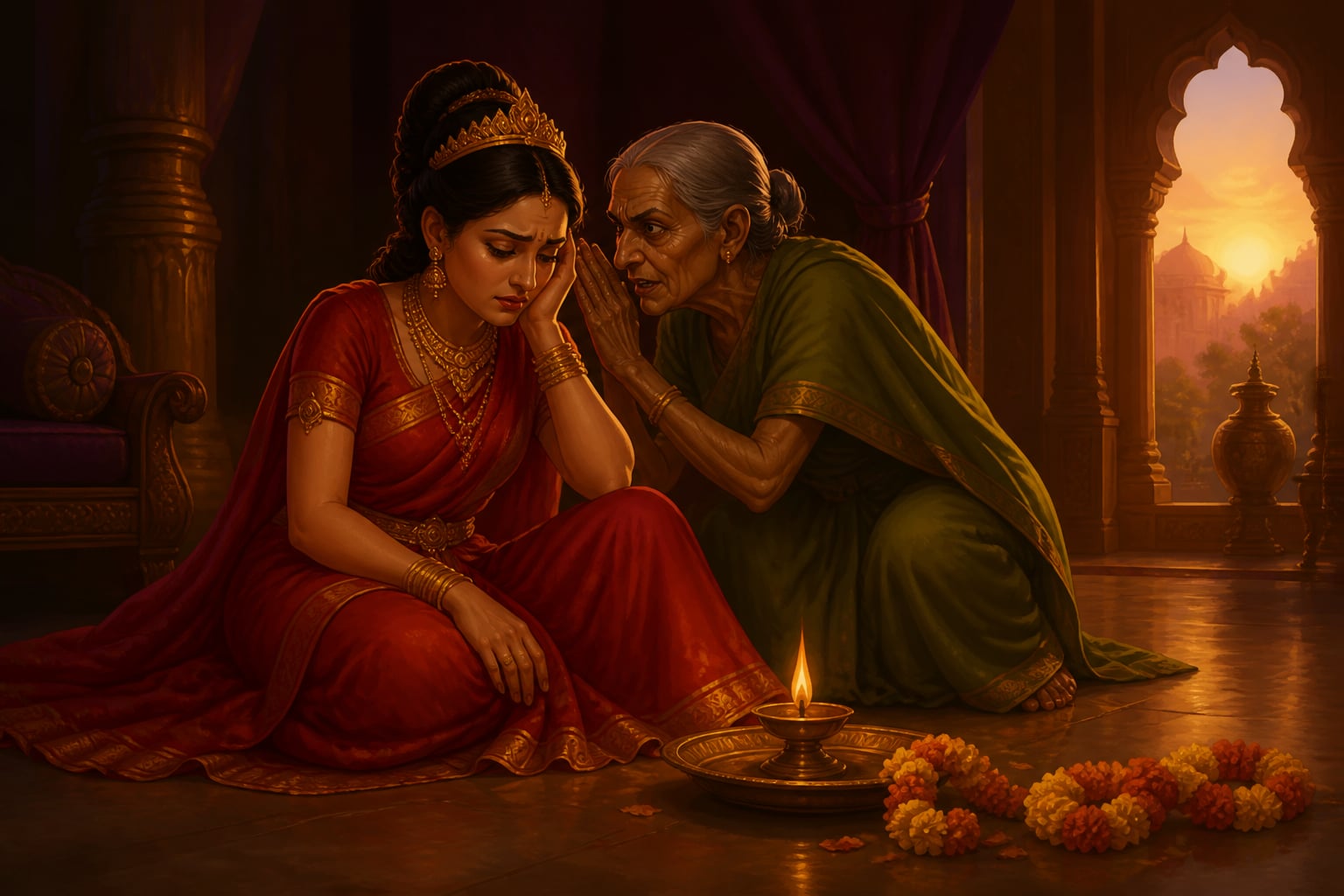
"Don't you see, my queen?" Manthara whispered. "Once Rama is king, your son Bharata will be no more than a servant. Your room will be smaller. Your power will be less. Rama and his wife will rule everything. And you, my queen, will be forgotten."
Kaikeyi laughed at first. "Manthara, what nonsense. Rama is like my own son. He would never treat me badly."
But Manthara whispered. And whispered. And whispered.
Drop by drop, like Kaliya's poison in a river, fear seeped into Kaikeyi's heart. By the end of the morning, she was sitting on the floor of a dark little chamber, her ornaments thrown into a corner, weeping.
Two Old Promises
Long, long ago, when Kaikeyi had been a young warrior queen, she had ridden into battle beside Dasharatha. In one fierce moment, she had saved his life with her quick hands and her chariot. Dasharatha had been so grateful that he had said, "Ask for two boons. Anything. I will keep my word."
Kaikeyi had laughed and said, "I'll keep them for later."
For years, she had never asked. Dasharatha had even forgotten.
But today, sitting on the floor with Manthara's poison in her ears, Kaikeyi remembered.
Dasharatha came running when he heard she was upset. He saw her tear-streaked face, her ornaments on the ground, and he fell to his knees. "My queen! Why? Tell me what is wrong. I will give you anything."
Kaikeyi looked up. Her eyes were strange.
"Two boons, my king. The two you promised me long ago."
Dasharatha's heart skipped. Of course. He had promised. "Ask, my queen. Anything you want is yours."
Kaikeyi spoke very slowly. As if even her own mouth did not want to say the words.
"My first boon. My son Bharata will be crowned king today. Not Rama."
Dasharatha turned white.
"My second boon. Rama will leave Ayodhya. He will live in the forest, dressed as a hermit, for fourteen years. He will not see this city or this palace until those years are over."
Dasharatha could not breathe.
He begged. He wept. He fell at her feet. "Take my throne, take my life, but not Rama. Anything but Rama."
Kaikeyi did not move.
Dasharatha had given his word. And in the Raghu family, a word once given was a sacred thing.

The king of Ayodhya, the lion of the Raghu line, fell to the floor and wept like a small child.
Rama Hears the News
They called for Rama.
When Rama walked into the room, dressed in white, calm and bright as the morning sun, he saw his father lying broken on the floor. He saw Kaikeyi sitting silent like a statue.
Rama bowed first to his father, then to Kaikeyi. "Mother," he said gently, "please tell me. What is troubling Pitaji?"
Dasharatha could not even look up.
Kaikeyi swallowed hard. And then, in the softest voice she had ever used, she told Rama everything. The two boons. The crown for Bharata. The fourteen years in the forest.
The whole room held its breath.
And Rama smiled.
A real smile. Not a fake one.
"Mother, is that all?" he said. "You should have just told me. Of course I will go. If father has given his word, then his word must be kept. I will leave today."
Dasharatha gasped. "My son... no..."
Rama knelt and held his father's hand. "Pitaji, listen to me. The Raghu family has only one rule. Prana jaye par vachan na jaye. The breath may leave the body, but the word given must not leave the lips. If a king's word can break, then the kingdom itself is already broken. I will keep your word for you. I will go, and I will go gladly."
He bent and touched Kaikeyi's feet. Kaikeyi flinched. She had expected him to be angry. To shout. To accuse her.
Instead he was thanking her, as a son thanks his mother.
For the first time that morning, a tiny crack opened in her heart.
Sita and Lakshmana Will Not Stay Behind
Rama walked back to his own chambers. His face was as calm as before. He was already taking off his royal silks.
Sita was waiting. She had heard.
She didn't ask, Why? She didn't ask, Are you sure? She quietly walked to her cupboards, took off her gold and her silks, and folded them into a neat pile.
"I am ready," she said.
Rama's eyes filled. "Sita, you don't have to come. The forest is no place for you. Stay here. The palace is your home."
Sita shook her head. She smiled the way only Sita could smile.
"My Rama," she said, "where you walk, that is my Ayodhya. The forest will be home if you are in it. The palace will be empty if you are not. Don't argue with me about this. I'm coming."
At that very moment, the door swung open.
Lakshmana stood there, bow in hand, dressed already in plain forest cloth. His eyes were red.
"Bhaiya," he said. He didn't say anything more. He didn't need to.
Rama opened his arms and Lakshmana ran into them.
"Lakshmana, your wife Urmila..."
"Urmila knows," Lakshmana said. "She told me to go. She said her duty is to wait, and mine is to be with you."
The three of them changed into the simple cloth of forest dwellers. They tied their hair back. They picked up only what a forest dweller needs: a bow, a knife, a small bag.
The crown sat untouched on its silver tray.
The City Walks Out
When the people of Ayodhya saw Rama, Sita, and Lakshmana coming out of the palace dressed in tree-bark cloth, the city fell apart.

Mothers wept. Children ran. Old men collapsed on the streets. Shopkeepers threw down their goods and followed.
"If our prince is going to the forest," they cried, "then we are going too. There is no Ayodhya without Rama."
The whole city poured out of the gates and walked behind the chariot. For miles. For hours. The city of Ayodhya became, for one afternoon, a moving river of weeping people.
When evening came, Rama, Sita, and Lakshmana camped on the banks of the Tamasa river. The people camped beside them. They would not leave.
In the dead of night, while the people were finally asleep, Rama whispered to his charioteer, "Sumantra. Take the chariot away as quietly as you can. Quickly. Before they wake up. They cannot follow us. They will starve in the forest."
And that is how, in the silent darkness, Rama, Sita, and Lakshmana slipped away from their own beloved people, who had loved them too much to let go.
The Father Who Could Not Bear It
Back in the palace, Dasharatha lay on the floor where Rama had left him. He could not eat. He could not sleep. He kept whispering, "Rama, Rama, Rama," like a small boy who has lost something he can never get back.
A few days later, with Rama's name on his lips, the great king of Ayodhya breathed his last.
Kaikeyi, who had lit the fire, finally understood what she had done. She tore off her ornaments. She wept until her eyes were sore. But it was too late. Manthara's whispers had cost a kingdom its king.
And Bharata, when he came home and learned everything, refused to even sit on the throne. He said, "This crown belongs to my elder brother." He took Rama's wooden sandals and placed them on the throne, and ruled the kingdom in his brother's name for fourteen years. But that, my child, is a different story.
In Your Life
The whole Ramayana, all of Rama's adventures with Hanuman and the bridge to Lanka and the great war, none of it would have happened if Rama had not kept one promise.
A promise his father had made years ago. A promise that wasn't even his to keep. A promise that cost him a crown.
He kept it anyway.
That morning in Ayodhya is why we still call him Maryada Purushottama, the perfect upholder of the line that must not be crossed.
Next time you say, I promise, remember the boy who walked into the forest in plain cloth on the day he was meant to wear a crown. Small promises matter too. Maybe even more, because nobody is watching to make sure you keep them. Only you.
And somewhere, in the way the Raghu family taught us, a small voice will whisper:
Prana jaye par vachan na jaye.
The breath may go. But the word, never.
Living traditions
Rama leaving the kingdom for his father's word is one of the most retold scenes in Indian theatre, dance, and television. The phrase 'Raghukul reet sada chali aayi, prana jaye par vachan na jaye' ('the Raghu family rule has always been that the breath may go but the word must not') is still used by parents and grandparents to teach children why a promise matters. The serial Ramayan, watched by hundreds of millions of Indians in 1987 and again in 2020, made this scene weep its way into nearly every Indian home.
- Tamasa River and Sringaverapura: On the very first night of his exile, Rama, Sita, and Lakshmana camped on the banks of the Tamasa river, a small stream just outside Ayodhya. The next day they reached Sringaverapura, a riverside town, where the tribal chief Guha welcomed them. Today Sringaverapura has a small temple and a ghat where families come and remember the very first stop of the long fourteen-year journey.
Reflection
- Has someone in your family ever made a hard rule, and even though you didn't like it, you decided to follow it anyway? What was it like? How did you feel afterwards?
- Rama could have used his bow, his army, and his huge popularity to refuse the exile. Why do you think he didn't even try?