The Golden Deer That Changed Everything

It was beautiful. Sita wanted it. It was a trap. And nothing was the same after.

Rama, Sita, and Lakshmana were living happily in their forest hut when a deer with a golden coat and silver spots appeared at their door. Sita wanted it. Rama went to catch it. The deer was actually a demon in disguise, sent by Ravana. By the time Rama figured out the trick, Sita was gone.

A Quiet Morning in Panchavati

For a long time, the forest had been kind to them.

Rama, Sita, and Lakshmana had built a small hut of bamboo and palm leaves in a place called Panchavati, on the banks of the Godavari river. Thirteen of their fourteen years of exile were behind them. Just one more year, and they could go home to Ayodhya.

The hut was small but full of life. Sita had planted flowers. Lakshmana kept his bow oiled and ready. Rama woke before dawn to do his prayers by the river. Deer came right up to the door without fear. Birds sat on Sita's shoulder while she ground grain. The peacocks danced in the courtyard whenever it rained.

It was the kind of morning a child remembers forever. The sun was warm. The river was calm. Sita was humming a song her mother used to sing.

And then, at the edge of the trees, something glinted.

The Most Beautiful Deer in the World

A deer stepped out from behind a sal tree.

Not an ordinary deer.

Its coat was the colour of pure gold. Real gold, the kind that makes you blink. Silver spots ran down its back like tiny stars. Its hooves were the deep blue of a summer sky just before night. Its eyes were like polished black stones, and its little tail had a tuft of pearl-white fur.

It looked at Sita.

It blinked once. Slowly.
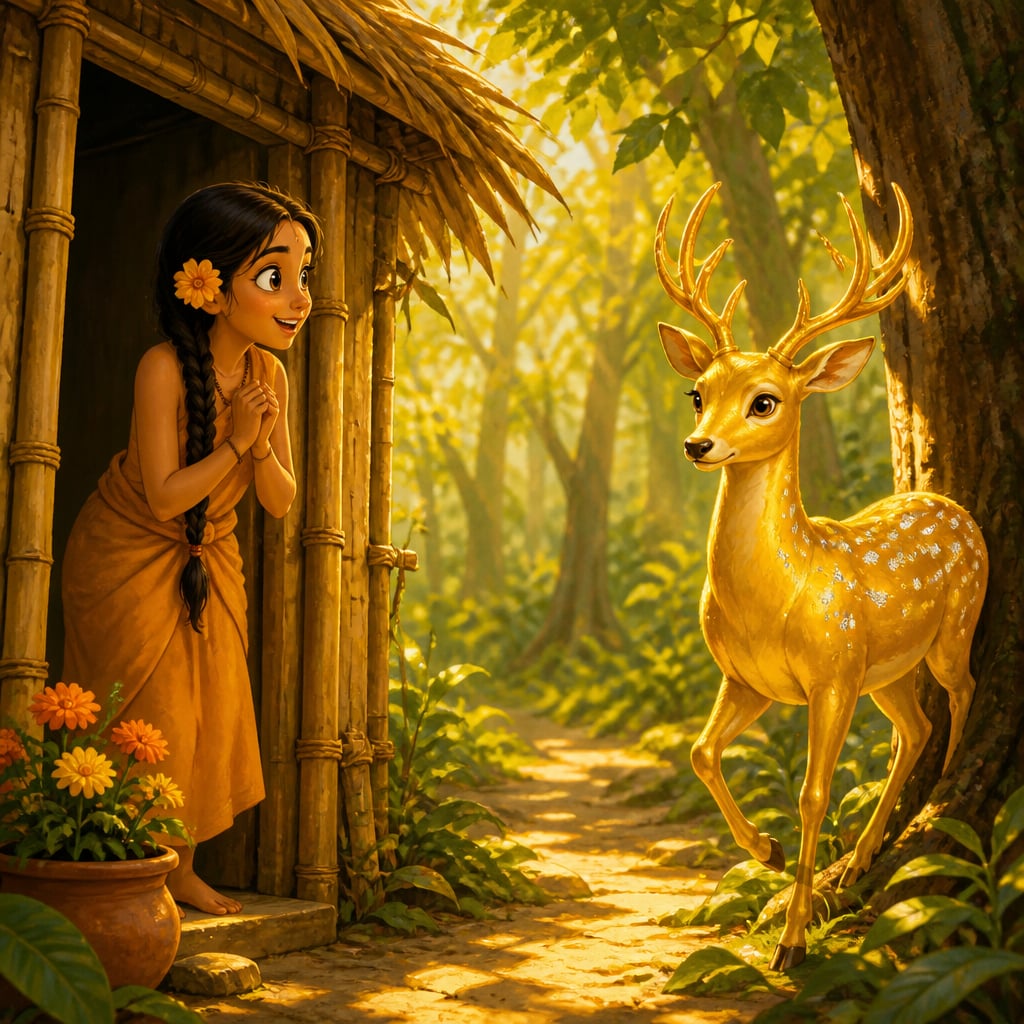
Sita stands in wonder at the doorway of her forest hut as a golden deer steps out from behind a sal tree.

Sita stood up. The grain spilled from her lap. "Rama," she whispered, "Lakshmana, come and see."

The two brothers came out. Rama saw the deer. He looked at it for a long, long moment. His face went very still.

Lakshmana frowned. "Brother," he said quietly, "that is not a deer."

Lakshmana was a careful person. He had been watching forests for thirteen years. He knew what a real deer looked like. Real deer were brown or grey. They were thin and frightened. They did not glitter. They did not stand at the door of a hut and stare at the lady of the house, blinking like they wanted to be invited in.

"That," said Lakshmana, "is a demon in disguise. I am sure of it."

But Sita's eyes were shining.

"Please," she said, looking at Rama. "Just look at it. I have never seen anything so beautiful. Catch it for me. Alive if you can. If not, I would still love its golden skin to keep in our hut."

Rama hesitated. He looked at Lakshmana. He looked at the deer. He looked at Sita.

And then he picked up his bow.

The Demon's Plan

What Sita did not know, what even Lakshmana could only guess, was who had sent the deer.

Far to the south, on the island of Lanka, lived Ravana, the ten-headed king of the rakshasas. His sister had recently been insulted in this very forest, and Ravana wanted revenge. But Ravana had also heard about Sita. Heard she was the most beautiful and the most pure-hearted woman in the world. He wanted her for himself.

He knew he could never beat Rama in a fair fight. Rama was too strong, too good. So Ravana did what cowards do. He came up with a trick.

He had an uncle named Maricha, a demon with a special power. Maricha could change his shape into anything he wanted. A cloud, a tiger, a bird, a man. Or, on this morning, a golden deer.

Maricha did not want to do it. He had been hit by Rama's arrow once before, years ago. He still remembered the sting. "Please, nephew," he begged Ravana, "send me anywhere else. Rama is no ordinary prince."

But Ravana was furious. "Help me, or I will kill you myself."

So Maricha turned himself into the most beautiful deer in the world, and walked very slowly to Rama's hut.

The Chase

Rama set off after the deer with his bow.

The deer was clever. It did not run too fast. It let Rama get close, then bounded just out of reach. It stopped, looked back, blinked. Came closer. Ran again. Always staying just visible. Always pulling Rama deeper into the forest.

Lakshmana stood at the door of the hut, watching Rama disappear into the trees. His face was tight with worry.

"Sister," he said to Sita. "I do not like this."

Sita smiled. "Lakshmana, you worry too much. Rama is the greatest archer alive. He will be back before lunch."

The deer led Rama for hours. Up hills, down valleys, across streams, through thorn bushes. Finally, deep in the forest, Rama understood. He drew his bow. He took careful aim.

The arrow hit.

Rama with the dying golden deer changing back into the demon Maricha

And then Maricha did the meanest thing of all. As he fell, dying, he used his last breath to copy Rama's voice exactly. Loud. Loud enough to carry for kilometres.

"Lakshmana! Sita! Help me!"

The Cry from the Forest

Back at the hut, Sita heard it.

Her face went white. "Lakshmana! That is Rama! He is hurt! Go!"

Lakshmana stood very still. "Sister, no. That is not Rama. Nothing in this forest can hurt Rama. It is a trick. I will not leave you alone."

Sita started to cry. "How can you stand here? Your own brother is calling for help! Go now!"

"Sister, please. He told me to guard you. I cannot leave."

"Then you are a coward!" Sita cried. The words came out sharp, sharper than she meant. "You are jealous of him. You want him to die so you can have me. Go, Lakshmana, go and help your brother!"

Lakshmana flinched. The words hurt more than any arrow.

He knew, deep down, that the cry was a trick. He knew Rama was fine. But Sita was crying. Sita was begging. Sita was accusing him of the worst thing a brother-in-law could be accused of. He could not bear it.

He picked up his bow. He walked to the edge of the forest. Before he stepped out, he did one last thing. He drew a line on the ground all around the hut, with the tip of his arrow. A clear, deep line in the dust.

"Sister," he said, his voice cracking. "I am going. But promise me one thing. Do not step outside this line. Whatever happens. Whoever comes. As long as you stay inside this Lakshmana Rekha, no demon, no monster, no trick can touch you."

Then he ran into the forest.

The Old Man at the Door

A few minutes later, an old sadhu came down the path.

He had a long white beard. He carried a wooden begging bowl. His robes were saffron, faded by sun. He stopped outside the hut and called out the way wandering holy men have called for thousands of years.

"Bhiksham dehi." Please give alms.

Sita came to the door. Her eyes were still red from crying. She saw the old man. She bowed. In Bharat, you never turn away a sadhu.

She brought a plate of fruit and rice. She held it out. But she could not reach him without crossing the line.

The old man smiled gently. "Daughter, why do you stand so far away? Step out and give it to me properly. An old man's hands are tired."

Sita hesitated. The line on the ground was still fresh. She remembered Lakshmana's voice cracking.

But the old man looked so harmless. So tired. So holy.

She stepped over the line.

The moment her foot touched the ground outside, the old man was no longer old. The beard fell off. The robes turned to gold armour. The begging bowl became a sword. Ten heads grew where one had been.

It was Ravana.

He grabbed her. His chariot, the Pushpaka, came swooping down from the sky. He threw her in. She screamed for Rama. She screamed for Lakshmana. She tore off her jewels one by one and dropped them through the air, hoping someone, somewhere, would find them.

And then Ravana flew her south, all the way to Lanka.

When the Brothers Came Back

Rama met Lakshmana on the path. Both of them were running. Both of them already knew, somehow, in the way you sometimes know terrible things before anyone tells you, that something had gone wrong.

They reached the hut.

The door was open. The flowers were trampled. Sita's shawl was on the floor. The Lakshmana Rekha had been crossed.

Rama fell to his knees.

Rama and Lakshmana finding the empty hut in Panchavati

For the first time in the whole story, the perfect prince of Ayodhya cried. Not a small cry. A big, loud, broken cry, the kind a child cries when they cannot find their mother in a crowd. Lakshmana stood next to him, fists clenched, trying not to cry too.

"Sita," Rama whispered to the empty hut. "Sita, where are you?"

The river kept flowing. The peacocks did not dance.

Nothing in this story would ever be the same again.

The Hardest Part

This is one of the saddest moments in all of our stories. And it is here for a reason.

Nothing in this lesson was simple.

Sita was not foolish for wanting the deer. It was the most beautiful thing she had ever seen, and she was a young woman who had been living in the forest for thirteen years.

Rama was not careless for chasing it. His wife asked. He went.

Lakshmana was not wrong to draw the line. He gave Sita the best protection he could.

Sita was not weak for stepping over it. She was being kind to an old sadhu, doing what a generous heart does.

And yet, all of these good people, doing reasonable things, ended up in disaster. Because someone with bad intent was using their goodness against them.

That is the lesson hidden inside this terrible morning.

Kindness is beautiful. Trust is beautiful. Generosity is beautiful. But the world also has Ravanas in it. People who will dress up as old men, as golden deer, as anything, to take advantage of your kind heart.

The answer is not to stop being kind. Sita does not become a hard-hearted woman after this. Rama does not stop helping people. But every one of us learns, the hard way or the easy way, that some lines are drawn for a reason. When someone you love draws one for you, even if it feels too strict, even if you do not fully understand, pause before you step over it. Ask. Wait. Check. The cost of stepping over the wrong line is sometimes very high.

And if you are the one drawing the line for someone else, draw it with love, not with anger. Lakshmana did. That is why we still call it the Lakshmana Rekha today, thousands of years later. A line drawn out of love is never forgotten.

Living traditions

The phrase 'Lakshmana Rekha' has crossed from religion into everyday Indian life. It appears in Supreme Court judgments, parliamentary speeches, and popular cinema. The 1987 television Ramayana series, in which the deer-and-Lakshmana-Rekha episode was watched by an estimated 80 million people, is the single most-watched television episode in Indian history. Sita Gufa in Nashik draws over a million pilgrims a year, especially during the Kumbh Mela.

Reflection

More in Rama the Good Prince

All lessons in Rama the Good Prince ยท Heroes of Ancient Bharat course