The Best Prince in Ayodhya

Everyone loved Rama. His teachers, his brothers, the whole city. But what made him so special?

In the happy city of Ayodhya, four brothers grow up together: Rama, Bharata, Lakshmana, and Shatrughna. Rama is the eldest. He is brave but gentle, truthful, kind to everyone from kings to gardeners. Everyone loves him, but his perfect childhood is about to change.

The Boy Who Picked Up the Old Servant

In the kingdom of Ayodhya, on a cool morning many, many summers ago, an old gardener tripped on a stone and fell in the palace courtyard. His basket of marigolds spilled all over the path. Two of the palace guards walked right past him.

A boy in white silk was crossing the courtyard at the same time. He was about ten years old. He had dark, curly hair and very kind eyes. The boy stopped, knelt down on the marble floor, picked up every single marigold, dusted them off, and helped the old man stand up.
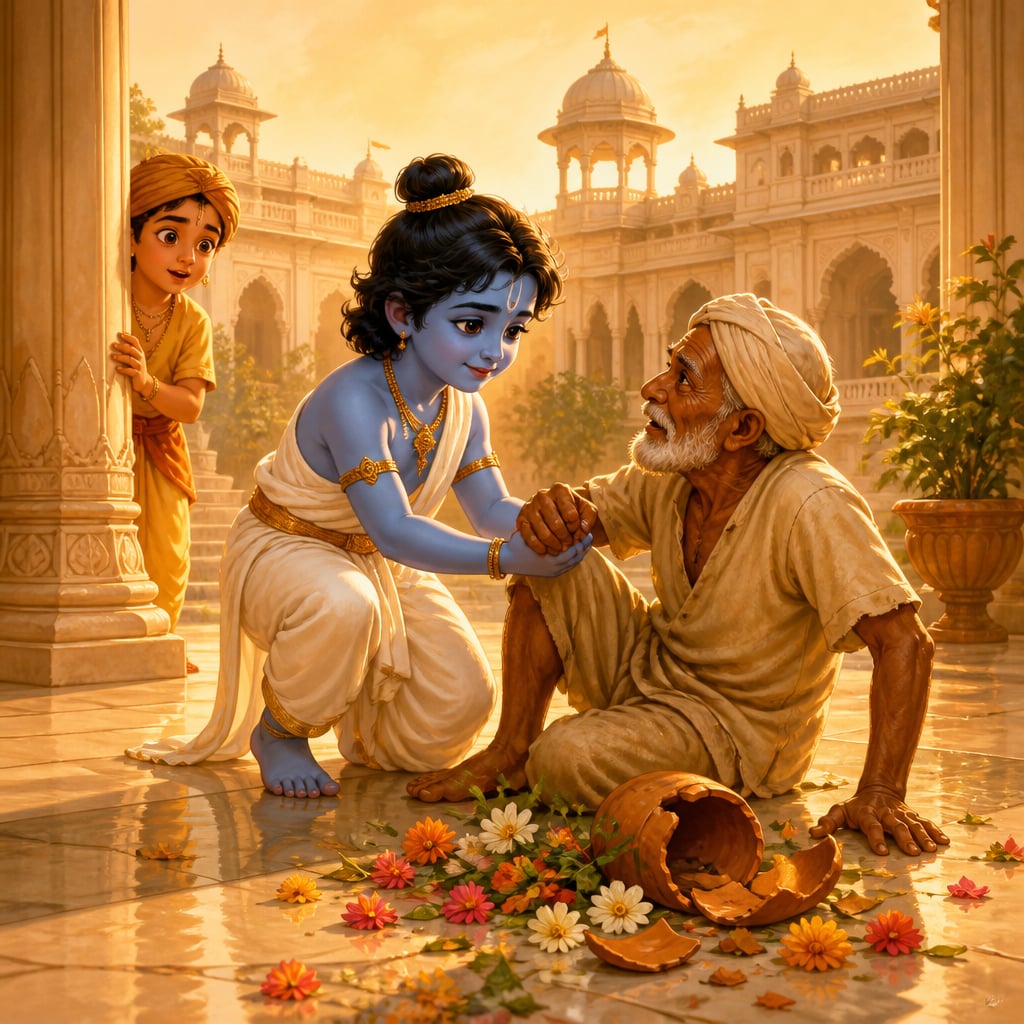
Young prince Rama kneels to help an elderly gardener up in the palace courtyard of Ayodhya.

"Thank you, little prince," the gardener whispered, surprised.

The boy smiled. "Why are you thanking me? You always pick the best flowers for my mother. I was just helping back."

The boy's name was Rama. And by the time he was ten, the whole city of Ayodhya had a hundred small stories like this one.

Four Brothers and a Father

Rama's father was King Dasharatha, the kindest, busiest king Ayodhya had ever known. Dasharatha had four sons.

The four boys were not just brothers. They were best friends. They learned together, ate together, fought play-fights together, and slept on the same wide cotton mattress on hot nights with all four heads in different directions.

Rama and Lakshmana
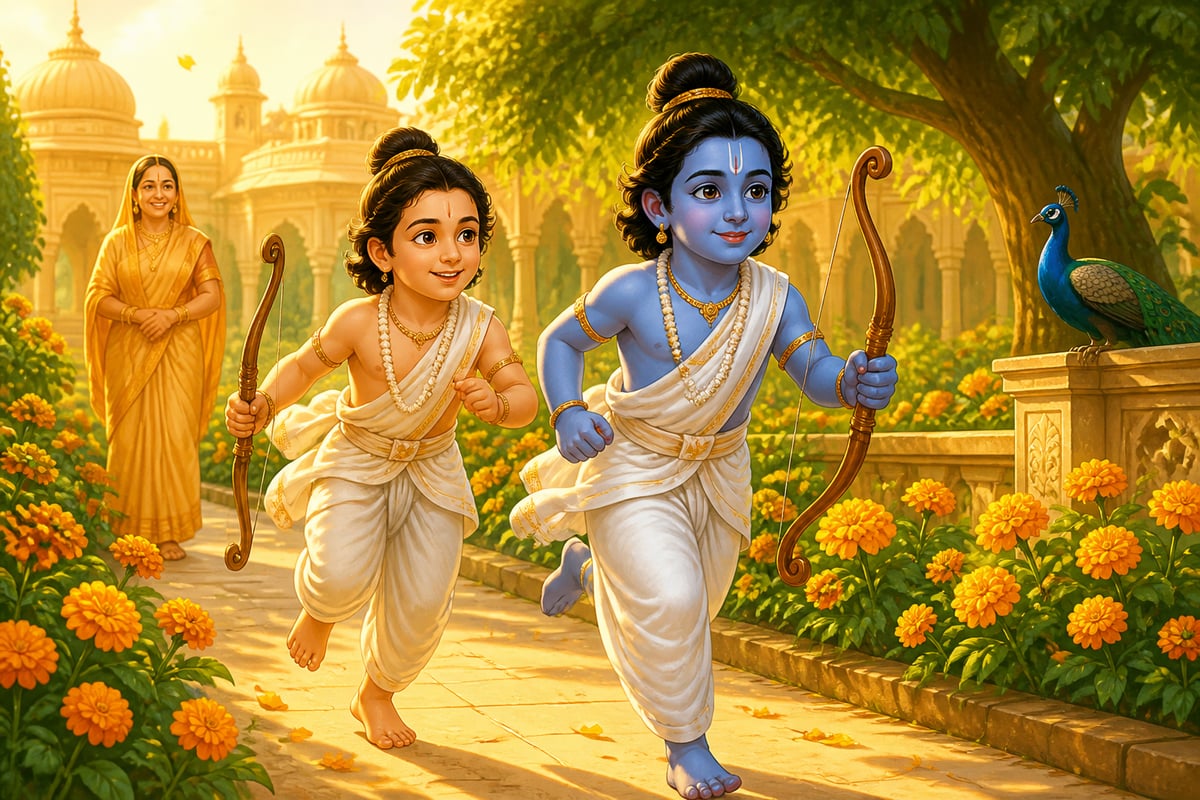
Young Rama and Lakshmana running together in the palace garden

If you asked anyone in Ayodhya about the brothers, the first thing they would say was about Rama and Lakshmana.

Those two were impossible to separate.

If Rama woke up early, Lakshmana woke up earlier. If Rama said he was thirsty, Lakshmana was already standing there with a cup. If Rama walked, Lakshmana walked beside him, half a step behind, because that is how a younger brother should walk, he said.

One day, Queen Sumitra found tiny Lakshmana crying because Rama had been put to bed in a different room. He just could not sleep without his brother nearby. From that day, the two cribs were always pushed together.

This closeness is going to matter a lot in the stories that come later. Hold on to it.

The Guru's School

When Rama was old enough to start his proper studies, King Dasharatha sent him to the great guru, Vasishtha.

Vasishtha was an old, white-bearded sage with a memory as long as a river. He taught the boys everything. How to read the Vedas. How to shoot a bow. How to ride a horse. How to speak to a farmer. How to listen to a sad person. How to recognise a lie. How to forgive.

Vasishtha had taught many princes over many years. But one day, an old friend visited him at his ashram. The friend asked, "Of all your students, who is the best?"

The sage thought for a long time. Then he said something quiet.

"All four boys are bright. Bharata has the heart. Lakshmana has the loyalty. Shatrughna has the spirit." He paused. "But Rama... Rama is the kind of student you only get once in many lifetimes. Not because he is the smartest. Because he never, ever shows off how good he is."

That was the first time anyone in Ayodhya outside the family understood what was special about Rama.

The Small Things

Rama was good at the big things. He could already hit the eye of a moving deer with an arrow. He could recite long Sanskrit verses without a mistake. He could ride a horse at full gallop.

But what people loved was the small things.

A City That Felt Safe

Because of the kind of family that ruled Ayodhya, the city itself was a happy place.

The markets were full. The cows were fat. The Sarayu river that ran past the palace walls was clean and full of fish. People sang at sunrise. Children played in the streets late into the evening because no one was afraid.

Elders said the kingdom looked the way it did because of how the four brothers were growing up. "You can tell what a kingdom is going to be," an old courtier once said, "by how the king's sons treat the servants."

In Ayodhya, the king's sons treated the servants like family. So Ayodhya treated everyone like family.

In Your Life

This is the lesson that Rama teaches before any of his big adventures even start. The truly great people are easy to spot, not because of how they win the big moments, but because of how they handle the small ones.

Think about your school. Think about the kids you actually like. The ones you want to sit with at lunch. They are usually not the loudest. They are usually not the ones who win every prize. They are the ones who pass you the extra pencil. The ones who do not laugh when you trip in PE class. The ones who sit next to the new student on the first day.

That is Rama-greatness. Be that person. Or look out for that person. They are around you, and they are easy to miss, just like the boy who knelt down for an old gardener that morning in Ayodhya.

What Came Next

For years, Ayodhya was happy. Rama grew taller. Lakshmana grew tougher. Bharata grew wiser. Shatrughna grew stronger. The four brothers were a quiet, warm fire in the centre of the kingdom.

The sage Vishvamitra arriving at King Dasharatha's court

But one day, a very serious-looking sage with matted hair and bright eyes walked into King Dasharatha's court. His name was Vishwamitra. And he had come to ask for one thing.

He wanted Rama.

The perfect childhood was about to end. The boy who picked up marigolds was about to step out of Ayodhya for the first time, and the world was waiting to see what he was made of.

Living traditions

The Ram Janmabhoomi Mandir was consecrated on 22 January 2024 after a long legal and historical journey, including a 2019 Supreme Court of India judgment. In its first year, the temple welcomed over 13 crore (130 million) visitors, making it one of the most visited religious sites in the world. Ram Navami is a national holiday in many Indian states. And every single year, the line 'Jai Shri Ram' is spoken in homes from Ayodhya to Bali to Bangkok to New Jersey, by millions of people who are still trying, in their own small way, to be a little more like the boy who picked up the gardener's flowers.

Reflection

More in Rama the Good Prince

All lessons in Rama the Good Prince ยท Heroes of Ancient Bharat course