The Night Ayodhya Lit Up
Rama came home. The whole city put out diyas. That's the night we still celebrate.
After fourteen long years of exile and the great battle against Ravana, Rama, Sita, and Lakshmana fly home to Ayodhya in the Pushpaka Vimana. Bharata, who had been ruling all this time with Rama's wooden sandals on the throne, runs to receive them. The whole city cleans, decorates, and lights tiny clay lamps in every window, on every wall, along every path. That night of light became Diwali, the festival families across the world still celebrate.
The Boy at Nandigram
For fourteen years, a young man had been waiting.
His name was Bharata. He was Rama's younger brother. And he was, on paper, the king of Ayodhya. But he had refused to live in the palace. He had refused to sit on the golden throne. Instead, he had built himself a small hut in a place called Nandigram, just outside the city, and he had lived there like a forest hermit, in plain clothes, eating simple food.
On the throne in his hut, instead of a king, sat a pair of small wooden sandals. Padukas. Rama's sandals. Bharata had asked for them when Rama left for the forest, and he had carried them home on his head like a crown.
"These will be the king," Bharata had said back then. "Not me. I am only the servant of the one who wears these."
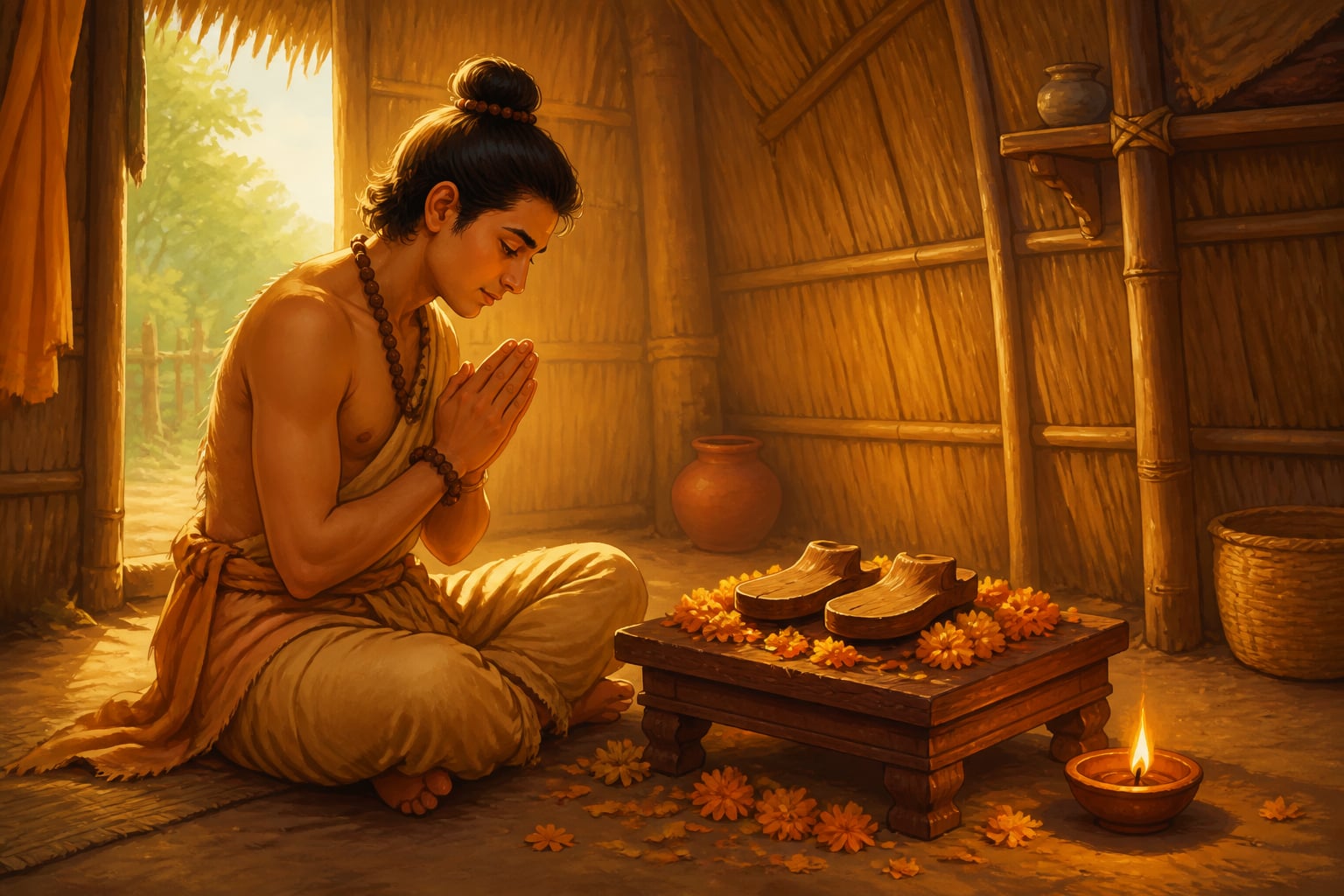
For fourteen years, every single day, Bharata had bathed the padukas, decorated them with flowers, brought them food, asked them about the day's decisions. Every law of Ayodhya had been passed in front of those sandals.
And every day, Bharata had counted. Fourteen years. Fourteen long, long years. Rama had promised to come back on the very last day. Bharata had promised himself something too.
"If my brother does not come back on the day he said," he had whispered to the padukas, "I will not live another sunrise."
Now it was the last day.
A Sound in the Sky
That morning, Bharata was sitting outside his hut, looking up at the sky. He had not eaten. He had not slept. The sun was rising. Where was his brother?
And then, very softly, very far away, he heard something.
A sound he had never heard before. A whoosh, almost like a giant bird. Almost like the wind in a thousand silk flags. The deer in the field looked up. The birds went quiet.
Bharata stood.
There, in the morning sky, was something he could not believe.
It was a flying chariot. A whole palace, floating in the air, pulled by no horses, drawn by no wings. Carved from wood and gold, with little windows and silken curtains fluttering. This was the Pushpaka Vimana, an ancient flying machine, and Rama had won it from Ravana.
Bharata's eyes filled up. He squinted.
And standing at the front of that flying palace, his hair longer, his face thinner, his arm around his wife, was a man Bharata would have recognized in any crowd, in any darkness, on any day of his life.
"Brother," Bharata whispered. "Brother. You came."
A City Gets the News
Before the vimana even landed, Hanuman had gone ahead.
Hanuman flew faster than the wind. He had reached Bharata earlier that morning, breathless, and given him the news. Rama is coming. Today. Now. Get ready.
Then Hanuman had flown straight on into Ayodhya itself. He shot through the streets like a small storm, knocking on doors, calling at windows, climbing onto rooftops.
"He is coming! He is coming! Our Rama is coming home!"
The city, which had been quiet and grey for fourteen years, suddenly woke up.
Women ran out with brooms. Children grabbed buckets of water. Old men carried baskets of flowers. Doors that had not been opened in years swung open. Windows that had not been wiped were wiped. Streets were swept. Walls were scrubbed.
And then somebody had a thought.
It was the darkest night of the month. The sky would have no moon. Rama and Sita would be arriving in the dark. How would the city greet them properly if they could not even see it?
So the people of Ayodhya did something simple, and beautiful, and unforgettable.
They ran to their kitchens. They pulled out tiny clay lamps, the kind every Indian home has even today. They poured oil into them. They twisted little cotton wicks. And they lit them.
One diya in the window. One diya by the door. One diya on the wall. One diya along the path. Then ten. Then a hundred. Then a thousand.

From every house. Every street. Every rooftop. The whole city of Ayodhya began to glow.
From far away, if you had been a bird flying over Ayodhya that night, the whole city would have looked like a piece of the sky had fallen down to earth. Rivers of gold light. Tiny stars in every window. Light, light, everywhere.
Two Brothers, One Crown
The Pushpaka Vimana came down softly outside Nandigram.
Rama stepped out, holding Sita's hand. Lakshmana came right behind, still watching for danger out of habit, still looking for someone to protect his brother from. Hanuman, Sugriva, and Vibhishana came too. These were the friends who had walked through fire with Rama. They were not going to miss this morning.
Bharata ran. He did not walk. He did not wait for Rama to come to him. He ran, fell at his brother's feet, and could not speak. He just held on.
Rama lifted him up gently and held him. They stood like that for a long time, two brothers, the older one not letting the younger one hide his tears.
Then Bharata went inside the hut. He came out carrying the wooden padukas on a silver tray, the same way he had carried them home fourteen years ago.
"Brother," he said, "these have been the king of Ayodhya. Now they go back to the only feet they belong to."
Right there, in the morning light, Bharata kneeled down and slipped the padukas back onto Rama's feet. Fourteen years of waiting ended in one quiet, beautiful moment.

Ayodhya Comes Home
The last short walk into the city was something nobody who saw it ever forgot.
The streets were lined with people. Ten deep. Twenty deep. Some on rooftops. Some on tree branches. Mothers held up their babies so they could see. Old people who had known Rama as a boy stood with hands joined, eyes leaking quiet tears.
And everywhere, the diyas. Burning. Glowing. A small flame in every hand, on every shelf, beside every doorway.
Flowers fell from the sky like rain. Conch shells boomed. Drums rolled. Children flung petals from the windows.
Kausalya, Rama's mother, came running down the palace steps the way only a mother can, with no thought of dignity, no thought of kingdom, only her boy. She held Sita's face in her hands. She held Lakshmana close. And then she just held Rama, her firstborn, the son she had cried for every night for fourteen years, and she did not let go for a long, long time.
Few days later came the Rajyabhishekam, the coronation. The royal priests poured sacred water from every river of Bharat over Rama's head. They placed the crown on him. Sita sat beside him in golden silk. Lakshmana, Bharata, and Shatrughna stood around the throne. Hanuman sat at Rama's feet, and would not leave them, then or ever.
From that day, Ayodhya entered a time the world has never quite stopped talking about. It was called Rama Rajya, the rule of Rama. People say there was no hunger in those years. No fear. No theft. The rivers ran full. The crops grew tall. Children played without anyone watching them. Even old age and sickness seemed to step softly.
When people today wish for a fair, kind, honest country, they still say two words. Rama Rajya. That is the dream that started the night Ayodhya lit up.
The Festival That Never Ended
The diyas of that night did not stop after that night.
The next year, when the same dark moon of the month of Kartik came around, the people of Ayodhya remembered. This is the night our Rama came home. And they lit their diyas again.
The year after, they lit them again.
And then their children lit them. And their children's children. And their children's children's children.
That festival is called Diwali. Deepavali, in proper Sanskrit. It means a row of lamps. Every Diwali, in every Indian home from Ayodhya to America, from Hyderabad to Mauritius, from Singapore to Trinidad, families clean their houses, draw rangolis at the door, and light little diyas in every window.
The reason is the same reason as that first night. Somebody we love is coming home. Light is winning. Goodness is back.
In Your Life
The next time you light a diya at Diwali, remember what your tiny flame is really doing.
It is doing what the people of Ayodhya did that night. It is saying, welcome home. It is saying, I waited for you. It is saying, I am so glad you are back.
You can light a diya for Rama. You can light a diya for someone in your own family who has come home from far away. You can light a diya for someone you are missing, who has not come home yet, but who you are still waiting for. The flame does the same job either way.
And remember Bharata. Remember the boy in the small hut who never sat on the throne, who waited fourteen long years, and whose love was so steady that the kingdom waited with him. Sometimes the bravest thing in the world is not to grab what is in front of you. Sometimes it is to keep it warm, carefully, every day, for somebody else.
This whole chapter has been Rama's story. The good prince. The bow he broke. The promise he kept. The forest. The deer that was a trick. The eagle who tried. The army of monkeys and bears. And now, the homecoming.
What began with a quiet boy who would not lie even to win a kingdom ended with a city of a million lamps welcoming him back. That is what dharma looks like when it walks home in the dark.
And somewhere in your house, this very Diwali, your little diya will be one of those lamps.
Living traditions
Diwali is now one of the most-celebrated festivals in the world. India lights up. Nepal, Sri Lanka, Mauritius, and Singapore declare it a national holiday. The White House in Washington and 10 Downing Street in London light diyas. New York's Times Square goes orange and gold. Ramlila is performed every year in Bali, Thailand, and Cambodia, where the Ramayana has been beloved for over a thousand years. The phrase 'Ram Rajya' is still used by political leaders, novelists, and everyday people across India to mean a country that is honest, fair, and kind. And every Diwali, in some flat in Mumbai or some farmhouse in Iowa or some terrace in Trinidad, a child lights a small diya and a parent says, 'Do you know why we do this?' That is when the story of Ayodhya begins again.
- Lighting Diyas at Diwali: On the night of Kartik Amavasya every year, families across India clean their homes from top to bottom, draw beautiful rangolis at the doorway, and place tiny clay lamps in every window, on every wall, and along the path to the front door. Many families also keep one diya burning all night long, the way the people of Ayodhya kept their lamps burning until Rama was safely home.
- Ramlila: Every year in the days leading up to Dussehra and Diwali, towns and villages across north India act out the entire story of Ramayana on open-air stages. Children play monkeys. Grown-ups play Rama, Sita, Lakshmana, and Hanuman. The final scene is always the homecoming. Real diyas are lit. Real flowers are thrown. The audience cries the same tears as Ayodhya cried.
- Ram Janmabhoomi Mandir, Ayodhya: The grand new temple at the very spot where Rama is believed to have been born. The temple was opened in January 2024 after centuries of waiting. Inside, a beautiful image of baby Rama holds a tiny bow. On Diwali night, the entire town glows with lakhs of diyas, and the Saryu river ghats become rivers of golden light.
- Hanuman Garhi: A beautiful old hilltop temple to Hanuman, sitting on a small fort right in the middle of Ayodhya. By tradition, every pilgrim is supposed to bow to Hanuman before going to Rama. There are seventy-six steps up to the shrine, and at the top a sweet image of Hanuman as a child sitting on his mother Anjana's lap.
- Nandigram: The small town where Bharata lived for fourteen years in a simple hut, ruling Ayodhya from a distance with Rama's wooden sandals on the throne. There is a temple here called Bharatkund where his pādukās are still worshipped. Standing in this quiet, gentle place, you can almost feel Bharata still waiting.
- Rameshwaram: The far-southern town where Rama is believed to have built the great bridge to Lanka and worshipped Shiva before the war. The Ramanathaswamy Temple here has the longest temple corridor in India. Many families do a special pilgrimage that connects Ayodhya in the north and Rameshwaram in the south, walking the full path of Rama's story.
- Ram Janmabhoomi Mandir: The new grand temple built right where Rama is believed to have been born. The whole story of this lesson, from the homecoming to the coronation, happened in this very town. On the night of Diwali, lakhs of diyas are lit in and around the temple, and the same magic of that ancient first night is brought back to life.
- Hanuman Garhi: By long tradition, no visit to Ayodhya is complete until you have bowed to Hanuman first. He is the one who flew ahead with the news of Rama's return, and locals will tell you he still keeps watch over the city. Children especially love this temple because of the steep stone steps and the image of baby Hanuman with his mother.
Reflection
- Has there been a time you waited a long, long time for someone you loved to come home? What did the moment they finally walked through the door feel like?
- Bharata could have become king himself. Why do you think he chose to live in a hut and keep the throne for Rama instead?
- Every Diwali we light tiny clay lamps. Why do you think people, for thousands of years, have chosen a small flame instead of a loud noise to welcome someone they love?