Why We Always Start With Ganesha

Before any puja, before anything new. Ganesha comes first. Here's why.

Before any wedding, any new house, any school exam, any new shop, families across India fold their hands and call Ganesha first. This lesson tells you why. It is the gift Shiva gave him on Mount Kailash, it is the promise he kept at his mother's door, and it is the simple shloka any child can learn to start their own day with him.

A Sticker on the New Notebook

It was the first day of school. A girl named Aanya was eight years old, with two black plaits and a brand-new green schoolbag. Her grandmother had bought her a fresh notebook the night before. Crisp white pages. A blue cover. It still smelled like a new book smells, sharp and a little bit like glue.

Aanya was about to put the notebook into her bag when her grandmother stopped her. "Wait, kanna," she said softly. "Bring it here first."

Grandma took out a small silver sticker from her purse. It was a little Ganesha. Round belly. Long trunk. One tiny hand raised in blessing. She peeled the sticker off carefully and pressed it onto the very first page of the notebook.
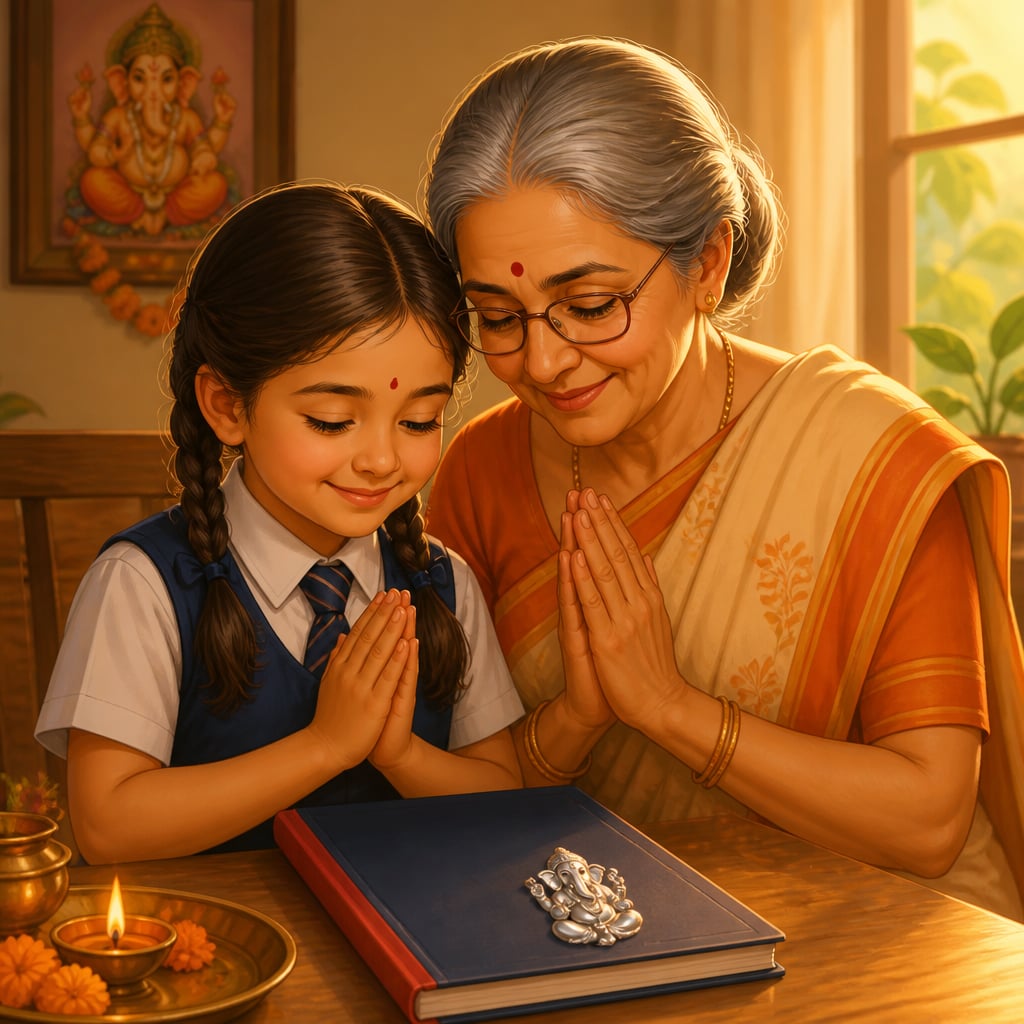
Aanya's grandmother presses a small silver Ganesha sticker onto the first page of her new notebook

Then she folded Aanya's hands together. "Om Gam Ganapataye Namaha," she whispered. "Now you can take it to school."

Aanya looked up. "Why, Ajji? Why do we always do this first?"

Grandma smiled. "Sit down, kanna. Let me tell you."

The Promise on Mount Kailash

You already know the story. A boy was made from sandalwood paste. A boy stood at his mother's door. A boy kept his promise so well that even the most powerful god in the world could not get past him. And then there was a terrible mistake. And then there was a brand-new elephant head. And then there was a brand-new name.
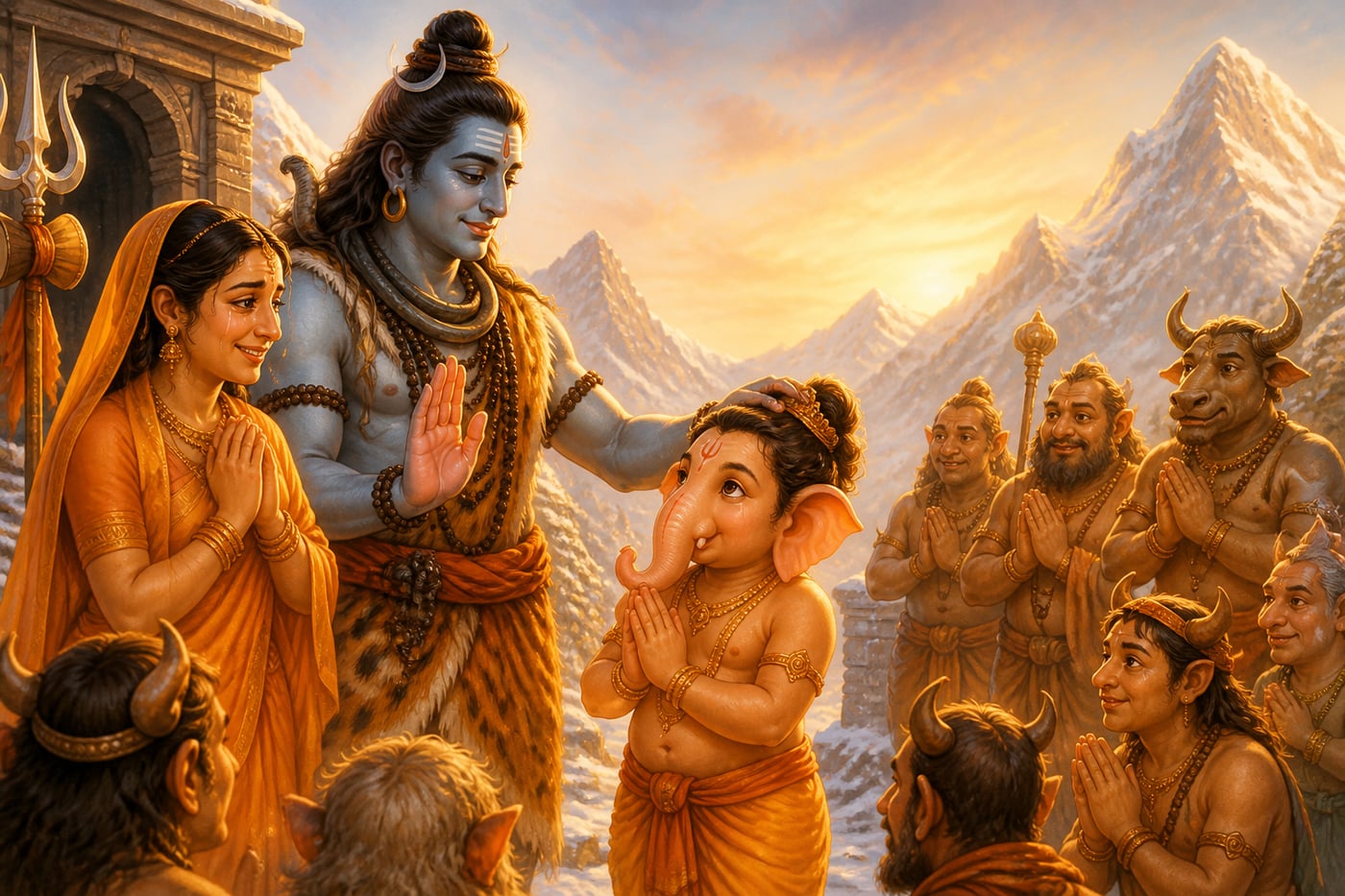
Shiva placing his hand on Ganesha's head making the cosmic promise on Kailash

That day, when Shiva placed his hand on the boy's head and called him Ganesha, he did not stop there. He made a promise.

"From today," Shiva said, "every family in every village will say your name first. Before any other god. Before anything new. Before a wedding, before a journey, before a school exam, before a brand-new notebook."

Shiva is the kindest god. But he is also the one whose word is unbreakable. And so, ever since that day on Kailash, the world has kept his promise for him.

That is the first reason we call Ganesha first. Because Shiva said so, and the world listened.

The Hurdles in the Road

But there is a second reason. A more practical one.

Imagine you are walking down a path. Maybe it is a path through your school playground. Maybe it is the road in front of your house. Maybe it is a forest trail. Whatever the path, it has bumps. Stones. Twigs. Maybe a puddle. Maybe a sleeping cat.

In Sanskrit, those bumps are called vighnas. A vighna is anything that gets in your way. It can be a real stone. It can also be the wobbly feeling in your tummy before a test. It can be the friend who is not talking to you today. It can be the thing your little brother spilled on your homework.

Ganesha has a special name. Vighnaharta. The one who takes away the bumps.

When we call him first, we are asking him, very politely, to walk down the path before us. To gently move the stones aside. To wake up the sleeping cat. To make our wobbly tummy a little less wobbly.

Does he move every stone? No. Some stones we are meant to step over ourselves. That is how we get strong. But he clears the ones we do not need to face. He makes the path just easier enough that we can walk it bravely.

That is the second reason. Because we want a clear path, and he is the clearer.

The Way You Begin

There is a third reason, and it is the deepest one.

The Dharmic tradition figured out, a very long time ago, something that we are only just remembering now. The way you begin something usually decides how it ends.

If you begin your homework angry, the homework feels angry. If you begin a game shouting, the game ends in tears. If you begin a journey grumbling, the journey feels longer. But if you begin calmly, gently, with a soft folded hand and a quiet shloka, then even hard things feel a little softer.

Ganesha is the god of beginnings. Not the god of endings. He is at the start, not at the finish. Because the start is what matters most.

When we call his name first, we are choosing how to start. We are saying: let this beginning be calm. Let this beginning be kind. Let this beginning be a little bit lucky.

That is the third reason, and Aanya's grandmother was about to tell her something else too.

What Aanya's Grandma Said Next

"Kanna," said Grandma, "do you know who Ganesha was, before he was a god?"

Aanya thought for a moment. "He was a little boy. Like me."

"Yes," Grandma said. "A little boy who kept his promise to his Amma. That is the most important thing about him."

Grandma tapped the sticker gently. "Every time you open this notebook, you will see him. And you will remember. He kept his promise. He stood his ground. He loved his mother more than he was afraid of anyone. That is why we call him first. Not because he is the biggest god. Not because he is the strongest. Because he is the one who, even as a small boy, did the right thing."

Aanya nodded slowly. She picked up her notebook. She held it the way you hold something precious.

"Om Gam Ganapataye Namaha," she whispered, all by herself, on her very first morning.

Then she put the notebook in her bag and ran to school.

How Families Do It Today

In India, the calling-first happens everywhere, all the time, often without anybody even noticing.

When your family buys a new car, the priest paints a small swastika and a tiny Ganesha face on the dashboard. Before the wheels move, his name is said.

A modern family welcoming a Ganesha statue across the threshold of their new home

When a family moves into a new house, the very first thing that goes through the front door is a small Ganesha statue. Before the furniture, before the boxes, before the people. Him.

When a wedding starts, before the bride and the groom even meet, the priests do a Ganapati puja. The whole rest of the wedding can only happen after.

When a film is made in Mumbai, the very first scene is shot on a day called muhurat, and the director picks up a coconut and offers it to a small Ganesha sitting next to the camera. Only then does the camera roll.

When a child writes their very first letter on a slate, the parent guides their hand to write Shri Ganeshay Namaha before any other word. That is why, in some Indian languages, to start something literally translates as to do the Shri Ganesha of it.

In the city of Mumbai, there is a temple called Siddhivinayak. Around 25,000 to 50,000 people visit it every single day, and most of them are calling Ganesha first before something brand new in their life. A new business. A new film. A new exam. A new baby on the way.

And once a year, the whole country celebrates Ganesh Chaturthi, the festival of Ganesha's birthday. For ten days, families bring small clay Ganesha statues home, sing to them, feed them his favourite sweet (called modak), and then walk together to the river or the sea to say a gentle goodbye. Ganpati Bappa Morya, the streets sing. Father Ganesha, come back to us soon.

In Your Life

Tomorrow morning, before your school day begins, try one small thing. Sit up in bed for one breath. Fold your hands. Say Om Gam Ganapataye Namaha three times.

That is it. That is all you need.

Notice how the rest of the morning feels. Most kids who try this, even just for one week, say their mornings get a little less grumpy. Their breakfast tastes a little better. Their bag feels a little lighter on their shoulder.

That is Ganesha doing what he promised, on Kailash, all those years ago. He is walking down the path before you. He is moving the small stones. He is waking up the sleeping cat.

All because, a long time ago, a little boy stood at a door, kept his promise, and never moved.

Aanya's notebook went to school. The little silver sticker on its first page caught the morning sun. The brand-new pages waited, ready to be filled with everything that came next.

Reflection

More in Ganesha and His Adventures

All lessons in Ganesha and His Adventures ยท Heroes of Ancient Bharat course