Ganesha and the Laughing Moon

The moon made fun of Ganesha. Big mistake.

After a huge feast of modaks at Kubera's palace, Ganesha is riding home on his little mouse when a snake startles them. Ganesha tumbles, his belly bursts, and the modaks roll out. The Moon up in the sky laughs at him. Ganesha gets angry and curses the Moon. That is why, even today, families look away from the sky on Ganesh Chaturthi night.

A Belly Full of Modaks

It was a warm Bhadrapada night, the kind of night when the sky over Mount Kailasa is so full of stars that you cannot count them. Ganesha had just finished a feast.

Not a small feast. A huge one.
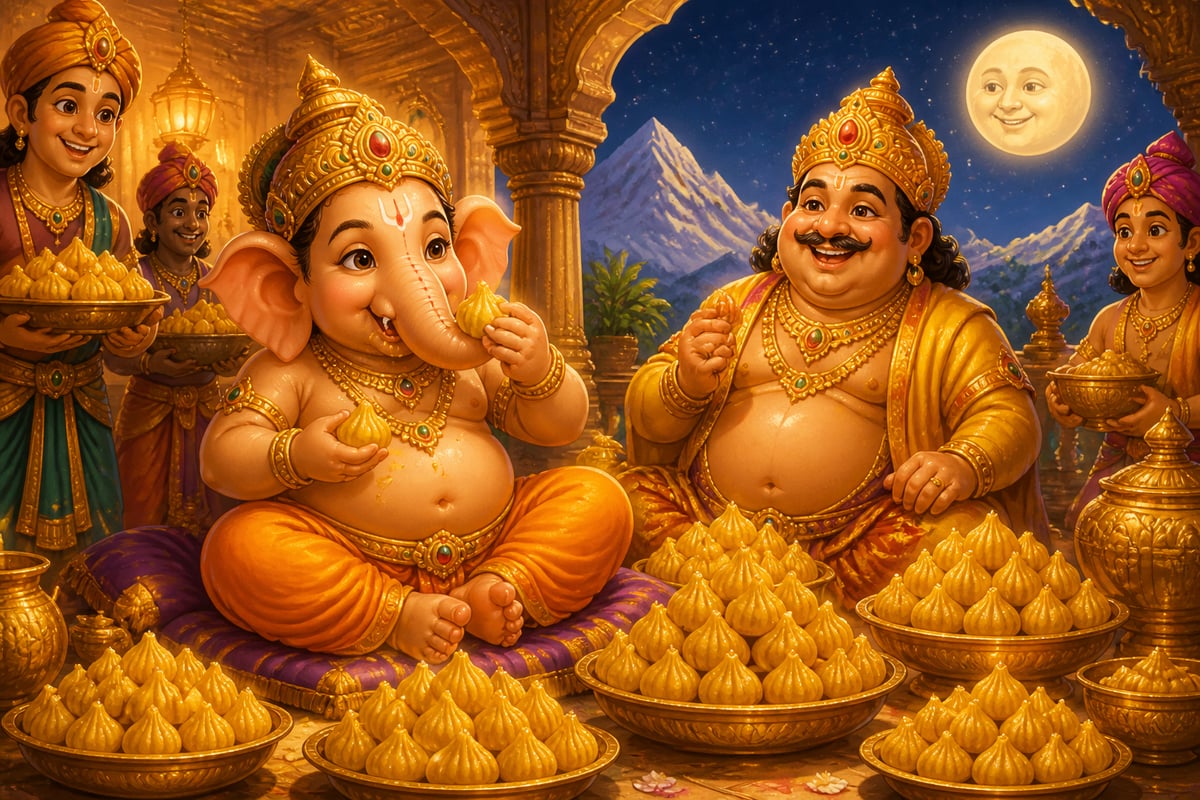
Ganesha enjoying a feast of modakas at Kubera's palace

Kubera, the god of wealth, had invited him over and put out plate after plate of his favourite sweet. Modak. Soft rice flour outside. Hot, melty jaggery and coconut inside. Ganesha ate one. Then ten. Then a hundred. Then so many that even Kubera lost count.

By the end, Ganesha's round belly was rounder than ever. He waddled, he burped, he smiled the happiest smile a god has ever smiled. Then he climbed onto his little mouse, Mooshika, and started the ride home.

What happened next is the reason your grandmother might tell you, on one special night every year, not to look up at the sky.

The Snake on the Path

The path back to Kailasa wound through tall grass. Mooshika the mouse was small. Ganesha was big. With a belly full of a hundred modaks, he was even bigger than usual.

And the road was dark.

Suddenly, in the grass, a long shape moved. A snake. Long and silver, sliding right across the path.

Mooshika squeaked and jumped sideways. His tiny feet skidded. Ganesha tilted. He tilted a little more. And then, with a soft whump, he fell off.

His belly hit the ground. It split open like an over-stuffed sack. Modaks rolled everywhere. Across the path, into the grass, under the bushes. Sticky, sweet, perfectly round modaks, everywhere.
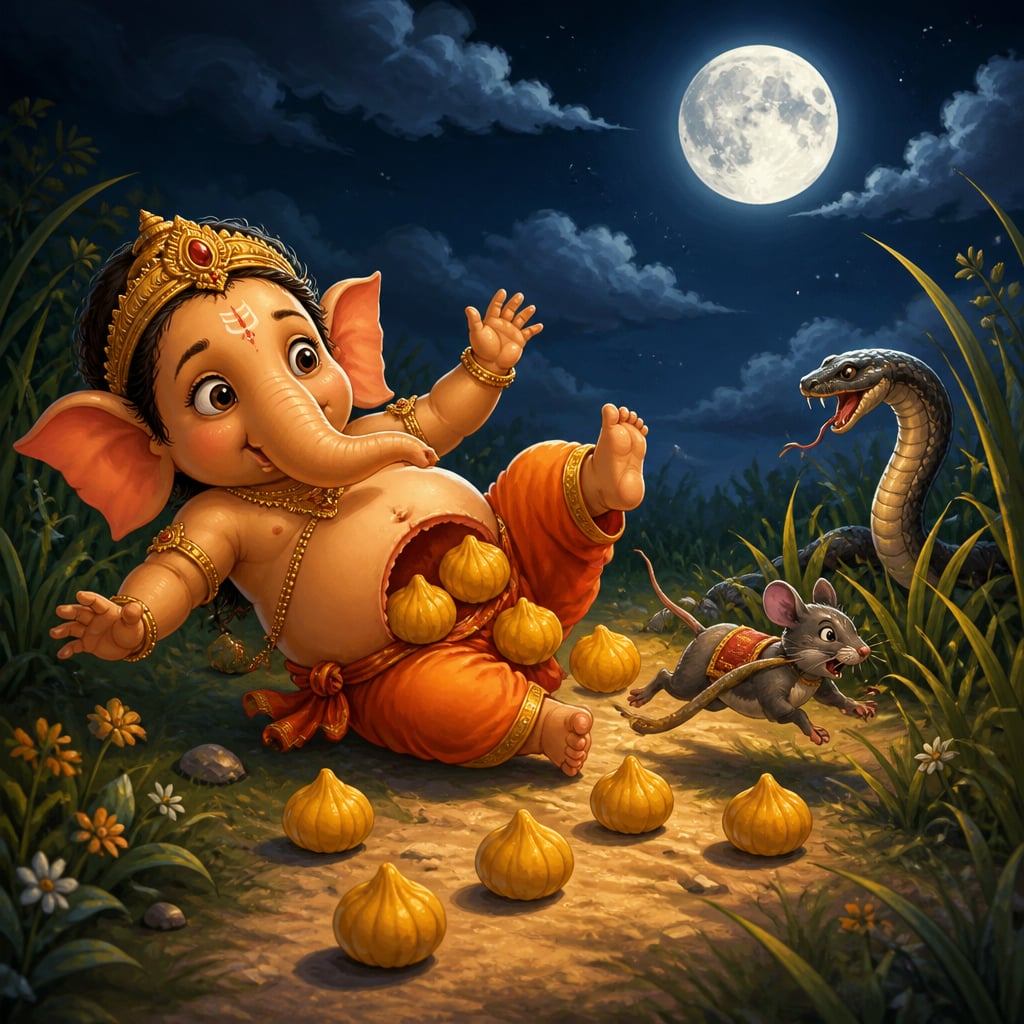
Ganesha tumbles off Mooshika at night with bright modaks rolling across the moonlit path

Ganesha looked down at himself. He was not hurt. Gods do not hurt the way we hurt. But his belly was open, and his sweets were running away from him in every direction.

He sat up. He grabbed the snake (who was very surprised) and tied it gently around his middle like a belt to hold his belly together. Then he started picking up modaks, one by one.

The Laugh from the Sky

It was while he was crawling around in the grass, picking up modaks, that he heard it.

Ha. Ha. Ha.

A bright, silver laugh. Coming from above.

Ganesha looked up. There, full and round and very pleased with himself, was Chandra, the Moon. Shining down on the whole scene. The fallen god. The frightened mouse. The wriggling snake belt. The runaway sweets.

Chandra the moon laughing prideful from his chariot at fallen Ganesha

And Chandra was laughing.

"Look at you," Chandra giggled. "The great elephant-headed god, rolling in the grass after his dinner. A snake for a belt! Modaks in the bushes! What a sight!"

Ganesha stood up slowly. The mouse hid behind his foot.

Now, Ganesha is one of the kindest gods you will ever meet. He laughs at himself all the time. He is round and friendly and patient. But there is a difference between laughing with someone and laughing at someone. Chandra was not laughing with him. Chandra was laughing down at him. Proud, sharp, mean.

And Chandra was proud anyway. Proud of his beauty. Proud of his silver light. Proud of being the most handsome face in the night sky.

Ganesha's eyes went very still.

The Curse and the Promise

Ganesha reached up to his broken tusk, the one he had used to write the great Mahabharata. He held it like a weapon.

"Chandra," he said. His voice was not loud. It did not need to be. "You laughed because you think you are beautiful. You laughed at someone who was already on the ground. Listen carefully."

The sky went silent.

"From now on, anyone who looks at you will be wrongly blamed. They will be accused of things they did not do. Their good name will get muddy for no reason. Your beauty will become a trap."

The Moon's silver light started to fade. He grew smaller. And smaller. And smaller. Until he was just a thin, scared sliver in the sky.

The other gods rushed to Ganesha. "Please," they said. "Without the moon, the tides will stop. The night will be too dark. The poets will have nothing to write about."

Chandra himself spoke, in a tiny, shaky voice. "Ganesha. I am sorry. I really am. I should not have laughed. Please, do not let me disappear forever."

Ganesha thought. He was angry, but he was never cruel. He was the god who removes obstacles, not the god who creates them.

"All right," he said at last. "I cannot take the curse back. But I can change it."

He pointed his trunk at the Moon.

"You will grow back. Every month, you will fade and return. Fade and return. That is your reminder. And the full curse, the one where looking at you brings false blame, will only fall on one night. The night of my own birthday. Ganesh Chaturthi. On that night, no one should look up at you. On every other night, you may shine."

Chandra bowed his pale face. The other gods sighed in relief. Ganesha picked up the last modak from the grass, popped it into his mouth, climbed back onto Mooshika, and rode home.

Why We Look Down on Ganesh Chaturthi

This is why, every year on Ganesh Chaturthi night, families in India tell their children the same thing.

Don't look at the moon tonight.

In old stories, even Lord Krishna once forgot and glanced up at the moon on this very night. People wrongly accused him of stealing a famous jewel called the Syamantaka. He had to go on a long, hard adventure just to clear his name.

So we keep the tradition. On Ganesh Chaturthi, we look at the clay Ganesha murti in our home, decorated with flowers and lit by little lamps. We eat modaks. We sing aartis. And we keep our eyes off the sky.

It is not that the moon is bad. The moon learned his lesson long ago. The wax and wane every month is his apology, still going on. The one-night rule is just a memory, kept alive by every family that hands the story down.

The Bigger Lesson

If you look closely, this story is not really about a moon and a god. It is about laughing.

Ganesha did not get angry because he fell. He did not get angry because his belly opened. He did not even get angry that a snake had to become his belt. He laughed at all of that himself.

He got angry because someone proud was laughing down at him from the sky, when he was already on the ground.

There is a kind of laughter that brings people together. Friends giggling at the same silly joke. A grandmother laughing as she watches you try to make your first roti. That kind of laughter is a gift.

And there is another kind. The kind that points and shrinks someone. The kind Chandra used.

Ganesha's curse was not really about the moon. It was a warning to anyone who ever opens their mouth to laugh that second kind of laugh. The world will turn. One day, you may be the one in the grass, with a snake for a belt, and someone will be standing above you choosing which laugh to use.

Choose well.

And if you ever forget, just look up on Ganesh Chaturthi night, by mistake, and an aunty will come running to remind you very fast indeed.

Living traditions

Ganesh Chaturthi is a public holiday in many Indian states. The 'do not look at the moon' tradition is so widely followed that astronomy clubs in India sometimes joke about being the only ones with their telescopes pointed at Chandra that night. The Mumbai festival, popularised by Bal Gangadhar Tilak in 1893 to bring people together during freedom struggle, is now one of the largest street festivals in the world, drawing millions every year.

Reflection

More in Ganesha and His Adventures

All lessons in Ganesha and His Adventures ยท Heroes of Ancient Bharat course