How Ganesha Got His Head
Parvati made a son from sandalwood paste. What happened when Shiva came home?
Parvati shapes a boy from sandalwood paste and gives him life so she has someone of her own. He guards her door bravely when Shiva returns, and a terrible misunderstanding leads to a promise, a journey north, and the elephant head that gives Ganesha his beloved face.
A Mother Alone on Mount Kailash
High up on a snowy mountain called Kailash, Parvati sat by herself. The wind was cold. The pine trees were quiet. Her husband, Shiva, had gone away to meditate, and nobody knew when he would come back.
Parvati looked around her empty home. There was nobody to talk to. Nobody to hug. Nobody to call her Amma.
She wanted a child. Her very own child. Someone who belonged only to her.
So she had an idea. A very Parvati kind of idea.
The Boy Made of Sandalwood
Parvati took a small bowl. She poured some water in it. Then she rubbed a piece of sandalwood against a stone, the way our grandmothers still do, until the wood became a soft, golden paste. The whole room started to smell sweet.
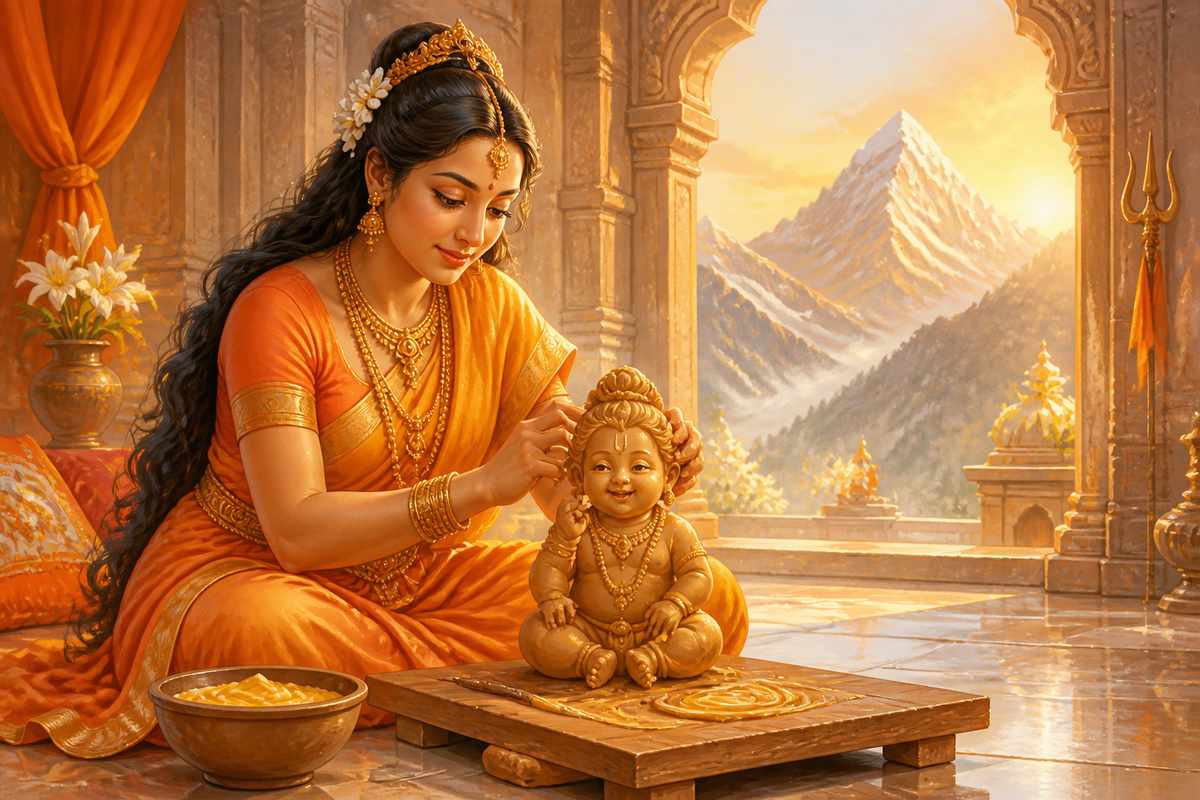
She took the paste in her hands and began to shape it. A little nose. Two little ears. Ten tiny fingers. Ten tiny toes.
When she was done, she had made the most beautiful boy you can imagine.
Then Parvati closed her eyes and breathed gently on him.
The boy opened his eyes.
He sat up. He looked at Parvati and smiled. "Amma," he said.
Parvati hugged him so tight she nearly squeezed the breath back out of him. She finally had her own child. A son who belonged only to her.
"Guard the Door, My Son"
After a while, Parvati wanted to take a bath. On Mount Kailash, in those days, there was nobody around to keep watch. So she turned to her brand-new son.
"My brave boy," she said. "I am going to bathe. Stand at the door. Don't let anyone come in. Not anyone. Promise me."
The boy stood up tall. He picked up a stick like a little soldier. "I promise, Amma."
Parvati smiled and went inside.
The boy stood at the door, very serious. The wind blew. The clouds drifted past Kailash. He did not move.
Shiva Comes Home
Far away, Shiva opened his eyes. His meditation was done. He thought of Parvati and started walking home.

When he reached Kailash, he saw something strange. There was a small boy at his front door. A boy he had never seen before. Holding a stick. Looking very fierce.
Shiva smiled kindly. "Move aside, little one. I am going inside."
The boy did not move. "Nobody goes in," he said. "Amma is bathing. I promised."
Shiva blinked. His own home. A boy at the door. Telling him to stop.
Now remember, the boy had never met Shiva. Parvati had only just made him. He didn't know that the man at the door was his father. He only knew one thing. He had given his Amma his word. And he was going to keep it.
Shiva tried to walk past him. The boy raised his stick. "I said no."
Shiva is the kindest god of all. But he is also the most powerful. And he had been away for a long time. He didn't know who this boy was. He didn't know about the sandalwood paste or the breath or the promise.
He got angry.
The Terrible Mistake
Shiva had a sword called the trishul. In one quick flash, the sword swung. And the little boy's head was gone.
The stick fell to the ground. Kailash went very, very quiet.
Inside the house, Parvati heard the silence first. Mothers always do. She came running out, water still on her hair.
When she saw what had happened, she fell to her knees. Her son. Her brand-new son. Her very own boy. Lying still.
She cried so hard the mountains cried with her. "What have you done? He was my son. I made him. I asked him to guard the door. He was just keeping his promise."
Shiva's heart broke into a thousand pieces. He had not known. He had not known.
And Parvati would not stop crying.
A Promise to a Mother
Shiva took her hands. "I will bring him back," he said. "I promise you. He will live again. And I will give him a gift so big that everyone, in every village, in every age, will love him first. Before any other god. Before anything new begins."
He called his ganas, his helpers. "Go north," he told them. "Run as fast as the wind. Bring back the head of the very first creature you see facing the north."
The ganas ran. Over rivers. Past forests. Past sleeping villages. The sky began to lighten.
And then they saw it. A great elephant, standing tall, its trunk lifted, looking calmly toward the north.
The ganas brought back the elephant's head.
Shiva placed it gently on the boy's shoulders. He whispered an ancient prayer. He breathed life back into him.

The boy's eyes opened.
He sat up. He looked at his hands. He felt his new face, his long, soft trunk, his big, kind ears that could hear everything.
He was the same boy. The same brave heart that had stood at the door. Just a brand-new face.
Parvati ran to him and hugged him as tight as before. He hugged her back with his trunk.
A Name for the Whole World
Shiva placed his hand on the boy's head. "From today," he said, "you are Ganesha. The leader of all my ganas. The remover of every hurdle. The one who is called first."
And that is why, even today, before a wedding, before a new house, before a school exam, before opening a new shop, before anything important, our families fold their hands and say, "Om Gam Ganapataye Namaha."
We call Ganesha first.
Not because Shiva felt sorry. Not because Parvati wept. But because of what the little boy did at the door. He kept his promise. He stood his ground. He loved his mother more than he was afraid of anyone.
In Your Life
The next time your Amma or Appa asks you to do one small thing, remember Ganesha at the door. He didn't have a big sword. He didn't have an army. He just had a promise. And he kept it.
That is what made him a god the whole world loves. Not the elephant head. Not the magic. The promise.
And back on Kailash? Parvati hugged her son. The pine trees were not quiet anymore. The mountain was finally home.
Living traditions
Ganesh Chaturthi was turned into a public, community festival by Lokmanya Tilak in 1893 to bring people together during the freedom struggle. Today it is celebrated in homes, schools, and street pandals across India, and by Indian families around the world. Many families now use clay Ganeshas that dissolve in water so the rivers stay clean.
- Siddhivinayak Temple: One of India's most loved Ganesha temples. The Ganesha here has his trunk curling to the right, which is rare, and families come from all over the country to see him. Kids are often lifted up to catch a quick darshan. Try and spot the modak in his hand.
Reflection
- Think of a time you made a promise to your Amma, Appa, or a friend. Did you keep it all the way, or did you change your mind in the middle? If you could go back, what would you do differently?
- Why do you think the little boy at the door did not move, even when a big, powerful god told him to? What was going on in his heart?