Why Ganesha Has a Broken Tusk

He needed a pen. He broke his own tusk. That's how much the story mattered.

The great rishi Vyasa has the longest, biggest story in the world inside his head, and he needs help writing it down. Only Ganesha can keep up. But the pen breaks. Ganesha breaks off his own tusk to keep going, and that is how the Mahabharata gets written.

A Rishi With a Story Too Big to Hold

Far away in the Himalayan mountains, in a quiet cave near a village called Mana, there lived a great rishi named Vyasa. His beard was long and white. His eyes were calm. And inside his head, he was carrying the biggest story in the world.

It was the story of two families of cousins. Of a great war. Of brave princes and clever queens and wise old grandfathers. Of love and loss and one whole kingdom torn apart.

Vyasa called it the Mahabharata.

The trouble was, the story was so long that nobody could remember it just by listening. If Vyasa told it once and walked away, it would be gone. Forever.

Vyasa needed someone to write it all down.

But who could? The story had a hundred thousand verses. Most people couldn't even keep up if Vyasa whispered.

Vyasa Goes to Brahma

Vyasa thought and thought. Then he closed his eyes and called on Brahma, the great creator god.

"Pitamaha, grandfather of all," he said, "I have a story so big and so important that it must never be lost. But I need a writer who can keep up with my mind. Someone faster than fast. Someone wiser than wise."

Brahma smiled gently. He stroked his white beard.

"There is only one," Brahma said. "Go to Ganesha. He alone can keep up with you."

Vyasa folded his hands and went looking for the elephant-headed god.

"I Will Help You. But on One Condition."
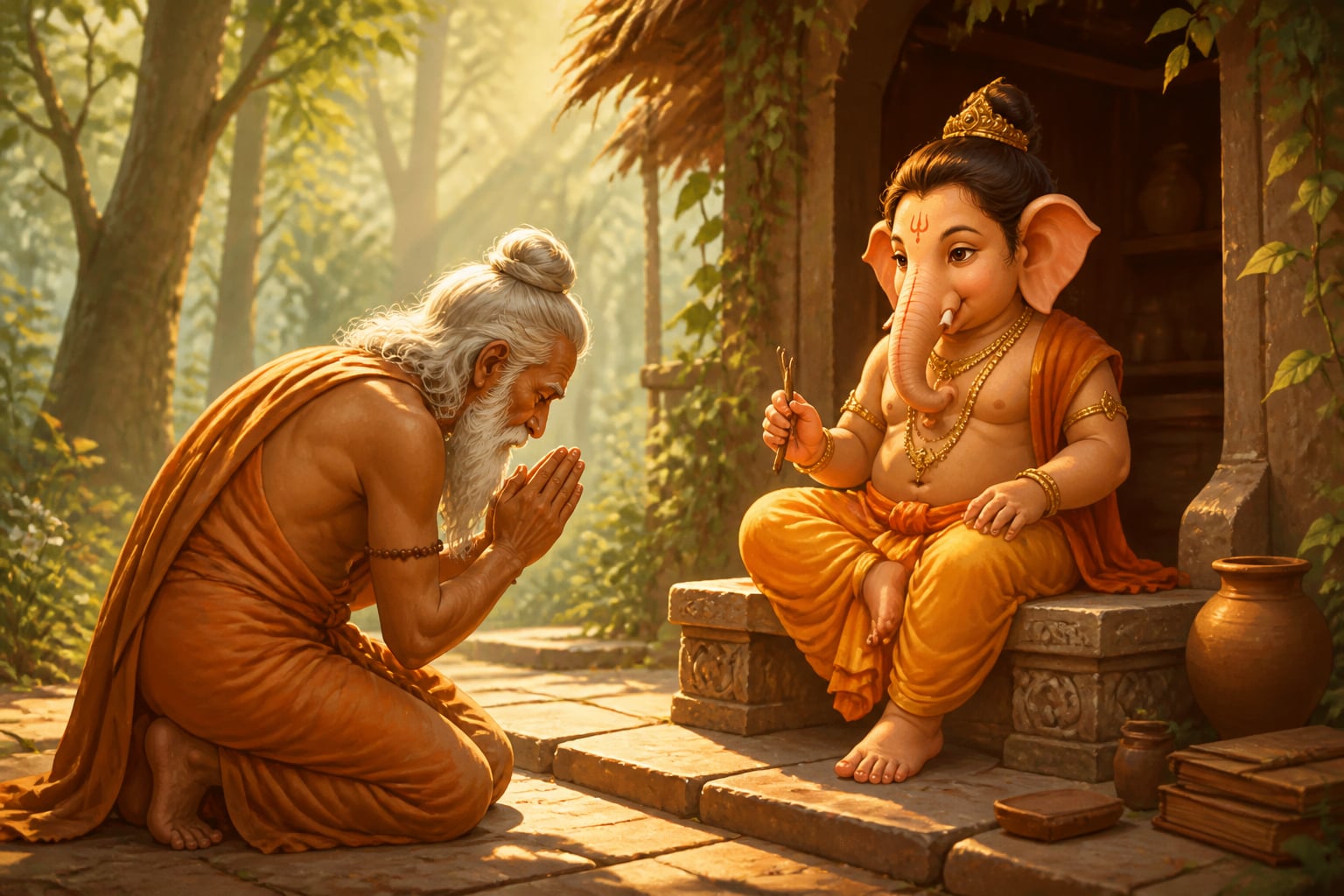
Vyasa bowing humbly before young Ganesha to ask for his help

When Vyasa found Ganesha, he bowed low and asked his question. "Will you be my scribe? Will you write the Mahabharata as I tell it?"

Ganesha listened carefully. He knew this story would last for thousands of years. He knew children would read it long after Vyasa was gone. He knew it mattered.

He nodded. "Yes," he said. "I will write it."

Vyasa's heart leapt.

"But," Ganesha said, lifting one finger, "I have one condition."

"Anything," said Vyasa.

Ganesha's eyes twinkled. "My pen must never stop. The moment you stop telling the story, I will stop writing, and I will go away. So you must keep speaking, without a single pause, until the very last word."

Vyasa's mouth fell open a little. Without a single pause? For a hundred thousand verses?

Vyasa was a great rishi. But even he needed a moment to breathe sometimes. To think. To find the right word.

He smiled slowly. He had an idea.

"I accept your condition," Vyasa said. "But I have one of my own."

Ganesha tilted his big elephant head. "Tell me."

"You must not write a single line that you have not understood," Vyasa said. "Whatever I say, you must understand it fully before your pen touches the page."

Ganesha laughed his rumbly elephant laugh. "Agreed."

It was a clever deal. Whenever Vyasa needed a tiny moment to think, he would say something tricky, something Ganesha would have to pause and figure out. While Ganesha understood, Vyasa would breathe, sip water, and prepare the next part of the story.

Both of them were happy. The work could begin.

The Story Begins to Flow

Vyasa reciting and Ganesha writing the Mahabharata together in the cave

They sat together in the cave at Mana. Vyasa closed his eyes. Ganesha picked up a long, sharp pen.

Vyasa began.

He spoke of kings and queens. Of forests and palaces. Of arrows that could split a leaf falling through the air. Of a game of dice that broke a kingdom in half.

Ganesha's pen flew. Faster than wind. Faster than thought. The leaves filled up with neat, beautiful letters.

Days passed. Then weeks. Then months. Outside the cave, the seasons changed. The snow melted, the flowers bloomed, the snow came back again. Inside the cave, Vyasa kept speaking. Ganesha kept writing.

Neither of them slept much. Neither of them ate much. The story was too important.

The Pen Breaks

Then one day, in the middle of a long, fast verse, the pen made a tiny crack.

Ganesha looked down. The tip had snapped clean off.

The pen was finished.

And Vyasa was still talking. Words were pouring out of him like a waterfall.

Ganesha had a problem. If he stopped to find a new pen, the deal was broken. He would have to walk away. The story would be lost.

He looked around the cave. There was no other pen. There was no time.

Vyasa kept speaking. The verses kept coming.

Ganesha did not panic. He did not shout. He did not say, "Wait, just a moment, the pen is broken."

Instead, very calmly, he reached up to his own face. He took hold of one of his big, white tusks.

And he broke it off.

Young Ganesha calmly breaks off his own tusk to use as a new pen so Vyasa's words are not lost

It must have hurt. Of course it did. But Ganesha did not even flinch. He sharpened the broken tusk into a new pen, dipped it in ink, and went right on writing.

Not a single word of Vyasa's story was lost.

Why It Matters

It took years. But the Mahabharata got finished, all hundred thousand verses of it. The longest poem in the world. The story Hindu families have been telling to their children for thousands of years.

And the writer? He had one tusk full and one tusk gone.

That is why every picture, every murti, every drawing of Ganesha you will ever see has one tusk broken. It is not a mistake. It is a memory. A memory of the day a god broke a piece of his own body so a story could live forever.

From that day on, Ganesha had a new name: Ekadanta. The one with one tusk.

In Your Life

Something you are doing is going to break one day. A pen. A toy. A plan. A homework idea. The easy thing is to stop and say, "It's not my fault. The pen broke."

But think of Ganesha. He had no spare pen. So he made one. Out of himself.

That is how big stories get finished. Not by people who only work when everything is going right. By people who keep going, even when the pen breaks.

Next time something doesn't work, take one breath. Look around. Ask, what do I have? What can I use? You will be surprised how often there is a way.

And if you ever feel small, just remember. The longest story in the world was written with a pen made of one broken tusk.

Living traditions

Today, in many Hindu homes, children are still told this story before they sit down to write something important: an exam, a letter, a school project. Some families place a small Ganesha murti on the study table. Many writers, students, and teachers begin their day by remembering Ganesha, the patient one who broke his own tusk so a story could live forever.

Reflection

More in Ganesha and His Adventures

All lessons in Ganesha and His Adventures ยท Heroes of Ancient Bharat course