The Revival of Kannauj
Rising from Chaos
After a century of chaos following Harsha's death, Kannauj - once the greatest city of northern India - lay in ruins and obscurity. Yashovarman emerged to restore its glory, building a new kingdom and attracting the greatest minds of his age to his court. His story is one of cultural renaissance amidst political turbulence.
A City Waiting to Be Reborn
The year is approximately 720 CE. A traveler approaching Kannauj from the south would first smell the city before seeing it, wood smoke, river mud, the faint sweetness of temple incense carried on the wind. But something was wrong. The great walls still stood, their red sandstone weathered but intact. Yet the bustle that should have filled the roads was absent. Where caravans from a dozen kingdoms once jostled for space, now only local merchants moved with the unhurried pace of men who expected nothing remarkable.
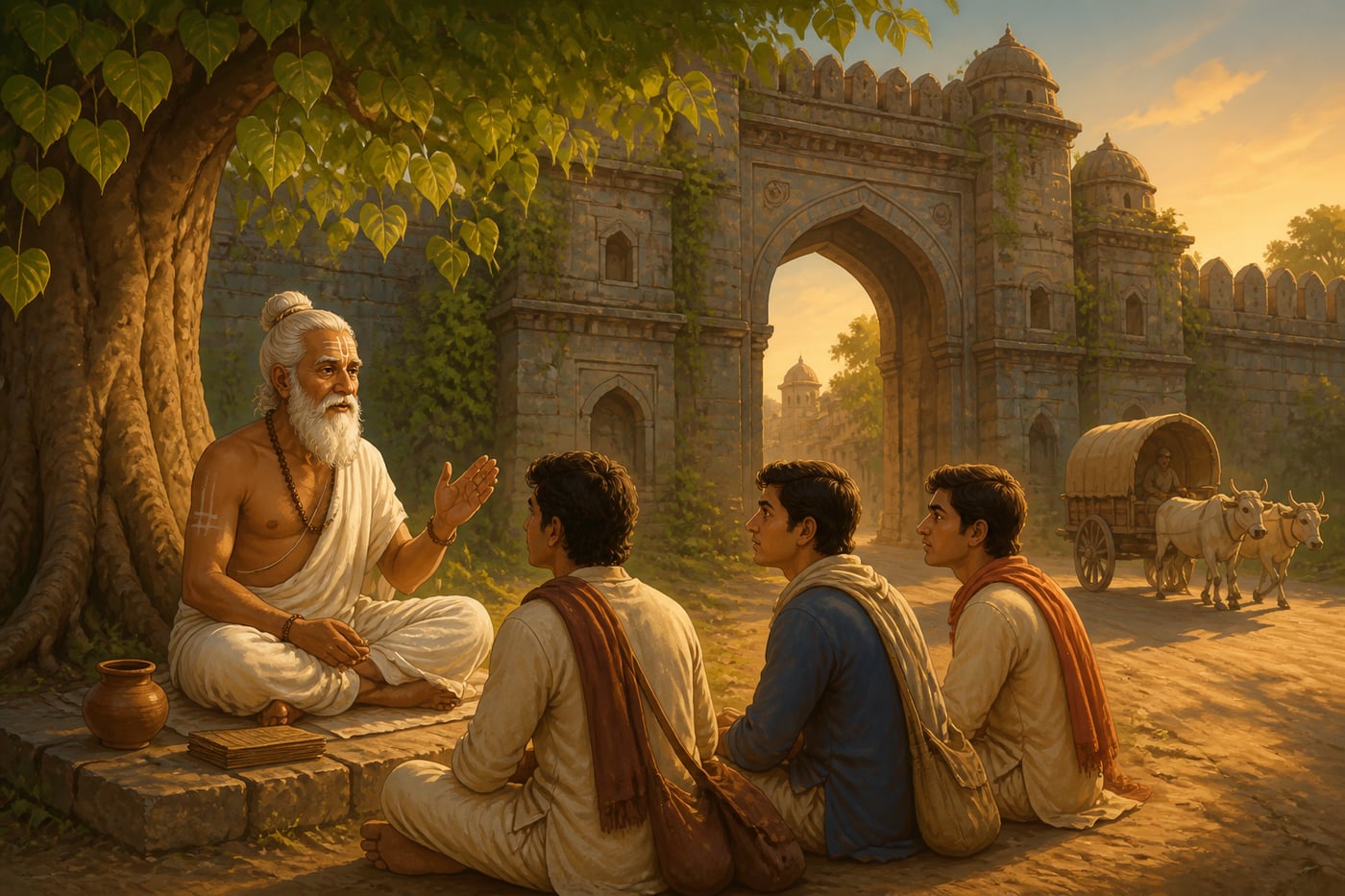
An old Brahmin, sitting beneath a pipal tree near the southern gate, would tell you stories if you asked. "In my grandfather's time," he might say, "the Chinese pilgrim came here. Xuanzang, they called him. He said our Kannauj was the greatest city in all of Jambudvipa. Thousands of monks at the monasteries. Scholars debating in the courtyards. Emperor Harsha himself would come to hear them argue about dharma."
The old man would fall silent then, watching the sparse traffic through gates built for multitudes.
Emperor Harsha had died in 647 CE without an heir. His vast empire, stretching from the Himalayas to the Narmada, collapsed overnight. Ministers turned warlords. Generals became petty kings. The city that had been the heart of his realm descended into obscurity. For nearly a century, Kannauj passed through the hands of forgotten rulers, men whose names survive, if at all, only in fragmentary inscriptions.
Into this vacuum stepped Yashovarman, a man whose origins remain tantalizingly obscure, but whose ambition was unmistakable.
The Man From Nowhere
Who was Yashovarman? The question haunted his contemporaries and continues to puzzle historians.
His dynasty's name is uncertain. Some scholars connect him to the Maukharis, the ancient ruling family of Kannauj. Others suggest he came from outside, a capable general who seized power during the chaos. His family background is obscure. Even the exact date he came to power remains contested, though most scholars place it around 715-720 CE.
Unlike Harsha, whose lineage the poet Bana celebrated in loving detail in the Harshacharita, Yashovarman seems to have emerged from the chaos itself. No court poet sang of his ancestors. No inscription traced his genealogy back to the gods.
Perhaps this was deliberate. A man building a kingdom from nothing has no old claims to defend, no dynastic baggage to carry. Or perhaps the records simply did not survive. What we know of Yashovarman is not where he came from, but what he achieved, and that achievement was remarkable enough to speak for itself.
"Who is this Yashovarman?" a visiting merchant from Gujarat might have asked in those early years.
"The king," would come the reply. "The man who is making Kannauj remember what it was."
A World of Rivals
The early 8th century was no time for quiet ambition. Yashovarman's Kannauj sat at the center of a battlefield where every neighbor was a potential enemy, or a potential victim.
To the northwest, the Arabs had conquered Sindh in 712 CE under Muhammad bin Qasim. Though their advance had stalled at the borders of Rajasthan, the threat remained. No one knew if or when they might push further into the subcontinent.
To the west, the Gurjara-Pratiharas under Nagabhata I were rising fast. From their base in Rajasthan, they had already proven themselves by defeating Arab raids. They watched Kannauj with hungry eyes, the ancient city would make an excellent capital for their own ambitions.
To the north, in the mountain fastness of Kashmir, Lalitaditya Muktapida was building an empire of his own. His armies had already swept through the hills and were beginning to eye the rich plains below.
To the east, the Palas were consolidating their hold on Bengal. Gopala, the founder of the dynasty, had recently unified the region. His successors would prove formidable.
Kannauj's geography was both blessing and curse. The Gangetic plains offered fertile land, control of major trade routes connecting east and west, and the prestige of Harsha's memory. But those same flat plains offered no natural defenses. Mountains protected Kashmir. Deserts shielded Rajasthan. Rivers could be forded, forests could be cleared. Kannauj had only its walls, and the strength of whoever held them.
Yashovarman understood this calculus. Holding Kannauj required military power. But being worthy of Kannauj, being recognized as Harsha's true successor, required something more.
The Vision of Revival
What separates Yashovarman from a dozen forgotten 8th-century warlords is what he did after securing his throne. He could have simply fortified and expanded, building his power through conquest alone. Instead, he invested in something that would outlast any fortress: punaruddhāra, revival.
"This King Yashovarman, lord of Kannauj, after Harsha, again restored the glory of cities." , Vakpati, Gaudavaho
The word choice matters. Not "built" but "restored." Not "created" but "revived." Yashovarman understood that legitimacy came from connection to the past. He was not starting something new, he was finishing what Harsha had begun and the century of chaos had interrupted.

The program was comprehensive. Nalanda, the great Buddhist university in Bihar, received royal patronage. Land grants ensured the monks could continue their studies. The gesture connected Yashovarman to a pan-Asian network of learning that stretched to China, Tibet, and Southeast Asia. When scholars at Nalanda spoke of their royal patron, they named Yashovarman alongside the Gupta emperors and Harsha himself.
Hindu temples were maintained and endowed. The great Shiva temples of the region received gifts of villages, their income supporting priests and rituals. Jain scholars found welcome at court, their philosophical disputations adding to the city's intellectual prestige.
And then there were the poets.
The Gathering of Genius
Word spread through the networks of Sanskrit learning: Kannauj is rising again. The king welcomes scholars.

They came from across India. Bhavabhuti, a Brahmin from Vidarbha in the Deccan, arrived with manuscripts of dramas that would make him Sanskrit's second-greatest playwright after Kalidasa. Vakpati, master of Prakrit verse, came to compose his epic celebrating the king's conquests. Grammarians, philosophers, astronomers, the intellectual elite of the age found their way to Yashovarman's court.
This was not idle generosity. Every land grant to Nalanda, every poet supported, every temple restored sent a message to every court in India: Kannauj is again what it was under Harsha. The city of learning has returned.
An inscription from this period captures the transformation: "At Nalanda, the abode of learning, by Yashovarman's grace, the light of knowledge has been kindled again as it was before."
Cultural prestige was political capital. A king who hosted Sanskrit's greatest living dramatist was no mere regional chieftain. He was the heir to a great tradition, and a force to be reckoned with.
The Stakes of Revival
Yet for all his achievements, Yashovarman's revival rested on uncertain foundations.
A century of chaos had depleted the region's wealth and population. The administrative systems that had made Harsha's empire function had broken down. Rebuilding them took time, time that ambitious neighbors might not allow.
The Pratiharas watched from the west. The Palas consolidated in the east. And in Kashmir, Lalitaditya Muktapida was building an empire that would soon stretch from Tibet to the Deccan. Two ambitious world-conquerors cannot share northern India for long.
Yashovarman had achieved something remarkable. He had taken a forgotten city and made it shine again. He had attracted geniuses to his court. He had begun rebuilding the infrastructure of civilization.
But revival was only the beginning. To secure what he had built, Yashovarman would need to prove himself on the battlefield. The greatest campaigns of his reign, and the tragic collision that would end it, still lay ahead.
The revival of Kannauj was real. The question was whether it could last.
Historical context
Post-Harsha Period, Early 8th Century CE
India was fragmented after Harsha's death. The Pratiharas were rising in Rajasthan, the Palas consolidating in Bengal, Lalitaditya building power in Kashmir, and the Chalukyas declining in the Deccan. Multiple powers competed for dominance.
Living traditions
Kannauj remains a city in Uttar Pradesh, known for its perfume industry. The memory of its ancient glory as Harsha's and Yashovarman's capital persists in regional identity and historical consciousness.
- Kannauj Archaeological Sites: The ancient city where Harsha and Yashovarman held court, with ruins from multiple periods
- Nalanda University Ruins: The famous Buddhist university that Yashovarman patronized, now a UNESCO World Heritage Site
Reflection
- Can past glory truly be recreated, or can it only be imitated?
- Why did Yashovarman invest in culture and learning when his political position was still insecure?
- What does it mean to be 'worthy' of a historical legacy?