The Fall

Lalitaditya's Conquest

At the height of his power, Yashovarman faced a challenge from the north. Lalitaditya Muktapida of Kashmir, one of India's greatest military commanders, descended from the mountains with an army that would sweep across the subcontinent. Their collision would end Yashovarman's revival and mark the tragic conclusion of Kannauj's brief renaissance.

The Shadow From the Mountains

The messenger came from the north, exhausted from crossing the mountain passes, bearing news that would change everything. Lalitaditya Muktapida, the king of Kashmir, had mobilized his armies. The mountain warriors were marching toward the plains.

Yashovarman received the news in his court at Kannauj, surrounded by the poets and scholars who had made his reign famous. The Bengal campaign had been years ago. His digvijaya claims had established him as a major power. His court was celebrated across India.

But Lalitaditya was no regional chieftain seeking tribute. He was building an empire that would stretch from Tibet to the Deccan. And he wanted Kannauj.

"Two suns cannot rise in a single sky," an advisor might have warned. "Two world-conquerors cannot share northern India."

The collision was inevitable. And it would be fatal.
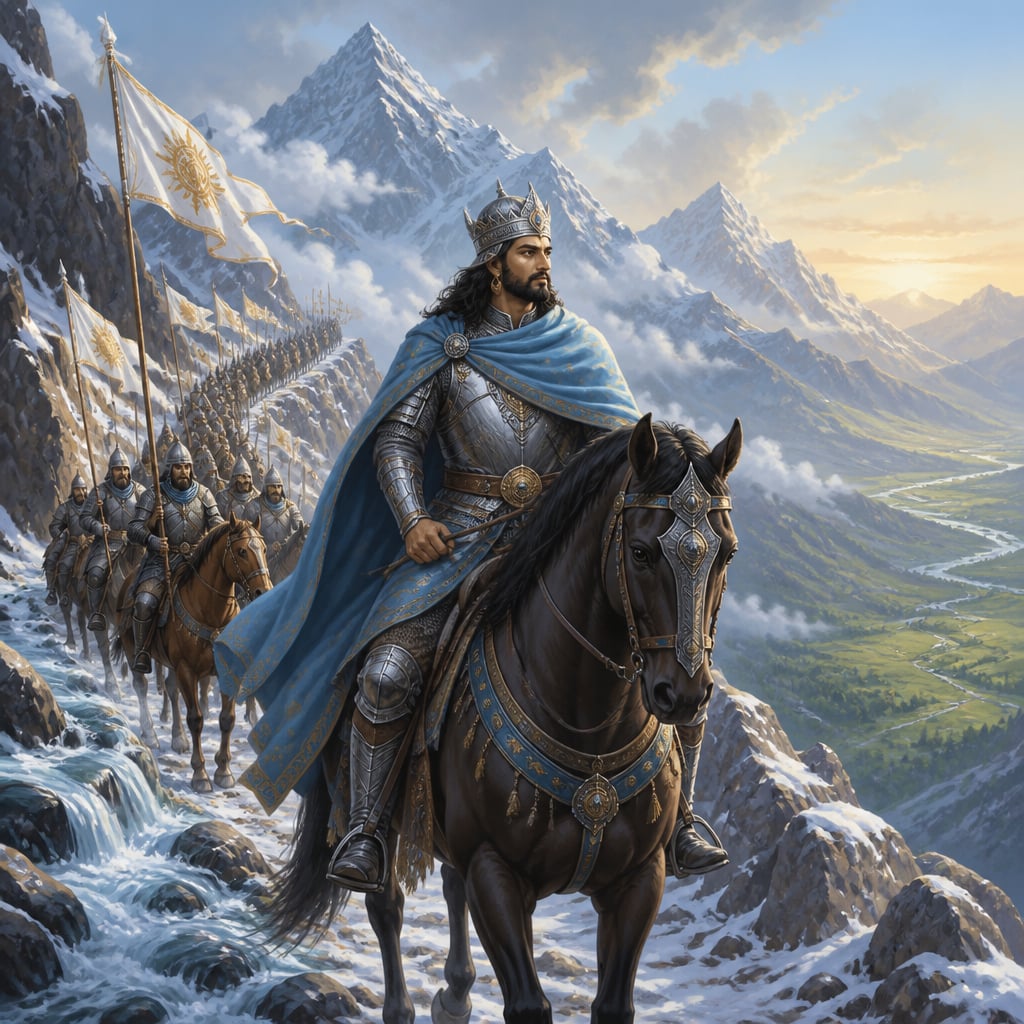
Lalitaditya of Kashmir descending a mountain pass at dawn

The King of Kashmir

Lalitaditya Muktapida (ruled c. 724-760 CE) was one of the most extraordinary figures in Indian history. From his capital at Parihaspora in the Kashmir valley, he commanded armies that would campaign across the entire subcontinent and beyond.

His achievements were staggering. He built the magnificent Martand Sun Temple, whose ruins still stand as testimony to his grandeur. He defeated the Tibetans in the mountains. He would march south to conquer territories in Karnataka. Some accounts suggest his campaigns reached into Central Asia.

The 12th-century historian Kalhana, writing in the Rajatarangini ("River of Kings"), celebrated Lalitaditya as Kashmir's greatest monarch:

"In his reign, like the sun's unchanging light, Kashmir's glory never knew setting or night."

This was the opponent Yashovarman now faced, a rival as ambitious as himself, with an army hardened by mountain warfare and a strategic position that gave him the initiative.

The Geographic Calculation

The geography favored Lalitaditya. Kashmir's mountain valley was a natural fortress, easy to defend, difficult to invade. The passes could be held with small forces. But from this protected base, Lalitaditya could strike downward into the plains whenever he chose.

Kannauj had no such protection. The flat Gangetic plains offered rich farmland and control of trade routes, but they were open to invasion from every direction. The same geography that made Kannauj wealthy made it vulnerable.

Yashovarman could march north to meet the threat, but that would mean fighting in terrain that favored the enemy. He could wait for Lalitaditya to descend, but that would cede the initiative and allow the Kashmiri army to choose the battlefield.

There were no good options.

The Campaign and Defeat

The exact details of the campaign are lost to history. Kalhana, writing centuries later, preserved the outcome but not the specifics. We know that Lalitaditya led his armies into the plains. We know that a major confrontation occurred. We know that Yashovarman was defeated.

What we don't know is where exactly the battle was fought, what tactics were employed, whether there was a single decisive engagement or a series of battles, or how many men died. The sources are silent on these details.

What Kalhana does record is the scale of Lalitaditya's ambition:

"Lalitaditya's conquest of directions was wondrous indeed, in Bengal and Karnataka, Kashmir's lord did succeed."

Yashovarman's defeat was just one stop on a campaign that swept across India. Lalitaditya was not merely defending Kashmir or expanding marginally, he was attempting to conquer everything.

Yashovarman kneeling before Lalitaditya after defeat

The battle, wherever and however it was fought, ended in Yashovarman's complete defeat. His armies were broken. His claims to universal sovereignty were exposed as hollow. The revival of Kannauj, which had seemed so promising just years before, ended in catastrophe. Kalhana's verdict was clear:

"The powerful King Yashovarman, lord of Kannauj, was conquered by Lalitaditya and came under the control of the lord of Kashmir."

What happened to Yashovarman after the defeat? The historical record falls silent. He may have died in battle. He may have fled into obscurity. He may have been captured and humiliated. We simply don't know. His disappearance from history is itself testimony to the completeness of his fall.

The Dispersal

Bhavabhuti and Vakpati leaving Kannauj at dawn

With Yashovarman's defeat, his court dispersed. The scholars and poets who had gathered at Kannauj sought new patrons or returned to their homelands. The administrative structure he had rebuilt collapsed. The feudatories who had acknowledged his sovereignty transferred their loyalty to the victor.

What happened to Bhavabhuti and Vakpati? Again, the sources are silent. They may have died with their patron. They may have escaped to other courts. They may have lived out their days in obscurity. Their fates are unknown.

But their works survived. The manuscripts of Bhavabhuti's plays, the verses of Vakpati's Gaudavaho, these entered the broader Sanskrit and Prakrit literary traditions, preserved by scribes and scholars who recognized their value regardless of their patron's political fate.

Why Yashovarman Lost

Why did Lalitaditya win? Several factors likely contributed:

Geographic advantage: Kashmir's protected position allowed Lalitaditya to choose when and where to fight. Yashovarman had to defend the open plains.

Military experience: Lalitaditya's armies had been hardened by campaigns in the mountains against Tibetans and others. They were experienced in warfare against diverse opponents.

Strategic position: The Bengal campaign may have weakened Yashovarman, stretching his resources and creating enemies to his rear. Lalitaditya could strike when his opponent was extended.

Leadership: Lalitaditya was, by all accounts, an exceptional military commander. His campaigns across the subcontinent demonstrated strategic and tactical abilities that few could match.

But ultimately, we must acknowledge that the historical record does not allow us to reconstruct the campaign in detail. Yashovarman lost. That is what we know for certain.

The Aftermath and the Tragic Pattern

Lalitaditya's victory made him the dominant power in northern India. He continued his campaigns, marching south into the Deccan and perhaps beyond. For a brief period, Kashmir ruled over territories stretching across the subcontinent.

But Lalitaditya's own empire would not last. He died while campaigning, some accounts say in the far north, perhaps against Central Asian opponents. His successors could not hold what he had conquered. Kashmir retreated to its mountain valley, and the territories he had won slipped away.

The irony is profound. Lalitaditya defeated Yashovarman, ending the revival of Kannauj. But within decades, Lalitaditya's own achievements had faded. Neither the victor nor the vanquished created anything permanent. Except, in Yashovarman's case, the poetry.

Yashovarman's story fits a pattern that recurs throughout medieval Indian history:

  1. A capable ruler revives a declining region
  2. He builds cultural and military power
  3. He challenges or is challenged by a rival
  4. He falls, and his political achievements disappear
  5. His legacy survives mainly through literature or monuments

This pattern reflects the fragmented nature of medieval India, no single power could maintain dominance for long. The political instability that allowed Yashovarman to rise also enabled his fall. The same forces would eventually undermine Lalitaditya's conquests too.

What survived the political turmoil was culture. The works created under patronage outlasted the patrons. The temples, the poems, the scholarly traditions, these endured while kingdoms rose and fell around them.

Historical context

Clash of Northern Powers, c. 730-740 CE

Northern India lacked a single dominant power after Harsha. Multiple kingdoms competed, Kannauj, Kashmir, the Pratiharas, the Palas. The clash between Yashovarman and Lalitaditya was one episode in this ongoing competition.

Living traditions

Lalitaditya remains a legendary figure in Kashmiri history, remembered as the king who made Kashmir a world power. The clash with Yashovarman is part of both kings' historical memory, the victor remembered in Kashmir, the vanquished in the Sanskrit literary tradition.

Reflection

More in Yashovarman

All lessons in Yashovarman ยท Lesser Known Guardians of Dharma course