The Digvijaya
Conquest of the Directions
Yashovarman's revival of Kannauj required more than culture, it required military proof. His armies marched east to Bengal, south toward the Deccan, and into every direction in a classic digvijaya campaign. The conquest of Bengal, culminating in the death of its king, became the defining military achievement of his reign and the subject of Vakpati's epic poem.
The King Who Would Conquer
In the courtyard of Kannauj's royal palace, the war drums began before dawn. Yashovarman stood on the elevated platform where kings addressed their armies, watching as regiment after regiment assembled in the torchlight. Elephants swayed in their lines, their mahouts checking harnesses and weapons. Cavalry officers called roll. Infantry captains counted spears.
The king had made his decision. Cultural revival alone would not secure Kannauj's future. To be recognized as Harsha's true successor, to be acknowledged as samrat, emperor, he would need to do what Harsha had done: conquer.
"A king who only defends," went an old saying, "invites attack. A king who conquers, commands respect."
Yashovarman intended to conquer in every direction. This was the digvijaya, the conquest of the quarters, the ancient ritual by which Indian kings claimed universal sovereignty. His armies would march east, south, west, and north. They would return victorious or not at all.
The digvijaya was more than military strategy, it was a statement of cosmic ambition. In Indian political thought, a true sovereign ruled not merely a territory but a chakra, a wheel of power that rolled in all directions. The chakravartin, the wheel-turning emperor, had conquered all four quarters and brought them under his righteous rule. Harsha had been such a king. His armies had swept from the Himalayas to the Narmada, from the mountains of the west to the shores of Bengal. His defeat of Shashanka of Gauda had avenged his brother's murder and established his supremacy over the east. Yashovarman would follow in those footsteps. But his first and greatest campaign would be directed eastward, toward Bengal, the land of the Gaudas, where a worthy opponent awaited.
The Road to Bengal
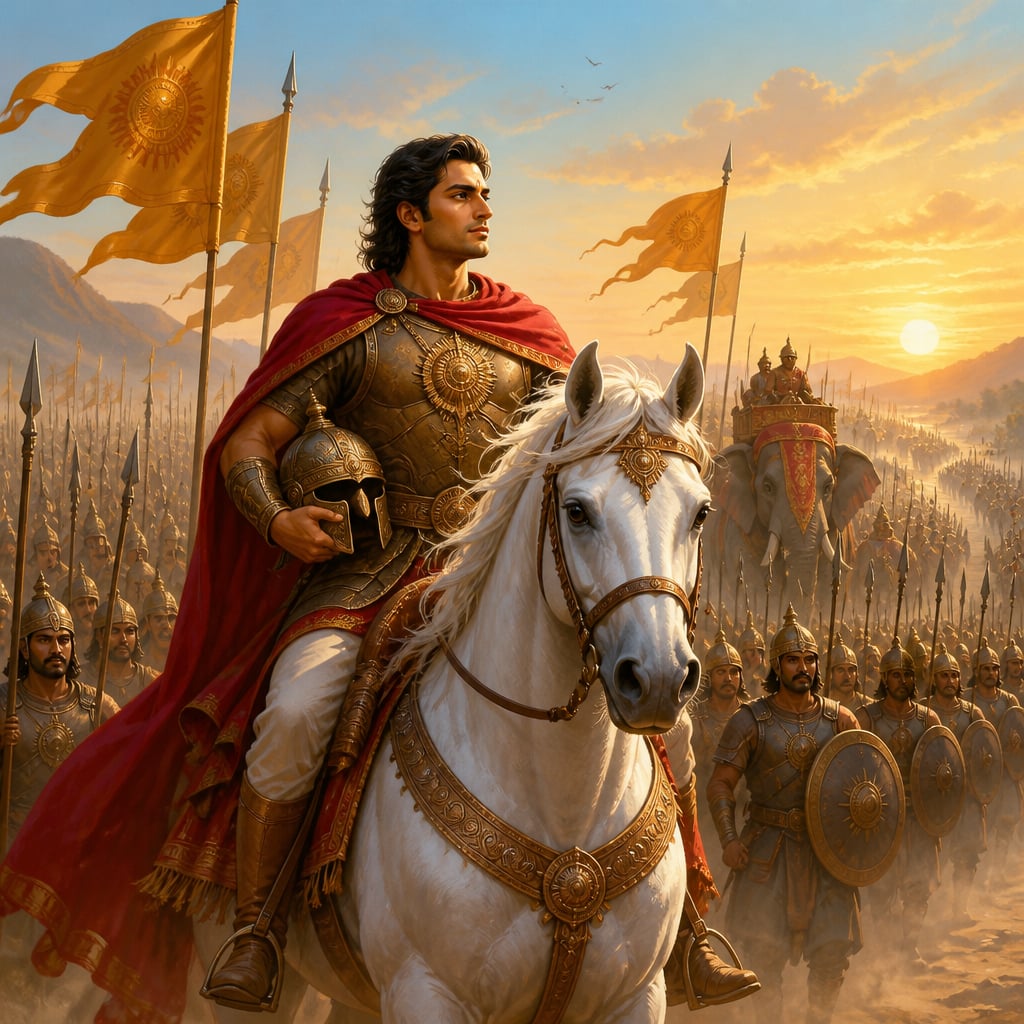
The army that marched from Kannauj in approximately 728 CE was formidable: thousands of infantry armed with spears and swords, cavalry units mounted on the swift horses of the northwest, and the war elephants that were the backbone of Indian military power.
The poet Vakpati, who would later celebrate this campaign in his epic Gaudavaho, accompanied the army. He recorded what he saw:
"The army of Yashovarman, lord of Kannauj, stretched across the horizon like a second earth. The dust of its march darkened the sky. The sound of its drums reached the gods themselves."
The route led through Magadha, the ancient heartland of empires. Here the Buddha had walked. Here the Mauryas and Guptas had ruled. Here Nalanda's monks looked up from their studies to watch the glittering host pass by. Yashovarman had patronized their university; now they offered prayers for his victory.
Beyond Magadha lay the forests and rivers of Bengal. The Ganges split into a hundred channels here, creating a landscape of water and mud and dense vegetation. It was difficult terrain for an invading army, but Yashovarman pressed on.
The Gauda King
Who ruled Bengal when Yashovarman's army arrived? The historical record is frustratingly unclear. Some scholars believe it was an early Pala ruler, perhaps even Gopala himself, founder of the dynasty. Others suggest a pre-Pala king, one of the regional rulers who had emerged during Bengal's own period of chaos.
What we know for certain is that Bengal had a king, that he resisted Yashovarman's invasion, and that he died.
Vakpati's poem is explicit about the outcome. The Gaudavaho, "Slaying of the Gauda King", takes its very name from the event. The Gauda ruler fell in battle against Yashovarman's forces, and Bengal submitted to Kannauj's overlordship.
The poem describes the climactic battle in vivid terms:

"The battlefield was sprinkled with Ganga water mixed with the blood of the Gauda king. The elephants of Bengal trumpeted in defeat. The banners of Kannauj flew over the conquered land."
Victory and Its Meaning
The conquest of Bengal was Yashovarman's greatest military achievement. It established him as a king capable of projecting power across hundreds of miles. It brought the wealthy eastern territories under his influence, if not direct control. And it provided the material for an epic poem that would preserve his fame.
But Bengal was not the only direction. Vakpati's poem also mentions campaigns to the south, toward the Deccan, and victories over mountain kingdoms. The details are vague, court poetry tends toward hyperbole, but the pattern is clear: Yashovarman was attempting a comprehensive digvijaya.
"By whom Bengal was conquered, the southern lands crossed through, to the great ocean, mountain kingdoms submitted too.", Vakpati, Gaudavaho
How much of this was actual conquest and how much was tribute extracted or submission acknowledged is impossible to determine. Medieval Indian warfare often involved forcing opponents to acknowledge superiority rather than permanent occupation. A defeated king might retain his throne while accepting the victor's overlordship.
The Western Front
To the west lay more dangerous opponents. The Gurjara-Pratiharas under Nagabhata I controlled Rajasthan and were themselves expanding. They had already proven their military prowess by defeating Arab raids from Sindh.
Did Yashovarman clash with the Pratiharas? The evidence is ambiguous. No clear record of a major battle survives. Perhaps the two powers avoided direct confrontation, each focusing on expansion in other directions. Perhaps there were skirmishes that neither side chose to commemorate. Perhaps Yashovarman's western campaigns were directed at smaller rulers who left no record.
What is clear is that the Pratiharas remained a western boundary to Kannauj's expansion, and that they would eventually inherit the city that Yashovarman was trying to restore.
The Northern Challenge
The most dangerous rival lay to the north. In Kashmir, Lalitaditya Muktapida was building an empire of his own. His armies had already swept through the mountains and were beginning to eye the rich plains below.
Lalitaditya was no regional chieftain. He would prove to be one of the greatest military commanders in Indian history, his campaigns eventually reaching from Tibet to the Deccan. His capital at Parihaspora would become a center of power and culture. His Martand Sun Temple would stand for centuries as testament to his ambition.
For now, the two great kings did not clash. Both were occupied with expansion in other directions. But northern India was not large enough for two world-conquerors. Their collision was only a matter of time.
The Warrior's Return
Yashovarman returned to Kannauj in triumph. The Bengal campaign had been a success. His digvijaya claims, whatever their actual extent, had established him as a major power. He was no longer merely the king who was reviving Kannauj, he was a conqueror in his own right.

Vakpati would spend years crafting the Gaudavaho to commemorate these victories. Written in Prakrit rather than Sanskrit, perhaps to reach a wider audience, perhaps as an artistic challenge, the poem would run to some 1,200 verses celebrating the campaign in elaborate detail.
The king had proven himself on the battlefield. Now he could turn his full attention to the cultural project that would define his reign, and create the legacy that would outlast his kingdom by thirteen centuries.
Historical context
Yashovarman's Military Campaigns, c. 725-735 CE
Northern India was fragmented among competing powers. The Pratiharas controlled Rajasthan, the Palas were rising in Bengal, and Kashmir under Lalitaditya was becoming a major force. Yashovarman's campaigns sought to establish Kannauj's dominance in this competitive environment.
Living traditions
The Gaudavaho remains studied as both a masterpiece of Prakrit literature and a historical source for early 8th-century India. Yashovarman's Bengal campaign represents an important episode in the political history of medieval northern India.
- Kannauj Archaeological Sites: The ancient capital from which Yashovarman launched his campaigns of conquest
- Nalanda University Ruins: The great university on Yashovarman's route to Bengal, whose monks witnessed his army's passage
- Rajgir and Magadha Region: The historic heartland through which Yashovarman's forces marched on their way to Bengal
Reflection
- Why was military conquest necessary for Yashovarman's revival project, even though he was also investing heavily in culture?
- Yashovarman chose to attack Bengal rather than the more formidable Pratiharas. Was this wisdom or missed opportunity?
- What does it mean that our main source for Yashovarman's military achievements is a poem rather than a military record?