The Literary Court
Bhavabhuti and Vakpati
At its height, Yashovarman's court hosted two of the greatest poets in Indian literary history, Bhavabhuti, second only to Kalidasa in Sanskrit drama, and Vakpati, master of Prakrit epic. Their works, composed under royal patronage, would outlast everything else their patron built. The literary flowering at Kannauj represents one of the defining moments in Indian cultural history.
A Gathering of Genius
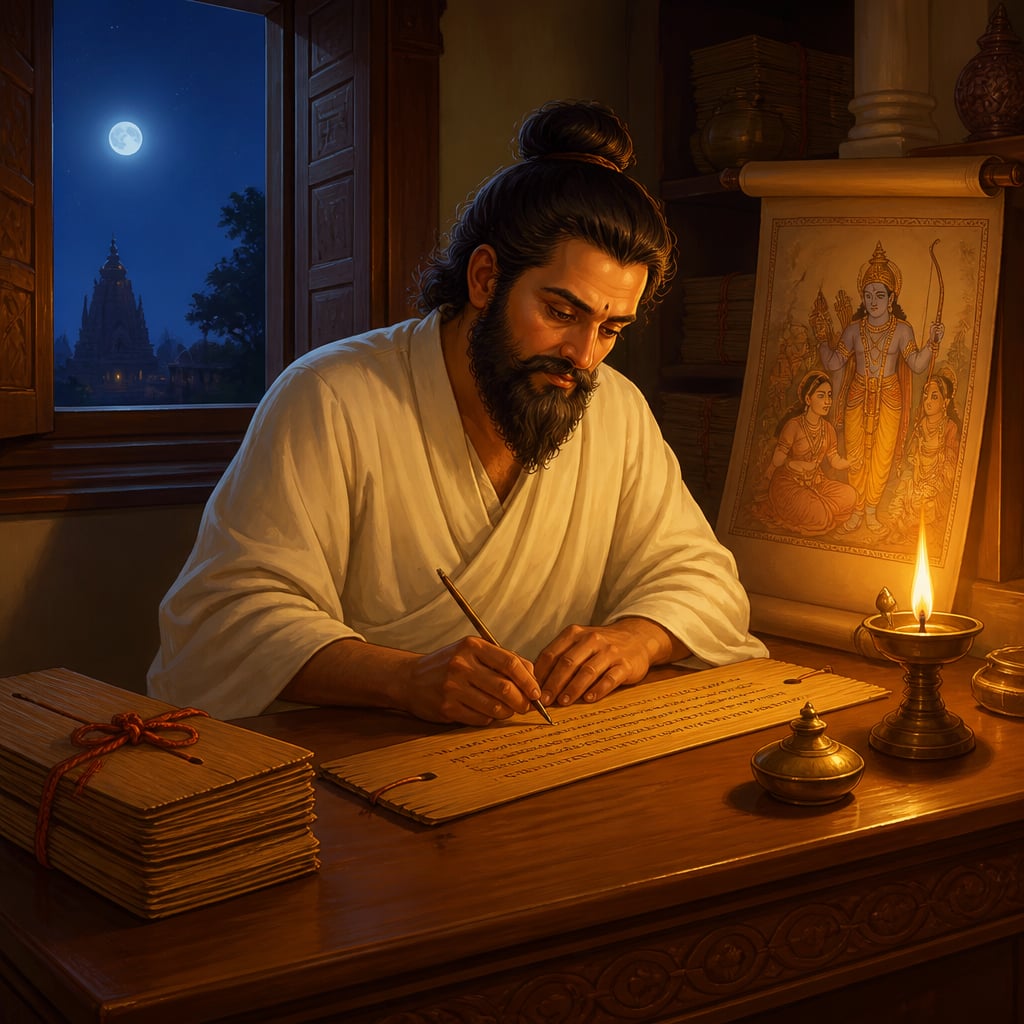
The messenger arrived at Kannauj bearing news that would change the history of Indian literature. A poet from Vidarbha, a Brahmin named Shrikantha, who called himself Bhavabhuti, sought royal patronage. He carried manuscripts of dramas unlike anything composed since Kalidasa himself.
Yashovarman received him in the great hall. The poet, middle-aged and intense, began to read from his Mahaviracharita, a dramatization of Rama's early life. The language was elevated, the emotions profound, the Sanskrit dense with meaning.
By the time Bhavabhuti finished, the court sat in silence. Then Yashovarman spoke: "You will stay at Kannauj. Whatever you need, you shall have."
It was one of the most consequential decisions of his reign.
Bhavabhuti: The Second Master
Who was this poet who would become Sanskrit's second-greatest dramatist? Bhavabhuti was born into a learned Brahmin family in Vidarbha (modern eastern Maharashtra). His education was encyclopedic: Vedic learning, Sanskrit grammar, the philosophical schools, and above all, the theory and practice of drama.
He had come to Kannauj with three plays already composed or in progress:
- Mahaviracharita, Rama's early life, from birth through his marriage to Sita
- Uttararamacharita, The later story of Rama, including Sita's exile and the final reunion
- Malatimadhava, A romantic drama with invented characters
The first two drew from the Ramayana, but Bhavabhuti's treatment was unprecedented. His Rama was introspective, tormented, wrestling with the conflict between duty and love. His Sita was dignified in suffering, her pain rendered with devastating power.
"There is only one rasa, karuna (compassion). All other emotions are merely its transformations." , Bhavabhuti, Uttararamacharita
This was Bhavabhuti's revolutionary aesthetic claim. All emotions, love, heroism, fear, wonder, ultimately derived from our capacity for fellow-feeling. Literature moved us because it awakened compassion.
The Kalidasa Question
Every Sanskrit poet worked in Kalidasa's shadow. The master of the Gupta era, author of Shakuntala, Meghaduta, Kumarasambhava, remained the standard against which all others were measured. How did Bhavabhuti compare?
The critics noticed differences immediately. Where Kalidasa was graceful, Bhavabhuti was grand. Where Kalidasa flowed naturally, Bhavabhuti used dense, elaborate compounds that demanded close attention. Where Kalidasa evoked sweet sentiment, Bhavabhuti portrayed intense, sometimes overwhelming emotion.
Some found Bhavabhuti difficult. They complained that his language was obscure, his style too elaborate. Bhavabhuti's response became legendary:
"Those who spread contempt for my work know something, perhaps. But this effort is not for them. Someone of similar nature to me will be born, time is endless and the earth is vast."
History vindicated him. Today Bhavabhuti is universally acknowledged as second only to Kalidasa in Sanskrit drama, and some prefer his emotional intensity to Kalidasa's polished grace.
Vakpati: The Prakrit Master

While Bhavabhuti worked in Sanskrit, another genius served Yashovarman: Vakpati, master of Prakrit verse.
Vakpati made a bold choice. Instead of composing in Sanskrit, the prestige language of learning, he wrote his epic in Prakrit, a literary vernacular. This was not a concession to accessibility but a demonstration of mastery. Prakrit had its own ancient traditions, and Vakpati would prove that heroic poetry could achieve greatness outside Sanskrit.
His subject was Yashovarman himself. The Gaudavaho, "Slaying of the Gauda King", celebrated the Bengal campaign in some 1,200 verses. Vakpati had accompanied the army, witnessed the landscapes and battles, and now transformed them into art.
"The army of Yashovarman stretched across the horizon like a second earth. The dust of its march darkened the sky." , Vakpati, Gaudavaho
The poem combined vivid nature descriptions, elaborate battle scenes, and sophisticated emotional texture. It was court poetry in the best sense, commissioned work that transcended its origins to become genuine literature.
Two Modes of Excellence
Bhavabhuti and Vakpati represented complementary approaches to literary greatness:
| Aspect | Bhavabhuti | Vakpati |
|---|---|---|
| Language | Sanskrit | Prakrit |
| Genre | Drama | Epic |
| Subject | Mythological Rama | Contemporary king |
| Purpose | Aesthetic/philosophical | Royal glorification |
| Emotional mode | Intense, introspective | Grand, celebratory |
Both served the same king. Both achieved immortality through their art. Together, they made Yashovarman's Kannauj one of the great literary courts in Indian history.
The Performance at Court

Imagine the scene when Bhavabhuti's Uttararamacharita was first performed at Yashovarman's court. The assembled nobles, scholars, and poets watched as actors brought to life Rama's torment over Sita's exile. The play's emotional climax came when Rama, wandering in the forest, encountered a painting of Sita and broke down in grief. Bhavabhuti's language captured the king's anguish with unprecedented intensity. The audience wept. Even the king, it was said, could not hide his emotion. This was the power of great literature, to move even the mighty.
The relationship between Yashovarman and his poets was one of mutual benefit. The king provided material support, land grants, stipends, housing, and the resources needed for creative work. He provided an educated audience capable of appreciating sophisticated literature. He provided prestige, works performed at his court carried royal endorsement.
In return, the poets provided legitimacy. Bhavabhuti's Rama dramas implied a comparison between the mythical king and his patron, both were righteous rulers facing difficult choices. Vakpati's Gaudavaho explicitly celebrated Yashovarman's achievements, creating an official record in artistic form.
More than that, the poets provided something that outlasted both parties: cultural contribution. Yashovarman's political achievements would vanish when he fell. Bhavabhuti's and Vakpati's works would survive for thirteen centuries and counting.
The Meaning of Patronage
Yashovarman's literary court raises questions about the relationship between power and art. Was this genuine cultural achievement or merely propaganda? Were Bhavabhuti and Vakpati free artists or servants of royal ideology?
The answer is complex. Court poets operated within constraints, they praised their patrons, avoided criticism, served political purposes. But within those constraints, genuine art was possible. Bhavabhuti's exploration of grief and compassion transcended any political agenda. Vakpati's Prakrit mastery would have been valuable regardless of subject matter.
The patronage system enabled creation that might otherwise not have happened. Without support, Bhavabhuti might have remained an obscure provincial scholar. Without an audience, Vakpati's linguistic virtuosity would have found no outlet. The system had costs, but it also had benefits, and the benefits included works still studied and admired after more than a millennium.
Historical context
Sanskrit Literary Renaissance, c. 725-740 CE
Sanskrit drama had a long tradition going back to Bharata's Natyashastra. Kalidasa remained the supreme master, but the tradition continued evolving. Bhavabhuti represented the last great flowering before the form began to decline.
Living traditions
Bhavabhuti remains required reading in Sanskrit literature programs. His plays are occasionally staged by classical theater groups. His aesthetic theory about karuna as the fundamental rasa continues to influence discussions of Indian aesthetics.
- Sampurnanand Sanskrit University: One of India's premier Sanskrit universities where Bhavabhuti's texts are studied and preserved
- Kannauj Archaeological Sites: The city where Bhavabhuti's plays were first staged before Yashovarman's court
Reflection
- Was Bhavabhuti's famous declaration about future appreciation confidence or arrogance?
- Why might Bhavabhuti's claim that all rasas derive from karuna (compassion) be philosophically significant?
- How does the patronage system shape what art gets created and preserved?