The Cost of Victory
The Price
Every victory has a price. Skandagupta saved Indian civilization, but the decade of war that made this possible exacted heavy tolls: a depleted treasury, debased coinage, uncertain succession, and an empire transformed from golden age to defensive posture. This lesson honestly examines what it cost to stop the Hunas, the economic strain visible in coins, the political fragility that would emerge after Skandagupta's death, and the uncomfortable truth that even heroic leaders leave complicated legacies.
The Honest Accounting
History celebrates victors but rarely examines their invoices. Skandagupta defeated the Hunas and saved Indian civilization, this is true. But what did victory cost? And did the empire that emerged from these wars resemble the one that entered them?

This lesson offers an honest accounting. Not to diminish Skandagupta's achievement, which was extraordinary, but to understand the full reality of what civilizational defense requires.
The Economic Toll
The most measurable cost appears in Skandagupta's coinage. Numismatists have studied Gupta gold coins across generations, measuring their precious metal content. The results tell a story:
Coin Quality Over Time:
| Emperor | Approximate Gold Purity | Context |
|---|---|---|
| Chandragupta II | ~90% pure gold | Height of Golden Age |
| Kumaragupta I | ~85-90% pure | Continued prosperity |
| Skandagupta (early) | ~80-85% pure | Pre-Huna invasion |
| Skandagupta (late) | ~70-75% pure | After years of war |
| Post-Skandagupta | ~60-70% pure | Decline accelerates |
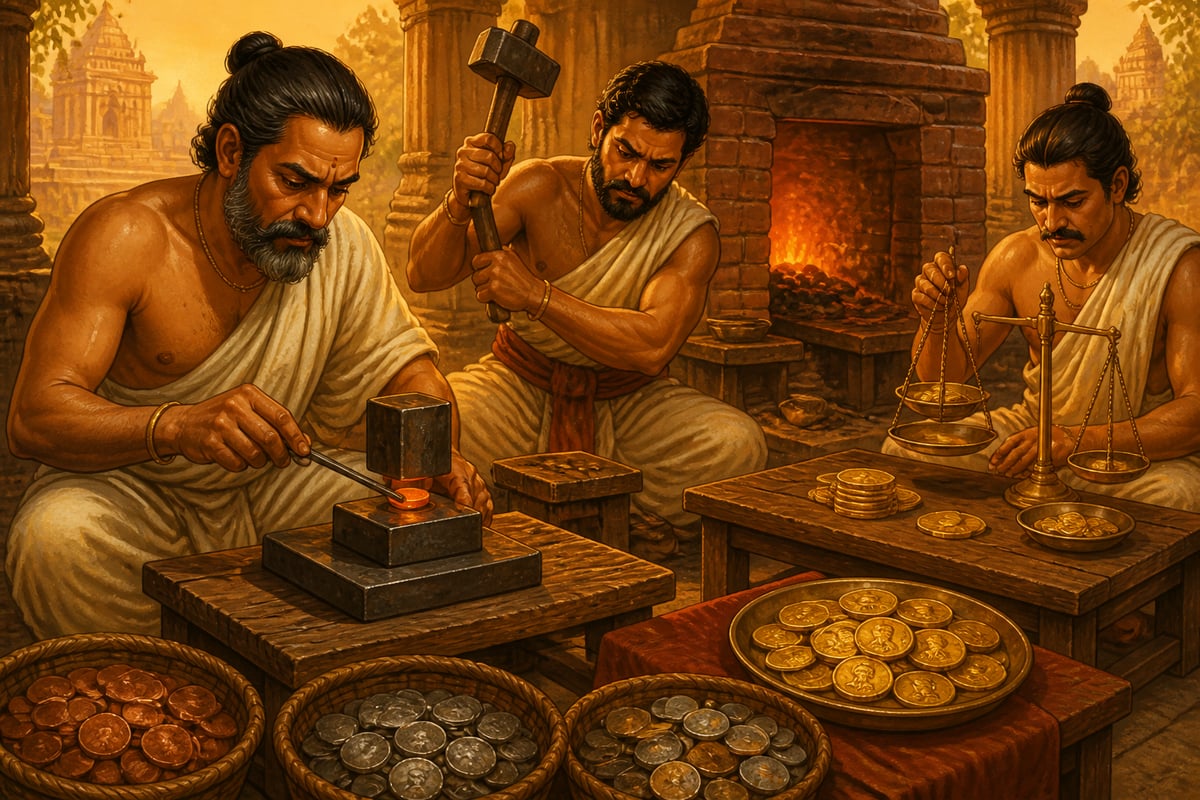
This "debasement", adding cheaper metals to maintain coin volume while reducing gold content, is the universal sign of fiscal stress. The Guptas were not corrupt; they were paying for war.
Where the Money Went:
- Military salaries: Standing armies require constant payment
- Cavalry costs: Horses, equipment, breeding programs
- Fortification: Building and maintaining frontier defenses
- Intelligence: Spy networks extending into Huna territory
- Reconstruction: Repairing damage from raids and battles
The treasury that had funded Chandragupta II's cultural patronage, the temples, universities, poets, and artists, was consumed by the machinery of survival.
The Infrastructure Deficit
Beyond currency, the cost appeared in what wasn't built:
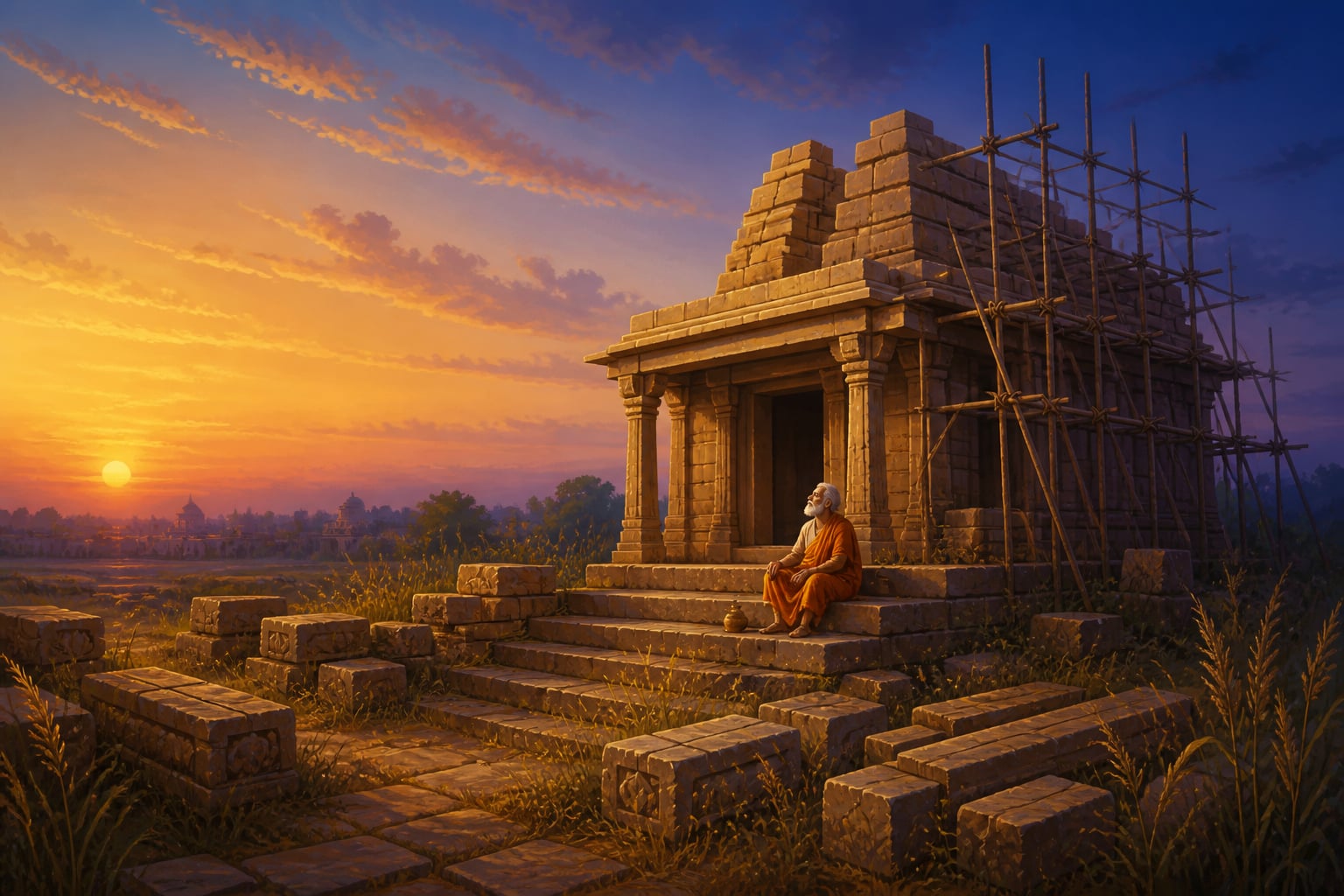
Temples Not Constructed: The great temple-building traditions of earlier Gupta reigns slowed dramatically. Archaeological evidence shows fewer major religious constructions from Skandagupta's era compared to his predecessors. Resources went to forts, not shrines.
Universities Not Expanded: Nalanda and other centers continued operating, but the expansive patronage that had made them world-famous diminished. Survival left little surplus for scholarly endowments.
Roads and Infrastructure: The elaborate road systems, rest houses, and trade infrastructure that facilitated Gupta commerce received less attention. Maintenance continued, but expansion halted.
Irrigation Projects: Except for emergency repairs like the Sudarshana dam, new irrigation works were rare. Agricultural development stalled as resources went to defense.
Human Costs
Beyond economics, the war exacted human tolls that inscriptions don't record:
Soldiers Lost: Frontier battles and garrison duty claimed lives, men who would have been farmers, craftsmen, fathers. The Bhitari inscription celebrates victory but doesn't count the dead.
Civilians Displaced: Northwestern populations lived in fear or fled. Communities that had prospered for generations were disrupted. Trade routes that supported livelihoods became dangerous.
Families Separated: Soldiers stationed at distant garrisons for years couldn't raise children, support elderly parents, or maintain households. The social fabric strained.
Psychological Burden: An empire under permanent threat develops anxiety its peaceful predecessors didn't know. The confident expansiveness of the Golden Age gave way to defensive watchfulness.
Political Fragility
Perhaps most consequentially, the wars revealed and exacerbated political weaknesses:
Provincial Autonomy: Governing from distant Pataliputra while fighting on the frontier required delegating authority. Provincial governors like Parnadatta gained effective independence. This decentralization, necessary for wartime efficiency, proved difficult to reverse.
Feudatory Independence: Subordinate kings who provided troops and resources for the Huna wars expected rewards and autonomy in return. Their loyalty became conditional, based on perceived benefit rather than unconditional submission.
Succession Uncertainty: Skandagupta appears to have died without a clear, strong successor. The circumstances of succession after his death are murky, multiple claimants, disputed legitimacy, rapid turnover. This suggests that the wars had disrupted normal succession planning.
"The king who spends all his strength on external enemies may find he has none left for internal order." , Paraphrase from Arthashastra
The Succession Crisis
When Skandagupta died around 467 CE, the empire's stability died with him:
Immediate Aftermath:
- Purugupta, likely a brother or half-brother, succeeded briefly
- Kumaragupta II followed, with unclear legitimacy
- Budhagupta eventually emerged, but his authority was contested
- By the 480s, the empire had effectively fragmented
Why Did Succession Fail?
Exhausted Resources: No new emperor could offer the patronage and rewards that built loyalty. The treasury was empty.
Decentralized Power: Provincial governors and feudatories who had gained autonomy during the wars didn't willingly surrender it.
Disputed Legitimacy: Multiple claimants weakened each other. Civil conflict drained what war had spared.
Renewed External Pressure: The Hunas, held at bay by Skandagupta's vigilance, sensed weakness. By the late 5th century, Huna kings like Toramana and Mihirakula would penetrate deep into India, accomplishing what Skandagupta had prevented.
Comparing Costs: Rome's Fall
The Western Roman Empire collapsed during Skandagupta's lifetime. Examining Rome's experience illuminates what India avoided, and what similar costs produced:
Roman Costs:
- Constant military expenditure consumed tax base
- Currency debasement accelerated (worse than Gupta)
- Provincial populations resented imperial demands
- Barbarian federates became ungovernable
- Administrative capacity collapsed
Gupta Costs:
- Similar military expenditure, but from larger economic base
- Currency debasement significant but less extreme
- Provincial administration strained but functional
- No barbarian federates, army remained Indian
- Administrative capacity diminished but survived
The difference was magnitude, not kind. India paid heavily but survived. Rome paid beyond its capacity and fell. Skandagupta's achievement was ensuring that costs remained bearable.
The Transformation of Empire
The Gupta Empire after Skandagupta was fundamentally different from the one before the Hunas:
Before the Hunas (c. 400-455 CE):
- Expansive, confident, culturally productive
- Surplus resources for patronage and construction
- Unified command from strong emperors
- External threats manageable and distant
- "Golden Age" in full expression
After Skandagupta (c. 467-500 CE):
- Defensive, anxious, culturally stagnant
- Resources consumed by survival
- Decentralized authority, contested succession
- External threats continuous and immediate
- Decline toward fragmentation
Skandagupta had saved the empire, but he couldn't restore what war had taken. The Golden Age ended not because of defeat but because victory consumed the resources that made it golden.
Was It Worth It?
This uncomfortable question deserves consideration. The costs were enormous. Was survival worth the price?
Arguments for Yes:
Civilization Preserved: The universities, temples, literature, and traditions that war protected continued for centuries. Nalanda survived until the 12th century. Sanskrit literature was transmitted to future generations. Dharmic civilization maintained its continuity.
Regional Kingdoms Flourished: Even as the Gupta center weakened, strong regional kingdoms emerged, the Chalukyas, the Pallavas, later the Cholas. These inherited and developed what the Guptas had preserved.
Cultural Transmission: The knowledge, art, and religious traditions of the Gupta era spread across Asia, to Southeast Asia, Tibet, Central Asia. This transmission required survival.
Arguments for Complexity:
The Hunas Eventually Entered: Despite Skandagupta's defense, Huna kings ruled parts of India within decades of his death. Did the delay matter?
Resources Might Have Bought Peace: Could tribute, diplomacy, or accommodation have achieved survival at lower cost? We'll never know.
The Empire Fell Anyway: Within a century, the Gupta Empire was gone. Did Skandagupta delay the inevitable or change history's trajectory?
The Leader's Dilemma
Skandagupta faced a dilemma every leader confronting existential threat encounters:
Option 1: All-Out Defense Commit maximum resources to stopping the threat. Accept that this depletes reserves, disrupts normal governance, and may leave successors weakened. Survive today; manage tomorrow later.
Option 2: Managed Accommodation Limit defense spending. Accept some losses. Preserve resources for long-term sustainability. Risk that limited defense fails catastrophically.
Option 3: No Good Options Recognize that every choice has costs. Victory is expensive. Defeat is fatal. Accommodation may be both expensive and fatal. Choose the least bad option and accept its consequences.
Skandagupta chose Option 1. His victory preserved civilization. His costs burdened his successors. Both are true.
The Honest Legacy
Skandagupta deserves celebration for what he achieved: he stopped the force that destroyed Rome. But honesty requires acknowledging costs:
- He saved the empire but couldn't save the Golden Age
- He preserved civilization but depleted its resources
- He maintained unity but weakened its foundations
- He ensured survival but not prosperity
This is not criticism but realism. Leaders who face existential threats rarely leave their successors comfortable inheritances. The generation that fights for survival consumes the wealth that peaceful generations accumulate.
Skandagupta's coins, progressively debased, technically competent, symbolically proud, embody this truth. The gold decreased, but the images of royal power continued. The substance diminished, but the form persisted. This was the cost of victory: maintaining appearances while spending reserves, projecting strength while managing scarcity.
What Remains
Skandagupta died around 467 CE, after perhaps twelve years of reign consumed by war and its consequences. He left:
- An empire intact but strained
- A frontier defended but not secured
- A treasury depleted but not bankrupt
- A succession uncertain but not chaotic
- A civilization preserved but not flourishing
This was his achievement: not a perfect outcome but the best available under the circumstances. He bought time. His successors used it poorly. But the time itself, the decades of survival that allowed cultural transmission, regional development, and dharmic continuity, was the gift.
The cost was high. But as the Western Roman Empire's corpse demonstrated, the alternative was higher.
Historical context
Late Gupta Period (c. 465-480 CE)
The late 460s saw an empire exhausted by victory. Skandagupta's death (c. 467 CE) triggered succession disputes. Multiple claimants weakened each other while the treasury remained empty. Provincial governors who had gained autonomy during the wars didn't readily surrender it. The Hunas, sensing weakness, prepared for renewed invasion.
Living traditions
Economics textbooks use the Gupta debasement as a case study in war financing. The trade-off between military spending and currency stability that Skandagupta faced recurs throughout history, from Roman debasement to modern deficit spending. His reign demonstrates that even successful defense comes at economic cost.
- National Museum Coin Collection: The National Museum houses an extensive collection of Gupta-era coins, including specimens from Skandagupta's reign. Visitors can observe the declining gold content that documents the fiscal strain of the Huna wars, numismatic evidence of the cost of civilizational defense.
- Patna Museum: The museum near ancient Pataliputra contains Gupta artifacts including coins and inscriptions. Pataliputra was the Gupta capital from which Skandagupta governed during the Huna crisis. The archaeological collections document both Gupta achievements and their gradual decline.
Reflection
- Have you ever 'won' something, a negotiation, a conflict, a goal, only to find that the cost of winning changed you or your situation more than you expected?
- Was Skandagupta's sacrifice worth it if his successors couldn't maintain what he preserved? Does delayed defeat differ from ultimate victory?
- When resources are finite and threats are endless, is there a 'right' balance between present defense and future flourishing? Or is this a tragic choice with no good answer?