The Battle of the Frontiers

The Defender

In the decisive confrontation that would determine India's fate, Skandagupta marched his armies to meet the Huna horde at the northwestern frontier. Unlike Rome and Persia, which crumbled before the Central Asian onslaught, India would stand, because one emperor chose to fight not in the heartland but at the gates. Witness the desperate battles where Gupta valor met Huna fury, and discover how leadership, terrain, and tactical brilliance combined to save a civilization.

The March to the Frontier

In 455 CE, Skandagupta made a decision that would determine the fate of Indian civilization. Rather than wait for the Hunas to pour through the mountain passes and devastate the wealthy cities of the Gangetic plain, as they had done in Persia and were doing in Europe, he would march to meet them at the frontier itself.
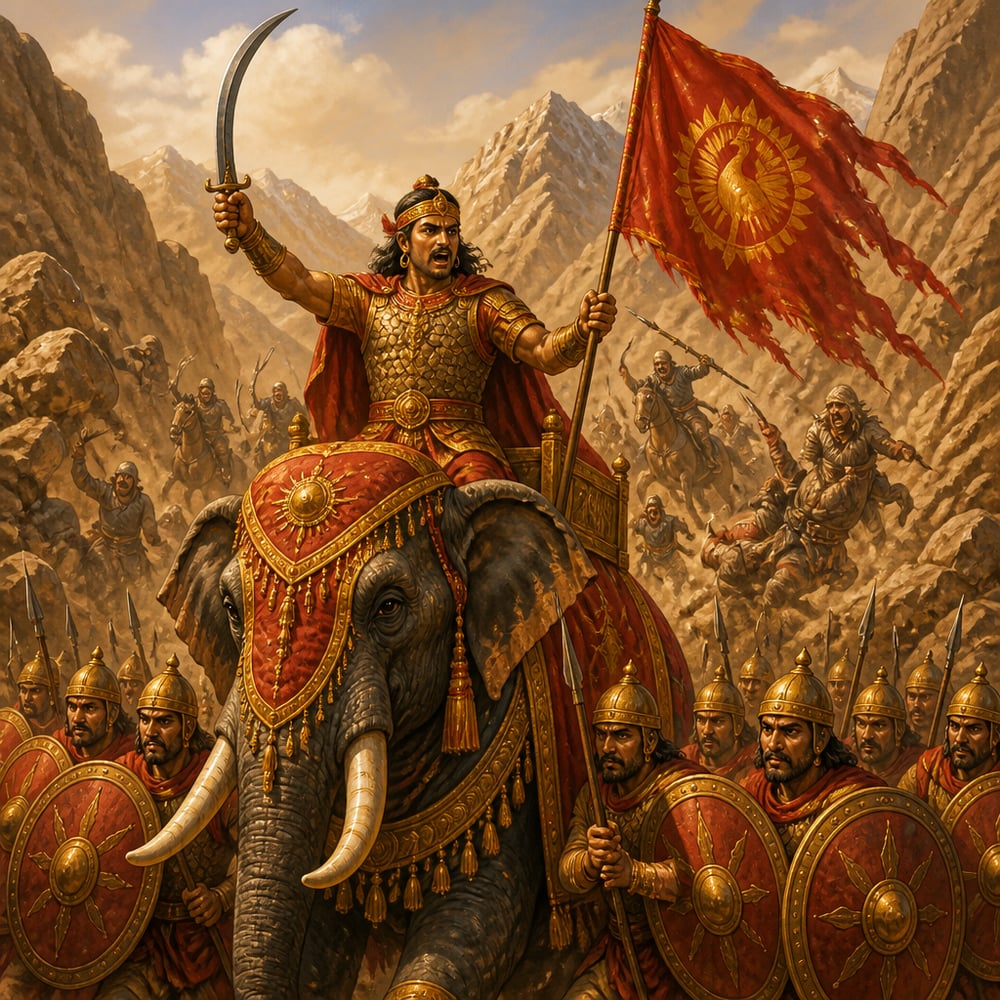
Skandagupta rallying his army before the frontier battle

This was not obvious strategy. The Gupta heartland offered advantages: established supply lines, fortified cities, familiar terrain. Fighting at the frontier meant stretched logistics, difficult terrain, and battle on ground the Hunas knew well. But Skandagupta understood something crucial: the Hunas' strength multiplied with every conquest. Each city they took added to their resources, their manpower, their confidence. He had to stop them before they gained momentum.

The Northwestern Frontier

The Sindh-Punjab region was where empires met and clashed. The great invasion routes through the Khyber Pass, Bolan Pass, and Gomal Pass had been highways for conquerors since time immemorial, the Persians under Darius, the Greeks under Alexander, the Kushanas, and now the Hunas.

The terrain offered both dangers and opportunities:

Challenges:

Advantages:

Skandagupta positioned his forces to leverage these geographical realities. He chose his ground carefully, not the open plains where Huna cavalry would dominate, but the approaches to the passes where terrain would constrain their movements.

The Huna Onslaught

Huna horse archers loosing arrows on Gupta lines

The Huna army that descended upon India was a terrifying instrument of war. The Bhitari inscription describes the earth being "overcome by enemies" and Skandagupta fighting "with his arm" to restore it. Though the inscriptions are poetic rather than tactical, we can reconstruct what the Gupta forces faced:

Huna Military Advantages:

Huna Numbers: Exact figures are lost, but the Hephthalite confederation could field massive armies. Their conquest of Persia required tens of thousands of warriors. Against India, they likely brought a force comparable to what had crushed the Sassanids.

"The Hunas came like a flood from the mountains, covering the land with their horsemen. But at the frontier, they met the rock upon which their flood would break." , Paraphrase from later texts

Skandagupta's Military Response

Facing this unprecedented threat, Skandagupta adapted Gupta military traditions while innovating where necessary:

Cavalry Reform: Traditionally, Gupta armies relied heavily on infantry and war elephants. Against Huna horse archers, this would be suicidal. Skandagupta expanded and reformed his cavalry, training them for the mobile warfare the Hunas excelled at. Though the Guptas could never match Huna horsemanship, they could become competent enough to contest the field.

Strategic Defense: Rather than seeking a single decisive battle, which favored the Hunas, Skandagupta employed a strategy of multiple engagements. He harassed Huna forces at the passes, contested river crossings, defended fortified positions, and denied the invaders the quick victory they needed.

Elephant Corps: The Guptas' war elephants, while vulnerable to horse archers in open terrain, remained effective for defending fixed positions and breaking enemy formations at close quarters. Skandagupta used them selectively, at times and places of his choosing.

Alliance Network: The Bhitari inscription mentions that Skandagupta's mother Anantadevi was from a different royal lineage, suggesting marriage alliances that provided additional military resources. Various regional lords joined the imperial defense, recognizing that the Huna threat respected no boundaries.

The Critical Battles

Gupta forces trapping the Hunas in a narrow pass

The exact locations and dates of Skandagupta's battles against the Hunas are not precisely recorded, a frustration for military historians. However, the inscriptions and later texts allow us to reconstruct the campaign's general character:

Phase 1: Initial Contact (c. 455 CE) The first engagements occurred as Huna advance forces probed Gupta defenses. These skirmishes tested both sides' capabilities. Skandagupta's forces, though initially caught off guard by Huna tactics, learned quickly.

Phase 2: The Main Invasion (c. 455-456 CE) The Hunas launched their major offensive, likely through multiple passes simultaneously. This was their standard approach, overwhelming defenders who couldn't be strong everywhere. Skandagupta was forced to make hard choices about which routes to defend and which to merely delay.

Phase 3: Decisive Engagement (c. 456-457 CE) At some point, there was a major confrontation, perhaps multiple major battles, where Gupta forces definitively defeated the Huna invasion. The Junagadh inscription speaks of Skandagupta's valor restoring "the earth diminished by the Hunas," implying significant combat and clear victory.

Phase Approximate Date Character Outcome
Initial Contact 455 CE Skirmishes, probing attacks Tactical learning
Main Invasion 455-456 CE Full-scale Huna offensive Contested, heavy fighting
Decisive Battle 456-457 CE Major engagement(s) Gupta victory, Huna retreat

The Emperor in Battle

Unlike later rulers who commanded from the rear, Gupta emperors led from the front. The inscriptions emphasize Skandagupta's personal valor, he restored the earth "by his arm," not by his generals' arms. This was both symbolically important and tactically significant.

Personal Leadership:

The gold coins from Skandagupta's reign show him as a powerful, confident figure, imagery meant to project strength to allies and enemies alike. For an emperor facing existential war, every symbol mattered.

Why India Won

The question that echoes through history: How did India succeed where Rome and Persia failed? Several factors converged:

Unified Command: Skandagupta commanded a unified empire with a centralized military. Rome's defenders were hampered by civil wars; Persia's by succession disputes. The Guptas presented a coordinated defense under a single determined commander.

Strategic Geography: India's northwestern frontier, while permeable, offered better defensive options than the Danube or Persian frontiers. The Hindu Kush and associated ranges channeled invasion routes into manageable chokepoints.

Defensive Strategy: Skandagupta chose not to seek glory through offensive warfare but to defend methodically. He avoided the catastrophic defeats that destroyed Persian armies and instead fought the patient war that exhausted Huna resources.

Economic Base: The Gupta Empire retained access to its wealthy heartland throughout the war. Agricultural surplus, trade revenues, and accumulated treasury reserves funded the extended campaign. The Hunas, operating far from their Central Asian bases, could not match Gupta staying power.

Psychological Resilience: Perhaps most importantly, Skandagupta and his subjects chose to fight rather than accommodate. Other societies had collapsed psychologically before the Huna terror. India's civilization, anchored in dharmic conviction, found the will to resist.

The Price of Victory

Though victorious, India paid dearly. The inscriptions' references to the earth being "diminished" by the Hunas before restoration suggest significant damage:

The Junagadh inscription records that a dam (the Sudarshana Lake) had breached, whether from the war or from neglect during the crisis. This engineering project, originally Mauryan, was repaired by Skandagupta's governor Chakrapalita in 457-458 CE. The repair of civilian infrastructure immediately after the war shows imperial priorities returning to peacetime concerns.

The Aftermath

With the main Huna invasion defeated, the immediate existential threat passed. But this was victory, not peace:

Short-term:

Long-term Reality:

Skandagupta had saved India, but he had also committed the empire to eternal vigilance. The Hunas would return, again and again, throughout his reign. Each incursion would require repulse. The golden peace of Chandragupta II's era was gone forever.

A Civilization Preserved

Consider what Skandagupta's victory preserved:

The Battle of the Frontiers was not just a military victory but a civilizational one. By his valor and strategic judgment, Skandagupta ensured that Indian civilization would not share Rome's fate, would not endure the Dark Ages that descended upon Europe.

This is why the Bhitari inscription compares Skandagupta to Indra, king of the gods. For his subjects, he had performed nothing less than cosmic protection, defending the realm of dharma against the forces of chaos.

The Shield Holds

As the dust of battle settled on the northwestern frontier, Skandagupta had accomplished what no Persian emperor, no Roman general had achieved: he had stopped the Hunas. The shield held.

But the emperor who had saved civilization now faced a different challenge: rebuilding what war had damaged, maintaining readiness for future attacks, and governing an empire that had expended enormous resources on survival. The battles at the frontier were won. Now came the equally difficult work of holding together what he had fought to preserve.

Historical context

Late Gupta Period (c. 455-457 CE)

The Gupta Empire faced its greatest external threat since its founding. The Hunas had already destroyed the Kidarite kingdom in Gandhara and crushed Sassanid Persia. Their invasion of India represented the eastern arm of the same nomadic storm that was ending the Roman Empire in Europe. The empire's resources were strained by succession struggles, but under Skandagupta's command, a unified defense materialized.

Living traditions

Military academies study Skandagupta's frontier defense as an example of successfully countering technologically superior mobile forces through terrain selection, tactical adaptation, and strategic patience. The contrast with Rome's failure against similar threats is analyzed in comparative military history. The term 'frontier defense' in Indian strategic discourse often invokes this period.

Reflection

More in Skandagupta

All lessons in Skandagupta · Great Emperors: The Golden Age course