Legacy of the Shield

Legacy & Lessons

Skandagupta died around 467 CE, having held the line for over a decade. Though the Gupta Empire would decline after him, his achievement was unique: he bought India two more centuries before permanent nomadic conquest. This lesson examines why 'The Shield' matters more than gilded patronage, and what Skandagupta's story teaches about the relationship between survival and civilization.

The Man Who Saved a Civilization

In 467 CE, Skandagupta died. The Bhitari Pillar, which had celebrated his victories, offers no details of his passing, no grand funeral described, no succession ceremony recorded. The man who had saved India from the Hunas slipped from history quietly, perhaps worn out by a decade of ceaseless vigilance.
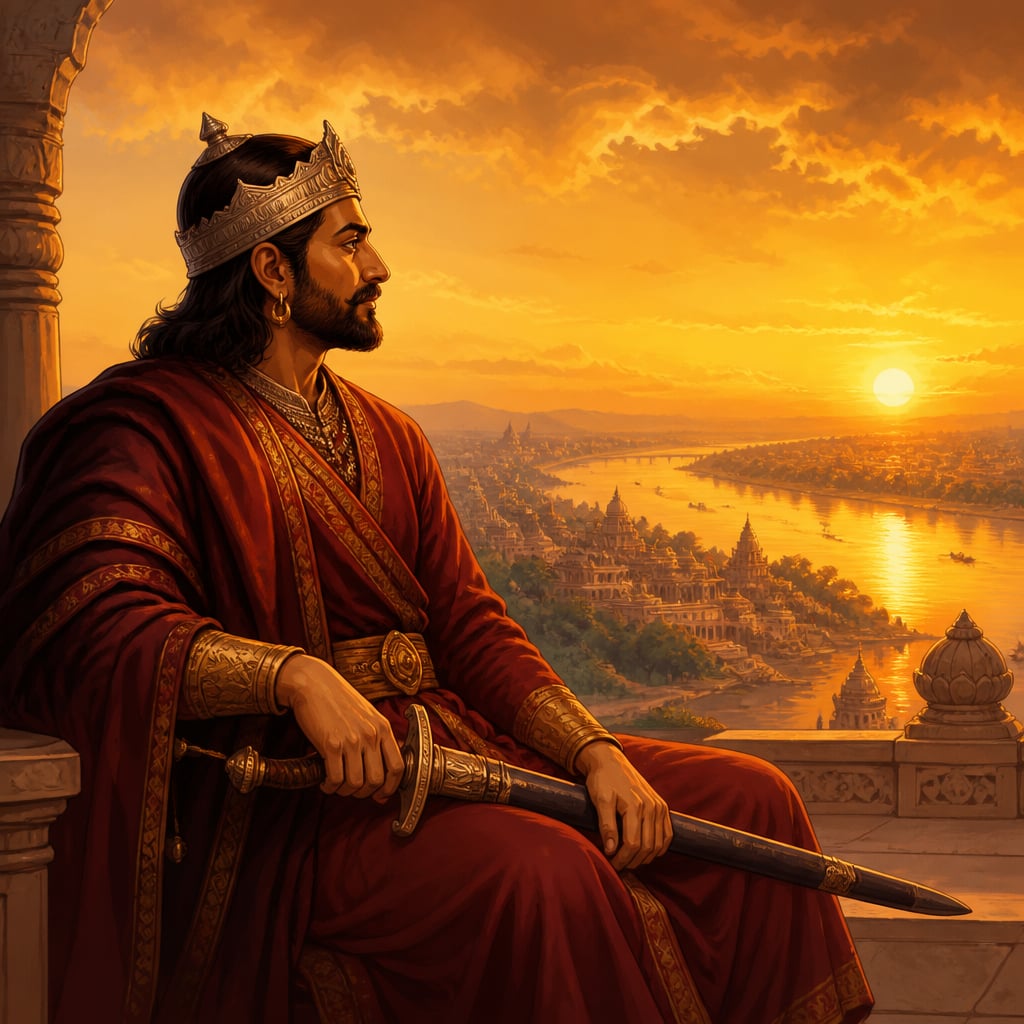
Skandagupta in his final years on a palace terrace

But what he left behind was incalculable.

Measuring the Unmeasurable

Historians often compare rulers by what they built, temples raised, cities founded, monuments inscribed. By these measures, Skandagupta seems modest. He completed no great temple complexes. His coins show a declining empire. His inscriptions speak more of war than of culture.

But this metric fundamentally misunderstands his achievement.

Samudragupta and Chandragupta II had the luxury of building because earlier generations had secured the frontiers. Skandagupta never had that luxury. His reign was consumed by a single question: would Indian civilization survive at all?

The answer, because of him, was yes.

What the Hunas Would Have Destroyed

To understand Skandagupta's legacy, consider what the Hunas destroyed wherever they succeeded.

In Persia: The Hephthalites crushed the Sassanid Empire in 484 CE, killing King Peroz I and plunging Iran into a century of weakness. Persian culture survived, but political continuity was shattered.

In Central Asia: The sophisticated Buddhist kingdoms of Bactria were obliterated. The Bamiyan Buddhas, which the Taliban destroyed in 2001, were among the few remnants of a civilization the Hunas had largely erased centuries earlier.

In China: The northern regions fell to successive nomadic dynasties. Only the south, protected by the Yangtze, preserved Chinese civilization during the 'Period of Disunion.'

India's northwestern frontier offered no natural barrier like the Yangtze. If Skandagupta had failed, the Hunas would have swept into the Gangetic plain just as they had swept through Persia. The Nalanda university, still being built during his reign, might never have become the greatest center of learning in the ancient world. The temple traditions being established across the subcontinent might have been stillborn.

The Rome Comparison, Concluded

We have compared Skandagupta to Rome's late defenders throughout these lessons. Now we can complete that comparison.

Rome's western empire fell in 476 CE, less than a decade after Skandagupta's death. But the fall was different in character.

Rome fell because its defenders failed. The barbarians broke through. Emperors were puppets of Germanic generals. The last emperor, Romulus Augustulus, was deposed by his own barbarian troops.

India, in contrast, held. The Hunas were stopped, thrown back, contained. When they eventually did establish kingdoms in western India during the 6th century, they ruled as Indianized dynasties, adopting Hindu practices and Sanskrit titles. They conquered bodies but were themselves conquered by ideas.

This difference matters. Rome's fall meant the loss of classical civilization in the West for centuries. The "Dark Ages" that followed saw literacy decline, trade collapse, and cities shrink to villages. India experienced nothing comparable. The Gupta decline was political, not civilizational.

The Shield's True Purpose

Skanagupta's epithet, "The Shield", reveals a profound truth about different types of greatness.

Conquerors like Samudragupta expand the boundaries of what is possible. They add new territories, new peoples, new wealth to their realms. Their greatness is measured in addition.

Defenders like Skandagupta protect what already exists. They prevent subtraction. Their greatness is measured in what continues to flourish because of their sacrifice.

Both types of greatness are necessary. Samudragupta created the empire that made the Golden Age possible. Skandagupta ensured that age's achievements would survive to be transmitted forward.

But we must be honest: the world rarely celebrates defenders. Conquerors get epic poems. Defenders get obscure inscriptions. Alexander the Great is a household name. Skandagupta is known only to specialists.

This asymmetry in memory is itself a form of civilizational blindness. We romanticize expansion while taking survival for granted. We praise those who add while forgetting those who preserve.

What Survived Because of Him

Let us be specific about Skandagupta's legacy:

Students learning at Nalanda after Skandagupta's reign

Nalanda University continued developing after his reign, eventually hosting 10,000 students from across Asia. It flourished for another seven centuries. The knowledge preserved and transmitted there, Buddhist philosophy, logic, grammar, medicine, shaped civilizations from Tibet to Japan.

Temple traditions established during the Gupta period became the foundation for Hindu temple architecture across India. The structural temples that emerged in the 6th-8th centuries built directly on Gupta precedents.

Sanskrit literature experienced a renaissance that continued for centuries. Kalidasa may have written during Chandragupta II's reign, but his works survived because Skandagupta held the line.

Administrative systems developed under the Guptas remained influential even as political power fragmented. Later dynasties consciously modeled themselves on Gupta precedents.

Indian civilization itself, the complex of Dharmic traditions, Sanskrit learning, temple-based society, and sophisticated urbanism, survived intact to be inherited by successor kingdoms.

The Lesson of the Long Defense

Skanagupta's twelve-year reign offers a final lesson: sometimes the greatest achievement is buying time.

He could not permanently solve the Huna problem. The nomads were too numerous, their reserves in the steppes too deep. But he could delay them. He could ensure that when they finally established themselves in India, they did so as tributaries of Indian culture rather than destroyers of it.

This is not a glamorous form of victory. There are no decisive battles that end the threat forever. There is only the grinding work of holding the line, year after year, knowing that the enemy will return.

But without this work, nothing else matters. All the poetry of Kalidasa, all the astronomy of Aryabhata, all the philosophy of Nalanda, all would have been swept away like the achievements of Bactria, remembered only in fragments and ruins.

Skandagupta Among the Guptas

Where does Skandagupta rank among the Gupta emperors?

Samudragupta was the greater conqueror. Chandragupta II was the greater patron of arts. Kumaragupta I enjoyed the longer reign.

But Skandagupta was the one who faced the impossible challenge, and met it. He took an empire already strained by generations of warfare and held it together against an enemy that had destroyed every other civilization in its path.

He was not given the luxury of building great monuments. His treasury was depleted, his armies exhausted, his frontiers under constant pressure. In these circumstances, his achievement in preserving the empire was itself monumental.

The Bhitari Pillar's description, that he "re-established the ruined fortunes of his family", is the understatement of ancient Indian history. He did not merely restore fortunes. He preserved a civilization.

The Shield Remembered

Today, Skandagupta remains less famous than his predecessors. His coins are studied for what they reveal about imperial decline. His inscriptions are parsed for chronological details. His reign is often treated as prologue to the empire's fall.

This is a mistake.

Every generation that benefited from Indian civilization after the 5th century, every student at Nalanda, every devotee at a Gupta-style temple, every reader of Sanskrit literature, owes a debt to the man who held the northern frontier when all seemed lost.

The Hunas came like a flood. Skandagupta was the dam.

The dam cracked under pressure. It was not beautiful. It required constant maintenance. Eventually, it gave way.

But it held long enough.

That is the legacy of the shield: not perfection, but sufficiency. Not victory forever, but survival long enough for what matters to take root so deeply it cannot be uprooted.

In a world that celebrates conquerors, let us remember the defender who made their conquests meaningful. Let us remember Skandagupta, the last great Gupta, the shield of Dharma, the man who saved Indian civilization when no one else could.

Historical context

Late Gupta Period (455-467 CE)

India remained divided among regional powers but culturally united by Sanskrit, Dharmic traditions, and Gupta-era precedents. The Huna threat had been contained, buying centuries of continued cultural development.

Living traditions

Skandagupta's strategy of 'active defense' is studied in Indian military academies. His example is cited in discussions of how civilizations survive existential threats.

Reflection

More in Skandagupta

All lessons in Skandagupta ยท Great Emperors: The Golden Age course