Reconstruction and Repair
The Administrator
Victory over the Hunas was only half the battle. The war had devastated frontier regions, disrupted trade, and strained the treasury. Now Skandagupta faced an equally demanding challenge: rebuilding what war had damaged. Through the remarkable Junagadh inscription, we witness an empire transitioning from war to peace, repairing a dam first built by the Mauryas, restoring prosperity to Gujarat, and demonstrating that great kings must be administrators as well as warriors.
From Battlefield to Building Site
When Skandagupta returned from the northwestern frontier, victorious but exhausted, he found an empire in urgent need of repair. The Huna wars had not just cost treasure and lives, they had disrupted the careful systems that made the Gupta Empire function.
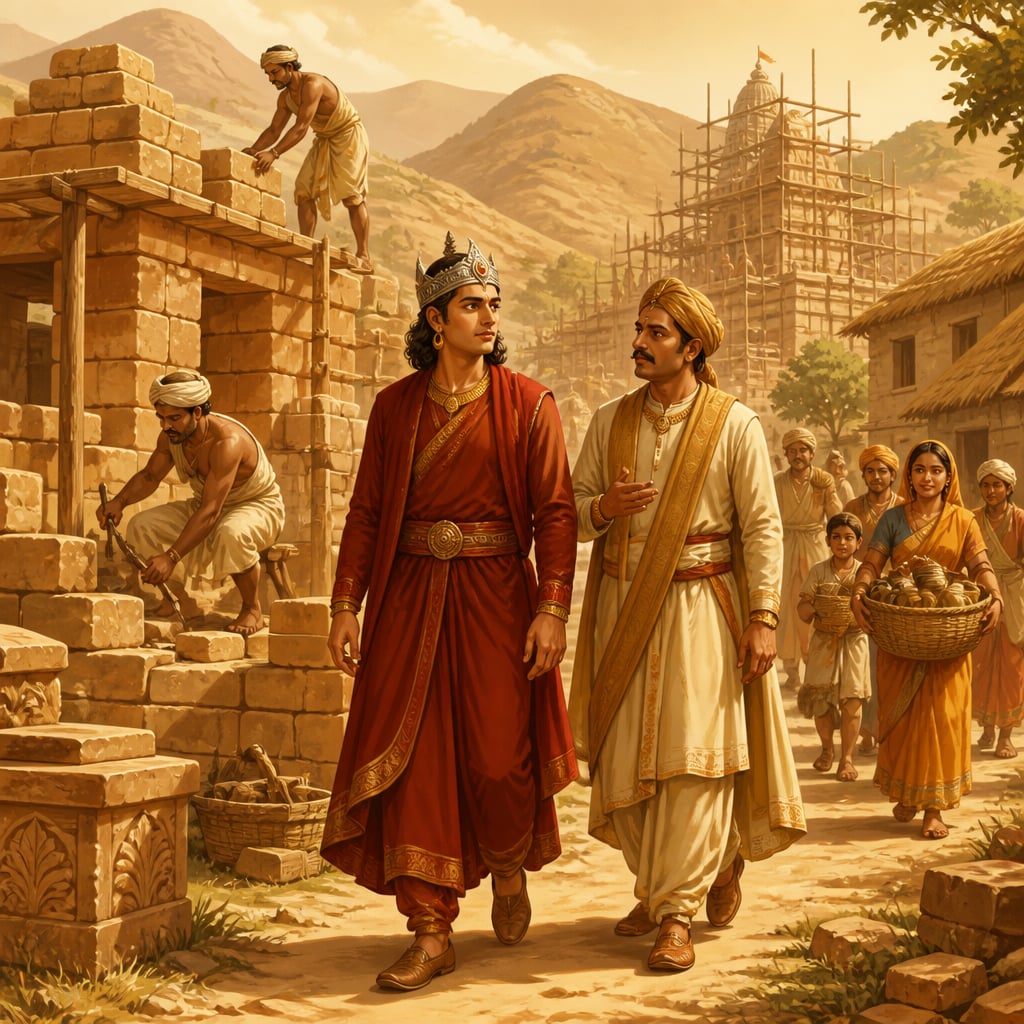
The test of a ruler is not just winning wars but what comes after. Many conquerors have won great victories only to lose the peace. Skandagupta understood that his legacy would be defined not just by the battles he won but by the civilization he preserved and restored.
The Damage Assessed
The Huna invasion had left deep wounds across the empire:
Frontier Devastation: The northwestern provinces bore the brunt of the fighting. Cities had been besieged, villages burned, populations displaced. The fertile Punjab and Sindh regions had seen their agricultural systems disrupted.
Trade Disruption: The Gupta Empire's prosperity depended on trade routes connecting India to Central Asia, Persia, and ultimately Rome. These routes passed through the very territories the Hunas had attacked. Merchants who had fled would not return until stability was assured.
Treasury Strain: War is expensive. Maintaining large armies in the field, paying soldiers, supplying cavalry, all this had drained resources accumulated over generations. The gold content in Gupta coins began to decline, suggesting fiscal pressure.
Administrative Gaps: In wartime, governance suffers. Governors focused on military matters; tax collection became difficult; infrastructure maintenance was neglected. The careful administrative machinery the Guptas had built needed recalibration.
"A king who wins war but loses peace has won nothing. The earth must be restored, not merely defended." , Paraphrase from Arthashastra principles
The Sudarshana Lake: A Case Study
The most detailed account of Skandagupta's reconstruction efforts comes from an unexpected source: the repair of a dam in Gujarat. The Junagadh Rock Inscription of 457-458 CE provides an extraordinary window into Gupta administration.
The Sudarshana Lake was an artificial reservoir created by damming streams near Junagadh (ancient Girinagar) in Gujarat. Its history reads like a chronicle of Indian empires:
| Period | Ruler | Action |
|---|---|---|
| c. 300 BCE | Chandragupta Maurya | Original dam constructed |
| c. 150 CE | Rudradaman I (Shaka) | Major repair after breach |
| 457-458 CE | Skandagupta (Gupta) | Second major repair after breach |
The dam had breached sometime during Skandagupta's reign, whether from wartime neglect, unusual floods, or simple age is unclear. What matters is what happened next.
Chakrapalita's Mission
Skandagupta's governor of Saurashtra was Parnadatta, a member of the distinguished Parivrajaka family. When the Sudarshana dam breached, Parnadatta was aging and infirm. He appointed his son Chakrapalita to handle the crisis.
The Junagadh inscription, composed by Chakrapalita himself, describes the situation:
"The dam, struck by the flood of excessive water, was broken... the land, that excellent ornament of Saurashtra, was laid waste."
This was no minor engineering problem. The breach had destroyed the irrigation system that supported agriculture across the region. Farmers faced ruin; towns dependent on that agriculture faced famine. The local economy was collapsing.
The Repair Project

Chakrapalita responded with impressive speed and resources:
Immediate Response:
- Mobilized labor and materials
- Assessed the damage and designed repairs
- Secured funding (from provincial treasury with imperial backing)
Engineering Achievement: The inscription records that Chakrapalita repaired the dam breach, described as a significant opening where water had carved through the structure. The new work was built to be stronger than the original, learning from the failure.
Financial Management: The inscription specifically notes that Chakrapalita spent his own wealth on the project, not just state funds. This was expected of high officials, personal investment demonstrated commitment and shared sacrifice.
Timeline: The repair was completed relatively quickly, the inscription is dated to 457-458 CE, suggesting work was done within 1-2 years of the breach. For a major engineering project without modern equipment, this was efficient.
The Inscription's Significance
The Junagadh Rock Inscription is remarkable for several reasons:

Administrative Continuity: The same rock face bears inscriptions from Ashoka (3rd century BCE), Rudradaman (2nd century CE), and now Skandagupta's era. Each ruler inherited and maintained infrastructure built by predecessors, even when those predecessors were foreign conquerors. The Shaka king Rudradaman had repaired what the Mauryas built; now the Guptas repaired what the Shakas had restored. This continuity of stewardship across dynasties and centuries is extraordinary.
Provincial Governance: The inscription reveals the Gupta administrative system in action. The governor Parnadatta had authority and resources to handle regional crises. His son Chakrapalita could mobilize significant resources quickly. The imperial government trusted provincial officials to act effectively.
Wartime to Peacetime: Dated to 457-458 CE, the inscription falls immediately after the Huna wars. The rapid return to civilian infrastructure projects demonstrates that Skandagupta's government was functioning effectively despite the recent crisis. War had strained but not broken the administrative machinery.
Documentation Standards: The Guptas kept records. They commemorated achievements in permanent inscriptions. This bureaucratic culture of documentation preserved information that would otherwise be lost and signaled to future generations the empire's accomplishments.
Reconstruction Across the Empire
The Sudarshana repair is our best-documented example, but reconstruction must have occurred across the empire:
Frontier Restoration:
- Rebuilding fortifications damaged in the war
- Resettling populations displaced by fighting
- Re-establishing trade routes and security
Agricultural Revival:
- Repairing irrigation systems
- Providing seed and support for farmers returning to land
- Restoring tax collection to sustainable levels
Temple Maintenance:
- Continuing patronage of religious institutions
- Completing construction projects interrupted by war
- Supporting the ritual life that legitimized royal authority
Urban Recovery:
- Restoring markets and commercial activity
- Maintaining roads and communication
- Ensuring public order in cities
The Economics of Reconstruction
How did Skandagupta finance reconstruction while maintaining military readiness for future Huna incursions?
Preserved Heartland: The Gangetic plain, the economic core of the empire, was never invaded. Agricultural surplus from this region continued to flow into the treasury.
Trade Restoration: As the northwestern frontier stabilized, trade resumed. Gujarat's ports (like Bharukaccha/Baroda) connected India to the Mediterranean world. Trade revenues, crucial for Gupta prosperity, began recovering.
Temple Economy: Temples functioned as banks and economic centers. Their continued operation, often with royal patronage, helped maintain economic activity even during difficult times.
Deferred Investment: The declining gold content in later Skandagupta coins suggests the treasury remained under pressure. Some projects may have been scaled back or postponed. This was the price of survival.
Governance Philosophy
The reconstruction effort reflected Gupta governance philosophy:
Dharmic Kingship: The king's duty (rajadharma) included maintaining infrastructure, protecting agriculture, and ensuring prosperity. Rebuilding was not optional but obligatory.
Hierarchical Responsibility: The emperor set priorities; governors executed them. Chakrapalita didn't wait for detailed instructions from Pataliputra, he was empowered to act. This delegation was essential for an empire this size.
Fiscal Prudence: Even in reconstruction, costs were managed. Officials contributed personal resources. Projects were prioritized by urgency and impact.
Long-term Thinking: The Sudarshana repair was designed to last, it did last, for centuries. Gupta engineering wasn't temporary patching but durable construction.
Continuity of Civilization
The Junagadh inscription's most remarkable feature may be its placement. By adding his inscription to the same rock that bore Ashoka's edicts and Rudradaman's record, Chakrapalita (acting for Skandagupta) made a powerful statement:
We are the heirs of all who came before.
The Mauryas built the dam. The Shakas maintained it. The Guptas repaired it. Dynasties changed, even foreign dynasties held power, but the infrastructure of civilization was maintained. This was what dharmic kingship meant in practice.
Skandagupta had just saved India from the Hunas, the same Hunas who were destroying Roman infrastructure in Europe, never to be restored. The contrast is stark. In India, an emperor who had fought desperately for survival immediately returned to the patient work of maintaining dams and supporting agriculture.
The Administrator's Achievement
We remember Skandagupta primarily as a warrior, and rightly so, given the magnitude of the Huna threat. But the Junagadh inscription reveals another dimension:
The warrior was also an administrator.
Any general can win battles. Only a true king can win the peace that follows. Skandagupta's reconstruction efforts ensured that his military victory actually meant something, that the civilization he defended continued to function.
Consider what might have been: Skandagupta defeats the Hunas but neglects his exhausted empire. Provincial administration collapses. Infrastructure fails. Trade doesn't recover. Within a generation, the empire fragments not from external attack but internal decay.
This didn't happen. The empire held together. Regional governors like Parnadatta and Chakrapalita had the authority and resources to act. The center supported the provinces. The patient work of reconstruction complemented the dramatic work of defense.
The Peace After Victory
By 458 CE, the crisis had stabilized. The Hunas were contained at the frontier. The Sudarshana dam was repaired. Provincial administration was functioning. Trade was recovering.
But this was not a final victory. The Hunas remained powerful in Central Asia. They would return. Skandagupta had bought time and preserved capability, but eternal vigilance was now the price of survival.
The emperor who had saved civilization now governed it. The warrior became an administrator. The shield that had defended the realm now provided the stability under which reconstruction could proceed.
This transition, from war to peace, from defense to development, is perhaps the truest test of leadership. Skandagupta passed it. The evidence is carved in stone at Junagadh, where an inscription recording a dam repair bears witness to an empire that knew how to rebuild what war had damaged.
Historical context
Late Gupta Period (c. 457-458 CE)
The immediate post-war period saw the Gupta Empire transitioning from crisis to recovery. The Hunas had been repelled but remained a threat. The northwestern frontier required ongoing defense. Meanwhile, the empire's core territories, the Gangetic plain and Gujarat, returned to normal governance. The Junagadh inscription documents this transition in remarkable detail.
Living traditions
Modern dam engineering in India consciously draws on this ancient tradition. The Narmada Dam project and other major water infrastructure invoke the precedent of rulers like the Mauryas and Guptas who understood irrigation as a state responsibility. Water resource management remains central to Indian governance, as it was in Skandagupta's time.
- Junagadh Rock Inscription Complex: The remarkable rock face bearing inscriptions from three eras: Ashoka's edicts (c. 250 BCE), the Shaka ruler Rudradaman's record (150 CE), and Skandagupta's governor Chakrapalita's dam repair inscription (457-458 CE). This single location chronicles seven centuries of Indian imperial history and demonstrates the continuity of governance across dynasties.
- Uparkot Fort: An ancient fort complex near the inscription site, with structures dating from Mauryan to Gupta periods. The Buddhist caves and stepwells within the fort complex demonstrate the long history of Junagadh as an administrative and religious center.
Reflection
- After a major crisis in your life, personal, professional, or communal, how quickly did you transition to rebuilding? Did you take time to repair what was damaged, or did you move on too quickly?
- Why do you think Chakrapalita placed his inscription alongside Rudradaman's rather than erasing it or placing his own elsewhere? What does this reveal about Gupta attitudes toward history?
- Is the patient work of reconstruction as heroic as the dramatic work of defense? Why do we typically celebrate warriors more than administrators?