Securing the Throne

Origins & Rise

In the shadow of his legendary father Samudragupta, a young prince named Chandragupta would rise through controversy and conflict to claim the throne of India's mightiest empire. The story of his succession involves a disgraced brother, a brave queen, and a dramatic act that transformed a second son into the greatest emperor of the Golden Age. Discover how Chandragupta II earned his throne, and his eternal title of Vikramaditya.

The Shadow of the Napoleon

In 375 CE, the greatest conqueror India had seen since Chandragupta Maurya lay dying in Pataliputra. Samudragupta, who had "violently uprooted" nine kings of the north and humbled twelve kingdoms of the south, whose horses had drunk from the Eastern and Western seas, was passing into legend. The empire he had forged stretched from Bengal to Gujarat, from the Himalayas to the Narmada.

But who would inherit this magnificent creation?

The answer was not simple. Samudragupta had multiple sons, and his choice would determine whether the Gupta Empire would rise to even greater heights, or fracture like so many empires before it.

The Succession Question

According to the historical record, Samudragupta had at least two sons:

Prince Mother Status
Ramagupta Queen Dattadevi Eldest son, heir apparent
Chandragupta Queen Dattadevi Younger son, eventually became Chandragupta II

The Allahabad Pillar inscription, the primary source for Samudragupta's reign, is silent on the succession details. But later literary traditions, particularly the lost play Devichandraguptam by Vishakhadatta, preserve a dramatic story that explains how the younger brother came to rule.

The Ramagupta Episode

The story preserved in later sources tells of a shameful episode that decided the succession:
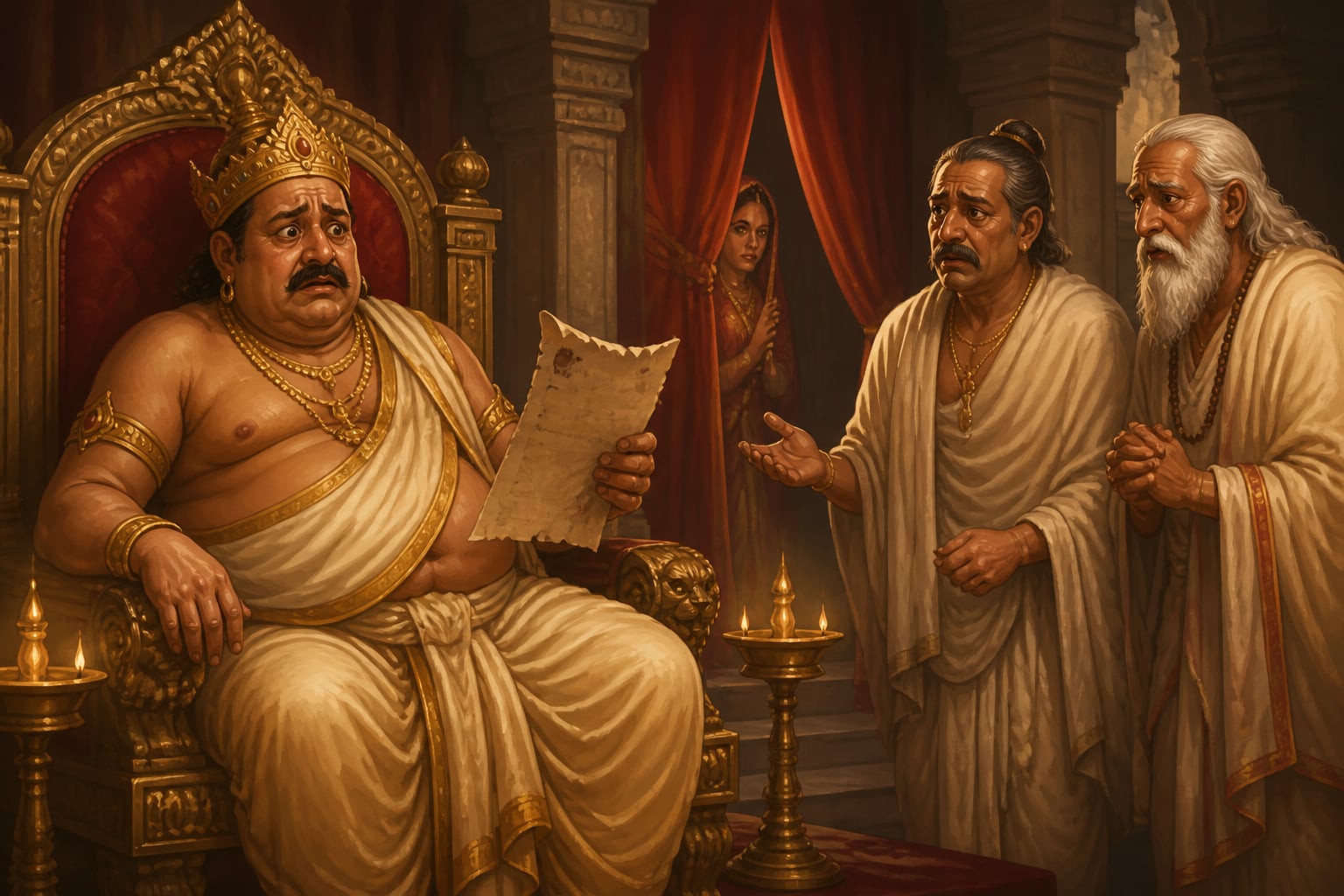
Ramagupta cowering before Shaka demands

Ramagupta, the elder brother, became king after Samudragupta's death. During a campaign against the Shakas (Western Kshatrapas who still controlled Gujarat and Malwa), Ramagupta's army was surrounded. Facing defeat, Ramagupta agreed to a humiliating peace, he would surrender his queen, Dhruvadevi, to the Shaka king.

This was unthinkable. To surrender a royal woman to enemies was the ultimate disgrace in Indian political culture. It violated every principle of rajadharma (kingly duty).

"A king who cannot protect his own queen cannot protect his kingdom." , Ancient maxim of statecraft

What happened next transformed Indian history.

Chandragupta's Heroic Act

Chandragupta, the younger brother, could not accept this dishonor. According to tradition, he disguised himself as Dhruvadevi and entered the Shaka camp. In the darkness of the enemy tent, he killed the Shaka king and escaped.

Chandragupta II disguised as Queen Dhruvadevi entering the Shaka king's tent at night

The act demonstrated:

Ramagupta's cowardice stood exposed. The army and court could now see clearly: the younger brother possessed what the elder lacked. In the aftermath, Chandragupta killed Ramagupta and married Dhruvadevi, claiming both the queen and the throne.

Historical Evidence

Is this dramatic story true? The evidence is mixed but suggestive:

Supporting evidence:

Complicating factors:

What we can say with certainty: Chandragupta II came to power around 375-380 CE and proved himself one of history's greatest rulers. Whether through dramatic heroism or more conventional succession, he earned the throne.

The New Emperor

The man who became Chandragupta II was unlike his warrior father in temperament but equal in ambition. Where Samudragupta had conquered through relentless military campaigns, Chandragupta II would prove himself through a combination of:

Strategic warfare, He would complete his father's unfinished work against the Shakas

Marriage diplomacy, He forged the crucial Naga-Vakataka alliance through his daughter's marriage

Cultural patronage, His court would host the legendary "Nine Gems" including Kalidasa

Administrative excellence, His reign would be remembered as India's true Golden Age

The Western Challenge

The most pressing challenge facing the new emperor was the Western Kshatrapas, the Shaka dynasty that had ruled Gujarat, Malwa, and parts of Rajasthan for over three centuries.

The Shakas represented:

Chandragupta II understood that controlling western India was essential. The ports of Gujarat connected India to the Roman Empire and beyond. The Shakas sat on the wealth of the sea routes.

Building the Alliance

The Vakataka-Gupta marriage alliance

Before striking west, Chandragupta II secured his southern flank through a masterstroke of diplomacy. He arranged the marriage of his daughter Prabhavatigupta to Rudrasena II, king of the Vakatakas, the most powerful dynasty in the Deccan.

This alliance achieved multiple objectives:

  1. Secured the south, The Vakatakas would not threaten Gupta territory
  2. Created a pincer, The Shakas were now surrounded from north and south
  3. Extended influence, When Rudrasena II died young, Prabhavatigupta ruled as regent, effectively bringing the Vakatakas into the Gupta orbit

The Vakataka alliance demonstrated Chandragupta II's preference for intelligent strategy over brute force. Why fight the Vakatakas when marriage could achieve the same result?

The Stage Is Set

By approximately 388 CE, Chandragupta II had:

The young prince who had won his throne through controversy had become a mature emperor ready for his greatest challenge. The conquest of the Shakas would not just expand the empire, it would give India access to the maritime trade that would fund the Golden Age.

The Man Behind the Legend

What kind of man was Chandragupta II? Later traditions and contemporary inscriptions reveal:

A warrior-king: Unlike some later rulers who delegated military command, Chandragupta II led his armies personally. The title "Vikramaditya" (Sun of Prowess) reflects this martial aspect.

A cultured patron: He would gather the greatest minds of his age at his court. Poetry, astronomy, medicine, and philosophy flourished under his patronage.

A shrewd diplomat: His alliance with the Vakatakas showed sophisticated understanding of power politics.

A dharmic ruler: The Chinese pilgrim Fa-Hien, who visited during his reign, described a kingdom where crime was rare, punishments mild, and people prosperous.

The succession controversy, if it occurred, had forged a remarkable leader. The younger son who had to prove his worth became an emperor who would surpass all expectations.

The Title Vikramaditya

Chandragupta II adopted the title "Vikramaditya", a name that would echo through Indian history for over a millennium. Every subsequent ruler who aspired to greatness would claim this title.

The word breaks down as:

Together: "Sun of Valor" or "He whose prowess blazes like the sun."

This was not mere flattery. Chandragupta II earned the title through:

"Like the sun that illuminates the world, so did Vikramaditya illuminate the age of the Guptas."

Legacy of the Succession

The manner of Chandragupta II's rise, through crisis, courage, and the displacement of an unworthy elder, established several precedents:

  1. Merit over primogeniture, The most capable son, not necessarily the eldest, should rule
  2. Action over position, Leadership is demonstrated, not inherited
  3. Protection as duty, A king who cannot protect his family cannot rule

These lessons would resonate through Indian political philosophy. The Ramagupta story, true or embellished, served as a parable about the qualities required for legitimate kingship.

As Chandragupta II prepared to march west against the Shakas, he carried with him the mandate of proven worth. He had not simply inherited an empire, he had earned the right to expand it.

Historical context

Early Gupta Period (c. 375-388 CE)

The Gupta Empire under Samudragupta had unified most of northern India and established hegemony over the south. However, the Western Kshatrapas (Shakas) still controlled Gujarat and western Malwa, blocking Gupta access to the lucrative sea trade. The Vakataka kingdom in the Deccan was a significant independent power. In the religious sphere, Brahmanical Hinduism was ascendant, though Buddhism and Jainism flourished with royal patronage.

Living traditions

The title 'Vikramaditya' became the most sought-after epithet for Indian rulers for over a millennium. The legendary Vikramaditya of folk tales, patron of the Nine Gems, hero of countless stories, is based primarily on Chandragupta II. The Vikram Samvat calendar (starting 57 BCE) is traditionally associated with a Vikramaditya, though historically it predates Chandragupta II. Today, 'Vikramaditya' remains a popular name, and the INS Vikramaditya aircraft carrier carries the legendary title into the modern Indian Navy.

Reflection

More in Chandragupta II

All lessons in Chandragupta II · Great Emperors: The Golden Age course