Philosophy and Religion
The Hindu Renaissance & Religious Harmony
Under Chandragupta II, India witnessed one of history's most remarkable religious transformations. While the emperor himself was a devoted Vaishnava, his reign saw the flourishing of Buddhism, Jainism, and multiple Hindu traditions in peaceful coexistence. The Bhagavata tradition reached new heights, Puranic Hinduism took its classical form, and Nalanda began its ascent as the world's greatest center of learning. Discover how religious pluralism became the defining strength of the Gupta Golden Age.
The Age of Religious Flowering
When the Chinese Buddhist monk Fa-Hien arrived in India around 399 CE, he found something extraordinary. The emperor was a devout Hindu who bore the title 'Parama-bhagavata', Supreme Devotee of Vishnu. Yet Buddhist monasteries flourished throughout the realm, their monks honored, their institutions supported. Hindu temples rose beside Buddhist stupas. Jain scholars debated at the imperial court.
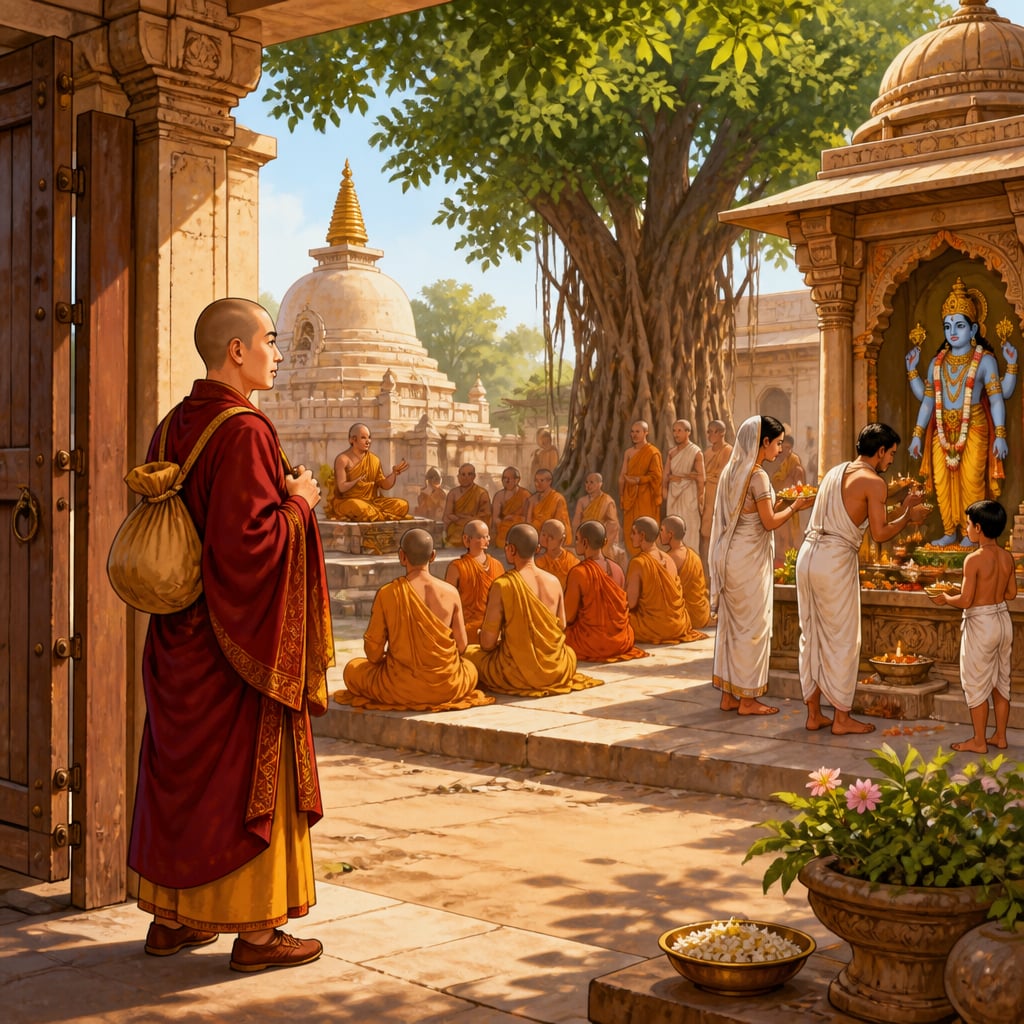
This was the religious genius of Chandragupta II's India: not uniformity, but harmony. Not forced tolerance, but genuine pluralism that saw different paths as leading to the same truth.
The Hindu Renaissance
The Gupta period marked a decisive transformation in Indian religious history. What we now call 'Hinduism', the synthesis of Vedic tradition, devotional movements, philosophical schools, and folk practices, took its classical form during this age.
Before the Guptas: Hindu practice was fragmented. Vedic ritualism served the elite. Popular devotion centered on local deities. Buddhist and Jain institutions often outshone Hindu ones in organization and reach.
During the Gupta period: These streams converged. The great gods, Vishnu, Shiva, Devi, became the focus of elaborate temple worship. Sanskrit was revived as the language of culture. The Puranas systematized mythology and practice for the common people. Temple architecture created sacred spaces for public devotion.
Chandragupta II stood at the center of this transformation, not as its creator but as its supreme patron and exemplar.
The Parama-Bhagavata Emperor
Chandragupta II's personal religion was Vaishnavism, the worship of Vishnu as the Supreme Being. His inscriptions repeatedly call him 'Parama-bhagavata', the Supreme Devotee.
This was not mere title. At Udayagiri, the emperor commissioned one of the most significant Vaishnava monuments in history: the great Varaha panel showing Vishnu as the Cosmic Boar rescuing the Earth (Bhudevi) from the cosmic waters.
The symbolism was deliberate and powerful:
- Vishnu rescues the Earth โ The emperor rescues his kingdom
- Divine order restores cosmic balance โ Royal authority restores political order
- The goddess Bhudevi is saved โ The land prospers under protection
"As Vishnu lifts the Earth from the waters, so does the righteous king lift his kingdom from chaos."
The Varaha panel proclaimed that Chandragupta II ruled not by mere force but as Vishnu's agent on Earth, performing the divine function of protection and restoration.
The Bhagavata Tradition
The Gupta period saw the Bhagavata tradition reach its mature form. This devotional movement, centered on Vishnu (especially as Krishna and Vasudeva), transformed Indian spirituality.
Key developments during Chandragupta II's reign:

| Element | Significance |
|---|---|
| Temple worship | Personal devotion (bhakti) replaced Vedic sacrifice as the primary mode of worship |
| Image veneration | Murtis (sacred images) became the focus of elaborate ritual |
| Puranic literature | The Vishnu Purana and early Bhagavata texts systematized theology |
| Avatar doctrine | Vishnu's incarnations, Rama, Krishna, Varaha, Narasimha, received canonical treatment |
The Bhagavata tradition democratized spirituality. While Vedic ritual required expensive sacrifices and specialized priests, bhakti required only love and devotion. A simple offering of flowers, a sincere prayer, these were sufficient to reach the divine.
Puranic Hinduism Takes Shape
The Puranas, literally 'ancient stories', were compiled and edited extensively during the Gupta period. These massive texts combined:
- Cosmology: Creation, dissolution, and recreation of the universe
- Mythology: Stories of gods, demons, sages, and heroes
- Geography: Sacred sites, rivers, and pilgrimage routes
- Genealogy: Lineages of kings, sages, and divine beings
- Dharma: Ethical teachings, rituals, and social duties
The Puranas made Hinduism accessible to everyone. Unlike the Vedas (restricted to the twice-born castes) or philosophical treatises (requiring years of study), the Puranas told stories. Through narrative, they transmitted profound truths to common people.
During Chandragupta II's reign, key Puranas including the Vishnu Purana, Vayu Purana, and early versions of the Bhagavata Purana received their classical form. These texts established the Hindu worldview that would shape Indian civilization for the next two millennia.
The Buddhist-Hindu Synthesis
One of the most remarkable aspects of Gupta religion was the synthesis between Buddhist and Hindu traditions. Rather than competing as enemies, the traditions cross-pollinated, each enriching the other.
Buddhist influence on Hinduism:
- Concepts of compassion (karuna) and non-violence (ahimsa) gained prominence
- Monastic institutions inspired Hindu matha organization
- Buddhist art influenced Hindu iconography
- Philosophical rigor from Buddhist logic schools sharpened Hindu thought
Hindu influence on Buddhism:
- Buddhist texts incorporated Hindu cosmology and deities
- Temple worship and image veneration became more elaborate
- Sanskrit became the primary language of Buddhist scholarship
- The bodhisattva ideal resonated with devotional hinduism
The Buddha himself was eventually incorporated into Hindu tradition as an avatar of Vishnu, a remarkable theological move that acknowledged Buddhism's importance while placing it within a Hindu framework.
Nalanda: The Light of Learning

Perhaps no institution better represented the intellectual flowering of the Gupta period than Nalanda. Though its greatest days lay ahead, Nalanda's rise began during Chandragupta II's reign.
Located in modern Bihar, Nalanda would become:
- The world's first residential university
- Home to thousands of scholars from across Asia
- The repository of Indian philosophy, science, and medicine
- A beacon that drew students from China, Korea, Japan, Tibet, and Central Asia
The curriculum at Nalanda was comprehensive:
Buddhist studies: Philosophy, meditation, ethics, Vinaya (monastic rules) Hindu philosophy: Vedanta, Samkhya, Yoga, Nyaya (logic) Sciences: Astronomy, mathematics, medicine, grammar Arts: Literature, poetry, debate, composition
Nalanda represented a unique institutional achievement: a place where Buddhist, Hindu, and even Jain scholars could study together, debate freely, and advance knowledge collectively. It embodied the Gupta ideal of unity in diversity.
Jainism Under the Guptas
While the Gupta emperors were Vaishnavas, Jainism flourished under their tolerant rule. Chandragupta II's reign saw significant Jain developments:
Patronage: Though not personally Jains, the Guptas allowed Jain institutions to thrive. Jain caves at Udayagiri sit alongside Hindu ones.
Literature: Jain scholars continued their rigorous textual traditions, producing important commentaries and new works.
Merchant support: Jainism's appeal to merchant communities ensured financial support independent of royal patronage.
Philosophical contributions: Jain logic (anekantavada, many-sidedness of truth) influenced broader Indian thought.
The Jain principle of anekantavada, that truth has multiple aspects visible from different perspectives, reflected the broader Gupta ethos. No single tradition held all truth; each path illuminated different aspects of reality.
Religious Pluralism as Strength
Why did Chandragupta II's empire support multiple religious traditions? The answer reveals profound political wisdom.
Economic benefits: Different religious communities controlled different trade networks. Jain merchants dominated western trade. Buddhist monasteries served as banking and educational institutions. Hindu temples anchored agricultural communities. Together, they created a robust economic ecosystem.
Social stability: By honoring all traditions, the Guptas prevented the conflicts that tear apart religiously divided societies. No community felt excluded or oppressed. All had stakes in the empire's success.
Intellectual vitality: Competition and dialogue between traditions drove innovation. Buddhist logic sharpened Hindu philosophy. Hindu devotionalism influenced Buddhist practice. Jain ethics enriched both.
Political legitimacy: By patronizing all traditions, the emperor appeared as a universal sovereign rather than a partisan of one group.
The Philosophical Schools
The Gupta period saw the classical formulation of the six orthodox schools (Shad Darshana) of Hindu philosophy:
- Samkhya: Cosmic dualism explaining creation through the interaction of consciousness (purusha) and matter (prakriti)
- Yoga: Systematic path to spiritual liberation through practice and discipline
- Nyaya: Logic and epistemology, how we know what we know
- Vaisheshika: Atomic theory and categorization of reality
- Mimamsa: Vedic interpretation and ritual philosophy
- Vedanta: Ultimate reality and the relationship between soul and Brahman
These schools were not merely abstract speculation. They provided comprehensive frameworks for understanding existence, knowledge, ethics, and liberation. Debates between schools, and with Buddhist and Jain philosophers, created unprecedented intellectual rigor.
Temple Religion Transforms Worship
Under the Guptas, temple worship transformed from elite practice to popular religion. Key innovations:
Permanent structures: Unlike temporary Vedic altars, Gupta temples were built to last, first in brick, then increasingly in stone.
Image worship: The murti (sacred image) became the center of worship. Elaborate rituals of bathing, clothing, feeding, and adorning the deity created intimate divine relationships.
Daily rhythms: Temples established regular worship patterns, morning awakening, midday offerings, evening ceremonies, that structured community life.
Pilgrimage networks: The Puranas established hierarchies of sacred sites, creating pilgrimage routes that united India spiritually even when politically fragmented.
The great temples of Udayagiri, Deogarh, and other Gupta sites pioneered forms that would influence Indian architecture for centuries.
The Chinese Witness: Fa-Hien's Testimony
The Chinese monk Fa-Hien (Faxian) traveled through Chandragupta II's India from approximately 399-414 CE. His account provides invaluable witness to religious life:
- Buddhist monasteries were well-maintained and active
- Monks received respect from all levels of society
- The dharma (Buddhist teaching) was transmitted freely
- Religious festivals brought communities together
- Vegetarianism was widely practiced out of compassion
Fa-Hien found India to be extraordinarily peaceful. Crime was rare. Punishments were mild. The people were prosperous. This Buddhist monk, traveling through a Hindu emperor's domain, encountered only respect and hospitality.
His testimony confirms that Gupta religious pluralism was not merely official policy but lived reality.
Bhakti: The Devotional Revolution
The Gupta period accelerated the bhakti (devotional) movement that would transform Indian spirituality. Key aspects:
Personal relationship: Bhakti emphasized a personal, loving relationship with the divine, not abstract philosophical understanding, but heartfelt connection.
Emotional expression: Love, longing, surrender, joy, these emotions became legitimate spiritual expressions. The Bhagavata tradition especially celebrated the passionate love between devotee and deity.
Accessibility: Bhakti required no special qualifications. Anyone, regardless of caste, gender, or education, could practice devotion.
Grace: While earlier traditions emphasized personal effort, bhakti stressed divine grace (prasada). The deity's love for the devotee was as important as the devotee's love for the deity.
The seeds planted during Chandragupta II's reign would flower into the great bhakti movements of later centuries, the Alvars and Nayanars of the south, the saints of Maharashtra, the poets of north India.
The Legacy of Gupta Religious Policy
Chandragupta II's approach to religion established principles that would influence Indian civilization:
State support without state religion: The emperor personally followed one tradition while supporting all.
Unity through diversity: Different traditions were not threats to unity but expressions of shared values in different forms.
Learning as sacred: Knowledge, regardless of its tradition of origin, deserved cultivation and preservation.
Tolerance as strength: A society that accommodated difference was more resilient than one that enforced uniformity.
These principles did not always prevail in later Indian history. But they remained as an ideal, a reminder that the greatest of ages had also been the most tolerant.
A Religion for the Ages
The religious developments of Chandragupta II's reign proved remarkably durable. The Hinduism that emerged, centered on bhakti, expressed through temples, guided by Puranas, philosophically sophisticated yet accessible to all, remains the living faith of hundreds of millions today.
The Buddhist institutions established during this period, particularly Nalanda, would influence Asian civilization for a thousand years. The Jain communities that flourished would preserve their traditions through all subsequent upheavals.
Most importantly, the ideal of religious pluralism, that truth has many faces, that different paths lead to the same summit, that diversity enriches rather than divides, became central to Indian identity.
"Ekam sat vipra bahudha vadanti" "Truth is one; the wise call it by many names." , Rig Veda 1.164.46
This ancient Vedic principle found its fullest expression in the Gupta Golden Age. Under an emperor who was personally a devout Vaishnava, India became a civilization where every seeker could find their path to the divine.
Historical context
Gupta Golden Age (c. 380-415 CE)
The Gupta period represented the classical flowering of Hindu civilization. Temple architecture took permanent form. The Puranas systematized religious knowledge. Sanskrit literature reached unprecedented heights with poets like Kalidasa. The six orthodox schools of Hindu philosophy achieved their classical formulations. Meanwhile, Buddhism remained vibrant, with monasteries serving as centers of learning, and Jainism flourished among merchant communities.
Living traditions
The religious framework established during Chandragupta II's reign shapes Hinduism today. Temple worship, murti veneration, Puranic festivals, bhakti devotion, and the philosophical schools all achieved their classical forms during this period. The Bhagavata tradition that the Gupta emperors championed remains the dominant form of Hindu practice. Most significantly, the principle of religious pluralism, 'truth is one, the wise call it by many names', became central to Indian identity. Despite subsequent periods of conflict, this Gupta ideal continues to inform India's constitutional commitment to secularism and religious freedom.
- Udayagiri Caves (Varaha Panel): The great Varaha panel in Cave 5 is the most magnificent surviving example of Gupta religious art. The colossal boar rises from the waters, the earth goddess clinging to his tusk, while sages and gods watch in reverence. Commissioned during Chandragupta II's reign, it embodies the theological vision of Gupta Vaishnavism.
- Nalanda Mahavihara (UNESCO World Heritage Site): The ruins of the world's first residential university, where thousands of scholars studied for over 800 years. Though its greatest period came after the Guptas, the foundations were laid during Chandragupta II's reign. The extensive brick ruins include monasteries, temples, and the great library site.
- Deogarh Dashavatara Temple: One of the earliest surviving structural Hindu temples from the Gupta period. The temple's remarkable panels depicting Vishnu's incarnations, especially the famous Gajendra Moksha (liberation of the elephant), represent the mature development of Gupta Vaishnava art and theology.
Reflection
- Chandragupta II held deep personal religious convictions while governing an empire of diverse faiths without imposing his beliefs. Have you faced situations where your personal convictions differed from those around you? How did you balance staying true to yourself while respecting others' different paths?
- The Gupta period saw Buddhist, Hindu, and Jain traditions cross-fertilizing rather than competing, each enriching the others. Why might periods of religious dialogue and synthesis produce greater achievements than periods of exclusivism and conflict?
- The ancient verse 'Ekam sat vipra bahudha vadanti' (Truth is one; the wise call it by many names) provided scriptural foundation for Gupta pluralism. Is this a genuine philosophical position, or a convenient compromise that avoids hard questions about truth? Can multiple traditions all be 'true' in any meaningful sense?