Art and Architecture

The Gupta Classical Style

Under Chandragupta II's patronage, Indian art reached heights that would define beauty for a millennium. From the mysterious rust-free Iron Pillar to the divine sculptures of Udayagiri caves, from the serene Buddha images of Sarnath to the emerging temple architecture at Deogarh, this era established the 'Gupta Classical' as the gold standard of Indian aesthetics. Discover how stone, bronze, and iron became vehicles for expressing the divine, and why artists across Asia would look to this period for inspiration for centuries to come.

The Birth of Classical Indian Art

In the workshops of Pataliputra, Mathura, and Varanasi, something extraordinary was happening. Master sculptors were creating images of gods and humans that would define Indian beauty for the next fifteen centuries. Metallurgists were forging iron with techniques that modern science still marvels at. Architects were transforming rock faces into sacred spaces that merged geology with theology.

This was the Gupta artistic revolution, and Chandragupta II stood at its center as patron, inspiration, and beneficiary.

The Concept of "Gupta Classical"

Art historians use the term "Gupta Classical" to describe the distinctive aesthetic that emerged during this period. Like the Periclean Age in Athens or the High Renaissance in Italy, Gupta art represents a moment when technical mastery, philosophical depth, and royal patronage combined to create works of enduring beauty.

What makes Gupta art "classical"?

Characteristic Description
Balance Perfect proportion between naturalism and idealization
Serenity Divine figures radiate inner peace and spiritual power
Refinement Technical virtuosity serves spiritual expression
Universality Forms that transcend time and speak to all cultures

The Gupta style avoided both the archaic stiffness of earlier periods and the excessive ornamentation of later eras. It found a perfect middle point, humans idealized but not inhuman, gods approachable but not ordinary.

"In Gupta sculpture, we see divinity that has descended to human form without losing its transcendence."

The Iron Pillar: Metallurgical Marvel

In the Qutub complex of Delhi stands a monument that has puzzled scientists for centuries: the Iron Pillar of Chandragupta II. Rising 7.2 meters (23.6 feet) and weighing over 6 tonnes, this pillar was originally erected at Udayagiri to commemorate the emperor's conquests.
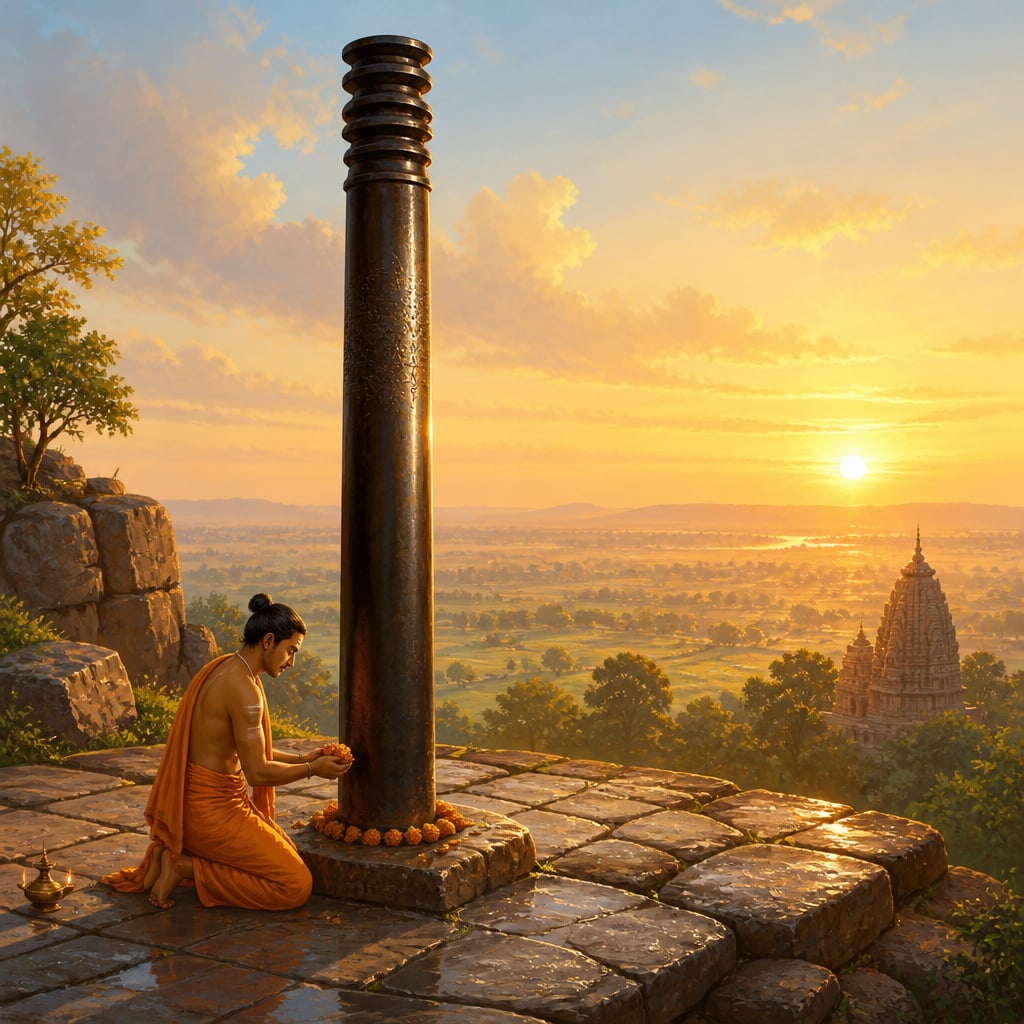
The Iron Pillar of Chandragupta II newly erected at Udayagiri at dawn

The pillar's Sanskrit inscription declares:

"He, on whose arm fame was inscribed by the sword, when, in battle in the Vanga countries, he kneaded back with his breast the enemies who, uniting together, came against him... having conquered the Vahlikas, he won an eternal fame upon this earth."

But the pillar's true fame rests on a different achievement: it has not rusted in over 1,600 years, despite exposure to Delhi's monsoons and temperature extremes.

Modern metallurgical analysis has revealed the secret: the pillar contains unusually high phosphorus content (0.25% compared to modern iron's 0.05%). This creates a protective layer of iron hydrogen phosphate hydrate that prevents corrosion. Additionally:

Gupta metallurgists had empirically discovered principles that modern corrosion science would not understand until the 20th century. The Iron Pillar stands as proof that ancient India's technological achievements matched its artistic ones.

Udayagiri Caves: Where Rock Becomes Divine

Near Vidisha in Madhya Pradesh, a sandstone hillside was transformed into one of India's most important religious sites. The Udayagiri Caves, twenty rock-cut sanctuaries, represent the earliest surviving examples of Hindu cave architecture and contain some of Gupta art's greatest treasures.

The Varaha Panel: A Sculptural Masterpiece

The Varaha rock-cut panel at Udayagiri

Cave 5 at Udayagiri contains what many consider the finest work of Gupta sculpture: the Varaha Panel. This monumental relief, measuring 7 meters high and 4 meters wide, depicts Vishnu in his boar (Varaha) incarnation rescuing the earth goddess Bhudevi from the cosmic waters.

The composition is remarkable:

The Boar Form: Varaha stands in dynamic pose, one leg raised, the tusked head powerful yet gentle. The earth goddess clings to his tusk in a pose of complete trust and deliverance.

The Cosmic Context: Rows of celestial beings, sages, gods, nagas (serpent deities), and apsaras (celestial dancers), fill the surrounding space. Ocean waves and lotus blossoms suggest the primordial waters from which earth emerged.

The Political Message: The relief was likely commissioned to celebrate Chandragupta II's western conquests. Just as Vishnu rescued the earth, so had the emperor "rescued" India from foreign Shaka rule. The art served both devotion and propaganda.

Cave 13: The Lion and the Boar

Another remarkable panel shows Vishnu as Narasimha (man-lion), the fierce protector who emerged from a pillar to destroy the demon Hiranyakashipu. Nearby, inscriptions record that Chandragupta II himself visited Udayagiri during a military campaign, the caves were imperial monuments as well as religious sites.

The Udayagiri caves established patterns that would influence Indian temple architecture for centuries:

The Deogarh Dashavatara Temple

While Udayagiri represents cave architecture, the Dashavatara Temple at Deogarh (in Uttar Pradesh) shows the Gupta genius for freestanding stone temple construction. Though now largely ruined, this temple reveals the sophistication of early 5th century architectural and sculptural arts.

The temple's surviving panels include:

Vishnu Anantashayana: Vishnu reclines on the serpent Ananta (Shesha) in the cosmic ocean between world cycles. Brahma emerges from a lotus growing from Vishnu's navel to create the universe anew. This panel established an iconographic tradition that continues today.

Nara-Narayana: The divine sages Nara and Narayana sit in meditation, representing the ideal of contemplative wisdom that Gupta culture valued alongside martial prowess.

Gajendramoksha: Vishnu rescues the elephant king from a crocodile, symbolizing the soul's liberation from worldly bondage.

The Deogarh sculptures share the Udayagiri aesthetic, serene divinity, balanced composition, technical excellence, but adapted to a different architectural context. Together, they demonstrate the versatility of the Gupta classical style.

The Buddha Images: Sarnath and Mathura

While the Guptas were Vaishnavas, they generously patronized Buddhist art as well. Two great centers, Sarnath (near Varanasi) and Mathura (in Uttar Pradesh), produced Buddha images that became models for all of Asia.

The Sarnath School

Sarnath, where the Buddha preached his first sermon, developed a distinctive style characterized by:

The Sarnath Buddha turning the wheel of dharma

The most famous Sarnath Buddha shows him in the dharmachakra-pravartana mudra, the gesture of turning the wheel of dharma (teaching). Seated in perfect meditation posture, the Buddha's face radiates the peace that his teachings promise. The sculpture captures a moment when the cosmic and the human meet.

The Mathura School

Mathura had been producing religious sculpture for centuries before the Guptas. Under Gupta patronage, Mathura artists combined their traditional boldness with the new classical refinement:

The Mathura Buddha images influenced art across Central Asia, China, Korea, and Japan as Buddhism spread. Gupta aesthetics traveled the Silk Road, shaping how millions visualized enlightenment.

The Gupta Coins: Art in Metal

Chandragupta II's gold coins (dinaras) are themselves masterpieces of miniature art. Unlike modern coins produced by mechanical stamping, each Gupta coin was individually die-struck, allowing for remarkable detail.

The coins show:

The Lion-Slayer Type: Chandragupta stands over a lion, bow in hand, symbolizing royal prowess and possibly his title "Simhavikrama" (Lion of Prowess).

The Horseman Type: The emperor rides a caparisoned horse, demonstrating martial skill.

The Goddess Lakshmi: The reverse typically shows the goddess of prosperity, associating the emperor's rule with abundance.

These coins circulated across the Indian subcontinent and beyond, carrying Gupta aesthetics wherever trade reached. They proclaimed both the empire's wealth and its artistic sophistication.

Patronage and Production

How did this artistic florescence occur? Several factors combined:

Royal Patronage: Chandragupta II and his nobles funded major projects at Udayagiri, Deogarh, and elsewhere. Imperial resources enabled ambitious undertakings.

Religious Motivation: Commissioning sacred images earned spiritual merit. Donors hoped their patronage would benefit them in this life and future births.

Technical Tradition: India had developed sophisticated artistic traditions over centuries. Gupta artists inherited skills in stone carving, metal casting, and painting.

Philosophical Framework: The concept of shilpa-shastra, sacred treatises on art, provided theoretical foundations. Artists were not merely craftsmen but practitioners of a sacred science.

Peace and Prosperity: Chandragupta II's stable rule created conditions where artists could work undisturbed. Trade wealth funded projects; peace protected them.

The Theory Behind the Art

Gupta art was not created in a theoretical vacuum. Shilpa-shastras, texts on sacred arts, codified proportions, iconography, and meaning. Key principles included:

Tala System: Sculptures were proportioned using a measurement unit called tala (palm-width). Different types of figures had prescribed proportions, heroic gods were 10 talas tall, graceful figures 9 talas, etc.

Lakshanas: Sacred texts specified identifying marks (lakshanas) for each deity, the number of arms, associated objects, posture, and expression. These ensured that viewers could recognize the god depicted.

Rasa: The theory of rasa (aesthetic emotion) guided artistic expression. Sculptures aimed to evoke specific emotional responses, peace, devotion, awe, in viewers.

Prana-pratishtha: Images were not merely representations but, after proper consecration (prana-pratishtha or "life establishment"), became actual dwelling places of the divine.

Thus Gupta artists worked within a sophisticated philosophical framework that united aesthetics, theology, and ritual.

Technical Innovations

The Gupta period saw significant technical advances:

Stone Carving: Artists achieved unprecedented detail in hard stone. The thin, clinging drapery of Sarnath Buddhas required extraordinary skill.

Bronze Casting: The lost-wax (cire-perdue) process reached new refinement. Bronze Buddha images from Sultanganj (7.5 feet tall) demonstrate large-scale casting capabilities.

Iron Working: The Iron Pillar proves mastery of forge welding large masses, the pillar was made by welding smaller pieces into a whole, yet appears seamless.

Paint and Gilding: While paint has faded from stone sculptures, traces indicate they were originally colored. Bronze images were often gilded.

Legacy of Gupta Art

The Gupta classical style did not end with the dynasty. Its influence spread:

Across India: Post-Gupta sculptural traditions in Odisha, Tamil Nadu, Karnataka, and elsewhere drew on Gupta precedents while developing regional variations.

Across Asia: Through Buddhism, Gupta aesthetics influenced art in Sri Lanka, Myanmar, Thailand, Cambodia, Indonesia, China, Korea, and Japan. The Buddha images of these cultures trace their lineage to Gupta prototypes.

Across Time: When later Indian dynasties, the Cholas, Pallavas, Palas, created great art, they looked to Gupta models as the classical standard. Even today, traditional sculptors follow principles established in this era.

The 5th century Gupta workshops created a visual vocabulary that still speaks to millions. When modern devotees worship at temples, when tourists marvel at museum collections, when scholars analyze ancient aesthetics, all engage with the legacy of Chandragupta II's golden age.

Chandragupta II's Personal Role

Inscriptions confirm that Chandragupta II personally commissioned works and visited sites like Udayagiri. The Iron Pillar's inscription suggests he took pride in the monument. His coins, more varied and artistically accomplished than his predecessors', reflect deliberate aesthetic choices.

As a parama-bhagavata (supreme devotee of Vishnu), Chandragupta II understood religious art as devotional practice. Patronizing sacred images was not mere display, it was dharma in action. The caves, temples, and sculptures proclaimed both his piety and his power.

The emperor who had won his throne through courage and his conquests through strategy also proved himself a man of refined taste. The Vikramaditya of legend, the cultured king presiding over poets and artists, finds confirmation in the stone and metal that survives.

Historical context

High Gupta Period (c. 400-415 CE)

The early 5th century was the zenith of Gupta power. Chandragupta II had completed the western conquests, bringing the entire Indo-Gangetic plain and western seaboard under Gupta control. Trade flourished with Rome (despite its troubles), Southeast Asia, and Central Asia. This prosperity funded ambitious artistic projects. Buddhist monasteries at Sarnath and Mathura, Hindu temples at Deogarh and Udayagiri, and Jain monuments throughout the realm all benefited from royal and merchant patronage.

Living traditions

The Gupta classical style continues to influence Indian art and architecture. Traditional sculptors (shilpis) still follow proportion systems derived from Gupta-era Shilpa Shastras. The rust-free Iron Pillar inspires modern metallurgists and has been studied by international scientists seeking to understand its corrosion resistance. The serene Buddha images of Sarnath remain iconic representations of enlightenment, reproduced in temples and meditation centers worldwide. Contemporary Indian artists often reference the Gupta aesthetic when seeking to express timeless beauty. In museums from Delhi to London to New York, Gupta sculptures are displayed as pinnacles of human artistic achievement.

Reflection

More in Chandragupta II

All lessons in Chandragupta II ยท Great Emperors: The Golden Age course