Defeating the Shakas
The Defender
For over three centuries, the Shakas, foreign rulers descended from Central Asian Scythians, had controlled western India and its lucrative sea trade with Rome. Chandragupta II's father Samudragupta had conquered most of India but left this task unfinished. Now the son would complete the work, in a campaign that ended three hundred years of foreign rule and opened the gates to India's true Golden Age.
The Unfinished Business
When Samudragupta died around 375 CE, he left behind the largest empire India had seen since Ashoka. His Allahabad Pillar inscription boasts of "violently uprooting" nine kings and humbling twelve southern kingdoms. Yet one significant power remained unconquered: the Western Kshatrapas.
These were the Shakas, descendants of Scythian tribes who had migrated from Central Asia centuries earlier. By Chandragupta II's time, they had ruled Gujarat, Malwa, and parts of Rajasthan for over 300 years. They weren't just foreign rulers; they had become Indianized, adopting Sanskrit, patronizing Hindu temples, and integrating into Indian society.
But they still represented:
- Foreign origin in a resurgent Hindu empire
- Control of western ports that connected India to Roman trade
- Unfinished Gupta ambitions, Samudragupta's one major omission
- A family insult, if the Ramagupta story is true
The Prize: India's Maritime Wealth
Why were the Shakas so important? The answer lay in trade.
The western coast of India, from Gujarat to the Konkan, was the terminus of one of history's most lucrative trade routes. Roman merchants came seeking:
| Indian Export | Roman Demand |
|---|---|
| Pepper and spices | Roman cuisine, medicine |
| Cotton textiles | Luxury clothing |
| Precious gems | Jewelry, status symbols |
| Perfumes | Religious and personal use |
| Iron and steel | Famous "wootz" steel for swords |
In return, Romans paid in gold coins, so much gold that the Roman writer Pliny complained that trade with India was draining the empire's treasury.
"India absorbs fifty million sesterces of our Empire's wealth every year." , Pliny the Elder, Natural History
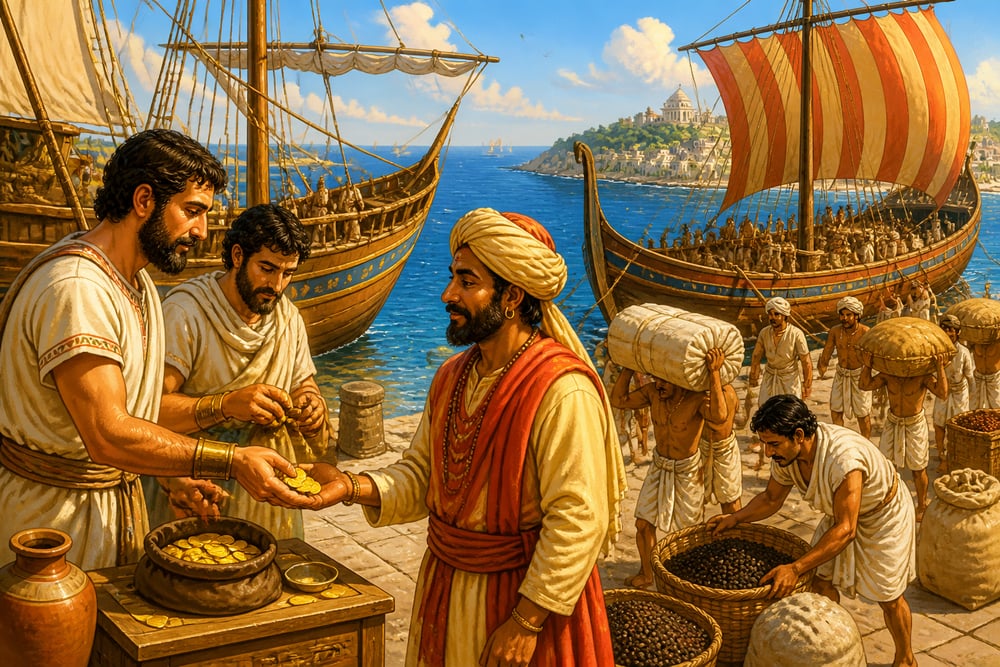
The ports of Bharuch (Barygaza), Sopara, and Kalyan were among the richest in the ancient world. Whoever controlled these ports controlled the wealth of maritime trade.
The Shakas sat on this treasure.
The Last Shaka King
The Western Kshatrapa dynasty had produced capable rulers, but by the late 4th century CE, they were in decline. The last significant Shaka king was Rudrasimha III (also called Rudrasena III), who ruled around 388-395 CE.
What we know of him:
- He issued silver coins continuing Shaka traditions
- His territory had shrunk from its earlier extent
- He faced pressure from multiple directions
- His dynasty had grown weak after centuries of rule
The Shakas had survived so long because:
- They controlled wealthy port cities
- They had made peace with Indian culture and religion
- Previous Indian powers had been too divided to challenge them
- Their cavalry remained formidable
But none of these advantages would help against a united Gupta Empire led by a capable, determined emperor.
The Campaign Strategy
Chandragupta II's western campaign demonstrated the strategic brilliance that earned him the title Vikramaditya. Unlike his father's whirlwind campaigns across multiple fronts, Chandragupta II proceeded methodically:
Phase 1: Secure the South The Vakataka marriage alliance (see Lesson 1) ensured that no southern power would threaten the Gupta rear while the army marched west.
Phase 2: Diplomatic Isolation Before military action, Chandragupta II isolated the Shakas diplomatically. We don't have detailed records, but the speed of his eventual victory suggests the Shakas had few allies when the attack came.
Phase 3: Military Conquest The actual campaign, launched around 395-400 CE, was swift and decisive. The Gupta army, inheriting Samudragupta's military traditions and enhanced by Chandragupta II's innovations, overwhelmed Shaka resistance.
Phase 4: Consolidation Unlike some conquerors who destroyed and moved on, Chandragupta II integrated the western territories into his empire systematically.
The Victory
The details of the campaign are sparse in surviving records, but the outcome is clear: Chandragupta II completely destroyed the Western Kshatrapa dynasty.

The evidence:
Numismatic proof:
- Shaka coins stop abruptly around 395-400 CE
- Chandragupta II issued silver coins from the western territories using the same weight standard as the Shakas, a clear sign of conquest
- The famous "Lion-slayer" gold coins of Chandragupta II may commemorate this victory
Epigraphic evidence:
- The Udayagiri inscriptions mention Chandragupta II's western campaigns
- Later records consistently credit him with ending Shaka rule
Literary traditions:
- The Iron Pillar inscription (originally at Udayagiri) mentions his conquest of enemies
- Later sources describe his victory over the "Sakas"
Rudrasimha III, the last Shaka king, disappears from history. His fate is unknown, whether killed in battle, captured, or fled, but his dynasty ended permanently.
The Lion-Slayer Coins
Among Chandragupta II's most famous coins are the "Lion-slayer" (Simhavikrama) gold dinars. These show the emperor killing a lion with a bow, a powerful symbol of martial prowess.
Historians debate whether these coins:
- Commemorate an actual lion hunt (royal hunts were traditional)
- Symbolize victory over the Shakas (who used lion imagery)
- Represent the defeat of all enemies (the lion as symbol of power)
Regardless of the exact meaning, these coins proclaimed Chandragupta II as a warrior-king who personally led in battle and emerged victorious.
The coins also demonstrate the sophistication of Gupta metallurgy and artistry. Their gold content remained consistent, a sign of economic stability, and their artistic quality surpassed previous Indian coinage.
Consequences of Victory
The defeat of the Shakas transformed the Gupta Empire:
Geographic expansion: The empire now stretched from the Bay of Bengal to the Arabian Sea, true subcontinental domination. For the first time since Ashoka, an Indian empire controlled both coasts.
Economic boom: Control of western ports unleashed a flood of wealth:
- Direct access to Roman trade
- Custom duties from maritime commerce
- Increased demand for Indian goods
- Influx of foreign gold
Cultural funding: This wealth would fund the cultural explosion of the Golden Age:
- The Nine Gems of Vikramaditya's court
- Temple construction across the empire
- Patronage of Sanskrit literature
- Scientific and artistic advancement
Strategic security: With no foreign power controlling Indian territory, the empire could focus on consolidation and culture rather than defensive warfare.
Ujjain: The Second Capital

After conquering the west, Chandragupta II established Ujjain as a secondary capital, and perhaps his preferred residence.
Ujjain was strategic:
- Central location for governing the western territories
- Ancient sacred city (one of the seven holy cities)
- Crossroads of trade routes
- Cultural center with deep traditions
The city became associated with Vikramaditya in legend. Later folk traditions would place his famous court, with the Nine Gems and the legendary judgment seat, at Ujjain rather than Pataliputra.
The choice of Ujjain showed Chandragupta II's understanding that empires need administrative centers close to their economic engines. While Pataliputra remained the nominal capital, Ujjain became the heart of Gupta prosperity.
The End of 300 Years
The Shaka conquest deserves emphasis: Chandragupta II ended three centuries of foreign rule in western India.
The Shakas had first arrived in the 1st century BCE, part of the great migrations that brought Central Asian peoples into South Asia. They had:
- Fought Greek rulers
- Battled the Satavahanas
- Survived Kushan expansion
- Outlasted multiple Indian dynasties
For 300 years, they had maintained their hold on Gujarat and Malwa. Many observers might have thought they were permanent, an accepted part of India's political landscape.
Chandragupta II proved otherwise. He demonstrated that determined, capable leadership could reverse even long-established situations. Foreign rule was not destiny.
Military Innovations
While specific details are scarce, the Gupta military under Chandragupta II showed several characteristics:
Combined arms: The Guptas used infantry, cavalry, elephants, and chariots in coordinated operations, each arm supporting the others.
Cavalry emphasis: Against the horse-riding Shakas, Gupta cavalry proved decisive. Coins show Chandragupta II as an accomplished horseman.
Engineering capability: The ability to besiege and capture fortified cities required sophisticated siege craft that the Guptas clearly possessed.
Logistics: Campaigning hundreds of miles from the capital required supply chains and administrative support that only a well-organized empire could provide.
The Model Conquest
Chandragupta II's western campaign became a model for how conquests should be conducted:
- Secure your rear before attacking
- Isolate the enemy diplomatically
- Strike decisively when prepared
- Integrate conquered territories rather than merely looting
- Invest the proceeds in lasting institutions
The campaign showed that military victory was not an end in itself but a means to greater purposes: economic prosperity, cultural flourishing, and stable governance.
The New Order
With the Shakas defeated, Chandragupta II reorganized western India:
Administrative integration: The western provinces received Gupta governors and were integrated into the imperial system.
Religious patronage: Temples and religious institutions received royal support, helping bind the new territories to Gupta rule.
Economic management: The ports were regulated to ensure trade flowed and customs were collected for the imperial treasury.
Cultural synthesis: The Shakas had contributed to Indian culture (their era name, for instance, remains in use as the "Shaka Samvat"). Chandragupta II didn't erase this heritage but absorbed it into the larger Gupta framework.
The transition was remarkably smooth. Within a generation, the western territories were fully integrated, a testament to Gupta administrative capability.
Legacy of the Western Victory
The defeat of the Shakas was Chandragupta II's most important military achievement:
It completed his father's work, proving the son worthy of the inheritance.
It opened the wealth of the West, funding the Golden Age.
It ended foreign rule, restoring Indian sovereignty after centuries.
It established Ujjain, creating a new center of culture and power.
It demonstrated strategic mastery, combining alliance, timing, and force.
Most importantly, the victory created the conditions for everything that followed. The Nine Gems of Vikramaditya's court, the masterpieces of Gupta art, the achievements of Gupta science, all were funded by the wealth that flowed through the western ports that Chandragupta II had won.
The warrior-emperor had created the economic foundation for India's Golden Age.
Historical context
Late 4th Century CE (c. 388-410 CE)
The Gupta Empire was at its political and military height. The Vakataka alliance had secured the south. Buddhist pilgrims were traveling from China to study at Indian monasteries. Trade with Rome continued to flourish despite Rome's own troubles. The stage was set for India's Golden Age once the western territories were secured.
Living traditions
The Shaka era calendar (beginning 78 CE) remains India's official civil calendar alongside the Gregorian. This ironic legacy means that the very foreigners Chandragupta II defeated are commemorated in India's calendar. Ujjain remains a major pilgrimage center, and its association with Vikramaditya persists in popular culture. The concept of defending India from foreign rule, exemplified by Chandragupta II's Shaka victory, became a recurring theme in Indian historical consciousness.
- Ujjain: The ancient city that became Chandragupta II's western capital. Key sites include the Mahakaleshwar Temple (one of twelve Jyotirlingas), the Kalbhairav Temple, and the Vedh Shala (observatory). The city's association with Vikramaditya is celebrated in local tradition.
- Bharuch (Ancient Bharukaccha/Barygaza): The ancient port city that was the jewel of Chandragupta II's western conquest. Once the most important trading port in India, where Roman merchants came for Indian goods. The modern city retains some old structures near the Narmada riverfront.
Reflection
- Have you ever inherited an important project or responsibility that someone else started but couldn't finish? How did you approach completing their work while also making it your own?
- Chandragupta II's conquest of the Shakas was framed as ending 'foreign rule' even though the Shakas had lived in India for 300 years and adopted Indian culture. When does someone stop being 'foreign'? What makes belonging legitimate?
- The wealth from the western ports funded art, literature, and culture. Is cultural achievement that depends on military conquest and trade domination morally compromised? Or does the source of funding not affect the value of what's created?