Tarakasi & Meenakari: Filigree & Enamel Traditions

Silver Wire in Cuttack, Enamel on Gold in Jaipur, and the Families Who Still Know the Ruby Red

Meet the Sunari silver filigree families of Cuttack's Nayasarak lane, who still build ten-kilogram chandi medhas for Durga Puja by hand, and the Johari Bazaar meenakars of Jaipur, whose ruby-red enamel recipe arrived with Raja Man Singh in 1590 and has survived four centuries of court patronage, colonial collapse and contemporary revival. Learn how two Persian crafts became unmistakably Indian, and meet the masters and brands keeping them alive today.

A Winter Morning in Cuttack
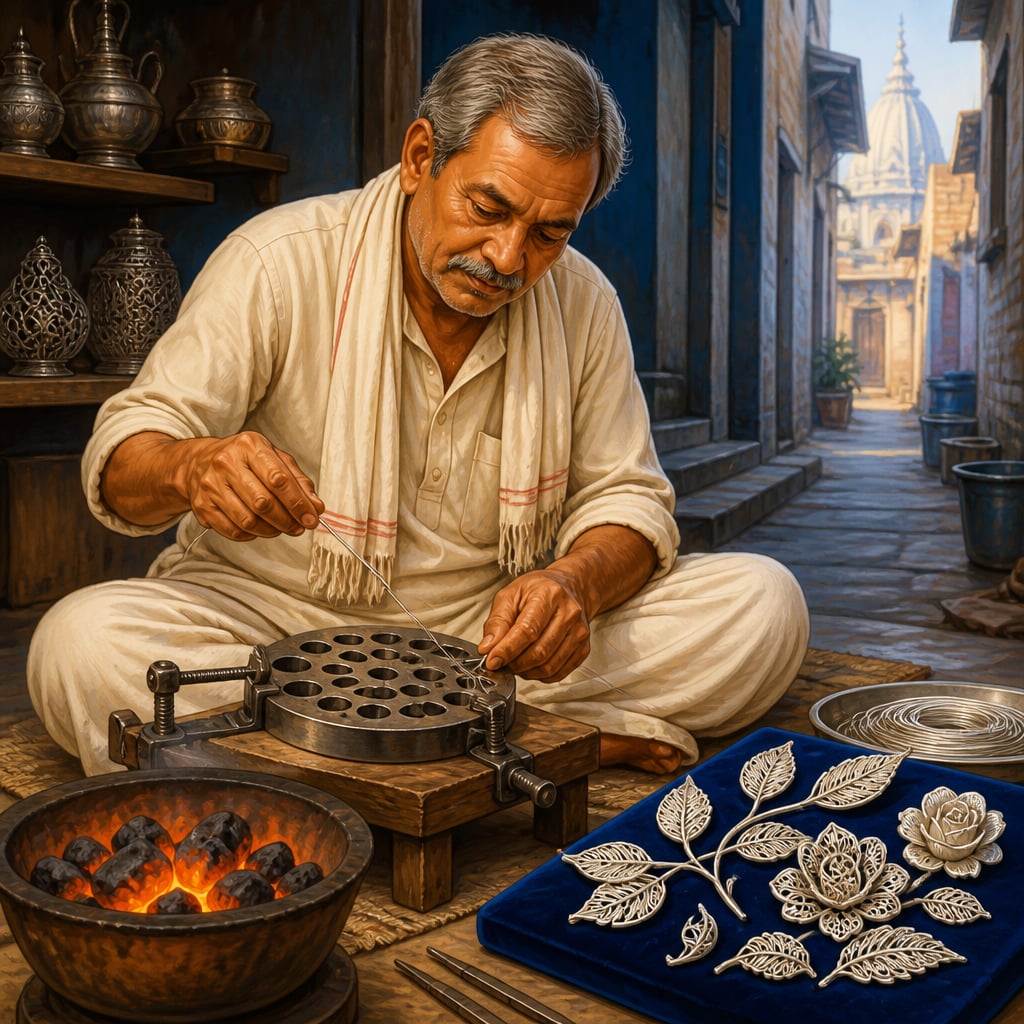
Cuttack tarakasi craftsman pulling silver wire through a draw plate

A winter morning in Cuttack, December 2012. In a narrow lane called Nayasarak, a senior tarakasi craftsman sits in front of a charcoal brazier, pulling silver wire through a steel draw plate. Call him Bhagirathi Rana, a composite figure drawn from the working lives of Nayasarak's silver lane. The wire starts as thick as a matchstick. By the last hole, it is thinner than a human hair. The room smells of borax and burnt charcoal. In eight weeks, the Sahid Nagar Puja Mandap will need a chandi medha, a full silver filigree backdrop for the goddess, ten kilograms of wire work assembled entirely by hand. Bhagirathi has built one every winter for thirty-seven years. But only four of his workers are under thirty. Will the medha after this one ever get made?

Cuttack's silver filigree has a name of its own. Tarakasi is Odia for 'wire work', and the craft has been running in these few lanes for at least seven hundred years. It is one of two extraordinary Indian metal traditions this lesson is about. The other sits fifteen hundred kilometres to the west, inside the walled city of Jaipur, and it is called Meenakari, the art of enamel on gold.

Both are Indian. Both are Persian in origin. Both arrived here through long journeys and royal decisions. And both are now held alive by a small number of families you could count on two hands.

What tarakasi actually is

Tarakasi is the art of making a flat or three-dimensional picture entirely out of drawn silver wire. The craftsman does not carve the silver. He pulls it. He starts with a thick silver rod and draws it, again and again, through a steel plate with graded holes. Each pull makes the wire thinner. A good Cuttack tarakasi wire can be pulled down to 0.2 millimetres, roughly the thickness of two sheets of paper.

At that point, the wire is almost alive in the hand. It can be curled into a leaf, twisted into a vine, or coiled into a rose. The curled pieces are laid out on a flat base, arranged like a drawing, and soldered together with a tiny flame fed by a goat-skin bellow. A single brooch may contain two hundred curls of wire and six hundred joints. A full chandi medha may contain fifty thousand. There is no machine anywhere in the process. The eye judges the curl. The thumb sets the angle. The flame seals the joint.

The weight of a finished tarakasi piece is mostly air. Light passes through it. This is why, in Cuttack, people still say that the goddess should be framed in silver filigree, because she should be framed in something that does not hide her.

What meenakari actually is

Jaipur meenakar applying ruby-red enamel into engraved gold

Meenakari works in the opposite direction. A tarakasi artist builds with almost nothing. A meenakari artist buries small amounts of coloured glass inside solid gold.

The gold piece starts as a flat or shaped sheet of 22-karat gold. A master engraver, called a ghadaiya, carves shallow grooves into the gold with tiny chisels. Into these grooves, the meenakar paints powdered mineral oxides that have been mixed with rose-water into a paste. Cobalt gives deep blue. Copper gives green. Iron gives yellow. Gold itself, ground fine, gives the most difficult colour in the craft: lal, the ruby red of Jaipur meenakari, which only a handful of families in the world still know how to mix without the colour turning brown in the kiln.

The piece is then fired in a kiln in stages. The colour with the highest melting point goes in first and survives the next firing. The one with the lowest melting point goes in last. Each firing is a gamble. A few seconds too long, and the enamel burns. A few seconds too short, and it bubbles. A finished meenakari pendant may have been in and out of the kiln six or seven times before it is done.

The finest meenakari in India is the double-sided enameled kundan, where the front of the piece carries a set of diamonds in pure gold foil while the back carries a full meenakari painting that the wearer never sees. The back is there only so that the piece is beautiful even when no one is looking. This is Jaipur's most famous contribution to Indian jewellery, and it is why a Jaipur wedding necklace is always turned over before it is bought.

How the two crafts came to India

Tarakasi travelled first. The best evidence suggests that silver filigree reached the Indian subcontinent from Persia through the Silk Road and the Indian Ocean trade in the thirteenth and fourteenth centuries. In Odisha, the craft took root under the Ganga and Bhanja dynasties, whose patronage of silver ornament survived the Mughal expansion. The old silver merchants of Cuttack organised themselves into guilds along Balu Bazar and Nayasarak, where tarakasi families still sit today. Cuttack became the unquestioned centre of Indian silver filigree, with smaller traditions surviving in Karimnagar in Telangana and in old Dhaka in undivided Bengal.

Meenakari arrived later, and by a much more precise route. When Raja Man Singh I of Amber served as one of Akbar's most trusted Rajput generals in the late sixteenth century, he was posted to Lahore, the headquarters of the Mughal empire's western frontier. Lahore at the time was home to a flourishing enamel industry whose techniques traced back through Iran to older Byzantine work. Some time around 1590, Raja Man Singh brought a group of Lahore master enamellers back to Amber with him and settled them in the court workshops. Over the next century, as Amber grew into Jaipur, those families became the founding lineage of Jaipur meenakari. The Persian craft had found its Indian home.

The communities

Both crafts are held by hereditary goldsmith communities. In Cuttack, the Sunari silversmith caste has worked the silver lanes of Nayasarak for generations. In Jaipur, the Johari and Sunar families work out of the narrow workshops of Johari Bazaar inside the walled city. In both cases, the knowledge is passed from father to son and, increasingly, from father to daughter.

The key difference is who the craft served. Tarakasi served a wide base: temple offerings, bridal dowries, household silver for middle-class Odias, and above all the great public art of Durga Puja. Meenakari served a narrower, richer one: Rajput royalty, Mughal courtiers, and after independence the big industrial families of Bombay and Delhi. Tarakasi is a people's craft in silver. Meenakari is a court craft in gold. Both are now kept alive by a small number of master families, and both are facing the same question about their next generation.

Regional variations

Within each tradition there are recognisable sub-styles.

The colonial squeeze and the slow revival

Like almost every Indian metal craft, tarakasi and meenakari suffered a long decline through the colonial period. Industrial silverware from Birmingham and Sheffield flooded the Indian market in the second half of the nineteenth century. The princely state system that had patronised meenakari was dismantled after 1947. By the 1960s, both crafts were quietly shrinking.

Three forces kept them alive.

The first was Durga Puja. Cuttack's public pujas never stopped commissioning silver medhas. As long as the festival existed, the tarakasi workshops had a guaranteed winter market, and every November their charcoal braziers lit up again. A craft that is plugged into a festival outlives a craft that is plugged only into the tourist market.

The second was the design revival movement of the 1970s and 80s. In Jaipur, the jewellery house of Amrapali, founded in 1978 by Rajiv Arora and Rajesh Ajmera, went back to old Rajasthani workshops and began commissioning meenakari in new forms for the urban Indian market. Amrapali grew into a global luxury brand without ever outsourcing the enamel work, and the money it paid kept the Johari Bazaar workshops in business through the lean years. The older house of Birdhichand Ghanshyam Das Jewellers, active in Jaipur since the 1860s, kept heritage meenakari techniques alive on the royal-commission side of the same street. More recently, Sunita Shekhawat, a Jaipur designer whose atelier specialises entirely in meenakari, has opened the world's first museum dedicated to the craft, on the floor above her own working workshop.

The third was the Geographical Indication system. Cuttack Rupa Tarakasi received its GI tag in 2023, giving the Nayasarak silversmiths a legal tool to defend their trade name against machine-made silverware sold as 'Cuttack filigree' in tourist markets. The Jaipur meenakari community is preparing its own GI application.

The hand and the kiln

Cuttack tarakasi silver chandi medha procession in January 2013

Back in Cuttack, it is now January 2013. The Sahid Nagar chandi medha is finished. It has been loaded onto a decorated truck and is moving slowly through the morning traffic on its way to the pandal. Bhagirathi Rana is sitting on the back of the truck, steadying one corner of the frame. At the same moment, fifteen hundred kilometres west, a young woman apprentice at Sunita Shekhawat's atelier in Jaipur is holding a small gold pendant in a pair of tweezers and lowering it into a kiln. The pendant will come out a minute from now with a perfect field of ruby red. The apprentice is twenty-four years old. She is the first person in her family to work in meenakari. The craft, it turns out, does not always pass from father to son. Sometimes it travels sideways, through a museum and an apprenticeship, to someone who simply refused to let it disappear.

Key figures

Raja Man Singh I of Amber

Sixteenth century Rajput general of Akbar's Mughal court, founder of Jaipur meenakari through his patronage of Lahore enamellers relocated to Amber around 1590

Kudrat Singh

Padma Shri master meenakar of Jaipur (1985) and the last working custodian of the classical ruby-red (lal) enamel recipe through the 1970s and 80s

Sunita Shekhawat

Contemporary Jaipur meenakari designer and founder of the Museum of Meenakari Heritage (2024), the world's first museum dedicated entirely to the craft

Case studies

Raja Man Singh I Brings Meenakari to Amber (c. 1590)

In the 1580s, Akbar posted Raja Man Singh I of Amber to Lahore as the Mughal empire's most trusted Rajput general. Lahore at that time was the headquarters of an enamel industry whose techniques traced back through Iran to older Byzantine work. Master enamellers produced painted boxes, sword hilts and courtly jewellery for the Mughal treasury. Man Singh spent several years on rotating postings in the city, and watched the Lahore workshops closely. Some time around 1590, when he returned to his Rajput capital at Amber, he did not come back alone. He persuaded a group of Lahori master enamellers to travel with him, resettle inside his court workshops at Amber, and work under permanent Rajput patronage. The families were given land, kilns and standing orders. They did not return to Lahore.

This is how the Dharmic tradition has always absorbed foreign knowledge: not as a purchase and not as a theft, but as a migration of families who are given a permanent place to practise. Raja Man Singh did not bring back a technique. He brought back the people who held the technique, and he gave them the infrastructure to keep holding it in new soil. The Sanskrit tradition calls this shrotriya parampara, a continuous line of trained practitioners. When a parampara moves from one soil to another, the soil and the parampara both change. What grew at Amber over the next century was no longer Lahori enamel and no longer purely Persian. It was Jaipur meenakari.

Within a hundred years, Jaipur meenakari had become the finest enamel tradition in South Asia. The signature ruby red on white ground that Man Singh's families developed at Amber is now the colour most associated with Rajasthani royal jewellery. The Lahore workshops themselves did not survive the collapse of Mughal power in the eighteenth century. The technique they held survives today only because it was moved to Amber in 1590.

A tradition can be saved by being relocated. Sometimes the most generous act a ruler can do is not to preserve a craft inside a museum, but to settle its practitioners in a new place with enough patronage to keep practising. Knowledge rides on families, not on objects.

Every Jaipur meenakar working in Johari Bazaar today traces his technical parampara back to a single migration of Lahore enamellers to Amber around 1590 under Raja Man Singh I. One decision, four centuries, one living craft.

Kudrat Singh and the Rescue of the Jaipur Ruby Red

Kudrat Singh was born in Jaipur in 1925 into a family of royal meenakars who had held the Jaipur ruby-red enamel recipe for at least five generations. The ruby red, called lal or kempa lal, is made from fine powdered gold suspended in a glass paste. It is the hardest colour in the craft, because the kiln temperature is unforgiving by a margin of seconds. By the early 1970s, most of the old meenakars who knew the recipe had died. The Jaipur tourist market was flooding with fake red enamel that was really red glass paste from Surat. Kudrat Singh, by then in his fifties, was quietly the last working master of the true lal in the city. Instead of hoarding the recipe inside his own household, he began taking apprentices from outside his family line.

Kudrat Singh's decision to train apprentices outside his own lineage is a contemporary working of the Upanishadic principle of shraddha-samvaran, the transmission of knowledge to those with faith and discipline rather than only those of the right blood. In the older days, caste and family were the main filter, because they were the cheapest way to guarantee continuity. When a craft is dying, that same filter becomes the bottleneck that finishes it. Kudrat Singh recognised that the real inheritance was the recipe, not the surname, and did what every Dharmic tradition quietly allows in times of crisis: he opened the gate to any student willing to accept the discipline the recipe demanded.

In 1985, the Government of India awarded Kudrat Singh the Padma Shri for his revival work on Jaipur meenakari. He trained a generation of meenakars, several of them unrelated to his family, who now run their own workshops in Johari Bazaar. The ruby red recipe survived. Every significant Jaipur wedding necklace made after 1985 owes the depth of its red, directly or indirectly, to his willingness to teach.

When a craft is on the edge, the filters that once protected the recipe become the filters that kill it. Kudrat Singh opened his bench to anyone who would learn, and the recipe survived. Blood is a convenience. Discipline and shraddha are the actual carriers of a tradition.

Kudrat Singh received the Padma Shri in 1985 for reviving the Jaipur lal recipe. The classical ruby red, nearly extinct in the 1970s, is now back in regular production in Johari Bazaar.

Sunita Shekhawat and the Museum of Meenakari Heritage (2024)

Sunita Shekhawat is a Jaipur-born designer who trained in the old Johari Bazaar meenakari houses and set up her own atelier in 1995. Over the next thirty years, she built one of the very few contemporary jewellery brands in India whose entire production is based on traditional meenakari, with every piece passing through a ghadaiya's chisel and a master meenakar's kiln in her own workshop. In early 2024, on the floor directly above her atelier in central Jaipur, she opened the Museum of Meenakari Heritage, the world's first museum dedicated entirely to the craft. The museum walks visitors through the origins of Persian mina, the arrival of enamel at Amber under Raja Man Singh, the colours and kilns of the classical palette, and the living contemporary practice, with regular demonstrations by the meenakars who work downstairs in her atelier.

A museum is usually the place where a craft goes to be remembered after it has stopped being practised. The Museum of Meenakari Heritage is built the other way round. The museum sits on top of a working atelier. The same artisans whose work is displayed upstairs are making tomorrow's pieces downstairs at the same moment. This is the Dharmic model of jivita parampara, a living transmission, where documentation is in service of production and not a substitute for it. The craft is not yet an object of memory. It is still a daily practice.

The museum became, almost immediately, the single most important teaching institution for Indian enamel work. It hosts regular workshops for young designers, documents historical Jaipur meenakari jewellery from private collections, and runs a structured apprenticeship programme for meenakars under the age of thirty. Sunita Shekhawat's atelier downstairs continues to produce commissioned meenakari pieces for Indian and international buyers.

A museum works best when it sits on top of a working workshop. Preserve a craft by giving its masters a place to practise, and build the archive around the practice. A museum without a workshop under it is a tombstone. A workshop with a museum on top of it is a library.

The Museum of Meenakari Heritage opened in Jaipur in 2024, above Sunita Shekhawat's working atelier. It is the first museum in the world dedicated entirely to meenakari.

Cuttack Rupa Tarakasi and the 2023 GI Tag

By the early 2010s, Cuttack's Nayasarak silver lane was losing market share to machine-made silver sheet jewellery produced in factories in Surat, Mumbai and Delhi, and sold in Odisha's tourist shops as 'Cuttack filigree'. The real tarakasi families, most of them from the Sunari silversmith community and all living within a few hundred metres of each other in Nayasarak and Balu Bazar, were struggling to compete on price. From 2018 onwards, a group of Cuttack tarakasi artisans, backed by the Utkal Karigar Kalyan Sangathan and the Odisha state handicrafts department, filed an application with India's Geographical Indications Registry. The application argued that only silver filigree made by hand in the registered Cuttack silver lanes, using wire drawn to the traditional gauges, and assembled without machine stamping, could legally be called Cuttack Rupa Tarakasi. The case worked through the GI registry in Chennai for five years.

The GI tag is a modern legal form of a very old Dharmic idea: that a craft belongs to a desha, a place, and a kula, a community, not to any individual trader who happens to own a shop in that place. The Arthashastra treats trade-mark disputes as matters of guild jurisdiction rather than personal ownership. The Cuttack tarakasi families are running that same logic through a twenty-first century registry. The silver wire drawn in Nayasarak is different from wire drawn anywhere else not because the chemistry is different, but because the lineage is different, and the lineage lives in a specific few lanes of Cuttack.

Cuttack Rupa Tarakasi received its Geographical Indication tag in 2023. The tag gives the Sunari silver filigree community the legal standing to act against factory-made copies sold under the Cuttack name. A cooperative of registered tarakasi families now operates out of Nayasarak, with shared purchase of raw silver, shared training for new apprentices, and a common sales channel through the Odisha state handicrafts emporium Utkalika. The chandi medha winter business for Durga Puja continues, now with a protected trade name.

A craft is protected not when one master is honoured, but when an entire community gets a legal name for what it has been quietly doing for centuries. The GI tag is a courtroom translation of parampara. Cuttack Rupa Tarakasi is the word the law now gives back to the Sunari lanes of Nayasarak.

Cuttack Rupa Tarakasi received its GI tag in 2023 after a five-year application process. It is one of only a handful of Indian metal crafts to hold a GI registration.

Historical context

Late medieval Persian influence through Mughal and Rajput courts into contemporary revival (c. 1300 to 2025 CE)

Silver filigree reached Odisha through the long-distance Persian-Indian trade in the late medieval period and was absorbed by the Sunari silversmith community of Cuttack, which organised itself along the Balu Bazar and Nayasarak lanes, where the workshops still sit today. Cuttack became the unquestioned centre of Indian silver filigree, with smaller traditions surviving in Karimnagar in Telangana and in old Dhaka in undivided Bengal. Meenakari took a much more precise path. When Raja Man Singh I of Amber served as one of Akbar's Rajput generals in Lahore in the late sixteenth century, he persuaded a group of Lahori master enamellers to return with him and settle inside his court workshops at Amber around 1590. When Sawai Jai Singh II founded Jaipur in 1727, he moved those enamel workshops into Johari Bazaar, where their descendants still work. For three and a half centuries, Jaipur meenakari served Rajput royalty, Mughal courtiers, and the British colonial elite. After 1947, both crafts went through a long, slow contraction, rescued in the tarakasi case by Durga Puja's annual silver commissions and in the meenakari case by the design revival movement of the 1970s and by contemporary designers like Sunita Shekhawat.

Living traditions

Cuttack tarakasi and Jaipur meenakari together form the most important surviving ornamental metalwork traditions in India. The 2023 Geographical Indication tag for Cuttack Rupa Tarakasi and the 2024 opening of the Museum of Meenakari Heritage in Jaipur mark the clearest signal in decades that both communities are finally receiving the formal recognition their four-century parampara deserves. Contemporary jewellery houses including Amrapali, Birdhichand Ghanshyam Das, Sunita Shekhawat, Tribe by Amrapali and Sunita Shekhawat's own label have rebuilt a luxury market for Indian enamel and filigree that runs from Mumbai and Delhi to Paris, London and New York. The tarakasi workshops of Nayasarak continue to build chandi medhas for Cuttack's Durga Puja every autumn, and a younger generation of women apprentices is, for the first time, entering the Johari Bazaar meenakari workshops. The line is still thin. But it is holding.

Reflection

More in Loha Kala (लोह कला) - Metalwork

All lessons in Loha Kala (लोह कला) - Metalwork · Traditional Crafts & Textiles course