Bidriware & Pembarthi: Inlay Arts of the Deccan
A black metal alloy that only turns black when rubbed with the soil of one specific fort, a Telangana village hammering the same brass motifs it made for the Kakatiya kings, and the small artisan families who still hold both secrets.
In a kirkhana in the Chaubara quarter of Bidar, northern Karnataka, a seventh-generation Bidri master named Shah Rasheed Ahmed Quadri inlays pure silver wire, drawn to the thickness of a hair, into the black surface of a zinc-copper vase. The black is not paint. It is a chemical colour that only appears when the metal is rubbed with a paste made from the soil inside the Bidar fort walls. For nearly six hundred years, no other soil on the subcontinent has produced the same permanent matt black. Three hundred kilometres east, in Pembarthi village in Jangaon district of Telangana, a community of Vishwakarma brass artisans has been hammering repousse sheet metal since the Kakatiya kings ruled the Deccan in the thirteenth century. This lesson walks into both traditions: the Bahmani and Barid Shahi Persianate workshops of Bidar, the Kakatiya-era brass workshops of Pembarthi, the 2006 Bidriware GI and the 2010 Pembarthi Metal Craft GI, and the contemporary designer and direct-to-buyer channels (Eina Ahluwalia jewellery, iTokri online retail) that are now keeping both crafts alive.
A Lane in Bidar
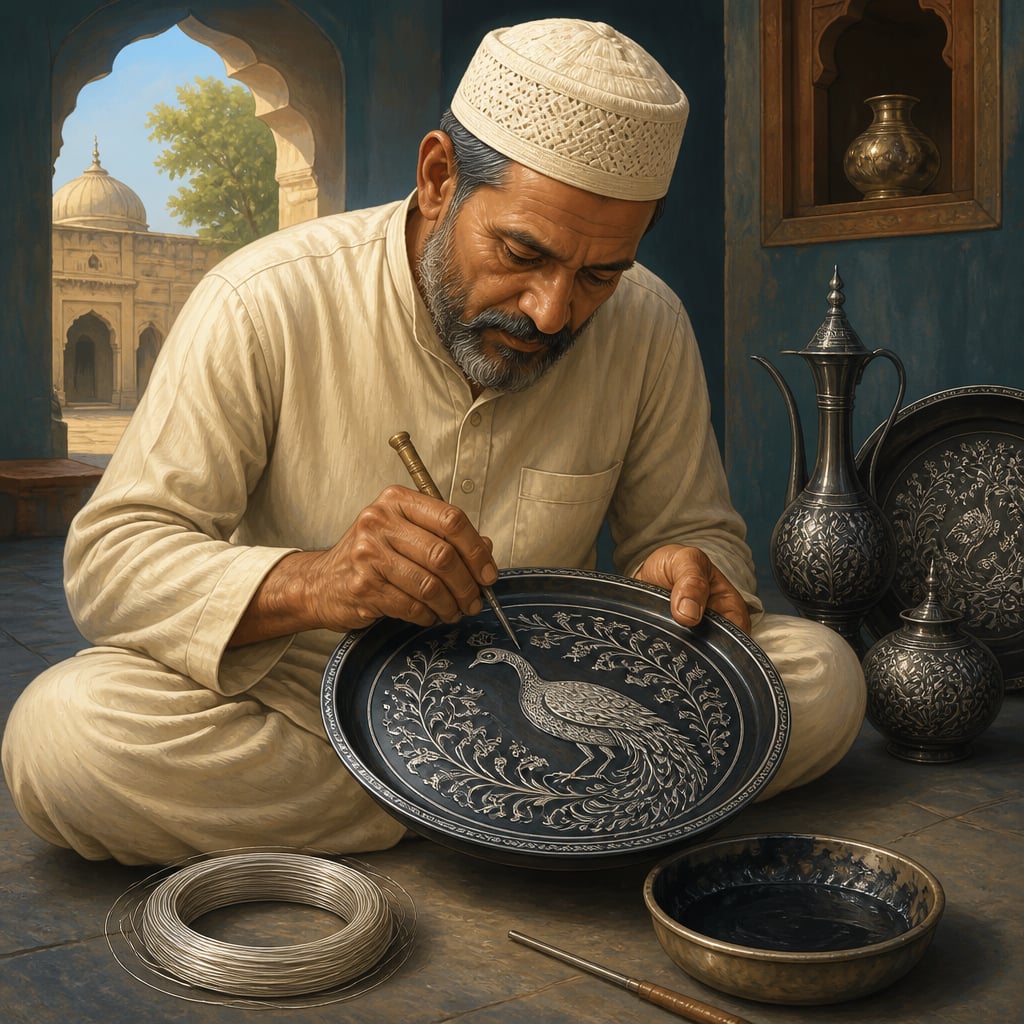
In a narrow lane in the Chaubara quarter of Bidar, in the far north of Karnataka, on a summer afternoon in the late 2010s, Shah Rasheed Ahmed Quadri sits cross-legged on the cool stone floor of his workshop. In his left hand is a small black metal vase. In his right hand is a fine steel chisel, no bigger than a pen. Next to him on a low wooden tray is a coil of pure silver wire, drawn to the thickness of a strand of hair.
His hands move without pause. He cuts a groove shaped like the petal of a poppy into the black surface of the vase, lays the silver wire into the groove, and taps it flat with a small hammer. His grandfather taught him this work when he was a boy. His grandfather's grandfather learned it from his own father, and so on back through seven generations of the Quadri family, all the way to the court of the Bahmani Sultans of Bidar in the fifteenth century.
The black vase in his hand is not painted. It is not dyed. The black is a chemical colour that appears only on a specific alloy of zinc and copper, and only when it is rubbed with a paste made from the dark soil inside the walls of the Bidar fort. No other soil on the subcontinent gives the same matt, permanent black. For nearly six hundred years, this secret has travelled through this one small town, from master to apprentice, and almost nowhere else. In 2015, the Government of India awarded Shah Rasheed the Padma Shri for keeping the secret alive.
Three hundred kilometres to the east, in a village called Pembarthi in Jangaon district of Telangana, a second Deccan metal tradition has survived just as long, and in just as small a geography. The artisans of Pembarthi do not work with silver on black. They work with brass sheet, hammering floral and figurative designs into thin metal panels that once decorated the temple chariots and the wooden gates of the Kakatiya kings, and that now decorate the homes of urban Indian collectors and the lobbies of Hyderabad hotels.
This lesson is the story of these two inlay traditions of the Deccan. Both outlived the courts that first paid for them. Both sit today on the edge of disappearing. Both are now protected by Geographical Indication law and by a small number of stubborn artisan families who have refused to let the work end.
The Bidar Alloy and the Bidar Soil
Bidriware is named after the town of Bidar, a hilltop fort city in the far north of Karnataka, near the borders of Telangana and Maharashtra. Bidar was the capital of the Bahmani Sultanate from 1427. When the Bahmanis broke apart in the sixteenth century into five successor sultanates, one of them, the Barid Shahi, kept Bidar as its own capital. Both courts patronised metalwork. The technique that the world now calls Bidriware was codified in their workshops.
The core chemistry of Bidriware is this. The base metal is an alloy, roughly sixteen parts zinc to one part copper. It is cast by the lost-wax method into the shape of a bowl, a vase, a hookah base, a tray, or a box. The cast piece is filed smooth and then temporarily blackened in a solution of copper sulphate. The craftsman draws the design on the blackened surface with a fine chisel. The most common motifs are vines, poppies, and Persian-style geometric lattices, all borrowed from the Persianate visual culture of the Bahmani and Barid Shahi courts.
Pure silver wire, drawn to the thickness of a thread, is then hammered into the engraved grooves. This is the central skill of Bidriware. The wire must sit flush with the surface, not above it and not below it. A good Bidri craftsman does this by eye and by feel, for hours at a time, on a piece no larger than a teacup.
Finally, the piece is rubbed with a paste made from a specific soil. The soil is taken from inside the Bidar fort walls, mixed with ammonium chloride and water, and left on the metal for a few minutes. The reaction turns the zinc-copper base a permanent matt black, while the silver wire stays bright. The contrast between the black ground and the silver flowers is the signature of Bidriware.
विश्वतश्चक्षुरुत विश्वतोमुखो विश्वतोबाहुरुत विश्वतस्पात्। सं बाहुभ्यां धमति सम्पतत्रैर्द्यावाभूमी जनयन्देव एकः॥
viśvataścakṣur uta viśvatomukho viśvatobāhur uta viśvataspāt saṃ bāhubhyāṃ dhamati sampatatrair dyāvābhūmī janayan deva ekaḥ
He has eyes on every side, faces on every side, arms on every side, feet on every side. With his two arms and with wings he forges heaven and earth, the one god who makes them both.
Rig Veda 10.81.3, the Vishvakarma Sukta
The verb dhamati literally means to blow on a fire, to smelt, to forge. The Vedic poets already saw the divine maker as a metalworker at a forge. The Bidri craftsman in Chaubara is a distant descendant of the same image.
The soil is the secret. Chemists have confirmed that the Bidar fort soil is unusually rich in certain oxides and salts, and that the reaction it produces on zinc alloy cannot be matched by any other local earth. Pieces made outside Bidar never turn the same deep permanent black. In this very literal sense, Bidriware is a craft that cannot be taken away from the town. The town is the recipe.
Designs, Tools, and the Kirkhana
A Bidri workshop is called a kirkhana, from the Persian word for a place of work. A working kirkhana in Bidar is a small room with a stone floor, a box of chisels, a coil of silver wire, a small vat for blackening, a pile of dark soil from the fort, and two or three artisans sitting cross-legged at the work.
The design styles of Bidriware are classified into four named categories, all in Urdu because the tradition runs through the Persianate court language of the Deccan.
- Tahnishan: the most common style. Silver wire inlaid into grooves to form the main pattern. The black ground dominates and the silver reads as the drawing on top of it.
- Zarnishan: a lower-relief variant where the silver sits flush with the surface.
- Zarbuland: a high-relief style in which small silver shapes rise above the black ground, almost like a small relief sculpture. Rare and difficult.
- Aftabi: a cut-out style in which the black ground is thinned or removed in places to create a two-layer visual effect. Rarer still.
A full hookah base or a large vase in the tahnishan style can take a single craftsman a month of steady work. A zarbuland masterpiece can take three months. The piece may then sell, through the right channel, for anywhere from a few tens of thousands of rupees to several lakhs. The economics are thin for everyone below the top tier, and most younger men in Bidar now leave the craft in favour of salaried jobs.
Pembarthi: Brass Under the Kakatiyas

Six hundred kilometres east of Bidar, across the Krishna river and into central Telangana, a different Deccan metal tradition has lived in a single small village for about eight centuries. The village is Pembarthi, in Jangaon district, roughly a hundred kilometres from Hyderabad. The craft is hand-hammered sheet brass, worked in a technique that English calls repoussé and that the village itself calls nakshi kala, the art of carved decoration.
The tradition goes back to the twelfth or thirteenth century, when the Kakatiya dynasty ruled much of what is now Telangana and Andhra Pradesh from their capital at Warangal. The Kakatiyas were great temple builders. Their temples needed brass fittings: door panels, chariot panels, kalasam finials, pillar ornaments, and ritual vessels. A community of Vishwakarma metal craftsmen settled in Pembarthi and began producing the sheet brass work that decorated Kakatiya temples and temple chariots.
When the Kakatiya dynasty fell in 1323 to the armies of the Delhi Sultanate, the great temple-building stopped. But the Pembarthi craftsmen did not leave the village. They continued the work for later Deccan patrons: the Bahmanis, the Qutb Shahis of Golconda, and eventually the Asaf Jahi Nizams of Hyderabad. Under Nizam patronage, Pembarthi brass became the standard decorative metalwork of the Hyderabad courts.
The method is this. A thin sheet of brass is placed over a bed of hot pitch or lac resin, which holds the sheet firm but yielding. The artisan hammers the design into the sheet from the back, raising the pattern in relief. He then flips the sheet and refines the details from the front. The result is a flat brass panel with a raised relief pattern that can be mounted on wood or framed as a standalone piece.
The master who gave the modern Pembarthi tradition its name was Pembarthi Chandraiah, a Vishwakarma brass artisan from the village who revived the Kakatiya-style repousse work at a time when the craft had almost disappeared. He received the Shilp Guru award, one of the highest state recognitions for an Indian craftsperson, for his role in keeping the tradition alive. His family workshop in Pembarthi continues to produce brass panels that carry the same motifs the Kakatiya temples once wore. He is the main reason Pembarthi is still on the craft map of modern India.
Geographical Indication: Bidar 2006, Pembarthi 2010
In the mid-2000s, the Handicrafts Development Corporation of Karnataka, working with the Bidar Collector's office and the local artisans' association, filed an application to register Bidriware as a Geographical Indication under the 1999 GI Act. The application had to prove that the craft was made by a specific community in and around Bidar, that the raw materials (especially the fort soil) were tied to the geography, and that pieces sold elsewhere as 'Bidri' were imitations that damaged the livelihood of the real artisans.
In 2006, the registration was granted. Bidriware became a GI-protected craft of Karnataka. Pembarthi received its own GI in 2010, registered as Pembarthi Metal Craft, covering the brass sheet repousse work of Pembarthi village and the surrounding Jangaon district.
Neither GI has stopped mass-market imitations completely. But the registrations give the real artisan families, and the buyers who want to support them, a legal line they can point to. A buyer who wants a real piece can now ask for the GI label, the name of the village, and the name of the craftsman.
From the Fort to the Designer Collection
Two recent routes to market show what the post-GI Deccan metal economy can look like.
On the Bidri side, the Kolkata-based conceptual jewellery designer Eina Ahluwalia is one of a small number of Indian designers who have worked with Bidar craftsmen to bring the black-and-silver inlay out of the hookah base and into wearable rings, pendants, and cuffs. The craftsmen in Bidar do the tahnishan inlay. The designer handles the concept and the urban distribution. Because each piece sells as a designer object rather than a tourist souvenir, the share that returns to the artisan is much larger than the hookah-base market ever offered.
On the Pembarthi side, the Gwalior-based online craft retailer iTokri has become one of the more consistent direct buyers of Pembarthi brass work. iTokri works directly with the Vishwakarma artisan families, photographs their pieces, and sells them online to urban buyers at prices that return a fair share to the village. A young person in Bangalore who wants a Pembarthi brass panel for her wall no longer has to travel to Jangaon district. She orders it online, and the money reaches the artisan's account within days.
Both channels show the same shape of answer. Direct contact between the artisan and the urban or international buyer, with the middlemen who used to capture most of the profit cut out of the chain.
Modern Echoes
The direct-to-buyer model is an instance of a larger idea the Indian craft economist Ritu Sethi, founder of the Craft Revival Trust and editor of the Asia InCH encyclopedia of South Asian crafts, has been arguing for more than two decades. Indian craft only survives when the maker and the final buyer meet, with as few people in between as possible. The Dastkari Haat Samiti, the artisan body founded by Jaya Jaitly, now reserves space for Bidar and Pembarthi craftsmen every winter at the Dilli Haat craft mela in Delhi, where a buyer can meet the craftsman in person and watch him work.
Back in his kirkhana in Chaubara mohalla, Shah Rasheed Ahmed Quadri finishes the last petal on the small black vase. The silver wire sits flush with the surface. Tomorrow he will rub the piece with the fort soil, and the black will deepen into the matt permanent finish that no factory in any other town can reproduce. The soil is still the recipe. The recipe is still in Bidar. And for as long as one family in Chaubara mohalla refuses to leave the craft, the black vase with the silver flowers will keep being made.
Key figures
Shah Rasheed Ahmed Quadri
A seventh-generation Bidriware master from the Chaubara quarter of Bidar town in northern Karnataka. He runs a small family kirkhana where he and a handful of other craftsmen continue to produce hand-inlaid Bidri pieces using the traditional Bahmani-era technique. In 2015, the Government of India awarded him the Padma Shri, one of the highest civilian honours in the country, for his role in preserving the Bidriware tradition.
Pembarthi Chandraiah
A Vishwakarma brass artisan from Pembarthi village in Jangaon district of Telangana, who revived the Kakatiya-style repousse brass work (nakshi kala) in the twentieth century and turned a nearly disappearing craft into a living rural economy again. He received the Shilp Guru award, one of the highest state recognitions for a master craftsperson in India, for his role in keeping the tradition alive.
Eina Ahluwalia
A Kolkata-based conceptual jewellery designer known for her use of traditional Indian craft techniques in contemporary, wearable forms. She is one of a small number of Indian designers who have worked directly with Bidar craftsmen to adapt the black-and-silver tahnishan inlay of Bidriware into rings, pendants, cuffs, and other jewellery pieces that sell through designer channels in Mumbai, Delhi, and international markets.
Ritu Sethi
An Indian craft researcher, editor, and policy advocate. She is the founder of the Craft Revival Trust and the founding editor of Asia InCH, an online encyclopedia of the crafts and textiles of South Asia. She has been one of the most consistent voices in Indian craft policy for more than two decades, advising the Ministry of Textiles, the United Nations, UNESCO, and several state governments on the legal and economic protection of traditional crafts.
Case studies
Pembarthi Chandraiah and the Return of the Kakatiya Brass
By the middle of the twentieth century, the Pembarthi brass sheet tradition was in serious trouble. The Kakatiya temples that had first patronised the craft had been gone for six hundred years. The Qutb Shahi and Nizam-era patronage that had kept it alive through the late medieval and colonial period had collapsed after 1948, when Hyderabad State was integrated into India and the Nizam's household stopped being the main buyer. The Pembarthi Vishwakarma families were down to a handful of active workshops, the younger sons were leaving for salaried jobs in Hyderabad and Warangal, and the motif vocabulary of the Kakatiya temples was being forgotten even in the village that had carried it for eight centuries. In this context, one master artisan from the Pembarthi Vishwakarma community, Pembarthi Chandraiah, refused to leave the work. He kept his family workshop running, took in younger apprentices, and spent years re-studying the stone panels of the Thousand Pillar Temple and the Ramappa Temple in order to reconstruct the full Kakatiya motif vocabulary for brass sheet repousse. He taught the reconstructed motifs to his sons and to a new generation of village apprentices.
From a dharmic perspective, Pembarthi Chandraiah was doing what the Shilpa Shastra tradition has always asked of its master craftsmen. He was not just producing objects for a market. He was holding the jnana (knowledge) of the craft, teaching it to the next generation, and anchoring it back to its religious and civic source in the Kakatiya temples. The Vishwakarma community has always understood its craft work as a form of worship of Vishvakarma, the divine maker of the Rig Veda. When Chandraiah re-studied the Thousand Pillar Temple panels in order to reconstruct the motif vocabulary, he was performing a traditional act: returning to the source text (in this case a temple) and re-reading it for his own generation. The Government of India recognised this with the Shilp Guru award, which is one of the few national honours that specifically names a craftsperson as a teacher of the next generation, not just as a maker of objects.
Pembarthi Chandraiah's revival work turned a nearly disappearing craft into a living rural economy again. His workshop trained dozens of younger craftsmen. The motif vocabulary of the Kakatiya temples, which had been weakening through the colonial and early post-independence period, was re-established as the core Pembarthi visual language. His sons and nephews continued the work, and other Pembarthi families followed his example. By the early 2000s, the village had enough active workshops and a strong enough motif vocabulary to support the 2010 application for the Pembarthi Metal Craft Geographical Indication. Without Chandraiah's decades of slow, unglamorous revival work, there would have been no GI, no cooperative, and possibly no living Pembarthi tradition left to protect.
A craft tradition is almost always saved by one or two stubborn masters in one critical generation. The wider structures, the cooperatives, the GI registrations, the designer collaborations, the online retailers, are all downstream of what those masters do. They are the foundation. Without Pembarthi Chandraiah in the twentieth century, the twenty-first century Pembarthi economy would not exist. The same is true of Shah Rasheed Ahmed Quadri's family in Bidar, of the Rabari grandmothers in Kutch, of the Salvi family in Patan, and of dozens of other small craft lineages across India. The most important intervention in any dying craft is almost always the one you cannot see from a distance: a master who refuses to leave the work.
The Pembarthi revival story is now used as a case study in craft policy discussions in India. It shows that the foundation of any successful craft GI registration is not the legal framework itself but the prior existence of a living tradition in the village, held together by at least one master lineage that can teach the craft to a new generation. Without the living tradition, the GI is just a piece of paper. With it, the GI becomes a legal weapon that can be used to protect and grow a rural economy.
The Pembarthi Metal Craft GI was registered in 2010 under the 1999 GI Act. The motif vocabulary it protects is drawn directly from the Kakatiya-era stone reliefs of the Thousand Pillar Temple (Hanamkonda, twelfth century) and the Ramappa Temple (Palampet, thirteenth century), the latter inscribed on the UNESCO World Heritage list in 2021. The core family workshops of Pembarthi village today include the Pembarthi Chandraiah family lineage and several related Vishwakarma households.
The 2006 Bidriware Geographical Indication
By the early 2000s, the Bidar craftsmen were in a strange position. Their craft had survived nearly six hundred years of court changes and colonial disruption. The Quadri family and a handful of other lineages in the Chaubara quarter were still producing genuine Bidri pieces with the traditional Bahmani technique and the fort soil oxidation. But in the national and international craft market, any factory in any state could produce an oxidised metal bowl, stamp it with a floral pattern, label it as 'Bidri' or 'Bidriware', and sell it at a tenth of what a real Bidar piece cost. Buyers had no way to tell the difference, and the real Bidar artisans were being systematically undercut in their own market by imitations that used their own name. In response, the Handicrafts Development Corporation of Karnataka, working with the Bidar Collector's office, the local Bidar artisans' association, and the Karnataka state government, drafted an application for a Geographical Indication registration under the 1999 GI Act. The application had to define the specific techniques covered, the community of artisans recognised as holders of the tradition, and the geographic boundary within which a piece could legitimately be called Bidriware.
From a dharmic perspective, the 2006 registration was not the creation of a new right. It was the formal recognition of a right that had always existed in the craft community's own practice. The Quadri family and the other Bidri lineages had held the technique, the soil recipe, and the name of the craft for centuries without any legal shield. The GI registration simply wrote this pre-existing community right into Indian law. Traditional Indian legal thinking, from the Arthashastra onward, has always recognised that communities can hold collective rights in their own ancestral practices, even if those rights are not codified in a single document. The GI Act of 1999 is a modern instrument that implements this ancient principle. The 2006 Bidriware registration is one of the cleanest examples of how that implementation works in practice.
In 2006, the Geographical Indications Registry in Chennai formally granted the Bidriware GI. The registration covers pieces produced in Bidar town and a few nearby villages, by artisans from the recognised Bidri community, using the fort-soil oxidation process. Since 2006, the word 'Bidriware' has had a legal meaning in India that can be defended in court. Enforcement is still imperfect. Factories in other states still produce oxidised metal imitations, and rural buyers are often still misled. But cooperatives, designers, museums, and international collectors now have a legal basis for authentication. A buyer who sees a Bidriware GI label, combined with the name of a Bidar kirkhana and the name of the craftsman, can be reasonably confident that the piece was genuinely made in Bidar using the traditional technique.
A Geographical Indication registration is one of the weakest-looking and most important protections a craft tradition can have. Before 2006, any factory could steal the word 'Bidriware'. After 2006, the word belongs, in Indian law, to the Bidar artisan families who have actually held the tradition. The GI does not solve the enforcement problem by itself. But it gives the real artisans a legal weapon they did not have before. Combined with designer collaborations (Eina Ahluwalia and others), state handicrafts outlets, and individual master recognitions like the 2015 Padma Shri to Shah Rasheed Ahmed Quadri, it closes the gap between the craftsmen in the Chaubara kirkhanas and the buyers who want to honour their work.
The 2006 Bidriware GI is now the legal foundation for the authentication tags that Karnataka state handicrafts outlets, designer collaborators, and international collectors use to verify a real Bidri piece. A buyer interested in the tradition can look for three things on any piece offered as Bidriware: the GI label, the name of the Bidar kirkhana or cooperative, and the name of the craftsman who made the piece. This three-part authentication chain is the strongest verification currently available for Bidri in the Indian market.
Bidriware was registered in 2006 under the 1999 Geographical Indications of Goods Act. It was among the early Karnataka craft and textile traditions to receive GI protection, alongside Mysore Silk, Channapatna Toys, Ilkal Sarees, and others. The registration is held collectively on behalf of the Bidar artisan community, not by any individual producer. More than a hundred Karnataka crafts and agricultural products have received GI protection since, using the Bidriware registration as a partial reference model.
iTokri and Pembarthi: A Village to a Bangalore Living Room
The post-2010 Pembarthi Metal Craft GI gave the village a legal name, but a legal name by itself does not pay the rent. The Pembarthi artisan families still needed a channel to the urban Indian buyer, and the traditional handicraft emporium system of the twentieth century was too slow, too geographically narrow, and too heavy on middlemen to support a small village of brass workers in Jangaon district. Into this gap stepped a new kind of craft retailer: the direct-sourcing online store. The Gwalior-based online craft retailer iTokri was founded in the early 2010s by Nitin Pamnani and his colleagues with an explicit mission to buy directly from Indian artisan communities, photograph their work, list it online at prices that return a fair share to the maker, and ship it anywhere in India within a week. Over the following decade, iTokri built direct relationships with several hundred Indian craft communities, and Pembarthi Metal Craft became one of its core categories in Deccan metalwork.
From a dharmic perspective, the direct-to-buyer channel restores something the traditional village economy always had and that the industrial-era handicraft supply chain lost. In the older economy, the village artisan and his direct buyer (the local temple, the local court, the local patron) knew each other and negotiated face to face. The supply chain was short, the relationship was direct, and the buyer's payment reached the artisan without being diluted by many middlemen. The industrial-era emporium and wholesale system broke this direct relationship and inserted five or six middlemen between the village and the urban buyer, each taking a share of the final price. The direct-sourcing online retailer is a modern instrument that rebuilds the short supply chain of the traditional village economy, using the internet as the medium instead of a physical road to the local temple.
Over the past decade, iTokri has become one of the more consistent direct buyers of Pembarthi brass work for the urban Indian market. The Pembarthi Vishwakarma artisan families receive commissions in advance, produce the panels at their own village workshop on their own schedule, and ship them to the iTokri warehouse in Gwalior. The pieces are then photographed, listed online, and sold to urban buyers in Bangalore, Mumbai, Delhi, Chennai, and smaller cities. A buyer who wants a Pembarthi brass panel for her wall no longer has to travel to Jangaon district. She finds it on the iTokri website, pays online, and receives it within a week. The Vishwakarma artisan receives his share directly, without the five-layer emporium chain that would otherwise have taken most of the margin.
Online direct-sourcing is one of the most effective modern tools for supporting traditional craft economies, not because it is glamorous or high-tech, but because it radically shortens the supply chain between the village maker and the urban buyer. A craft tradition that survives the collapse of its historical patronage almost always survives by finding a new, shorter path to its buyers. For Pembarthi, iTokri is currently one of the main such paths. For Bidriware, designer collaborations like Eina Ahluwalia's play a similar role. In both cases, the principle is the same: cut out the middlemen, pay the artisan directly, and let the urban buyer pay a price that reflects the real skill of the maker.
The iTokri model, and similar direct-sourcing platforms like GoCoop, Jaypore (before its acquisition), and Okhai, are now the main online channels through which urban Indian buyers can reliably buy Pembarthi brass, Bidri, and most other GI-protected Indian crafts without the traditional emporium chain. For a buyer interested in supporting any of these traditions, the direct-sourcing online retailer is currently the clearest single lever: one purchase, one verified village, and a payment that reaches the artisan without being diluted by many hands.
iTokri was founded in the early 2010s and has grown into one of the larger online Indian craft retailers, working with hundreds of artisan communities across the country. Its Pembarthi Metal Craft category carries brass sheet pieces, lamps, panels, and decorative objects sourced directly from the Pembarthi Vishwakarma artisan households in Jangaon district of Telangana.
Eina Ahluwalia and the Bidri Ring on a London Finger
The traditional object formats of Bidriware, the hookah base, the paan daan, the surahi, and the decorative vase, are products of a nineteenth-century Nizami household that no longer exists. Almost nobody in a modern Indian home smokes a hookah or keeps paan in a surahi. A Bidri craftsman in Bidar who tries to live only on these old formats is selling to a slowly disappearing market. The silver-on-black inlay technique itself, however, is visually stunning and wearable. In the last decade, a small number of contemporary Indian designers have recognised this and have begun collaborating with Bidar craftsmen to move the tahnishan inlay out of the hookah base and into wearable jewellery: rings, pendants, cuffs, and statement pieces. The Kolkata-based conceptual jewellery designer Eina Ahluwalia is one of the most visible of these collaborators. Her pieces use traditional Bidar inlay work as the core craft element, with contemporary jewellery design handling the concept, the setting, and the urban distribution.
From a dharmic perspective, the Ahluwalia collaboration is a perfect example of the Shilpa Shastra principle that the technique is the tradition, not the object. The Shilpa Shastra texts (the Mayamata, the Manasara, the Shilparatna) describe in detail how craftsmen should work with materials, proportions, and tools, but they do not freeze the list of objects a craftsman can make. The tradition has always allowed the same technique to migrate into new object formats as the needs of the patron and the user change. A twelfth-century Chola bronze craftsman made temple deities. A twenty-first century Chola bronze craftsman makes temple deities, decorative objects, and designer home pieces, all using the same lost-wax technique. The Bidar case is the same. The tahnishan inlay is the Bidri tradition. The hookah base and the ring are just two different containers for the same technique.
The designer jewellery collaborations have opened a new price band for Bidriware that the traditional hookah-base market could never reach. A designer ring or pendant that uses real Bidar tahnishan inlay can sell through designer showrooms in Mumbai, Delhi, and international markets for prices that return a meaningful share to the Bidar craftsman. Because the piece is small, the material cost (zinc, copper, pure silver) is low, and the craftsman's skill is the main value. The designer handles the concept, the photography, the marketing, and the distribution to urban and international buyers. The Bidar craftsman does exactly the same work he has always done, but on a new object, for a new buyer, at a new price.
The survival of a traditional craft in the modern market almost always depends on migrating the technique into new object formats that the contemporary user will actually buy. Loyalty to old object formats, when those formats have lost their household function, is the fastest way to kill a tradition. What should be loyal is the technique, not the object. The Eina Ahluwalia x Bidri collaboration is one of the clearest recent proofs of this principle in Indian craft: a six-hundred-year-old technique, a brand-new object format, and a buyer in London or New York wearing a small piece of Bidar fort soil on her finger.
For a buyer interested in supporting Bidriware directly, the designer collaboration channel is currently one of the higher-return options. A single designer ring or pendant can return more cash to the Bidar craftsman than several traditional hookah bases sold through a handicraft emporium. The buyer in Mumbai, Delhi, or London wears the tradition instead of displaying it, and in doing so keeps the silver wire, the fort soil, and the seventh-generation kirkhana in Chaubara mohalla all quietly alive.
Eina Ahluwalia is one of a small number of contemporary Indian designers working directly with Bidar craftsmen on wearable Bidri jewellery. Similar designer collaborations have been attempted with the Cuttack silver tarakasi tradition, the Meenakari enamel tradition of Jaipur, and the Dhokra lost-wax tradition of Bastar. The designer-artisan collaboration model is now one of the more promising paths for keeping traditional metal crafts economically viable in contemporary India.
Historical context
The Bidriware story begins in the fifteenth century under the Bahmani Sultanate at Bidar (from 1427) and continues under the Barid Shahi successor sultanate (sixteenth century), the Mughal and Nizam periods (seventeenth to twentieth centuries), and into the post-independence era of GI protection (2006) and contemporary designer collaborations. The Pembarthi story begins earlier, in the twelfth to fourteenth centuries under the Kakatiya dynasty at Warangal, and continues through the Bahmani, Qutb Shahi, Asaf Jahi, and post-independence periods into the 2010 GI registration and the present direct-to-buyer craft economy.
Both crafts are products of the Deccan plateau, the dry upland region between the Krishna and Godavari rivers, in what is now Karnataka, Telangana, and Andhra Pradesh. Bidar is a hilltop fort city in the far north of Karnataka, close to the borders of Telangana and Maharashtra. Pembarthi is a small village in Jangaon district of Telangana, roughly a hundred kilometres east of Hyderabad and about the same distance from the Kakatiya capital of Warangal. The two craft traditions sit at the two ends of a single Deccan court patronage system that has been continuous for nearly a thousand years, from the Kakatiyas through the Bahmanis, the Barid Shahis, the Qutb Shahis, the Mughals, and the Asaf Jahi Nizams of Hyderabad. The Persianate visual culture of the Deccan sultanates shaped the Bidri motif vocabulary. The Kakatiya temple tradition shaped the Pembarthi motif vocabulary. Both are Deccan crafts in the deepest sense of the word.
Bidriware has close technical cousins in the Persian and Central Asian damascening traditions, especially the silver-on-iron koftgari of Gujarat and Rajasthan and the silver-on-steel damascening of Toledo in Spain and Isfahan in Iran. The specific combination of a zinc-copper alloy base, silver wire inlay, and soil-based oxidation is an Indian innovation that does not appear anywhere else in the world. Pembarthi repousse work has cousins in the brass sheet traditions of Nepal, Tibet, and Central Asia, and in the Christian repousse metalwork of medieval Europe (used for reliquaries and altar fittings). The Kakatiya-era motif vocabulary of Pembarthi, with its temple chariots, gods, and lotus flowers, is specifically South Indian. The post-2006 and post-2010 GI protection model, used for both crafts, is similar to the French Appellation d'Origine Contrôlée system used for wines and cheeses and to the European Protected Designation of Origin framework.
The 2006 Bidriware GI registration recognises a few hundred artisan families in and around Bidar as the legal holders of the craft. The 2010 Pembarthi Metal Craft GI covers the Vishwakarma brass artisan families of Pembarthi village and the surrounding Jangaon district, estimated at between fifty and a hundred active households. A tahnishan Bidri vase of moderate size takes two to four weeks of work and retails through cooperatives or designer showrooms for a few tens of thousands of rupees. A zarbuland masterpiece can take three months and sell for several lakhs. A Pembarthi brass panel of moderate size takes one to two weeks of work and retails online through iTokri and similar retailers for a few thousand rupees.
Bidriware and Pembarthi Metal Craft are two of the clearest examples in Indian craft of how a living tradition can survive the collapse of its original court patronage (the Bahmani, Barid Shahi, and Kakatiya courts) and the colonial disruption of its market (the nineteenth and twentieth centuries), if a small number of artisan families refuse to leave the work and if a legal and economic infrastructure grows up around them to connect them to contemporary buyers. Both crafts are also proofs that Geographical Indication registration, used correctly, can be a genuinely useful tool at the level of the individual artisan, not just at the level of the state. Together they show what a modern Indian craft economy can look like when it works: one small town for Bidri, one small village for Pembarthi, a legal label, a direct channel to the urban buyer, and enough master craftsmen to keep teaching the next generation.
Living traditions
The 2006 Bidriware GI and the 2010 Pembarthi Metal Craft GI have together given both Deccan metal traditions a legal foundation they did not have before. Designer collaborations (Eina Ahluwalia and others for Bidri), online direct-to-buyer retailers (iTokri and others for Pembarthi), and state cooperatives (the Karnataka and Telangana state craft councils) now connect the artisan families to urban and international buyers. The Salar Jung Museum in Hyderabad, the Craft Revival Trust's Asia InCH encyclopedia, and the Dilli Haat craft mela in Delhi all function as institutional anchors for the two crafts. National honours including the Padma Shri (Shah Rasheed Ahmed Quadri, 2015) and the Shilp Guru (Pembarthi Chandraiah) have put both master lineages on the national map.
- Bidri kirkhana work in Chaubara, Bidar: A working kirkhana in Bidar runs on a daily rhythm of casting, filing, engraving, inlay, and oxidation. The master and his senior craftsmen sit cross-legged on a stone floor, working cross-referenced to a design book and a pile of silver wire. Casting is done in the early morning when the furnace is freshest. Engraving and inlay happen through the middle of the day. The final oxidation with the Bidar fort soil is usually done in the late afternoon, once the inlay work is complete, and the piece is left to cure before being polished. A single piece may move through several hands over several weeks before it leaves the kirkhana.
- Pembarthi brass sheet hammering: A Pembarthi workshop runs on a different rhythm. The brass sheet is first cut to size, then laid over a bed of hot pitch or lac resin poured into a wooden tray. The artisan hammers the design into the sheet from the back using small steel punches and chisels. He then flips the sheet over, reheats the pitch, and refines the details from the front. The finished panel is cleaned, polished, and mounted on wood or framed. A skilled Pembarthi artisan works on one panel at a time, and a moderate-sized panel takes one to two weeks to complete from sheet to finished piece.
- Annual Vishvakarma Puja in the Deccan metal villages: Both the Bidri artisans of Bidar and the Vishwakarma brass artisans of Pembarthi observe the annual Vishvakarma Jayanti (usually in September) in honour of the divine craftsman Vishvakarma described in the Rig Veda's Vishvakarma Sukta. On this day, the craftsmen wash their tools, decorate the chisels and hammers with flowers and turmeric, offer prayers to the divine maker, and traditionally do not begin any new commercial work. It is one of the few days in the year when the workshops stop. The puja connects the contemporary artisan to the Vedic image of the metalworker as a distant descendant of Vishvakarma himself.
Reflection
- Is there any piece of inlay metalwork in your home? A Bidri bowl, a Pembarthi brass panel, an oxidised metal jewellery box, an inlaid tray from a craft emporium? Look at it closely. Can you tell whether it was made by hand or by machine? Can you tell which region it came from? What would change in how you see this piece, and in how you buy the next one, if you could tell a real Bidar tahnishan from a factory-oxidised imitation?
- The Bidar fort soil is not just a workshop ingredient. It is the one thing in Bidriware that cannot be taken out of Bidar. Is there any work, craft, relationship, or tradition in your own life that is similarly tied to a specific place? A farm, a school, a family home, a river, a neighbourhood, a temple? If that place were taken away, how much of the work would still be the work?
- The modern survival of Bidriware and Pembarthi depends on direct channels between the artisan and the final buyer: designer collaborations, online retailers, craft melas where you can meet the craftsman in person. The next time you buy anything handmade, ask yourself how many people stand between you and the person who actually made the object. What would change in your buying habits, and in the maker's income, if you tried to make that number as small as possible?