Dhokra & Bell Metal: Tribal Casting Arts

The 4,500-Year-Old Wax Thread That Still Runs Through Bastar and Bankura

Meet the Ghadwa metalsmiths of Bastar, the Karmakar families of Bikna, and the kamsari households of Sarthebari and Mannar. Learn how a length of beeswax thread, a clay core, and a kiln of cow-dung cakes carry a casting tradition from the Mohenjo-daro Dancing Girl in 2500 BCE to a Padma Shri master in Kondagaon, and meet the brands and institutions keeping the wax winding alive today.

A Courtyard in Kondagaon
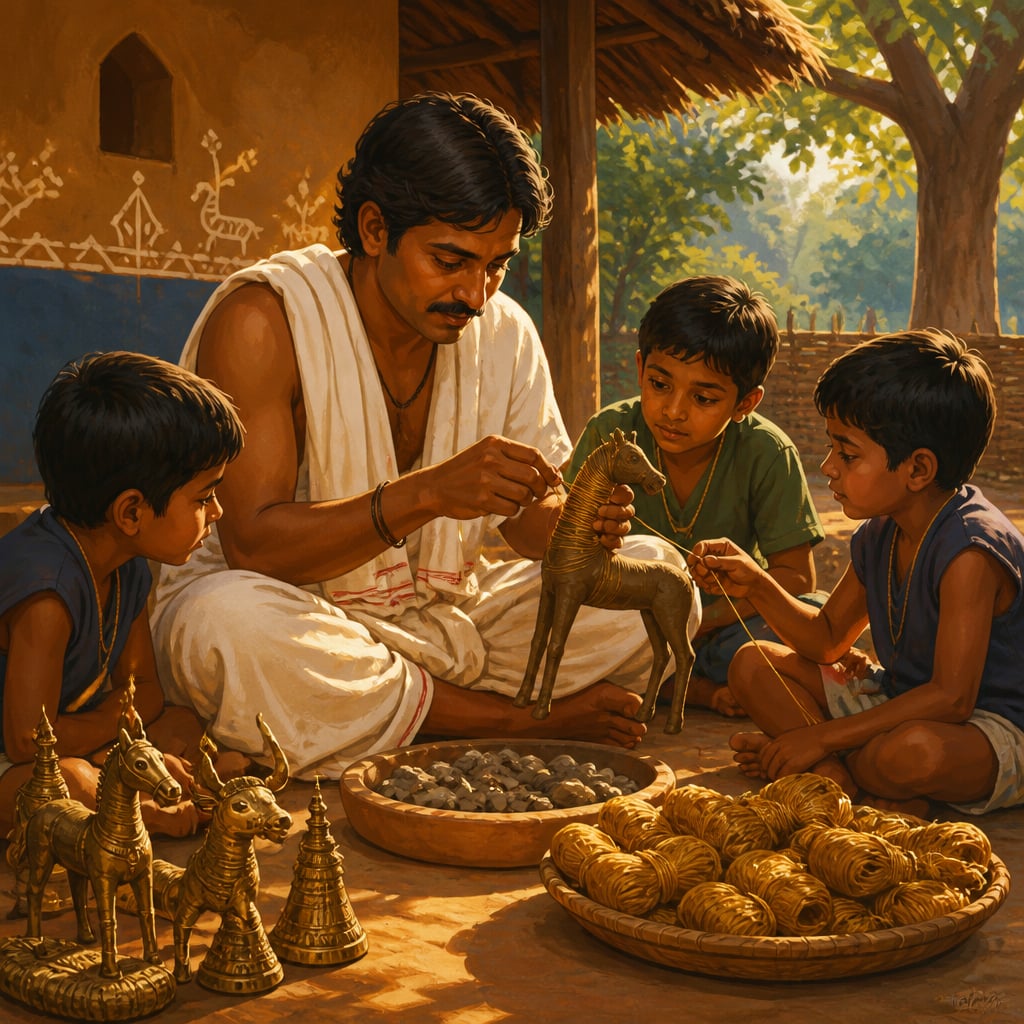
Jaidev Baghel teaching nephews to wind wax thread in Kondagaon

In the winter of 1982, in a courtyard in Kondagaon, a small town in the Bastar forests of what is now Chhattisgarh, a thirty-three year old Ghadwa metalsmith named Jaidev Baghel sat cross-legged on the packed earth and rolled a thin worm of beeswax between his palms. The wax was the colour of ripe mango. The clay core in front of him, shaped into the rough body of a horse, was still warm from the morning sun. In his hand was a length of waxed thread no thicker than a piece of grass. He was about to wind it, ring after ring, around the body of the horse. When he finished, the horse would be dressed in a coat of fine wax lace. None of the lace would survive. All of it would matter.

A few weeks earlier, Jaidev had been invited to a place he had never been: Bharat Bhavan, the new state museum in Bhopal that the painter Jagdish Swaminathan had founded that year. Swaminathan had done something India's art world had never done before. He had hung the work of Bastar's tribal metalsmiths and Madhubani's village painters on the same walls, in the same gallery, as the canvases of Delhi's modern oil painters. In Bhopal, Jaidev's horses had sat at eye level beside paintings worth ten times their price. He came home knowing two things he had not known before. The first was that what his family did was art, not just craft. The second was that almost nobody in Delhi understood how it was actually made.

So today, in his courtyard, he was teaching three of his nephews the only step nobody could shortcut: how to wind the wax thread.

What 'Dhokra' actually means

The word Dhokra (sometimes spelled Dokra) comes from the Dhokra Damar, a group of nomadic tribal metalsmiths who have moved for centuries across the eastern belt of India. Their old caravan routes ran through what is today Chhattisgarh, Jharkhand, Odisha and West Bengal. Wherever they stopped to camp, they cast small bronze figures for the local Adivasi villages: tribal gods, hunting horses, dancing women, weighing scales, oil lamps, hair pins. Then they moved on.

Today the word is used more loosely, for any lost-wax metal casting made by Indian tribal artisans using the ancient technique. But the heart of the tradition is held by a few specific communities in a few specific villages:

Each cluster has its own preferred motifs. Bastar specialises in horses, elephants, hunting scenes and tribal deities. Bikna specialises in the famous Bankura horse, the same long-necked posture that the village's terracotta makers turn out in fired clay. Mayurbhanj prefers ritual lamps and bell-bracketed peacocks. Look at twenty pieces from twenty workshops and a trained eye can place each one inside fifty kilometres of where it was made.

The lost-wax method, step by step

The technique these communities share is one of the oldest in human history. It is called cire perdue in French, lost wax in English, and madhuchchhishta vidhanam in Sanskrit, literally 'the procedure of using leftover honey-wax'. The same name appears in early Sanskrit alchemical texts. The method itself is older than the name. The Mohenjo-daro Dancing Girl, a small bronze statue of a slim adolescent with bangles up to her shoulder, was cast by a metalsmith on the Indus around 2500 BCE using exactly this process. Her descendants, in a sense, are still casting in Bastar.

The ancient hymns honoured the patron of all such work as the cosmic craftsman, Vishvakarma, the maker of every form.

विश्वतश्चक्षुरुत विश्वतोमुखो विश्वतोबाहुरुत विश्वतस्पात्। सं बाहुभ्यां धमति सं पतत्रैर्द्यावाभूमी जनयन्देव एकः॥

viśvataścakṣur uta viśvatomukho viśvatobāhur uta viśvataspāt saṃ bāhubhyāṃ dhamati saṃ patatrair dyāvābhūmī janayan deva ekaḥ

Eyes on every side, faces on every side, arms on every side, feet on every side. With his arms and his bellows he forges, fashioning heaven and earth, the one god alone.

Rig Veda 10.81.3 (Vishvakarma Sukta)

The method itself has five steps. Each one fails completely if the previous step is wrong.

  1. Build a clay core. The artist shapes the rough form of the figure in a mixture of fine clay, rice husk and dung. The core is dried in the sun for two full days. Most of the finished bronze will be hollow around this core, which keeps the metal weight down and the casting affordable.
  2. Wrap the wax. This is the step Jaidev was teaching. The artist draws fine threads of beeswax, mixed with resin from the dhuna tree, by squeezing warm wax through a brass sieve. He winds these threads around the clay core, ring after ring, until the core is completely covered. Every ring is the surface decoration of the final bronze. There is no way to add detail later.
  3. Coat in clay. The wax-wrapped figure is wrapped again, this time in two or three successive layers of fine clay. Two small openings are left at the top: one for the wax to flow out, one for the metal to flow in.
  4. Bake and pour. The whole thing is placed inside an open kiln of cow-dung cakes and fired. The wax melts and runs out, leaving a hollow space in the exact shape of the figure. Through the same opening, the artist now pours in molten bell metal, an alloy of about seventy-eight percent copper and twenty-two percent tin. The mould is left to cool overnight.
  5. Break the mould. The next morning, the artist breaks the clay shell with a small hammer. Each casting is unique. The mould cannot be reused. There are no copies. There never will be.

This is why Dhokra prices are what they are, and why a real Bastar horse cannot be told apart from a fake by looking at the face. You have to look at the back. A real lost-wax piece will carry tiny wax-thread join lines, slightly uneven, that no factory casting will ever have.

Bell metal, the older household cousin

Sarthebari kamsari hammering a glowing bell-metal vessel

Alongside Dhokra, India has another, older metal tradition that uses the same alloy. It is called bell metal because the same copper-and-tin recipe was used for temple bells. In Sanskrit it is kamsya, the same root as the modern Hindi word kansa. Bell metal has a particular sound. When you tap a real bell metal vessel with your fingernail, it rings like a small bell for several seconds. Aluminium and steel just clunk.

Bell metal in India is made by hereditary kamsari communities, not by the Dhokra Damar, and the famous centres are very different from Bastar. Sarthebari in Assam, on the southern bank of the Brahmaputra, has been making bell metal plates, water pots, lamps and dishes for at least five centuries. The Assamese household xorai, a tall offering tray on a flared stand that sits in almost every Assamese home, is made there. Mannar in Kerala makes the temple lamps, the prayer bells, and the uruli, the wide round cooking pot whose curved bottom is the secret of slow coconut-oil cooking in Kerala kitchens. The kamsari families of Mannar trace their craft back to the Chera kings.

Dhokra (lost-wax) Bell Metal (kamsya)
Made by Dhokra Damar tribes Made by settled kamsari castes
Forest and tribal villages Established temple towns and river ports
Sculptural figures, one of a kind Vessels, lamps and bells, made in batches
Mould broken after every cast Worked on the anvil and the wheel
Bastar, Bankura, Mayurbhanj Sarthebari (Assam), Mannar (Kerala)

Dhokra and bell metal share the alloy. They share the chemistry. But they belong to different worlds. Dhokra is tribal, sculptural and one-piece. Bell metal is settled, household, and made by hammering and turning. The two crafts have lived alongside each other in India for thousands of years without ever quite merging.

Three centuries of decline, four decades of recovery

By the early twentieth century, both traditions were in serious trouble. The Dhokra Damar nomads were losing their old caravan routes as forests were declared reserves and free movement became harder. Bastar's tribal market was collapsing as cheap aluminium pots reached the village haats. By the 1970s, mass-produced brass castings from the metal foundries of Moradabad in Uttar Pradesh were being sold in Delhi handicraft shops, often labelled as 'Bastar bronze'. A young metalsmith in Kondagaon could easily earn less in a day than a wage labourer.

Three things saved the craft, all of them slow, and none of them inevitable.

The first was Bharat Bhavan and Jagdish Swaminathan. When Swaminathan opened the Roopankar gallery in Bhopal in 1982, he placed tribal Bastar bronzes next to modern oil paintings on the same wall. He paid the metalsmiths the same artist's fee he paid the painters. He invited Jaidev Baghel and other Ghadwa masters to live in Bhopal as artists in residence. For the first time, the country's urban middle class was forced to look at a Bastar horse and see sculpture, not souvenir.

The second was the Geographical Indication tag. Bastar Dhokra received its GI in 2008. Bankura Dokra received its own GI in the same year. The tag does not stop a Moradabad foundry from casting fakes, but it gives the Ghadwa and Karmakar communities a legal weapon to sue traders who label those fakes as the real thing. It also gave government cooperatives, fair-trade brands and online platforms a reason to start paying GI-grade prices.

The third was the rise of artisan-direct marketplaces. Sasha in Kolkata, Tribes India under the central government's TRIFED, Okhai under the Tata Chemicals Society, and online shops like iTokri and Jaypore began going directly to Kondagaon and Bikna and buying from family workshops at fair prices. The middleman trader was cut out. The Ghadwa metalsmith now knows how much his horse sells for in Mumbai, and increasingly takes the difference home.

Why this thread matters

Almost every other ancient metal craft on earth has been lost. The lost-wax bronzes of Mesopotamia are gone. The bronze casting of pharaonic Egypt is gone. Even the great Greek and Roman bronze traditions survive only as museum objects, reconstructed by modern scholars from archaeology. The technique that made the Mohenjo-daro Dancing Girl four and a half thousand years ago, however, never went out of production. It just moved from city to forest, from urban karkhana to nomad camp, and waited.

A child today, in a Kondagaon courtyard, can sit beside a Ghadwa master and learn to wind wax thread around a clay core in exactly the same gesture, with exactly the same materials, that an Indus Valley metalsmith used in 2500 BCE. There is no other living craft on earth that can say this.

In 2003, the Government of India gave Jaidev Baghel the Padma Shri. He brought it home to Kondagaon and continued teaching wax winding to his nephews and their children until his death in 2014. The wax thread he had rolled between his palms in 1982 had become, by then, the longest unbroken thread in the history of metal.

Key figures

Jaidev Baghel

Padma Shri Ghadwa master metalsmith of Kondagaon, Bastar (Chhattisgarh), and the man who took Bastar Dhokra from a forest craft to international recognition

Jagdish Swaminathan

Painter, poet, and founding director of Bharat Bhavan in Bhopal (1982); the curator who placed tribal art on the same wall as modern art for the first time in India

Vishvakarma

The cosmic craftsman of the Vedas, patron deity of all metalworkers, carpenters, weavers and architects

Case studies

The Ghadwa of Bastar and the 2008 Dhokra GI Tag

By the early 2000s, Delhi and Jaipur tourist shops were full of small bronze figures sold as 'Bastar Dhokra'. Most of them were not. They were mass-produced brass castings from the metal foundries of Moradabad in Uttar Pradesh, made in two-piece reusable moulds at a tenth of the cost of a real lost-wax piece, sometimes machine-finished. The Ghadwa families of Kondagaon, Narayanpur and Jagdalpur, who had cast Bastar Dhokra for generations, were watching their market for genuine work disappear into a flood of fakes. Beginning in the early 2000s, Ghadwa cooperatives, the Chhattisgarh state handicrafts department and a handful of textile and craft scholars filed a Geographical Indication application for Bastar Dhokra with the GI Registry in Chennai. The application argued that only one-of-one lost-wax castings made by Ghadwa metalsmiths actually living in the Bastar region, using the traditional five-step beeswax-and-clay process, could legally be called 'Bastar Dhokra'. The case took several years to work through the registry.

The GI tag is a modern legal translation of an older Dharmic principle: that authority over a craft belongs to the community and the soil that produced it, not to any trader who can mimic the output. The Arthashastra treats trade identity as something that belongs to the guild and the town, not to the merchant. The Ghadwa of Bastar are a parampara, a living lineage whose knowledge cannot be detached from the lineage and resold. The GI tag simply gave that parampara a courtroom vocabulary. The Vishvakarma Sukta, by treating the smith's work as sacred forging, makes the same claim in older language: the right to call something 'Bastar Dhokra' belongs to the community whose hands shape it.

In 2008, Bastar Dhokra received its Geographical Indication tag. Bankura Dokra received its own GI in the same year. The tags do not stop Moradabad foundries from existing, but they give Ghadwa and Karmakar cooperatives the legal standing to challenge traders who label brass fakes as 'Bastar Dhokra'. Several Delhi and Jaipur traders have since been forced to relabel their stock. State handicrafts departments now use the GI tag as a basis for fair-price purchasing. Most importantly, Ghadwa families now have a recognised legal name for what they do.

A tradition that has been held by a community for centuries does not need to justify itself, but it does need legal tools to defend itself in a modern economy. The Bastar case shows that dharmic lineage and Indian GI law can be stacked on top of each other without contradiction. Old parampara, new courtroom.

Bastar Dhokra and Bankura Dokra both received their Geographical Indication tags in 2008. They were among the earliest Indian tribal crafts to be protected under the GI law, which had only come into force in 2003.

Jaidev Baghel: The Ghadwa Who Brought Kondagaon to Bhopal

Jaidev Baghel was born in 1949 in Kondagaon, a small town in the Bastar forests, into a Ghadwa metalsmith family that had cast lost-wax bronzes for generations. By the time he was in his twenties, the local market for Ghadwa work was collapsing. Cheap aluminium pots had reached the village haats, and Bastar's tribal customers were buying fewer ritual bronzes every year. In 1982, a quietly revolutionary thing happened. The painter Jagdish Swaminathan opened the Roopankar gallery at Bharat Bhavan in Bhopal and went looking for tribal artists to feature. He found Jaidev Baghel in Kondagaon and invited him to Bhopal as an artist in residence. For the first time in his life, Jaidev sat in a museum gallery and saw his Bastar horses placed at eye level beside canvases by Husain and Tyeb Mehta. He was paid the same residency fee as the painters. He came home knowing that what his family did was art, and that the rest of the country was about to find out.

Jaidev Baghel's life is a working example of the Vishvakarma Sukta's claim that forging is a sacred act. He never described himself as a sculptor or an artist in the modern sense. He used the older Hindi word ghadhai, shaping, the same word the Rig Veda hymn applies to the cosmic craftsman. His refusal to abandon his ancestral craft when its market was collapsing is the metalworker's version of the Gita's sahaja karma: the work you were born into is not abandoned because it has become difficult. You sit inside the difficulty and clean it up.

Over the next three decades, Jaidev Baghel trained dozens of younger Ghadwa metalsmiths in Kondagaon, took Bastar Dhokra to exhibitions in Europe, the United States and Japan, and helped build the case for the Bastar Dhokra GI tag, which arrived in 2008. In 2003, the Government of India awarded him the Padma Shri. He continued teaching wax winding to his nephews and their children in his Kondagaon courtyard until his death in 2014. Almost every Bastar Dhokra workshop active today traces some part of its lineage back to him.

Sometimes a single artisan's refusal to leave a forest village is all that stands between a craft and the archive. Jaidev Baghel did not save Bastar Dhokra by inventing anything new. He saved it by staying in Kondagaon and winding wax thread, year after year, while a museum in Bhopal slowly taught the rest of India to recognise what he was making.

Jaidev Baghel received the Padma Shri in 2003, five years before Bastar Dhokra received its Geographical Indication tag in 2008. His exhibition residency at Bharat Bhavan in 1982 is widely considered the moment Indian tribal metalwork crossed from craft category into art category.

Sasha and Tribes India: Buying Direct from the Courtyard

For most of the twentieth century, a Bastar Ghadwa metalsmith sold his work to a passing trader who came to Kondagaon once a season, paid him a flat per-piece price, took the bronzes to Delhi or Mumbai, and resold them at five or ten times what he had paid. The artisan never knew the final sale price. He had no negotiating power and no relationship with the customer. Two organisations tried to break this pattern from opposite ends. Sasha, a fair-trade craft cooperative founded in Kolkata in 1978 by activists associated with the Bengali fair-trade movement, began going directly to Bikna and Kondagaon to buy Dokra and Dhokra at fair prices and selling it under transparent pricing in Kolkata. Tribes India, the retail arm of the Government of India's TRIFED set up under the Ministry of Tribal Affairs, did the same at much larger scale, opening shops in every major Indian city that sourced exclusively from registered tribal artisan groups, including Bastar Ghadwa families.

The Arthashastra is unusually clear about the role of intermediaries in artisan trade. Kautilya warns that the trader who stands between the maker and the buyer must not be allowed to swallow more than a fair share of the value. The fair-trade cooperative and the state tribal procurement agency are two modern attempts to enforce that ancient principle. They restore the direct relationship between the maker and the buyer that the long supply chain had destroyed. In Dharmic terms, they treat the Ghadwa metalsmith as an artisan with rights, not as a forest supplier to be squeezed.

Sasha and Tribes India together transformed the economics of tribal metalwork in eastern India over the four decades from the late 1970s onwards. Ghadwa families in Kondagaon and Karmakar families in Bikna can now sell directly to a national customer base at fair prices. Tribes India has over a hundred retail outlets across India and a substantial online presence. Sasha continues as a smaller specialist fair-trade outlet in Kolkata. Younger artisan-direct platforms like iTokri, Jaypore and Okhai have built on the same model. The middleman trader has not disappeared, but he no longer controls the market the way he did in 1978.

Fair pricing is not charity. It is the restoration of a relationship between maker and buyer that traders had quietly broken. The Sasha and Tribes India model proved that customers will pay the real price of a Dhokra horse if they can see who made it. The middle of the chain was the problem, not the price.

Tribes India, established in 1987 under the central government's TRIFED, now operates over a hundred retail outlets across India sourcing exclusively from registered tribal artisan groups, including Bastar Dhokra and Bankura Dokra communities.

Okhai: A Tata-Backed Brand Buying Bastar Bronze at the Source

Okhai began in 2008 as a small artisan-empowerment programme run by the Tata Chemicals Society for Rural Development in Mithapur, Gujarat, originally to give local women a sustainable income through embroidery and craft. Over the next decade and a half, Okhai grew into a national craft brand with a transparent sourcing model: every product is tagged with the artisan group that made it, the village it came from, and a fair price negotiated directly with the maker. By the late 2010s, Okhai's metalwork section was buying Bastar Dhokra figures and lamps directly from Ghadwa family workshops in Kondagaon and bell-metal pieces from kamsari families in central India. The bronzes were sold online and through Okhai's Mumbai and Delhi retail stores at GI-grade prices, with a clear margin going back to the artisan.

Okhai's model treats the artisan workshop as a partner, not as a supplier to be squeezed. This is the same principle the older guild traditions of India operated on, where a craftsman's work was always tied to a community of named makers and not to an anonymous factory. The Dharmic concept of yajamana-shilpi, the patron and the maker as a balanced pair, predates the modern fair-trade movement by two thousand years. Okhai is, in effect, a corporate-scale rediscovery of an old principle.

Okhai now operates as a recognised national brand with retail and online channels reaching urban Indian and international customers. Its Bastar Dhokra range has become one of the more reliable artisan-direct sources of authentic lost-wax tribal bronze in the country. The brand is regularly featured in lifestyle media as an example of how a corporate sustainability programme can grow into a genuine commercial business without losing the artisan-direct relationships that started it. For Ghadwa families in Kondagaon, Okhai is one of several national buyers who pay the GI-grade price and credit the maker by name.

A serious sustainability brand does not have to choose between commercial scale and direct artisan relationships. Okhai shows that the two can grow together if the brand commits to transparent sourcing from the first day and refuses to insert anonymous intermediaries. The Ghadwa metalsmith and the Mumbai customer can be on the same first-name terms, even at scale.

Okhai began in 2008 as a Tata Chemicals Society for Rural Development programme in Mithapur, Gujarat, and has since grown into a national craft brand sourcing directly from artisan groups across multiple Indian states, including Ghadwa Dhokra workshops in Bastar.

Historical context

Indus Valley to contemporary revival (c. 2500 BCE to 2025 CE)

India is the only civilisation on earth where the lost-wax bronze casting tradition has run continuously from the Indus Valley to the present day. The Mohenjo-daro Dancing Girl, the Chola bronzes of the Tanjavur region, and the Bastar horses of contemporary Kondagaon are technically continuous with one another. They share the same five steps, the same beeswax-and-resin recipe, and the same rough alloy ratio of copper and tin. The carriers of the tradition, however, have moved over time. Urban karkhanas of the Indus and the Chola period gave way over the centuries to nomadic tribal metalsmith bands in the eastern forest belt, and from there to settled village clusters in Bastar, Bankura and Mayurbhanj. By the early twentieth century, colonial market disruption and the flood of cheap aluminium and machine-cast brass had pushed the Dhokra Damar communities to near collapse. Recovery began only in the 1980s, with Bharat Bhavan, and accelerated after 2008, with the GI tags and the rise of artisan-direct marketplaces. The bell metal kamsari communities of Sarthebari and Mannar, which work the same alloy in a settled household tradition, have followed a parallel decline-and-recovery curve. The thread that runs from Mohenjo-daro to Kondagaon is real, unbroken, and still very fragile.

Living traditions

Bastar Dhokra and Bankura Dokra both received their Geographical Indication tags in 2008, giving the Ghadwa and Karmakar communities a legal title to their craft for the first time in history. Jaidev Baghel's Padma Shri in 2003 made tribal metalwork visible in a way it had never been before. Tribes India under the central government's TRIFED, Sasha in Kolkata, Okhai under the Tata Chemicals Society, and online platforms such as iTokri and Jaypore now buy directly from family workshops in Kondagaon and Bikna at GI-grade prices. The Sarthebari Cooperative in Assam and the Mannar bell metal cluster in Kerala have been recognised as protected craft clusters under the Ministry of Textiles. None of this has solved the problem of cheap brass imitations from Moradabad, which still flood the tourist market in Delhi and Jaipur. But the four-and-a-half-thousand-year-old wax thread that begins with the Mohenjo-daro Dancing Girl is, for the first time in a century, no longer fraying at the ends. It is being rewound.

Reflection

More in Loha Kala (लोह कला) - Metalwork

All lessons in Loha Kala (लोह कला) - Metalwork · Traditional Crafts & Textiles course