Swamimalai Bronzes: Lost-Wax Legacy of the Cholas

A thousand years after Rajaraja Chola's workshops at Thanjavur, a small town by the Kaveri is still casting bronze gods the same way, one wax model and one pit of sand at a time.

In 1010 CE, the Chola king Rajaraja I consecrated the Brihadeeswarar temple at Thanjavur and filled it with portable bronze festival deities, or utsava murtis, cast by sthapatis using a technique older than the dynasty. The technique is madhuchchishta vidhana, the lost wax method. A wax model is covered in clay. The clay is heated until the wax runs out. A molten five-metal alloy, panchaloha, is poured into the empty space. The clay is broken away. The bronze is the god. A thousand years later, the technique is still practised in the small temple town of Swamimalai on the south bank of the Kaveri river, about forty kilometres west of Thanjavur. Swamimalai sthapatis still belong to the Vishwakarma community and still trace their guru-shishya lineage back to the Chola workshops. The Devasenapathy Sthapathy family, led in the twentieth century by Padma Shri S. Devasenapathy Sthapathy, kept the craft alive through the lean decades of the last century. The Swamimalai Panchaloha Bronze Icons received a Geographical Indication tag in 2008, giving the name legal protection. In June 2004, a two-metre Swamimalai Nataraja was installed outside the particle physics laboratory at CERN in Geneva. This lesson walks into one foundry at Swamimalai on the morning of a pour.

A Foundry at Swamimalai
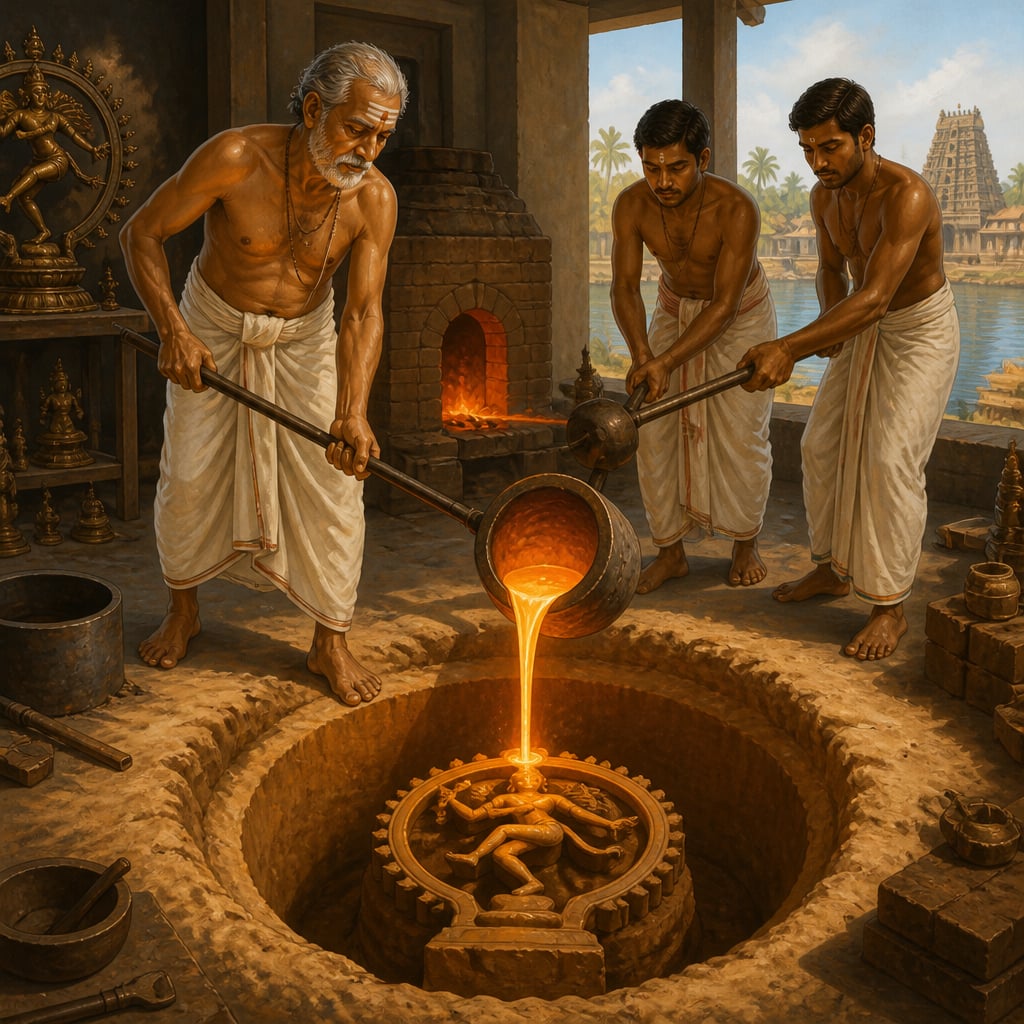
Swamimalai sthapati pouring molten panchaloha into a Nataraja mould

In a ground-floor foundry on the south bank of the Kaveri river at Swamimalai, in Thanjavur district of Tamil Nadu, on a hot morning in 2022, a senior sthapati of the Devasenapathy lineage stands with a long iron ladle in his hand. Beside him, a clay-wrapped mould the size of a small child is buried up to its shoulders in a pit of dry sand. The mould has been heated for a full day. Inside, a wax model of Shiva Nataraja has melted and drained out through narrow channels, leaving a hollow in the exact shape of the god.

The crucible is ready. Inside it is a glowing orange mix of five metals: copper, silver, gold, brass, and a little lead. This is panchaloha, the five-metal of the Chola bronze tradition. The furnace has roared all night. The men around the pit are silent. A single bubble in the wrong place, a single cold spot in the metal, and the image will come out of the sand with a blind eye, a broken arm, or a fingerless hand. The only fix for a bad pour is to melt the bronze back down and begin again.

He tips the ladle.

For about nine seconds, a ribbon of molten panchaloha flows into the clay mould and fills the Nataraja-shaped space inside. Then it is done. Nobody will know if the god came through until tomorrow afternoon, when the clay is broken away.

A thousand years ago, almost the same scene was playing out at the other end of the same Kaveri river, in the workshops of the Chola court at Thanjavur. What follows is the story of how the hands at the pit then became the hands at the pit now.

The Chola Bronze Century

Bronze casting in India is three thousand years older than the Cholas. The small Dancing Girl of Mohenjo Daro, cast around 2500 BCE, is the earliest known lost-wax bronze on the subcontinent. But the Chola dynasty of Tamil Nadu, who ruled from about 850 to 1280 CE, pushed the technique to a height that has not been matched anywhere else.

The turning point was Rajaraja Chola I (reigned 985 to 1014 CE). In 1010 CE, he consecrated the Brihadeeswarar temple at Thanjavur, his capital. The central shrine held a massive stone Shiva linga, but the daily worship moved through smaller, portable bronze images that could be carried in procession around the temple and through the city during festivals. These portable festival deities are called utsava murtis, and Rajaraja commissioned dozens of them. The inventory of the temple, carved onto its outer walls, names every donor, the weight of metal in every image, and even the jewels stitched into each cloth draping. It is the most detailed surviving record of a Chola-era bronze workshop.

Rajaraja's aunt, Sembiyan Mahadevi (around 941 to 1001 CE), had set the tone a generation earlier. She was the wife of King Gandaraditya and the mother of King Uttama Chola. After her husband's death, she spent almost fifty years as a royal widow commissioning temples and bronze icons across the Chola country. Many of the finest late tenth-century bronzes now in museum collections are attributed to her workshop. She was probably the single most prolific patron of bronze sculpture in first-millennium India.

By the time Rajaraja died in 1014 CE, Thanjavur had become the centre of a bronze-casting empire. The sthapatis who worked for the court lived in a cluster of villages along the Kaveri, including Swamimalai, a small temple town about forty kilometres west of Thanjavur. When the Chola court later fell to the Pandyas and then to the Delhi Sultanate and the Vijayanagara empire, the royal commissions slowed. But the Swamimalai workshops did not close. They kept casting for the temples that were still standing. They are still casting for them today.

Madhuchchishta Vidhana: The Science of the Lost Wax

Sthapati shaping the lost-wax beeswax model of Nataraja

The technique is called madhuchchishta vidhana in Sanskrit, the wax-abandoning method. In French it is cire perdue. In English it is lost wax. All three names describe the same idea. You make a model out of wax. You cover the wax with clay. You heat the clay until the wax melts and pours out. You fill the empty space with molten metal. You break the clay away. The metal image is the wax image, in bronze.

In Swamimalai, the process takes about three to four weeks for a two-foot icon and several months for a life-size Nataraja. It runs in seven rough stages:

Stage What happens
1. Wax model The sthapati carves every detail of the deity in pure beeswax mixed with resin. No clay yet. The wax is the god.
2. Clay mould He packs fine alluvial clay from the Kaveri bank around the wax, layer by layer, leaving channels for the wax to drain and the metal to enter.
3. Drying The mould dries in the sun for about a week. Any crack will ruin the pour.
4. Wax melt The mould is heated for a full day. The wax runs out through the channels and is collected to be used again.
5. Metal melt The panchaloha is melted in a clay crucible over a charcoal and coconut-shell furnace.
6. Pour The molten metal is poured into the empty hot mould. The whole pour takes less than a minute.
7. Break and finish After a day of cooling, the clay is broken away. The rough bronze is then filed, chased, and polished by hand for another week or two.

The catch is that every wax model is destroyed in the process. A Swamimalai bronze is always a one-of-one. There is no reusable mould. If a sthapati wants to cast ten Natarajas, he must carve ten wax models. Each is slightly different. No two Chola-style Swamimalai bronzes in the world are exactly the same object, because no two wax models were ever exactly the same.

The panchaloha alloy is not decorative. It is technical. Pure copper is too stiff to flow into a narrow mould channel. Pure bronze (copper and tin) is too brittle at thin extremities like fingers and jewellery. The small additions of silver, gold, brass, and lead give the alloy exactly the flow and the ductility a sthapati needs. The Shilparatna, a sixteenth-century Sanskrit craft manual, specifies the proportions. So do the older Manasara and Mayamatam, both first-millennium texts of temple-building and image-making.

The Sthapati Lineage

The men who do this work in Swamimalai today are called sthapatis, literally 'those who stand the thing up'. They belong to the Vishwakarma community, the traditional craft caste who trace their descent from Vishwakarma, the divine architect of the gods. Many Swamimalai families trace their own tree back to Chola-era temple builders of the tenth and eleventh centuries. The technique has been passed father to son, uncle to nephew, and guru to shishya for forty to fifty generations.

The most famous sthapati lineage of the twentieth century was the Devasenapathy Sthapathy family. S. Devasenapathy Sthapathy (1924 to 1988), a Padma Shri awardee, was widely regarded as the finest Chola-style bronze caster of his generation. After his death, his sons Radhakrishna Sthapathy and Srikanda Sthapathy took over the foundry. The family's apprentices now run several of the working workshops in Swamimalai town.

Every stage of the training is set in the Silpa Shastras, the old treatises on craft. The Manasara lays out the proportions for an image of Shiva, Vishnu, or Devi. Every limb, every finger, every ornament has a measurement in talas, the unit of one face-length from the crown to the chin. A Chola Nataraja is built in the 'nava-tala' system of nine face-lengths. An incorrect proportion is not an art failure. It is a ritual failure. The deity cannot be consecrated if the measurements are wrong. This is why the wax model is the heart of the craft. Everything rides on the carver's hand.

From Thanjavur to Geneva

Swamimalai bronze Nataraja installed outside CERN in 2004

For most of the nineteenth and twentieth centuries, Swamimalai was a sleepy craft town that survived on small orders from local Tamil temples and a thin tourist trade. The industrial Indian bronze market went to mass-produced brass idols from Moradabad and cheap aluminium alloys from Jaipur. A real Chola-style panchaloha Nataraja from Swamimalai cost twenty times as much as a brass lookalike, and nobody outside the temple world wanted to pay.

Two things changed that. The first was scholarly. In 1965, the British Museum curator Douglas Barrett published Early Cola Bronzes, the first systematic catalogue of the genre. In 2002, the art historian Vidya Dehejia of Columbia University curated The Sensuous and the Sacred: Chola Bronzes from South India at the Smithsonian in Washington. These two studies did more than any others to put the Chola bronze in front of a global audience and point them, for living examples, back at Swamimalai.

The second change was legal. In 2008, Swamimalai Panchaloha Bronze Icons received a Geographical Indication tag under the Indian GI Act of 1999. The registration protects the name Swamimalai for panchaloha icons cast by sthapatis in the Swamimalai cluster of Thanjavur district. A brass idol made in Moradabad can no longer legally be sold as a Swamimalai bronze. The Tamil Nadu state handicrafts emporium, Poompuhar, now certifies Swamimalai origin on every piece it sells, and runs the main retail channel for the craft outside the workshops themselves.

Modern Echoes

On 18 June 2004, the government of India gifted a two-metre bronze Shiva Nataraja to CERN, the European Organization for Nuclear Research, in Geneva. The bronze was cast in a Swamimalai foundry. It stands today on the lawn outside CERN's main particle physics laboratory. A plaque at its base quotes the physicist Fritjof Capra, whose 1975 book The Tao of Physics compared the dance of Shiva to the continuous creation and destruction of subatomic particles. Capra wrote that Shiva's cosmic dance is an image of matter being made and unmade at the heart of the physical world. The scientists who work on the Large Hadron Collider walk past the Nataraja every morning on their way in.

Look at the statue closely and you can count the hands and the feet. One hand holds the drum of creation. One hand holds the flame of destruction. One foot presses down a dwarf of ignorance. The other is lifted in the dance. The figure is held inside a ring of fire, which is the physical universe itself. The whole thing was made in a pit of sand in a small town by the Kaveri river, in a workshop whose technique goes back nine hundred years, by men who still read the Manasara at night.

And every few years, one of the old Chola bronzes stolen from a Tamil Nadu village temple in the late twentieth century turns up in a foreign museum and is returned home. In September 2014, the Australian government returned the Sripuranthan Nataraja, a twelfth-century Chola bronze stolen from a temple in the Ariyalur district, after an investigation by the Tamil Nadu Idol Wing CID showed the statue had been bought by the National Gallery of Australia from a New York dealer later convicted of trafficking.

From One Lump Of Metal

Almost two thousand seven hundred years before the Sripuranthan Nataraja was stolen, the sage Uddalaka Aruni was teaching his son Shvetaketu in a forest clearing somewhere in the Ganga basin. The boy had come home from twelve years of Vedic study thinking he knew everything. His father asked him a question about metals.

यथा सोम्यैकेन लोहमणिना सर्वं लोहमयं विज्ञातं स्याद् वाचारम्भणं विकारो नामधेयं लोहमित्येव सत्यम् ॥

yathā somyaikena lohamaṇinā sarvaṁ lohamayaṁ vijñātaṁ syād vācārambhaṇaṁ vikāro nāmadheyaṁ lohamityeva satyam

My dear, by knowing one nugget of metal, all that is made of metal becomes known. The different shapes are only names. The reality is only the metal.

Chandogya Upanishad 6.1.5

Uddalaka's lesson is the sthapati's secret. A Swamimalai bronze can take the shape of a Nataraja, or a seated Vishnu, or a standing Parvati, or a child Krishna holding butter. The shapes are not the same. But the metal is the same metal. The alloy is the same panchaloha. The hand that pours is the same hand. The Cholas knew this at Thanjavur in 1010 CE. Uddalaka knew it in a forest clearing two thousand years earlier. Fritjof Capra reached the same idea in California in the 1970s, and CERN put it on a plaque.

Back in the foundry at Swamimalai, on the day after the pour, the sthapati and his apprentices broke the clay away from the mould. The Nataraja inside had come through. Every finger was whole. The ring of fire was closed. The drum had sharp edges. In three more weeks the bronze would be carried across the Kaveri bridge to a temple on the other side, and given, after a thousand years of the same practice, a new name, a new dwelling, and a new life.

Key figures

Rajaraja Chola I

The Chola emperor of Tamil Nadu from 985 to 1014 CE. He ruled from Thanjavur and built the Chola empire into the dominant power of peninsular India and the Indian Ocean. In 1010 CE, he consecrated the massive Brihadeeswarar temple at Thanjavur, one of the largest and most important temples of medieval India and today a UNESCO World Heritage Site. He commissioned dozens of panchaloha bronze utsava murtis for the temple and kept detailed inventories of every image in his workshops.

Sembiyan Mahadevi

A Chola queen of the late tenth century, from about 941 to 1001 CE. She was the wife of King Gandaraditya Chola and the mother of King Uttama Chola, and an aunt of the later emperor Rajaraja Chola I. After her husband's early death, Sembiyan Mahadevi spent almost fifty years as a royal widow devoting her wealth and influence to the construction of stone temples and the commissioning of bronze icons across the Chola country.

S. Devasenapathy Sthapathy

A Swamimalai master sthapati who lived from 1924 to 1988, widely regarded as the finest Chola-style bronze caster of the twentieth century. He was awarded the Padma Shri by the government of India for his contribution to the craft. His workshop on the south bank of the Kaveri at Swamimalai cast panchaloha bronzes for temple installations across India and for private collectors and museums abroad. He trained his sons Radhakrishna Sthapathy and Srikanda Sthapathy, who continued the foundry after his death.

Case studies

Rajaraja Chola I and the Brihadeeswarar Bronzes of 1010 CE

In 1010 CE, the Chola emperor Rajaraja Chola I, then in the twenty-fifth year of his reign, consecrated the Brihadeeswarar temple at his capital at Thanjavur. The central shrine held a massive stone Shiva linga, but the daily ritual life of the temple moved through portable bronze festival deities, the utsava murtis, that were carried in procession around the temple and through the streets. Rajaraja commissioned dozens of these panchaloha bronzes from the sthapati workshops along the Kaveri river, including the villages around Swamimalai. The outer walls of the temple were then inscribed, in classical Tamil and Grantha script, with a detailed inventory of every bronze: the name of the donor, the weight of the metal in the image, the cloth draped on it, even the jewels stitched into the cloth. The inscriptions run to thousands of lines and are the most detailed surviving documentary record of any bronze workshop in medieval India. Queen Kundavai, Rajaraja's elder sister, was among the major personal donors. The inventories also record gifts of land to the sthapati families so that the workshops would be paid in a steady food supply for generations.

The Brihadeeswarar commissions are an example of rajasic patronage grounded in dharmic principles. Rajaraja did not treat bronze casting as a one-time decoration of his temple. He endowed land to the sthapati families so that the craft would keep eating for centuries after his own death. The inscriptions were written because the dharmic principle of dana (giving) requires the gift to be publicly recorded and unbroken. The sthapati lineage and the royal lineage were bound together into a single long-running institution. The Manasara and Mayamatam texts, which prescribed the iconometric rules and the panchaloha alloy, were the technical anchor. The guru-shishya parampara was the social anchor. The royal endowment was the economic anchor. All three had to hold at once.

The Chola dynasty fell to the Pandyas in 1279 CE and later to the Delhi Sultanate and the Vijayanagara empire. The royal endowments were disrupted. But the sthapati villages along the Kaveri, including Swamimalai, did not close their workshops. They kept casting for the temples that were still standing. A thousand years later, the Brihadeeswarar temple is a UNESCO World Heritage Site, and the Swamimalai foundries are still making bronzes in the same technique for temples across Tamil Nadu and the Tamil diaspora. Rajaraja's 1010 endowment is one of the longest-running craft patronages in world history.

A royal patron who wants a craft to outlast him must endow it with land, a teaching lineage, and a public record, not just a one-time purchase. Rajaraja did all three. His bronzes survived him by a thousand years, and the workshops that made them are still open. The lesson scales down: if you care about a craft or a tradition in your own life, a one-time donation is almost nothing. A long, patient, patient endowment of attention and resources is what keeps it alive.

The Brihadeeswarar temple is a UNESCO World Heritage Site and is visited every year by hundreds of thousands of pilgrims and tourists. Modern art historians including Douglas Barrett (British Museum, 1965) and Vidya Dehejia (Columbia University, 2002) have used the temple inscriptions to reconstruct the Chola workshop system in remarkable detail. Every Swamimalai bronze sold today through Poompuhar or directly from a sthapati foundry is, in a real sense, a descendant of the bronzes whose donors are named on the walls of Rajaraja's temple.

The wall inscriptions of the Brihadeeswarar temple record the names of donors and the weights of the panchaloha bronzes they commissioned, from the consecration in 1010 CE onward. The sthapati families of Swamimalai, about forty kilometres west of Thanjavur, trace their working lineage to these Chola workshops and continue to cast bronzes in the same technique today.

The CERN Nataraja of 2004: Cosmic Dance Meets Particle Physics

On 18 June 2004, the government of India gifted a two-metre bronze Shiva Nataraja, cast in a Swamimalai foundry, to CERN, the European Organization for Nuclear Research, in Geneva, Switzerland. The statue was installed on the lawn outside the main particle physics laboratory, where thousands of scientists pass it every morning on their way to work on the Large Hadron Collider and other experiments. A plaque at the base of the statue quotes the physicist Fritjof Capra, whose 1975 book 'The Tao of Physics' had compared the dance of Shiva to the continuous creation and destruction of subatomic particles. Capra wrote that Shiva's cosmic dance is an image of matter being made and unmade at the heart of the physical world. The gift was the idea of a small group of Indian scientists working at CERN and was formally handed over during an Indian government delegation visit in 2004. The bronze itself was made by a Swamimalai sthapati workshop using the same madhuchchishta vidhana technique and the same panchaloha alloy as the Chola bronzes of Rajaraja's Thanjavur, a thousand years earlier.

The Nataraja is, in the silpa-shastra tradition, the ultimate image of the universe in motion. The drum in the upper right hand is the sound of creation, the flame in the upper left is the fire of destruction, the lower right hand gives abhaya (the blessing of fearlessness), the lower left points to the uplifted foot of liberation, and the foot that presses down a dwarf is the crushing of ignorance. The whole figure is held inside a ring of fire, which is the physical universe itself. The Chandogya Upanishad 6.1.5 teaches that by knowing one nugget of metal, all that is made of metal becomes known. The Nataraja at CERN is exactly this teaching in three dimensions: one piece of panchaloha, cast in one wax mould, carries an image of the entire cosmos in motion. The modern physicists who walk past it every morning are studying the same dance in a different language.

The CERN Nataraja has become one of the most photographed symbols of the dialogue between Indian philosophical cosmology and modern physics. Every year, it is cited in science-and-spirituality articles, in university lectures on the history of science, and in CERN's own public outreach. It has also become one of the most visible ambassadors for Swamimalai itself. A working Chola-style foundry on the Kaveri river now has a major international commission visible to a global scientific audience, which has in turn drawn orders, research visits, and scholarly attention back to the sthapati villages of Thanjavur district.

A craft whose metaphors are deep enough can bridge worlds the craftspeople never imagined. The Swamimalai sthapati who cast the CERN Nataraja was working in a technique almost unchanged since 1010 CE, but the bronze landed in front of twenty-first-century physicists who recognised their own subject in its form. The lesson is that metaphors built slowly over many centuries carry further than slogans built in one press release.

CERN itself uses the Nataraja in its public outreach about the Large Hadron Collider and the history of science. The statue is regularly featured in articles by major physics journalists including the late Peter Higgs (who proposed the Higgs boson), Carlo Rovelli, and Lawrence Krauss. The Swamimalai foundries, meanwhile, have leveraged the CERN commission into global visibility that has generated further museum and temple orders from across the Indian diaspora and beyond.

The CERN Nataraja is approximately two metres tall and was installed on 18 June 2004 outside the main particle physics laboratory at CERN in Meyrin, Geneva. The plaque at its base quotes Fritjof Capra's 'The Tao of Physics' (Shambhala Publications, 1975), which sold over one million copies worldwide and helped establish the comparative frame of Indian cosmology and modern physics.

The Sripuranthan Nataraja: Stolen, Traced, Returned (2006 to 2014)

Sometime between 2005 and 2006, thieves broke into a small twelfth-century Chola temple in the village of Sripuranthan, in the Ariyalur district of Tamil Nadu, and stole a standing panchaloha Nataraja and several other bronzes. The Nataraja passed through a local middleman to the New York based dealer Subhash Kapoor, who ran the Madison Avenue gallery Art of the Past. Kapoor laundered the bronze through forged provenance papers and sold it in 2008 to the National Gallery of Australia in Canberra for about five million US dollars. The Gallery displayed the statue publicly for several years, unaware of its origin. In 2011, Kapoor was arrested in Germany, extradited to India, and put on trial. The journalist Jason Felch and the investigative team at the blog Chasing Aphrodite, along with the Tamil Nadu Idol Wing CID under its founding director Inspector General Prateep V. Philip and later Pon Manickavel, traced the Sripuranthan Nataraja from the temple to the Gallery using archival temple photographs and Kapoor's own invoices. The case became one of the highest-profile antiquities trafficking investigations in Asian history.

In the silpa-shastra tradition, a consecrated bronze is not an art object. It is the deity himself, the utsava murti in active worship. Removing him from his temple is not theft in the ordinary sense. It is a kidnapping. The Tamil Nadu Idol Wing, the Archaeological Survey of India, and the Indian government have all treated the recovery of stolen Chola bronzes as a dharmic restoration rather than a collectors' matter. The Chandogya Upanishad 6.1.5 reminds us that the shape is a name and the metal is reality, but the silpa shastra reminds us that once the consecration mantras have been said over a bronze, the name and the shape are charged with presence. The stolen Sripuranthan Nataraja was not simply a valuable twelfth-century object. It was a deity who had been taken from his home and needed to be returned.

In September 2014, during a visit to Australia, Prime Minister Narendra Modi received the Sripuranthan Nataraja back from Prime Minister Tony Abbott of Australia in a formal handover ceremony at Parliament House in Canberra. The bronze was returned to India and later to Tamil Nadu. Subhash Kapoor was convicted of multiple trafficking offences in Indian courts in 2022. Since 2014, the Tamil Nadu Idol Wing and the Archaeological Survey of India have secured the return of dozens of other stolen Chola and early medieval bronzes from museum and private collections in the United States, Britain, Germany, Singapore, and the United States. The investigation continues.

Stolen antiquities can be returned, but only if somebody is patient enough to trace the chain from the temple to the museum. The Sripuranthan Nataraja was returned because a small team in the Tamil Nadu Idol Wing and a handful of independent journalists refused to let the case go cold. The larger lesson is that a craft tradition is not only kept alive by its makers. It is also kept alive by the people who protect the old pieces from being sold, scattered, and lost. Preservation is half the craft.

The Sripuranthan case has become a template for antiquities repatriation from museums to source countries. It is cited alongside the return of the Euphronios Krater to Italy, the Bangkok-to-Cambodia Koh Ker statue returns, and the Benin Bronze returns to Nigeria as landmark cases in twenty-first-century heritage restitution. For Swamimalai, the case is more than historical. It has tightened the connection between the living sthapati tradition and the older Chola bronzes that are its direct ancestors, and it has made clear to museums around the world that buying a Chola bronze without an iron-clad provenance is now a legal and reputational risk.

The Sripuranthan Nataraja was stolen around 2005 to 2006, sold in 2008 by Subhash Kapoor to the National Gallery of Australia for approximately five million US dollars, returned to India in September 2014, and served as the headline case in Subhash Kapoor's conviction in Indian courts in 2022. The Tamil Nadu Idol Wing CID has since recovered dozens of other stolen Chola bronzes from collections around the world.

Historical context

The Swamimalai bronze story runs from the Chola imperial century (10th and 11th centuries CE), especially under Queen Sembiyan Mahadevi and King Rajaraja Chola I, through the post-Chola centuries of Pandya, Vijayanagara, Nayaka, and Maratha rule in Tamil Nadu, through the colonial decline of the nineteenth and twentieth centuries, and into the 21st-century revival under the 2008 Geographical Indication tag and a new global market for Chola-style bronzes.

Bronze casting in India is older than the Cholas by three thousand years. The Dancing Girl of Mohenjo Daro (around 2500 BCE) is the earliest known lost-wax bronze on the subcontinent, and small bronze figurines appear in Vedic, Mauryan, Gupta, and Pallava contexts. But it was the Chola dynasty of Tamil Nadu, between about 850 and 1280 CE, who pushed the madhuchchishta vidhana technique to its height. Queen Sembiyan Mahadevi (around 941 to 1001 CE) established the stylistic language. Rajaraja Chola I (985 to 1014 CE) commissioned dozens of panchaloha utsava murtis for the Brihadeeswarar temple at Thanjavur, consecrated in 1010 CE. The sthapatis who worked for the Chola court lived along the Kaveri river, including at Swamimalai, a small temple town about forty kilometres west of Thanjavur. When the Chola court fell to the Pandyas in 1279 and later to the Delhi Sultanate and the Vijayanagara empire, the royal commissions slowed, but the Swamimalai workshops kept casting for the temples that were still standing. In the twentieth century, the Padma Shri master S. Devasenapathy Sthapathy (1924 to 1988) carried the tradition through its leanest decades, and his family workshops remain at the centre of the living craft today.

Lost-wax bronze casting is a universal technique. It was used by the Benin Kingdom of West Africa in the fifteenth and sixteenth centuries for the famous Benin Bronzes, by the Shang and Zhou dynasties of ancient China for ritual vessels from about 1500 BCE, and by the Italian Renaissance workshops of Donatello and Ghiberti in fifteenth-century Florence. But only the Chola tradition at Swamimalai has been continuously practised by the same community using the same techniques and the same silpa-shastra texts for nearly a thousand years. The Benin Bronze tradition was largely interrupted by the 1897 British punitive expedition, the Chinese ritual-vessel tradition dissolved with the imperial system in 1911, and the Italian Renaissance workshops closed long ago. Swamimalai is the last living heir of any medieval bronze tradition on earth at this scale and continuity.

The Brihadeeswarar temple at Thanjavur, consecrated in 1010 CE by Rajaraja Chola I, received dozens of panchaloha utsava murtis whose donors, weights, and jewels are recorded in the wall inscriptions. A two-metre Swamimalai Nataraja was gifted by the government of India to CERN in Geneva on 18 June 2004. The Swamimalai Panchaloha Bronze Icons tradition received a Geographical Indication tag in 2008. In September 2014, the Australian government returned the twelfth-century Sripuranthan Nataraja to India after a Tamil Nadu Idol Wing investigation.

Swamimalai is the last living inheritor of any medieval bronze tradition at this scale and depth of continuity. The sthapatis there still belong to the Vishwakarma community, still read the Manasara and the Shilparatna, still cast panchaloha in clay moulds with Kaveri river clay, and still finish their images by hand. Every modern Swamimalai Nataraja is a direct technical descendant of the Chola bronzes that Rajaraja Chola I commissioned in 1010 CE. The story is a lesson in what it takes for a craft to survive for a thousand years: a teaching lineage inside a community, a technical manual that does not change, a patient supply of temple commissions, and a handful of masters like Devasenapathy Sthapathy who refuse to let the technique die in their own generation.

Living traditions

The Swamimalai Panchaloha Bronze Icons received a Geographical Indication tag in 2008, giving the name legal protection under the Indian GI Act of 1999. The Poompuhar state emporium runs the authenticated retail channel, and the Tamil Nadu Idol Wing CID works with the Archaeological Survey of India and foreign museums to trace stolen Chola bronzes. In September 2014, the twelfth-century Sripuranthan Nataraja was returned to India from the National Gallery of Australia after a Tamil Nadu Idol Wing investigation exposed the trafficking chain. A two-metre Swamimalai Nataraja gifted by India to CERN in Geneva on 18 June 2004 has become a symbol of the dialogue between dharmic cosmology and modern particle physics, quoting Fritjof Capra's 'The Tao of Physics' on its plinth. The Devasenapathy Sthapathy family foundry and its apprentices continue to carry the teaching lineage into the twenty-first century.

Reflection

More in Loha Kala (लोह कला) - Metalwork

All lessons in Loha Kala (लोह कला) - Metalwork · Traditional Crafts & Textiles course