The Temple of Corridors
Ramanathaswamy's 1,220-meter architectural marvel
Explore the Ramanathaswamy Temple, home to the world's longest temple corridor at 1,220 meters. Discover the architectural vision of the Nayak dynasty rulers, the dual lingas at the heart of the temple, and the Sethupathi kings who served as guardians of this sacred site for centuries.
A Temple Unlike Any Other
Approaching Rameswaram from across the Pamban Bridge, pilgrims have their first glimpse of the gopurams, the towering gateway towers that mark the Ramanathaswamy Temple. These pyramidal structures, covered in colorful sculptures of gods, goddesses, and mythological scenes, announce that something extraordinary lies ahead.
But the true wonder of Ramanathaswamy is not its height. It is its length.
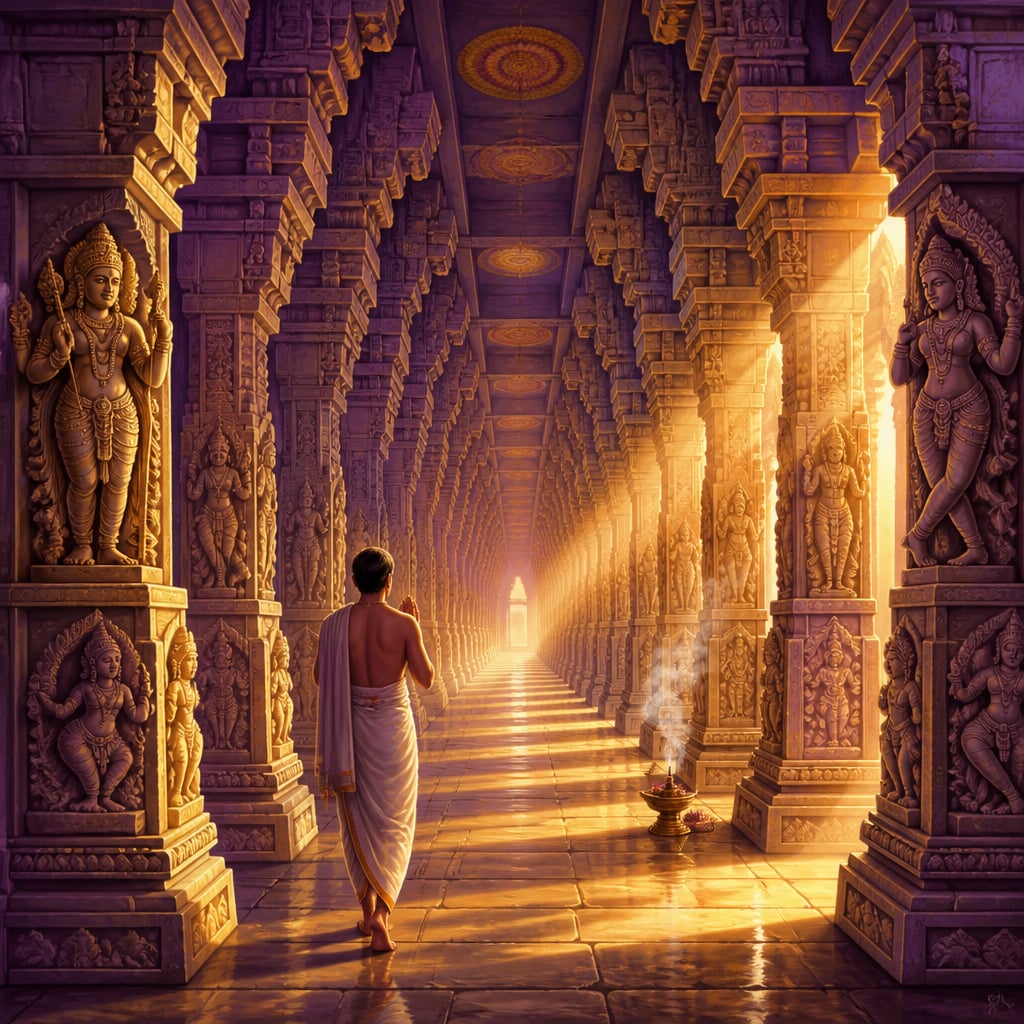
Entering through the eastern gopuram, pilgrims step into the longest temple corridor in the world, a covered walkway stretching 1,220 meters, lined with over a thousand granite pillars, creating a processional path of unmatched scale. This is not a temple you simply enter; it is a temple you journey through.
The Scale of Sacred Space
To understand what 1,220 meters means: it takes approximately fifteen to twenty minutes to walk from one end of the corridor to the other at a normal pace. But no pilgrim walks at a normal pace. Every few meters, there is a pillar carved with divine figures demanding attention. Every few steps, there is a shrine requiring acknowledgment. The corridor is not merely a passage; it is a graduated spiritual experience.
The main corridors form a rectangle around the inner temple complex. The outer dimensions are approximately 197 meters from east to west and 133 meters from north to south. The covered corridors, called prakarams, run along all four sides, with the third prakaram being the famous 1,220-meter circuit.
Walking this corridor, surrounded by pillars stretching to an unseen vanishing point in either direction, pilgrims experience something rare: the intersection of infinity and enclosure. You are both contained within the temple and seemingly walking forever within it. The architecture creates a paradox that mirrors spiritual truth, the infinite can be contained, the endless can be walked.
The Pillars: A Forest of Stone
The corridors contain approximately 1,212 pillars, sources vary slightly in their count, but all agree on the overwhelming abundance. Each pillar stands about 6 meters tall, carved from granite, supporting the heavy stone roof that keeps the corridors cool even in the Tamil Nadu heat.
But these are not mere structural supports. Each pillar is a work of art. The carving traditions of South Indian temple architecture reached mature expression here, with pillars featuring:
Sculptural panels: Depictions of deities, mythological narratives, and devotional scenes cover the pillar surfaces. One can spend hours studying a single pillar.
Musical pillars: Some pillars, when struck at different points, produce distinct musical notes. These shruti stambhas (tuned pillars) demonstrate sophisticated understanding of acoustics and stone resonance.
Geometric precision: The pillars are arranged in perfect lines that create visual corridors within corridors, perspectives that draw the eye forward while suggesting infinite regression.
The cumulative effect is overwhelming. Standing in these corridors, surrounded by carved stone in every direction, pilgrims find it impossible to maintain ordinary consciousness. The environment itself becomes a spiritual practice.
The Nayak Dynasty Vision

The Ramanathaswamy Temple's current form is largely the work of the Nayak dynasty rulers, who governed Tamil Nadu from the 16th to 18th centuries. While the temple site is ancient, tradition holds it was established by Rama himself, the magnificent architectural expansion was a Nayak achievement.
The Nayak kings were great builders. Their capital at Madurai contains the famous Meenakshi Temple, another masterwork of Nayak architecture. They understood that temples were not merely religious spaces but demonstrations of power, piety, and artistic achievement.
At Rameswaram, the Nayaks undertook an ambitious project: to create a temple complex that would honor the site's mythological significance through architectural grandeur. The long corridors were not simply practical, they were theological statements in stone.
Setupati Contributions: The local rulers of Ramnad, known as the Sethupathis (Lords of the Bridge, a title referring to their role as guardians of Rama's bridge), also contributed significantly. The Sethupathis saw themselves as hereditary servants of the Ramanathaswamy shrine, and their patronage helped fund the temple's expansion.
Marava Dynasty: The Marava rulers, who controlled the region at various points, added their own contributions. The temple's growth was thus a collaborative effort across centuries and dynasties, each adding to what previous generations had built.
The Gopurams: Gates to Heaven
The temple has four main gopurams, oriented to the cardinal directions:
Eastern Gopuram: The primary entrance, approximately 53 meters tall, facing the direction from which the sun rises. This is where most pilgrims begin their journey through the temple.
Western Gopuram: Approximately 38 meters tall, this gateway faces the direction of sunset and the open sea beyond. The western entrance is considered particularly auspicious for certain rituals.
Northern and Southern Gopurams: These complete the cardinal arrangement, making the temple a cosmic mandala with gates opening to all directions.
Each gopuram is a multi-tiered structure, narrowing as it rises, covered with painted stucco figures representing the divine realm. The figures are repainted regularly, maintaining the bright colors that make South Indian temple architecture so visually striking.
The gopurams serve both practical and symbolic functions. Practically, they mark entrances and provide impressive facades. Symbolically, they represent Mount Meru, the cosmic mountain at the center of the universe. Walking through a gopuram is entering the cosmic center; the temple inside is the universe in miniature.
The Two Lingas: Heart of the Temple

At the center of all this architectural magnificence are the two lingas that give Rameswaram its spiritual significance:
Ramalingam: The linga made by Sita from sand, installed before Hanuman's return from Kailash. This is the primary deity, worshipped first in the ritual sequence. The Ramalingam sanctum is the temple's innermost chamber, the ultimate destination of the pilgrimage journey through the corridors.
Vishwalingam: The linga brought by Hanuman from Kailash, installed with honor as the secondary deity. According to Rama's decree, the Vishwalingam grants greater merit even though it is worshipped second in sequence. This creates a beautiful teaching about precedence and value: the first is not always the most meritorious.
Both lingas are housed in separate sanctums within the temple complex. The devout pilgrim worships both, following Rama's original instructions. To worship only one is to receive incomplete blessing, the temple's design and ritual structure reinforces this teaching of completeness.
The Sanctum Structure
The temple follows the standard Dravidian (South Indian) temple plan, but executed on an exceptional scale:
Garbhagriha (Sanctum Sanctorum): The innermost chamber where the Ramalingam resides, small and dark, requiring the priest's lamp to see the deity. The contrast between the vast corridors and the tiny sanctum is deliberate, after walking through seemingly infinite space, the pilgrim encounters the infinite compressed into a point.
Antarala (Antechamber): The transitional space between the outer halls and the sanctum, where rituals of preparation occur.
Mandapas (Halls): Multiple halls of various sizes serve different functions, assembly, ritual performance, marriage ceremonies, festival celebrations. The Nandi Mandapa contains the sacred bull Nandi facing the main sanctum.
Prakarams (Corridors): The concentric rectangular corridors that define the temple's famous profile. The third prakaram is the 1,220-meter circuit.
The Sethupathis: Guardians of the Bridge
The Sethupathi kings of Ramnad hold a unique place in Rameswaram's history. Their title, Lords of the Bridge, references the Rama Setu, and their self-understanding was that they were hereditary guardians of this sacred geography.
The Sethupathis funded temple construction, maintained ritual observances, and protected pilgrims on their journey to Rameswaram. They saw this service not as political obligation but as spiritual duty, a continuation of the devotion that Rama himself had established.
Several Sethupathi rulers made major contributions:
Sadaika Thevar (1630-1659): Expanded the temple corridors significantly, understanding that the pilgrimage experience required architectural grandeur to match spiritual aspiration.
Thirumalai Sethupathi (1677-1708): Known as the patron of Tamil literature and arts, he combined cultural patronage with temple support, understanding that devotion expresses itself through beauty.
Muthuramalinga Sethupathi (1738-1773): Completed major portions of the corridor system and strengthened the temple's infrastructure.
The Sethupathi dynasty declined under colonial rule, but their legacy lives in the temple they served. Every pillar, every sculpture, every meter of the great corridor is a testament to their devotion.
Architectural Philosophy
The Ramanathaswamy Temple embodies several principles of Hindu sacred architecture:
Graduated approach: The pilgrim moves from outside to inside, from vast corridors to small sanctum, from diffuse light to focused darkness. This physical journey mirrors spiritual progress, from the dispersed consciousness of ordinary life to the focused awareness of divine encounter.
Repetition as meditation: The endless pillars, the repeated patterns, the recurring shrines, all create an environment of rhythmic repetition. The mind, surrounded by pattern, begins to settle into meditative awareness.
Cosmological mapping: The temple is a model of the universe. The sanctum represents the center; the corridors represent the cosmos that surrounds it; the gopurams represent the cosmic mountains at the cardinal directions. To walk the temple is to traverse the universe.
Material as teaching: The heavy granite, the cool corridors, the elevated sanctum, all these material choices carry meaning. Stone represents permanence; coolness represents relief from worldly heat; elevation represents spiritual ascent.
Visiting the Temple Today
Modern pilgrims approach the temple much as their ancestors did, though the journey has become easier. The Pamban Bridge connects the island to the mainland; roads bring visitors from across India; trains terminate at Rameswaram station.
But the temple experience itself remains remarkably unchanged:
Early morning darshan: The most auspicious time to visit, when the temple opens and the first rituals of the day commence. The corridors are quiet, the light is soft, and the experience is closest to what pilgrims centuries ago might have known.
Theertham circuit: Most pilgrims combine their temple darshan with the ritual bathing at the 22 theerthams (sacred wells) within the temple complex, a practice covered in the next lesson.
Circumambulation: Walking the full corridor circuit is itself a devotional act. Pilgrims often complete multiple circuits, using the walking meditation of parikrama (circumambulation) as spiritual practice.
The Temple in Festival
The Ramanathaswamy Temple transforms during major festivals:
Maha Shivaratri: The great night of Shiva brings tens of thousands of pilgrims. The corridors, which can feel spacious on ordinary days, become rivers of humanity flowing toward the sanctum.
Thirukalyanam: The annual celestial marriage festival celebrates the union of Ramanathaswamy with his consort. Elaborate processions wind through the corridors, the deities carried on palanquins surrounded by musicians and priests.
Arudra Darshan: Celebrated during the Tamil month of Margazhi, this festival honors Shiva's cosmic dance. Special rituals transform the temple into a stage for divine performance.
Sacred Geometry
The temple's layout follows principles of sacred geometry that govern Hindu temple construction:
Vastu alignment: The temple is oriented to the cardinal directions, with the main entrance facing east toward the rising sun. This alignment connects the human-built structure to cosmic order.
Proportional systems: The dimensions of different temple elements follow precise ratios derived from ancient architectural texts. These proportions are believed to create spaces that resonate with divine energy.
Mandala structure: Viewed from above, the temple reveals its mandala nature, concentric rectangles organized around a central point. This structure mirrors meditation mandalas used in spiritual practice.
The Corridor as Spiritual Technology
The 1,220-meter corridor is not merely impressive architecture; it is spiritual technology. Consider what happens to the pilgrim walking its length:
Time dissolves: In the endless corridor, the ordinary sense of time becomes uncertain. The walk takes however long it takes. Clocks become irrelevant.
Space transforms: Surrounded by carved stone in every direction, the normal spatial orientation shifts. You are both indoors and in an infinite field. The paradox disrupts ordinary spatial consciousness.
Mind settles: The repetitive pattern of pillars, the rhythmic footsteps, the absence of external stimuli, all create conditions for the mind to become quiet. The corridor is a walking meditation hall.
Body prepares: The physical act of walking the corridor prepares the body for the stillness of darshan. By the time you reach the sanctum, the body has released its restlessness through movement.
The Nayak architects understood something profound: the journey to the divine requires preparation, and architecture can provide that preparation. The corridor doesn't just lead to the sanctum; it makes the pilgrim ready to receive what the sanctum offers.
Preservation and Challenges
The Ramanathaswamy Temple faces challenges common to ancient monuments:
Structural concerns: The heavy stone roof places enormous pressure on the pillars. Monitoring and maintenance are ongoing concerns.
Salt air: The coastal location exposes the temple to salt-laden air that can corrode stone and affect structural integrity.
Crowd management: Major festivals bring overwhelming crowds. Balancing access with preservation requires careful planning.
Climate change: Rising sea levels and changing weather patterns pose long-term threats to this coastal site.
The Archaeological Survey of India and the temple administration work together on preservation efforts, recognizing that this architectural treasure must be maintained for future generations.
The Message in Stone
What does the Ramanathaswamy Temple teach those who walk its corridors?
Scale matters: The divine deserves our greatest efforts. The Nayak builders did not ask "what is sufficient?" but "what is magnificent?" The temple stands as a rebuke to spiritual minimalism.
Journey is destination: The corridor experience is not preliminary to something else; it is itself the spiritual encounter. The walk is the teaching.
Community builds: No single patron, no single generation built this temple. It is the accumulated devotion of centuries, the collaborative gift of countless contributors. Sacred spaces emerge from community commitment over time.
Beauty is worship: The carved pillars serve no structural purpose; they are pure offering. The musical stones have no practical function; they are divine play. Beauty itself is a form of worship.
When you walk the corridors of Ramanathaswamy, you walk through accumulated devotion. Every pillar was carved by hands in prayer. Every stone was placed by workers serving god. The temple is not merely a building; it is crystallized devotion, transformed into granite and standing for centuries as an invitation to walk the long path toward the divine.
Case studies
The Sethupathi Temple Building Campaign
In the 17th century, the Sethupathi kings of Ramnad faced a challenge: their ancient temple, sacred since Rama's time according to tradition, was physically modest compared to the great temples of the Tamil interior. Devotion demanded expansion. Sadaika Thevar Sethupathi (r. 1630-1659) initiated a sustained building campaign. He understood that pilgrims traveling from across India deserved an architectural experience matching the site's spiritual significance. The project faced obstacles: skilled craftsmen had to be recruited from other regions; granite had to be quarried and transported to an island; funding had to be maintained across years and decades. Sadaika Thevar's solution was to frame the construction as collective devotion. Contributions came from merchants who traded in Rameswaram, from pilgrims grateful for safe passage, from village communities across the Ramnad territory. The temple became everyone's project. His successors continued the work. Thirumalai Sethupathi added artistic refinements; later rulers completed the corridor system. By the 18th century, the Ramanathaswamy Temple had been transformed from a regional shrine into one of India's architectural wonders, a collective achievement spanning generations.
The Sethupathi kings understood their building project as a form of bhakti, devotional service to the Lord. In the Shaiva Siddhanta tradition dominant in Tamil Nadu, temple construction is considered one of the highest forms of meritorious action. The Agamas (temple construction scriptures) specify that building a temple for Shiva generates merit not just for the builder but for seven generations of ancestors and descendants. This belief transformed what could have been a vanity project into a multigenerational act of devotion. Each king added to the temple not to glorify himself but to continue the sacred work of his predecessors. The corridors grew longer, the pillars multiplied, the sacred geography expanded, all driven by a religious obligation that transcended individual ambition. The campaign's success across centuries proves that devotional motivation can sustain commitment far longer than personal glory.
The building campaign spanning four centuries produced what is now recognized as the temple with the longest corridors in India. The third corridor alone stretches 197 meters, and the total corridor length exceeds 1,200 meters. The temple complex grew to cover 15 acres, with 1,212 pillars, each individually carved. The Sethupathi dynasty eventually lost political power, but their architectural legacy endures as Rameswaram's defining monument. Modern conservation efforts have restored several corridors damaged by time and weather. UNESCO has placed the Ramanathaswamy Temple on India's tentative list for World Heritage status, recognizing it as a unique achievement in temple architecture.
The Sethupathi building campaign teaches that great works require sustained commitment across generations. No single ruler could have built the temple; it required continuous devotion across centuries. The campaign also demonstrates how framing a project as collective devotion mobilizes resources that purely royal projects cannot access. When people understand their contribution as spiritual participation, they give beyond calculation.
Crowdfunded cathedrals like Sagrada Familia (under construction since 1882) and Wikipedia's volunteer-driven knowledge project follow the Sethupathi model: when contributors see their work as participation in something sacred or transcendent, they give effort that economic incentives alone cannot motivate. Open-source software communities, built entirely on voluntary contribution to a shared vision, are the digital equivalent of multi-generational temple building.
The Ramanathaswamy Temple's third corridor is 197 meters long, making it the longest temple corridor in India. The 1,212 pillars were carved over four centuries by different sculptors, yet maintain remarkable stylistic consistency, a testament to the strength of the Shilpa Shastra tradition that guided the work.
Designing Spaces for Transformation
Consider an architect designing a meditation center for a modern wellness organization. The clients want something impressive, they've seen photos of dramatic modern structures and want their center to make a statement. How might the Ramanathaswamy Temple inform this design? First, the architect might consider the journey rather than just the destination. The temple's corridors teach that the approach is itself transformative. The meditation center might feature a deliberate path from entrance to meditation hall, with transitions that gradually shift awareness. Second, repetitive elements: the temple's thousand-plus pillars create an environment of pattern that settles the mind. The modern center might use repeated elements, light fixtures, spatial rhythms, material textures, to similar effect. Third, graduated sacredness: the temple moves from vast corridors to tiny sanctum. The center might similarly move from generous entrance spaces to increasingly intimate meditation rooms, with the most profound spaces being the smallest. Fourth, community-built quality: the temple was funded by many contributors over generations. The center might incorporate elements that donors can sponsor, not corporate naming rights but genuine devotional contribution woven into the fabric of the building.
Hindu sacred architecture operates on the principle that space itself can be a tool for consciousness transformation. The Vastu Purusha Mandala, the sacred diagram underlying all Hindu temple design, maps the human body onto the building plan. Moving through a temple is meant to mirror an interior journey through the layers of consciousness, from the busy, sensory outer world to the still, silent center where the divine resides. The Ramanathaswamy corridors take this principle to its extreme. The sheer length of the passages, the rhythm of pillar after pillar, the gradual reduction of light and sound: these are architectural tools for inducing meditative states. The architect designing a modern meditation center can learn from this: do not just create a room for meditation. Create a journey that puts the visitor in a meditative state before they even sit down.
The architect redesigns the meditation center using the temple corridor principle. Instead of a single impressive room, the design creates a journey: a long, gently curving entrance path flanked by water features (replacing the temple tank), a gradually narrowing passage where ceiling height drops and natural light dims, and then the meditation hall itself, a simple, low-ceilinged space with indirect lighting. Early users report that by the time they reach the meditation hall, they are already calm, that the building 'does half the work.' The clients, who originally wanted something visually dramatic, realize that the most powerful design is the one you feel rather than see.
Sacred architecture offers principles applicable beyond religious contexts. The Ramanathaswamy Temple teaches that space itself can be transformative technology, not just a container for activities but an active participant in consciousness change. Modern designers seeking to create transformative environments can learn from traditions that have refined this art over millennia.
The research on rhythmically spaced architectural elements reducing cortisol levels has practical implications for hospital design, school architecture, and urban planning. Architects designing healing environments now study temple corridors for the same reason therapists study meditation: these traditions encode centuries of empirical observation about how physical environments affect mental states. The Ramanathaswamy Temple's 197-meter corridor is not just beautiful but functionally therapeutic.
Research at the University of Exeter found that walking through corridors with rhythmically spaced architectural elements (columns, arches) reduced cortisol levels by 23% compared to walking the same distance in open space, supporting the temple corridor's function as a physiological calming device.
Living traditions
The Ramanathaswamy Temple continues to inspire architects and spiritual seekers alike. Its corridors have been studied by architecture schools as examples of space designed for transformation. Meanwhile, millions of pilgrims annually experience what the Nayak and Sethupathi builders intended: a journey through stone that prepares the soul for divine encounter. The temple also faces modern challenges, preservation concerns, crowd management during festivals, and the effects of coastal location on the ancient structure. These challenges have brought the temple into dialogue with contemporary conservation science while the core spiritual practices remain essentially unchanged from centuries past.
- Prakaram Parikrama: Pilgrims walk the complete 1,220-meter third prakaram as a devotional practice. Many complete multiple circuits, using the walking as a form of moving meditation. The rhythmic footsteps, the repeated pillars, the occasional stop at shrines, all create conditions for consciousness to shift.
- Stambha Vandana: Devotees pay respect to individual pillars, especially those with particularly significant carvings. The musical pillars receive special attention, with devotees requesting temple attendants to demonstrate the acoustic properties.
- Nandi Mandapa: The hall containing Nandi, Shiva's bull vehicle. The Nandi faces the sanctum in eternal watchful devotion. This mandapa is one of the first structures encountered after entering the inner temple areas.
- Devi Shrine: The shrine dedicated to Parvatavardini, the consort of Ramanathaswamy. Following South Indian temple conventions, the goddess has her own sanctum, emphasizing that divine feminine power is honored separately while remaining part of the unified temple complex.
Reflection
- The temple's corridors transform the approach into a spiritual practice. What journeys in your life could be transformed from mere travel into preparation for what awaits at the destination?
- The Sethupathi kings defined themselves through service to a sacred site. What sacred responsibility, to a place, a tradition, a community, might give deeper meaning to your life if you accepted it as your defining commitment?
- The temple required centuries and countless contributors to reach its current form. What great works in our time might require similar multigenerational commitment? How does accepting that you will not see completion change how you work?