Rama's Pilgrimage: Before the Battle

Why Rama worshipped Shiva at Rameswaram

Discover why Lord Rama, an avatar of Vishnu, established a Shiva temple before crossing to Lanka. Learn about the need to atone for the sin of killing Ravana (who was a Brahmin), how Sita made the first linga from sand when Hanuman was delayed, and why this dhama uniquely bridges Vaishnavism and Shaivism.

At the Edge of India

The army had marched for weeks. Vanara warriors beyond counting, their feet raising dust clouds that could be seen for miles, had traveled from the forests of Kishkindha to reach this point, the southern tip of Bharata, where the land simply ended and the sea stretched to the horizon.

Across that sea lay Lanka. And in Lanka, Sita waited.
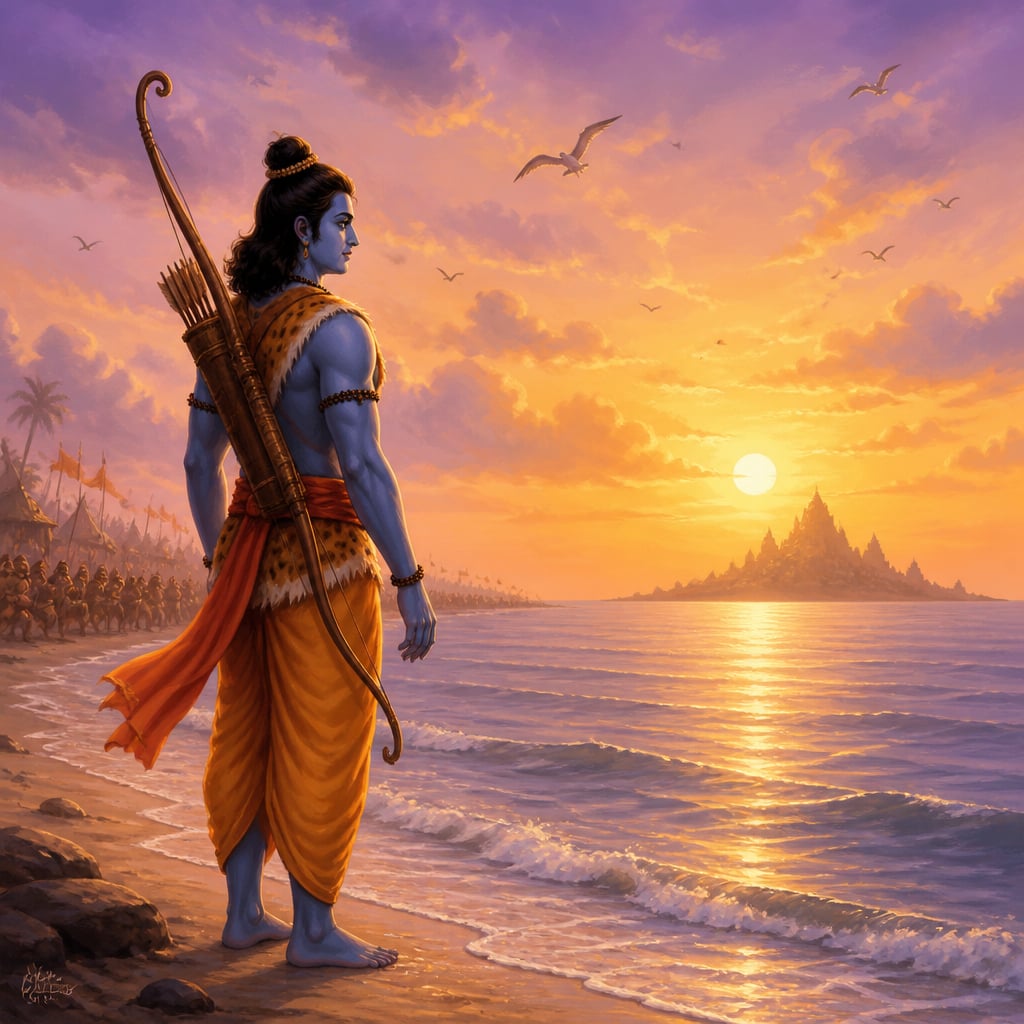
Rama gazing across the sea toward Lanka

Rama stood at the water's edge, gazing at the impossible expanse before him. Behind him gathered an army of bears and vanaras, devoted, fierce, and entirely without means to cross the ocean. The bridge that would be built had not yet been conceived. For now, there was only the challenge: how does one reach an island fortress defended by the most powerful demon king who had ever lived?

But Rama's mind was not only on strategy. He was troubled by something deeper, something that would need to be addressed before a single warrior set foot on Lanka's shores.

The Problem of Ravana

Ravana was many things: a kidnapper, a tyrant, a being of immense power who had terrorized the three worlds. He was also, inescapably, a Brahmin.

Ravana's father was the sage Vishrava, son of the great rishi Pulastya. Through his father's line, Ravana carried Brahmanical heritage despite his rakshasa nature through his mother. He had performed tremendous austerities. He had received boons from Brahma himself. His devotion to Shiva was legendary, he had once lifted Mount Kailash itself, and Shiva had blessed him with the name 'Ravana' (the roaring one) after hearing his agonized cries.

To kill such a being, even in righteous war, would carry consequences. The sin of Brahmahatya, killing a Brahmin, was among the gravest in dharmic tradition. It did not matter that Ravana had committed countless crimes. It did not matter that his death was necessary. The act itself would generate karma that needed to be addressed.

Rama, as an avatar of Vishnu, understood this completely. He was not merely a prince seeking his wife. He was dharma itself walking in human form. And dharma required that even the righteous slaying of evil be performed with proper spiritual preparation.

The Decision to Worship Shiva

Rama decided to establish a Shivalinga and worship Lord Shiva before proceeding with the invasion. This decision carries profound theological significance.

Here was Vishnu's avatar, the Supreme Being in human form, choosing to worship Shiva. This was not a political gesture or a concession to local traditions. It was a profound statement: even God, when incarnate, follows dharma. Even the divine, operating within the rules of the material world, observes proper protocol.

The worship served multiple purposes:

Atonement in advance: Rama was preparing spiritually for an act that, though necessary, would carry karmic weight. By worshipping Shiva beforehand, he was both seeking blessing for the coming battle and establishing the means by which the sin of killing a Brahmin would be mitigated.

Honoring Ravana's devotion: Ravana was Shiva's devotee. In a profound way, by worshipping Shiva before killing Ravana, Rama was honoring the one true virtue his enemy possessed. Even enemies deserve acknowledgment of their genuine devotion.

Demonstrating unity: The act declared that Vishnu and Shiva are not rivals. The avatar of one worships the other. Sectarian division dissolves in this image, the greatest Vaishnava establishing Shaiva worship.

Hanuman's Mission to Kailash

Rama asked Hanuman to fly to Mount Kailash and bring back a Shivalinga for the worship. Hanuman, who could leap across oceans, who had already journeyed to Lanka and back, set off immediately for the sacred mountain.

The distance to Kailash was vast. Even for Hanuman, the journey would take time. And time was something Rama did not have in unlimited supply. The auspicious moment (muhurta) for the puja was approaching. The installation and worship needed to occur at the proper time for maximum efficacy.

The sages with Rama's army began calculating. The hour was approaching when the worship must begin. Hanuman had not returned. Without a linga, there could be no puja.

Sita's Linga: Born from Love

Sita shaping the Ramalingam from sand on the Rameswaram beach

Sita, who had been liberated from Lanka in some versions of this narrative (or whose power worked at a distance in others), saw the predicament. The moment of worship was at hand. The greatest devotion would be expressed not through a brought object but through immediate creation with what was available.

Sita gathered sand from the beach. With her own hands, she molded a linga from this common material. Sand and sea water, shaped by fingers that had once worn the finest ornaments of Ayodhya, formed a representation of the Supreme.

The simplicity is striking. No rare stone, no precious metal, no object carried from sacred peaks. Just sand, the same sand that countless feet had walked upon, that waves had washed a million times. Sita transformed the ordinary into the sacred through intention and devotion.

This linga, made from sand, was called Ramalingam, Rama's linga, though Sita made it, because it was created for Rama's worship.

Hanuman Returns

Hanuman returning from Kailash with the Vishwalingam

Just as the puja commenced with the sand linga, Hanuman arrived carrying a magnificent linga from Kailash, a stone of tremendous spiritual power from the very mountain where Shiva resides.

Hanuman found the worship already in progress. The sand linga sat in the place of honor. The mantras were being chanted. His journey, his effort, his devotion expressed through travel to Kailash, all seemed to have been rendered unnecessary.

Hanuman, that ocean of devotion, felt a moment of disappointment. Not for himself, Hanuman had no ego to wound, but for the linga he had brought. This sacred object from Shiva's own mountain would now be secondary to a structure made of beach sand.

Rama, seeing Hanuman's face, understood immediately. He spoke words that would define how the two lingas would be worshipped forever after.

The Two Lingas: Dharma of Precedence

Rama declared that while both lingas were sacred, the sand linga made by Sita would be worshipped first. This was Ramalingam, the primary deity. Hanuman's linga from Kailash, which Rama named Vishwalingam (the universal linga), would be installed nearby and would receive worship second.

But Rama added something remarkable: he decreed that no pilgrimage to Rameswaram would be complete without worshipping both lingas. And more, worship of Vishwalingam, though second in sequence, would grant greater merit.

This arrangement satisfied multiple concerns:

Honoring Sita's devotion: The linga made with love and urgency, from materials at hand, received primacy. This honored the principle that devotion matters more than material value.

Honoring Hanuman's effort: The linga brought from Kailash was not discarded or diminished. It was installed with honor and declared to grant greater merit. Hanuman's journey mattered.

Teaching precedence: The first-made receives first worship, regardless of material. This establishes that order and timing have dharmic significance.

Creating completeness: Neither linga alone constitutes the pilgrimage. Both are necessary. The sand and the stone, the wife's creation and the devotee's offering, together form the complete sacred complex.

The Theological Bridge

Rameswaram is unique among the Char Dhamas for this reason: it is the only one that explicitly bridges Vaishnavism and Shaivism at its founding narrative.

Badrinath is Vishnu's site. Kedarnath (in the Chota Char Dham) is Shiva's. The other dhamas have their clear affiliations. But Rameswaram's very existence rests on Vishnu's avatar worshipping Shiva. The bridge Rama would later build to Lanka was physical. The bridge he created through worship was theological.

This has made Rameswaram a place of particular significance for those who understand that sectarian divisions are human constructions, not divine realities. When pilgrims worship at Rameswaram, they are participating in an act that their god himself performed. They are following Rama's footsteps not only geographically but spiritually.

The Question of Brahmahatya

Did Rama actually incur the sin of Brahmahatya by killing Ravana? The texts wrestle with this question.

Some argue that Ravana, through his actions, had forfeited his Brahmin status. A Brahmin who behaves as a rakshasa becomes, functionally, a rakshasa. The Brahmin-killing sin applies only when the victim is actually maintaining Brahminical conduct.

Others argue that lineage cannot be forfeited through action. Ravana remained a Brahmin by birth, and his killing created the karma regardless of his behavior. This view supports the narrative that Rama's Shiva worship was indeed necessary purification.

A third view holds that as an avatar, Rama transcended ordinary karma entirely. His worship of Shiva was not necessity but choice, demonstrating proper behavior for humans who might face similar dilemmas on a smaller scale.

The theological debates continue. What remains constant is that Rama chose to worship Shiva, and this choice created Rameswaram.

Sita as Creator

Sita's role in this narrative deserves special attention. In an age and context where women were often positioned as recipients rather than creators of sacred objects, Sita actively creates the primary deity of a major pilgrimage site.

The Ramalingam exists because of feminine creativity. Sita saw a need, used materials at hand, and created something sacred. She did not wait for male agency. She did not consider herself unworthy of such creation. She acted, and her action produced the central object of worship at one of Hinduism's holiest sites.

This aspect of the Rameswaram narrative is often overlooked in favor of Rama's agency. But without Sita's creation, there would have been no puja at the auspicious moment. The timing that mattered most was met through feminine initiative.

The Site of Faith

Where did this worship take place? The tradition holds it occurred at the spot where the Ramanathaswamy Temple now stands, on the island of Rameswaram (Pamban Island), separated from the mainland by a narrow strait.

The location itself is significant. This is where the land ends. Beyond lies only sea, and beyond the sea lies Lanka. The worship happened at the threshold, between known and unknown, between safety and danger, between Bharata and the demon's realm.

Liminal spaces have always been considered powerful in Hindu tradition. Doorways, riverbanks, twilight hours, these between-spaces are where transformation becomes possible. Rama chose to worship at the ultimate between-space: where the subcontinent itself ends and the unknown begins.

Preparation, Not Postponement

Some might ask: why did Rama pause for worship when Sita was suffering in Lanka? Every moment of delay was a moment of her continued captivity. How could religious observance take precedence over rescue?

The answer lies in understanding what kind of rescue Rama intended. He was not merely retrieving his wife. He was restoring cosmic order. Ravana's tyranny had upset the balance of the three worlds. The war to come was not a personal vendetta but a dharmic restoration.

Such a war required proper preparation. Rushing in without spiritual grounding might achieve the immediate objective but leave deeper imbalances unaddressed. Rama's worship was not delay but preparation, ensuring that the coming victory would be complete and properly established.

The Living Teaching

What does Rama's worship teach those who visit Rameswaram today?

Humility before action: Even when you are certain you are in the right, pause for spiritual grounding. Righteousness does not exempt you from preparation.

Unity beyond division: The avatar of Vishnu worshipping Shiva ends all sectarian arguments. Follow the god's example, not the priests' debates.

Devotion over material: Sita's sand linga teaches that what you have is enough. Divine presence does not require expensive materials or distant journeys. It requires sincere intention.

Completeness through inclusion: Both lingas are necessary. Both devotions, Sita's urgency and Hanuman's journey, are honored. Spiritual wholeness includes multiple perspectives.

When you stand at Rameswaram, you stand where Rama stood, facing the same sea he faced, addressing the same eternal questions about how to act rightly in a world where even righteous action carries weight. The answers he found, worship, preparation, humility, unity, remain available to all who seek them.

Case studies

Adi Shankaracharya and the Integration of Traditions

In the 8th century CE, Adi Shankaracharya traveled throughout India establishing the four dhamas that would define Hindu pilgrimage geography. His inclusion of Rameswaram in this circuit was strategically brilliant. Unlike the other dhamas, which are clearly Vaishnava (Badrinath, Dwarka, Puri), Rameswaram's founding narrative already integrated Shaiva and Vaishnava elements. By including it, Shankaracharya reinforced his philosophical position that sectarian divisions were ultimately illusory. Shankaracharya himself, though associated with Advaita Vedanta and often considered Shaiva-leaning, composed hymns to both Vishnu and Shiva. Rameswaram embodied his teaching that the Supreme could be approached through either name, either form. The site's position at the southern tip of India also completed the geographical mandala, pilgrims would literally traverse the entire subcontinent, experiencing its religious diversity while understanding its underlying unity. Shankaracharya reportedly composed verses at Rameswaram that emphasized this integration, some of which are still recited by pilgrims today.

Shankaracharya's Char Dham circuit is a masterpiece of applied dharmic philosophy. Each dham represents one of the four cardinal directions and, symbolically, one dimension of divine engagement. Badrinath (north) represents meditation and knowledge (jnana). Dwarka (west) represents divine play and strategy (lila). Puri (east) represents devotion and surrender (bhakti). Rameswaram (south) represents duty, atonement, and righteous action (karma and dharma). By including Rameswaram, a site where Rama worshipped Shiva before battle, Shankaracharya ensured that the pilgrimage circuit itself teaches sectarian unity. The pilgrim who completes the circuit has worshipped Vishnu AND Shiva, absorbed Advaitic AND Bhaktic teachings, and traversed the entire subcontinent. The circuit is not just geography. It is a complete curriculum in Hindu theology.

Shankaracharya's circuit became the defining framework of Hindu pilgrimage geography, enduring for over 1,200 years. The four dhamas function as cultural anchors that physically connect India's extreme corners. Pilgrims traveling between them created trade routes, cultural exchanges, and linguistic bridges that helped maintain Indian civilizational unity across periods of political fragmentation. The circuit also established a precedent for sectarian harmony: at Rameswaram, Vaishnavas worship at a Shiva temple without contradiction, because Rama himself did so. This practical demonstration of unity has proved more effective than any theological argument.

Shankaracharya's inclusion of Rameswaram in the Char Dham circuit demonstrates how sacred geography can be strategically organized to teach theological principles. The pilgrimage itself becomes a lesson in unity, by the time pilgrims complete the circuit, they have worshipped at both Vaishnava and Shaiva-connected sites, experiencing firsthand that the divisions are human constructions, not divine realities.

Modern interfaith initiatives struggle to move beyond polite coexistence to genuine integration. The Char Dham circuit solves this problem through embodied practice: pilgrims do not merely learn about unity, they walk it across 6,000 kilometers. This experiential approach to theological education is now studied by religious educators seeking alternatives to classroom-based interfaith dialogue.

The Char Dham circuit spans approximately 6,000 kilometers, from Badrinath in the Himalayas to Rameswaram at India's southern tip. Before modern transport, completing the circuit on foot took 2 to 3 years, and many pilgrims spent their entire savings and remaining years on the journey.

Preparing for Difficult Decisions

Consider a doctor who must recommend removing life support from a patient with no chance of recovery. The patient's family is divided, the hospital administration wants the bed for other patients, and the doctor's own conscience wrestles with the decision. She knows what must be done, but also knows the weight it will carry. Following Rama's example, the doctor might: (1) Acknowledge that the necessary action, though right, carries weight. Just as Rama recognized that killing Ravana, though dharmic, would generate karma. (2) Seek spiritual grounding before acting. The doctor might pray, meditate, or consult with a chaplain, not to change the decision but to prepare herself to carry its weight. (3) Honor what was good about what will be lost. Rama's Shiva worship honored Ravana's genuine devotion. The doctor might spend time acknowledging the patient's life, their relationships, what they meant to others. (4) Understand that preparation is not postponement. Rama did not delay indefinitely, he worshipped and then acted. The doctor's spiritual preparation should enable the difficult conversation, not avoid it. (5) Accept that doing the right thing doesn't make it weightless. The action will still carry emotional and spiritual weight. Preparation doesn't eliminate this; it provides resources for carrying it.

Rama's worship at Rameswaram before the Lanka war illustrates a core dharmic principle: even righteous action requires spiritual preparation. Rama was an avatar of Vishnu, yet he still performed puja before battle. If God himself sought sanctification before acting, the message to ordinary humans is clear. Difficult decisions, especially those involving potential harm to others, should never be undertaken casually. The tradition prescribes specific practices: fasting, prayer, consultation with elders, and sincere contemplation of whether the intended action aligns with dharma. This is not weakness or indecision. It is the recognition that consequential actions carry karmic weight, and the actor must be spiritually centered to bear that weight without being crushed by it. The doctor facing a life-support decision carries a burden similar to Rama's before Lanka.

The doctor takes a weekend away from the hospital. She visits a place that holds spiritual significance for her, spends time in reflection, and consults with a trusted mentor. She does not receive a divine sign or easy answer. What she gains is clarity and composure. On returning, she convenes the family, presents the medical facts with compassion, and recommends the course she believes is right. The family, sensing her conviction and calm, accepts the recommendation. The decision still weighs on her, but it does not break her. She incorporates a brief centering practice before all major medical decisions going forward, finding that it improves not just her emotional resilience but her clinical judgment.

Rama's worship at Rameswaram teaches that necessary actions can still carry weight, and spiritual preparation helps carry that weight without collapsing under it. Modern professionals facing difficult decisions, doctors, lawyers, executives, leaders, can learn from this: pause, prepare spiritually, honor what is good even in difficult situations, then act with full presence. Righteousness doesn't make hard things easy; it makes them possible.

The medical ethics finding that reflective practice reduces moral distress by 35% validates Rama's pre-battle worship as more than ritual. Surgeons, military commanders, judges, and executives making consequential decisions all face the same challenge: how to act decisively while remaining morally present. Structured reflection before difficult action is now a formal component of medical training, military ethics programs, and executive coaching.

A 2022 study in the Journal of Medical Ethics found that physicians who engaged in reflective practices before making end-of-life recommendations reported 35% lower rates of moral distress and burnout compared to those who relied solely on clinical protocols.

Living traditions

Rameswaram today draws pilgrims seeking both spiritual merit and the historical resonance of walking where Rama walked. The town has become particularly significant as a symbol of Hindu-Muslim communal harmony, as Dr. APJ Abdul Kalam, the beloved former President of India and a Muslim, was born and raised here. The scientific community also takes interest in Rameswaram due to debates about Adam's Bridge (Rama Setu), with some arguing the geological formation provides evidence for the Ramayana narrative. Whether approached through faith, history, or scientific curiosity, Rameswaram continues to draw those seeking to understand the intersection of myth and place, devotion and geography.

Reflection

More in Rameswaram: The Southern Gateway

All lessons in Rameswaram: The Southern Gateway ยท Char Dham Yatra course