The 22 Theerthams

A unique water pilgrimage within a temple

Discover the unique tradition of bathing in 22 sacred wells within the Ramanathaswamy temple complex. Learn the specific sequence, how each well is connected to a different deity or sage, the belief that each cures different ailments, and why this water pilgrimage inside a temple is unique in all of Hinduism.

The Pilgrimage Within a Pilgrimage

At most Hindu temples, you bathe before entering. At Rameswaram, you bathe while you worship.
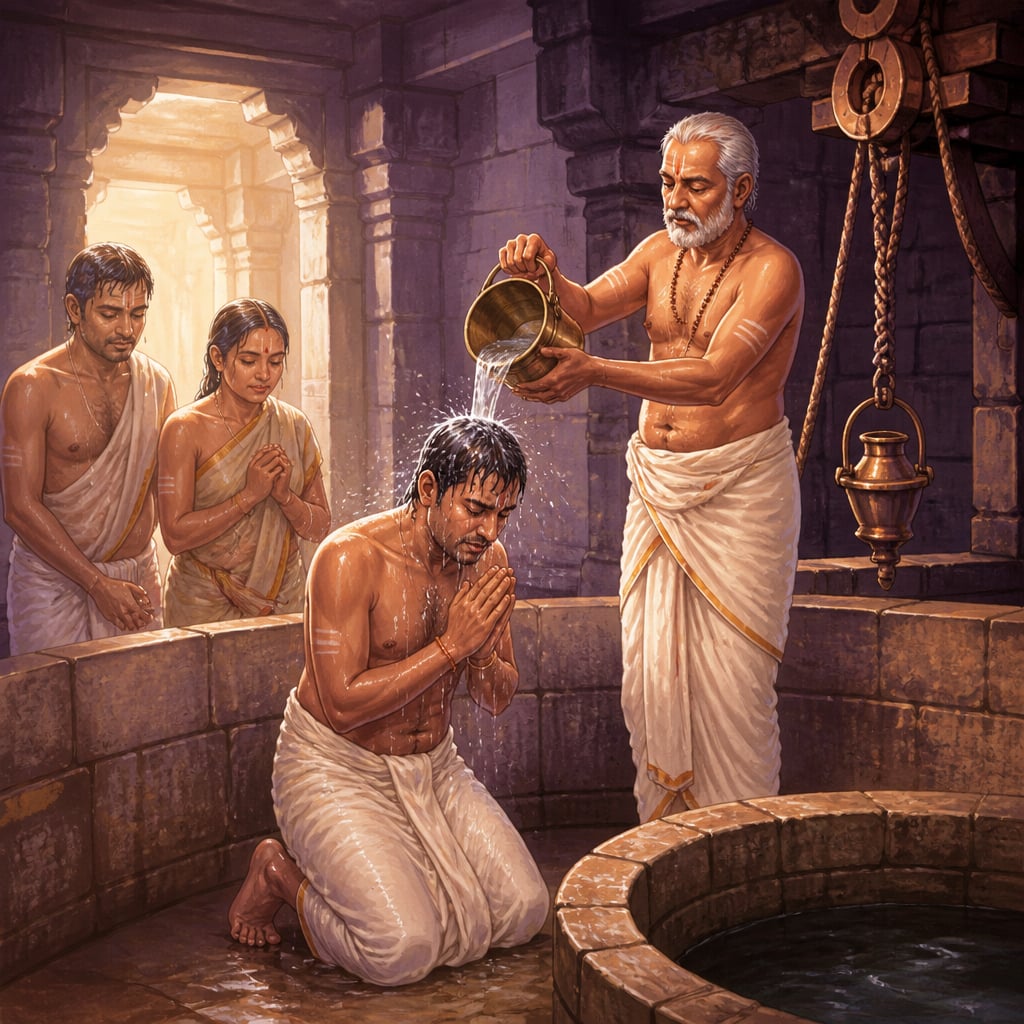
Pilgrim being doused at a Rameswaram theertham

The Ramanathaswamy Temple contains something found nowhere else in Hindu pilgrimage: 22 sacred wells, called theerthams, distributed throughout the temple complex, each with its own history, its own deity, its own healing properties, and its own place in a specific ritual sequence. Pilgrims don't just visit this temple; they get drenched inside it.

Walking through the temple corridors, you encounter groups of pilgrims in wet clothes, their hair dripping, their faces radiant with the combined experience of cold water and fervent devotion. The stone floors are perpetually damp. The air carries the mineral scent of well water mixed with incense. This is a temple where the boundary between water and worship dissolves.

The Origins of the Theerthams

Tradition holds that the 22 theerthams were created by various divine beings as offerings to the Ramanathaswamy shrine. Each well has its own origin story:

Some were created by the gods, Brahma, Vishnu, Indra, who wished to bathe before worshipping the linga established by Rama.

Some were created by sages who performed austerities here, their tapas (spiritual heat) causing water to spring from the ground.

Some are associated with specific episodes from the Ramayana, wells that appeared to serve Rama's army, or that commemorated moments from the epic narrative.

Some appeared through natural geological processes that were understood as divine intervention, the island's unique hydrology producing fresh water springs that seemed miraculous in a coastal location.

Whatever their origin, all 22 theerthams are now integrated into a unified pilgrimage system that transforms a temple visit into a complete spiritual journey.

The Sacred Sequence

The 22 theerthams must be bathed in a specific sequence. This is not arbitrary, each well is understood to purify different aspects of the pilgrim, and the sequence moves from gross to subtle, from body to soul.

Here are the theerthams in their traditional order:

  1. Agni Theertham, The sea itself, where pilgrims begin by bathing in the ocean before entering the temple. This is sometimes counted separately, making 23 theerthams total.

  2. Mahalakshmi Theertham, Associated with the goddess of prosperity; grants material and spiritual wealth.

  3. Savitri Theertham, Connected to the goddess of the Gayatri mantra; purifies the intellect.

  4. Gayatri Theertham, Named for the most sacred mantra; cleanses accumulated karma from speech.

  5. Saraswati Theertham, Associated with the goddess of knowledge; enhances learning and wisdom.

  6. Sethu Madhava Theertham, Connected to Vishnu as the builder of the bridge; grants determination.

  7. Gandhamadana Theertham, Named for the mountain Hanuman carried; provides physical strength.

  8. Nala Theertham, Named for the vanara who engineered the bridge; grants engineering and practical skills.

  9. Neela Theertham, Named for another bridge-builder; removes obstacles.

  10. Chakra Theertham, Associated with Vishnu's discus; provides protection from enemies.

  11. Brahmakunda Theertham, Connected to Brahma; grants creative powers.

  12. Surya Theertham, Associated with the Sun god; provides health and vitality.

  13. Chandra Theertham, Connected to the Moon; brings mental peace and emotional balance.

  14. Ganga Theertham, Holds waters spiritually connected to the Ganges; provides all the merit of Ganga bathing.

  15. Yamuna Theertham, Connected to the Yamuna river; purifies from sins related to relationships.

  16. Gaya Theertham, Associated with the sacred site of Gaya; benefits ancestors.

  17. Shiva Theertham, Directly connected to Lord Shiva; provides moksha-related benefits.

  18. Sathya Theertham, The well of truth; purifies one's commitment to honesty.

  19. Sarva Theertham, Contains the essence of all sacred waters; comprehensive purification.

  20. Kodi Theertham, One of the most sacred; located at the temple's heart.

  21. Panchapandava Theertham, Associated with the five Pandava brothers; grants heroic qualities.

  22. Jada Theertham, Named for Shiva's matted locks; final purification before darshan.

The Properties of Each Well

What makes the Rameswaram theerthams particularly remarkable is that each well genuinely has different water properties. Scientific analysis has confirmed what pilgrims have known for centuries: the waters vary in:

Salinity: Some wells are nearly fresh, others are brackish, others have significant salt content. The variation is dramatic given their proximity.

Mineral content: Different wells contain different mineral compositions, some high in sulfur, others in iron, others in calcium.

Temperature: While most are cool, some wells maintain slightly different temperatures, possibly due to varying depths or geological sources.

Taste: Pilgrims report that each well tastes distinctly different, some sweet, some bitter, some metallic.

This variation in a small area is geologically unusual. The island sits at the confluence of the Bay of Bengal and the Indian Ocean, with complex underground water systems that may explain the diversity. For pilgrims, the variation is simply confirmation of the wells' divine origins.

The Bathing Ritual

The theertham bathing follows a specific protocol:

Approach: Pilgrims arrive at each well, often in groups, guided by temple staff who manage the flow.

Invocation: Before bathing, pilgrims invoke the deity or sage associated with that particular well, often with a specific mantra.

Immersion: Typically, water from the well is poured over the pilgrim's head three times, using a bucket attached to a rope. The pouring is often done by temple assistants (pandas) for a small fee.

Prayer: After bathing, pilgrims offer a brief prayer specific to that theertham's purification purpose.

Movement: Pilgrims then proceed to the next theertham in sequence, maintaining the prescribed order.

The complete circuit takes approximately two to three hours, leaving pilgrims thoroughly soaked and spiritually cleansed by the end.

Agni Theertham: Where Fire Meets Water

Pilgrims bathing at Agni Theertham at first dawn

The pilgrimage begins before entering the temple, at Agni Theertham, the sea itself, just meters from the temple's eastern entrance.

The name "Agni Theertham" (fire-water) seems paradoxical. One interpretation holds that this is where Agni (fire) took aquatic form. Another connects it to the heat of the southern sun meeting the cooling sea. A third interpretation sees it as the place where the inner fire of the pilgrim's accumulated karma begins to be quenched.

Pilgrims wade into the ocean at dawn, facing the rising sun, immersing themselves in the waves while chanting prayers. This sea bathing is considered especially auspicious because these are the waters that Rama himself looked upon, the sea that his bridge would cross, the ocean that yielded passage to Lanka.

The Mystery of Constant Water

One of the persistent mysteries of the Rameswaram theerthams is their constant water level. Despite thousands of pilgrims bathing daily, despite seasonal variations, despite the island's complex relationship with groundwater, the wells maintain remarkably stable levels.

Various explanations have been proposed:

Hydrogeological: The wells may tap into an extensive aquifer system that replenishes faster than water is withdrawn.

Tidal connection: Some wells may be connected to tidal patterns, refilling as the sea rises.

Rainwater collection: The temple's design may channel rainwater into the wells through underground channels.

Divine maintenance: For devotees, the simple explanation is that divinely-created wells are divinely maintained.

Whatever the cause, the practical effect is that pilgrims never find the wells empty. The water is always there, always available, as if waiting for them.

Medicinal Beliefs

Traditional belief holds that different theerthams cure different ailments:

Skin diseases: Several theerthams, particularly those high in sulfur, are believed to cure skin conditions.

Joint pain: Wells with particular mineral compositions are associated with relief from arthritis and joint problems.

Digestive disorders: Some theerthams are specifically recommended for digestive issues.

Mental afflictions: Certain wells are believed to address psychological problems, anxiety, and emotional disturbances.

General purification: Most theerthams claim to remove the accumulated toxins (ama in Ayurvedic terms) from the body.

Modern medicine generally doesn't validate these specific claims, but the mineral waters do have documented effects. Balneotherapy (therapeutic bathing) is an established healing tradition, and the various mineral compositions of the theerthams would produce different effects on skin and potentially on systemic health through mineral absorption.

The Experience of Sequential Purification

What does it feel like to complete the full theertham circuit?

Pilgrims report:

Physical shock: The repeated dousing with cold water, especially early in the morning, creates physical intensity. The body wakes up completely; drowsiness becomes impossible.

Cumulative effect: By the fourth or fifth theertham, something shifts. The initial shock gives way to a kind of heightened awareness.

Dissolution of boundaries: Walking through a temple soaking wet, surrounded by others similarly drenched, creates a leveling effect. Dry clothing marks social distinctions; wet clothing erases them.

Energetic cleansing: Many pilgrims report feeling genuinely "cleaned", not just physically but emotionally and spiritually. Problems seem lighter; perspectives shift.

Embodied devotion: Unlike practices that happen only in the mind, the theertham circuit is fully embodied. You don't just think about purification; you feel it, cold bucket by cold bucket.

The Uniqueness of Interior Water Pilgrimage

Rameswaram's theertham system is unique in Hindu pilgrimage tradition. Consider:

Most temples: Pilgrims bathe in nearby rivers, tanks, or the sea before entering the temple. They enter dry and worship dry.

Rameswaram: Pilgrims enter, get wet, walk through the temple wet, and worship wet. The interior of the temple is designed for wet pilgrims.

This integration of water and temple space is architecturally unusual. The corridors can accommodate wet pilgrims; the stone floors are designed for drainage; the flow patterns account for people moving between wells.

The theological implication is significant: at Rameswaram, purification is not preliminary to worship but concurrent with it. You are purified as you worship, not before. The temple experience itself is the purification.

Practical Considerations for Modern Pilgrims

Pilgrims today face practical questions:

What to wear? Traditional advice is to wear clothes you're willing to get soaked, typically cotton clothing that dries relatively quickly. Many pilgrims bring a change of clothes for after the circuit.

Modesty: While getting drenched, pilgrims should maintain appropriate coverage. Wet cotton can become transparent, so wearing darker colors or multiple layers is advisable, especially for women.

Health conditions: Those with cold sensitivity, respiratory issues, or certain health conditions should consult with physicians. The repeated cold water immersion can be intense.

Time allocation: The full circuit takes 2-3 hours. Pilgrims should begin early in the morning to avoid the heat and to have time for temple darshan afterward.

Pandas (guides): Temple guides will offer to assist with the bathing for a fee. While not required, they can help with the sequence and with proper mantras for each theertham.

The Pandas of Rameswaram

A Rameswaram panda checking a pilgrim family's ancestral records

The pandas (traditional guides and assistants) of Rameswaram have served pilgrims for generations. They:

Maintain records: Some panda families have maintained records of pilgrims for centuries, tracking who visited and when. These records sometimes allow families to verify that their ancestors made the pilgrimage generations ago.

Guide the circuit: Pandas ensure pilgrims follow the correct sequence and receive proper ablution at each theertham.

Perform rituals: For pilgrims who wish, pandas perform special rituals at individual theerthams or at the main sanctum.

Provide continuity: The panda system connects modern pilgrims to generations of tradition, making them participants in an ongoing spiritual community.

The panda system has been criticized for commercialization, but many pilgrims value the guidance and the connection to tradition that experienced pandas provide.

Water as Spiritual Technology

Why water? Of all possible purification methods, why does Rameswaram center on water?

Water holds unique properties in Hindu thought:

Universal solvent: Water dissolves and carries away. As it cleanses physical dirt, it symbolically cleanses spiritual accumulations.

Life-giving: Water is essential for life. Bathing in sacred water symbolically connects the pilgrim to life's source.

Flowing nature: Water doesn't hold shape; it adapts to any container. This represents the flexible consciousness that spiritual practice cultivates.

Purifying fire's opposite: While fire purifies through destruction, water purifies through dissolution. Both are valid paths; Rameswaram chooses water.

Memory: Some traditions hold that water carries memory. Sacred waters, blessed by saints and deities, carry their blessing to all who bathe.

The Complete Pilgrimage Experience

The theertham circuit is not separate from temple worship but integrated into it:

Arrival: Pilgrims arrive at Rameswaram, typically by train to Rameswaram station or by road across the Pamban Bridge.

Agni Theertham: At dawn, pilgrims bathe in the sea, beginning the water pilgrimage.

Temple entry: Still wet from the sea, pilgrims enter through the eastern gopuram.

Theertham circuit: Moving through the temple, pilgrims complete the 22 interior theerthams in sequence.

Main darshan: After the theertham circuit, pilgrims proceed to the main sanctum to worship Ramalingam and Vishwalingam.

Circumambulation: Many pilgrims then complete one or more circuits of the famous corridors.

Departure: Pilgrims emerge, drenched and purified, to dry in the Tamil Nadu sun.

The entire experience can take half a day or more, but pilgrims consistently report that time seems to function differently during the theertham circuit. Hours pass like minutes; the immersive experience compresses or expands subjective time.

The Teaching of the Theerthams

What do the 22 theerthams teach?

Comprehensiveness: Purification isn't simple. Different aspects of the person require different attention. The 22 theerthams address the whole person, not just one dimension.

Sequence matters: The order isn't arbitrary. Moving from gross to subtle, from body to soul, the theerthams provide graduated purification. Spiritual practice often follows such patterns.

Embodiment: Spiritual development isn't just mental. The body must be involved. The cold shock of water, the physical movement between wells, the sensory intensity of the wet temple, all engage the body in purification.

Submission: You cannot bathe yourself at most theerthams; water is poured over you. This requires submission, receiving, allowing another to act upon you. Purification requires receptivity.

Community: Pilgrims bathe together, walk together, worship together wet. The theertham circuit is not solitary practice but communal experience. Spiritual development happens in community.

Integration: The theerthams are within the temple, not separate from it. Purification and worship are integrated, not sequential. Life doesn't separate into sacred and secular; the theerthams model integrated spiritual practice.

When you bathe in the 22 theerthams of Rameswaram, you participate in a tradition that has purified millions of pilgrims across centuries. Each bucket of water connects you to all who bathed before and all who will bathe after. The water is always the same water, always fresh, always waiting. The pilgrims change; the theerthams endure.

Case studies

The Geological Mystery of Rameswaram's Wells

In the late 19th century, British colonial officials became curious about the Rameswaram theerthams. How could 22 wells in such close proximity have such different water characteristics? They commissioned geological surveys that produced fascinating results. The surveys found that Rameswaram island sits at a complex junction where the Bay of Bengal and Indian Ocean meet, creating unusual underground water dynamics. The island's geology, a mix of coral, sand, and ancient rock formations, creates natural channels that carry water from different sources. Some wells tap into rainwater collected in shallow aquifers. Others reach deeper groundwater with higher mineral content. Still others may have connections to tidal patterns, explaining why some wells have slightly brackish water. The surveys also confirmed what pilgrims had always claimed: the water levels remain remarkably stable despite heavy usage. The aquifer system, combined with monsoon recharge and possible tidal contribution, maintains the wells year-round. What the British surveys couldn't explain, and what modern geology still can't fully account for, is why the different water sources happen to be accessible at precisely the 22 locations marked as sacred. The geological explanation and the theological explanation coexist without resolution.

Water in Hindu tradition is not merely a physical element but a carrier of spiritual potency. The concept of tirtha (sacred crossing point) originally referred to river fords where the boundary between the physical and spiritual worlds was considered thin. The 22 theerthams of Rameswaram extend this concept: each well is a specific tirtha, addressing specific spiritual conditions. This maps onto Ayurvedic thinking, where different waters have different properties (guna) and are prescribed for different ailments. The British scientists who found genuinely different mineral compositions in each well discovered the physical basis for what the tradition had long claimed. The dharmic framework does not separate body and spirit. Purifying the body with specific sacred waters simultaneously purifies the corresponding spiritual condition. The 22-well system is a complete pharmacy of sacred hydrology.

Modern chemical analysis has confirmed that the 22 theerthams contain measurably different mineral compositions, including variations in salinity, calcium, magnesium, and sulfur content. This variation across wells that are sometimes only meters apart has been attributed to the island's complex geology, where different aquifer layers intersect at different points. The temple trust now provides printed guides explaining both the spiritual significance and the mineral composition of each well. Pilgrims who complete the full 22-well bath circuit report both spiritual satisfaction and observable skin and joint improvements, consistent with the known therapeutic effects of the mineral variations.

The Rameswaram theerthams demonstrate that scientific and spiritual explanations need not conflict. The waters really do have different properties, that's geology. The wells are located where they are, that's either remarkable coincidence or divine arrangement, depending on one's framework. Both explanations can be held simultaneously; neither fully explains the complete phenomenon.

Hydrologists studying Rameswaram's wells increasingly collaborate with temple authorities, recognizing that pilgrimage records contain centuries of observational data about water quality changes. This mirrors the broader trend of scientists mining traditional ecological knowledge for climate data, from Aboriginal Australian fire management practices to Polynesian navigational knowledge. Ancient observation, preserved through ritual, often contains data that modern instruments have only recently begun to collect.

Chemical analysis shows that the salinity of Rameswaram's 22 theerthams ranges from nearly fresh (under 500 ppm) to moderately brackish (over 5,000 ppm), despite some wells being less than 10 meters apart. The variation is attributed to the island sitting atop multiple intersecting geological formations.

Designing Comprehensive Healing Programs

Consider a wellness center designer tasked with creating a comprehensive healing program. The clients want more than a spa; they want genuine transformation. How might the 22 theerthams inform this design? The theertham system offers several principles. First, comprehensiveness through specificity: rather than generic 'wellness,' the theerthams address specific dimensions of purification. The modern program might similarly address distinct dimensions, physical, emotional, mental, relational, spiritual, with specific interventions for each. Second, sequence matters: the theertham circuit moves from gross to subtle, from body to soul. The wellness program might similarly be sequenced, perhaps beginning with physical cleansing (diet, movement), moving to emotional work (therapy, bodywork), then to mental practices (meditation, reflection), and finally to spiritual integration. Third, embodiment: the theerthams are physically immersive. The wellness program might emphasize embodied practice over merely conceptual learning, you don't just learn about wellness, you experience it in your body. Fourth, community: the theertham circuit is typically done with others. The wellness program might incorporate group process, understanding that transformation often happens in community. Fifth, guide support: pandas assist pilgrims through the circuit. The wellness program would include trained facilitators who guide participants through the sequence.

The 22-theertham system reflects a holistic understanding of purification that modern wellness programs are only beginning to rediscover. Ayurveda identifies five koshas (sheaths) that constitute the human being: physical, energetic, mental, intellectual, and bliss. A truly comprehensive healing program must address all five. The theertham circuit does this through its specific sequence: physical immersion in mineral-rich waters, energetic activation through cold exposure and mantras, mental focus through the discipline of completing all 22 baths, intellectual engagement through learning each well's story, and the bliss of devotional surrender at the temple afterward. This is not random ritual but a carefully designed program. Each theertham targets specific conditions, the sequence matters, and a priest guides the process. Replace 'theertham' with 'treatment station' and you have a blueprint for a modern integrated wellness protocol.

The wellness center designer creates a 12-station circuit (adapted from the 22 for practical reasons) where each station addresses a specific dimension of health: mineral bath, cold plunge, herbal steam, guided breathing, movement therapy, sound healing, and so on. The stations are sequenced based on the theertham principle of progressive purification, moving from gross physical cleansing to subtle energetic work. Trained facilitators guide guests through the full circuit, explaining the purpose of each station. Initial results show that guests who complete the full circuit report significantly higher satisfaction and measurable wellness improvements compared to those who use individual treatments a la carte.

The 22 theerthams offer a template for comprehensive transformational programs: address multiple dimensions with specific interventions, sequence them appropriately, engage the body, include community, and provide skilled guidance. Ancient pilgrimage traditions often encode sophisticated understanding of human transformation that modern program designers can learn from.

Integrative medicine programs, wellness retreats, and rehabilitation centers are increasingly adopting multi-dimensional treatment protocols that address body, mind, and social connection in sequence. The 22 theerthams' design, with specific interventions targeting different aspects of purification in a prescribed order guided by a specialist, reads like a blueprint for modern holistic health programs. The pilgrim's 2-3 hour immersion circuit anticipates what program designers are now rediscovering.

Completing all 22 theertham baths takes approximately 2 to 3 hours. Pilgrims immerse themselves fully in each well in a prescribed sequence while priests chant specific mantras at each stop. Over 10,000 pilgrims complete the full circuit daily during peak season.

Living traditions

The theertham system continues to function much as it has for centuries, with modifications for modern crowd management. Scientific interest in the wells' unusual properties has led to water quality monitoring and geological studies. Some pilgrims now bring containers to take theertham water home, believing it retains purifying properties. The temple administration has had to balance traditional practices with health and safety concerns, particularly during pandemic periods when communal bathing raised public health questions. Despite these modern challenges, the theertham circuit remains central to the Rameswaram pilgrimage experience.

Reflection

More in Rameswaram: The Southern Gateway

All lessons in Rameswaram: The Southern Gateway ยท Char Dham Yatra course