The Submersion: An Ancient Atlantis
The curse, the flood, and what archaeology reveals
Discover the dramatic end of Dwarka - the curse of Gandhari, the self-destruction of the Yadavas, Krishna's departure, and the great flood that submerged the golden city. Explore the remarkable underwater archaeological discoveries by ASI that have found actual structures matching Mahabharata descriptions.
The Beginning of the End
The Mahabharata war had ended. The Pandavas had won, but at a cost so devastating that victory felt hollow. Eighteen akshauhinis - millions of warriors - lay dead on the fields of Kurukshetra. Among them were all one hundred sons of Gandhari, the blindfolded queen of Hastinapura.
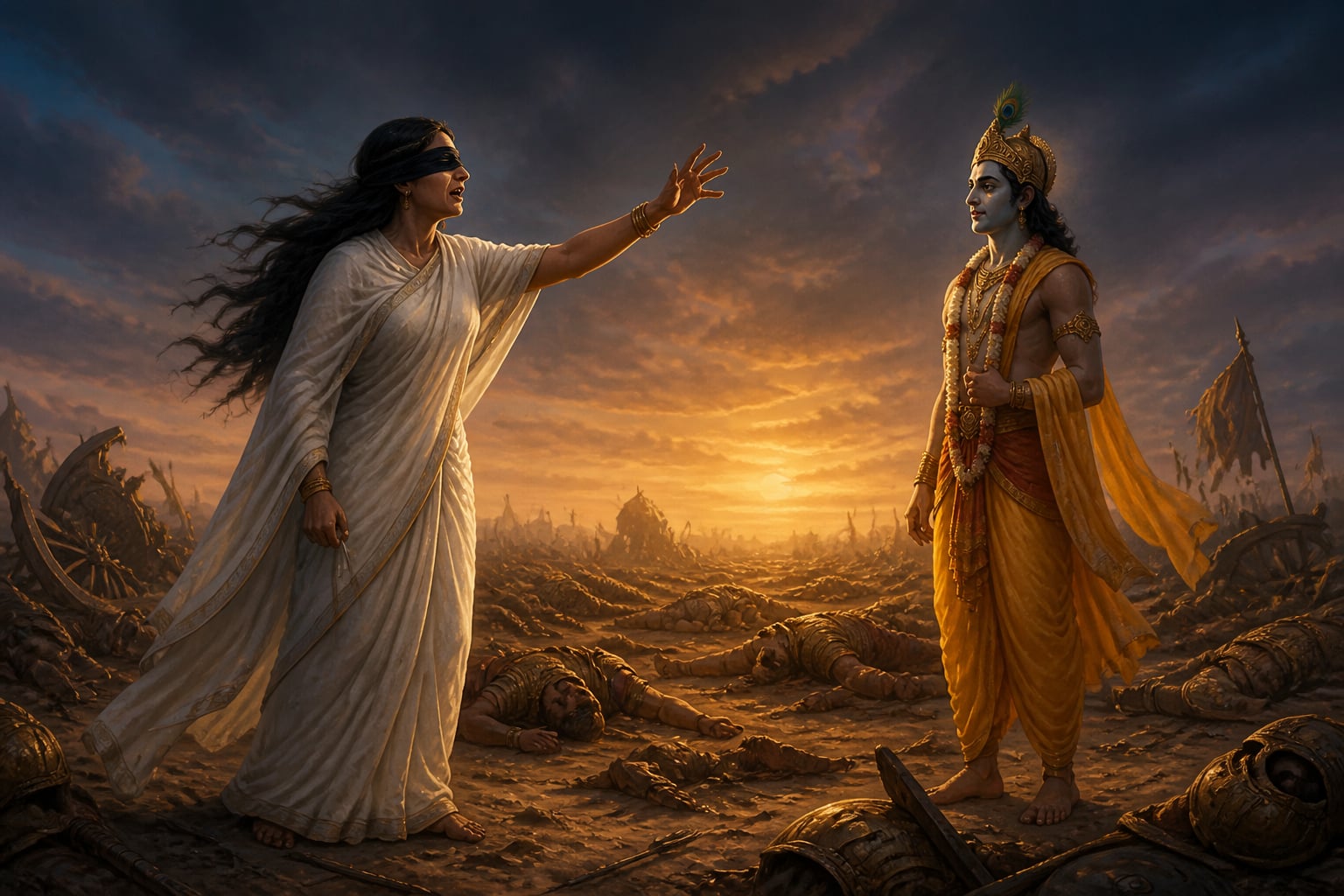
As Gandhari walked through the battlefield, guided by her attendants past the bodies of her children, her grief transformed into something darker. She summoned Krishna, the architect of the Pandava victory, the divine strategist who had made this slaughter possible.
"You could have stopped this war," she said, her voice trembling with rage and sorrow. "You had the power to prevent all this death. Instead, you let my sons die - all one hundred of them."
Krishna stood silent, accepting her words.
"Then hear my curse," Gandhari declared. "As you watched the destruction of my family, so shall you witness the destruction of yours. Thirty-six years from today, the Yadavas shall destroy themselves in drunken madness. And you, Krishna, shall die alone in the forest, slain by a common hunter's arrow."
Krishna smiled gently. "Tathaastu - so be it," he replied. "The Yadavas have become drunk on power and pride. Only I could have destroyed them, but I shall not raise my hand against my own people. Your curse gives them the end they would have brought upon themselves anyway."
The Sages' Curse and Samba's Folly
But Gandhari's curse was not alone. Another curse had sealed Dwarka's fate, born from the foolishness of youth and the arrogance of power.
Years before the end, a group of young Yadava princes - including Samba, Krishna's own son - encountered sages meditating in the forest. Intoxicated and seeking amusement, they decided to play a cruel prank.
They dressed Samba as a pregnant woman and approached the sages. "O great ones," they laughed, "this woman is with child. Can you divine whether she will bear a son or daughter?"
The sages, disturbed from deep meditation, saw through the deception immediately. Their eyes blazed with anger at this mockery of their sacred powers.
"This 'woman' shall give birth to an iron mace," they cursed. "And that mace shall be the instrument of your entire clan's destruction."
Terrified, the princes removed Samba's disguise - and found, impossibly, an iron mace tied to his belly. They rushed to tell their elders. King Ugrasena ordered the mace ground to dust and thrown into the sea. But one fragment remained, too hard to grind, and was cast into the waters whole.
The iron dust washed ashore at Prabhasa and grew into a type of wild grass called eraka. The unground fragment was swallowed by a fish, and a hunter named Jara later found it and fashioned it into an arrowhead.
The instruments of destruction were now scattered across the land, waiting.
The Fall of the Yadavas - The Mausala Parva
Thirty-six years after the Kurukshetra war, strange omens appeared in Dwarka. Rats multiplied beyond counting. Sacred fires burned the wrong colors. Women gave birth to deformed creatures. The Sudarshana Chakra and other divine weapons of Krishna rose into the sky and vanished.
Krishna saw these signs and knew the time had come. He ordered a pilgrimage to Prabhasa, the holy tirtha by the sea. "Let us purify ourselves," he announced to his people. "Let us leave our city and seek the blessing of the gods."
The Yadavas traveled to Prabhasa with great festivities. There, camp was established, and a celebration began. Wine flowed freely. As the night deepened, old resentments surfaced. Arguments broke out over slights remembered from decades past - over who had supported whom in which battle, over inheritances and honors.
Satyaki, the great warrior who had fought beside Arjuna, insulted Kritavarma, another Yadava hero. Words turned to blows. In the chaos, someone grabbed clumps of the eraka grass to use as weapons - the same grass that had grown from the cursed iron dust.

The moment the grass touched their hands, it transformed into iron clubs - mausala. The Yadavas fell upon each other in a frenzy of violence. Father killed son. Brother killed brother. The heroes who had survived the great war now butchered each other on that moonlit beach.
Krishna watched, making no move to stop the slaughter. When his own son Pradyumna fell, when Samba was struck down by his own kin, still Krishna did not intervene. This was the fruit of karma, the consequence of accumulated pride and sin. Even he, the Supreme Lord, would not interfere with the law he himself had established.
By dawn, the mighty Yadava clan was extinct. Only Krishna, his brother Balarama, and the charioteer Daruka remained alive.
The Departure of Krishna
Balarama walked to the forest's edge and sat in meditation. From his mouth emerged a great white serpent - Shesha Naga, the cosmic serpent on whom Vishnu reclines, returning to his eternal form. Balarama had left his earthly body.
Krishna instructed Daruka to ride to Hastinapura and inform the Pandavas of what had happened. "Tell Arjuna to come quickly," he said. "The women and children of Dwarka must be protected. The sea will soon reclaim our city."
Then Krishna walked alone into the forest. He lay down beneath a tree, his feet tucked beneath him, and entered meditation. His dark skin gleamed like a sapphire in the dappled light.
The hunter Jara, stalking deer in the forest, saw something move in the underbrush. The sole of Krishna's foot, red like a lotus petal, looked like a deer's ear. Jara released his arrow - the very arrowhead forged from the iron mace, the last fragment of the sages' curse.
The arrow struck true. As Jara rushed forward and realized his terrible mistake, Krishna consoled him.
"Do not grieve, Jara. In a previous age, you were Vali, the monkey king, and I was Rama who killed you from hiding. This is merely the balancing of that karma. You have done what was destined. Go in peace."
With those words, Krishna's divine light merged with the cosmos. The Supreme Lord had ended his earthly play.
The Submersion
Arjuna arrived at Dwarka to find a city in mourning. He gathered the surviving women, children, and elderly and began the long march to Hastinapura. But even this journey was cursed - forest brigands attacked the refugee column, and Arjuna, the greatest archer of his age, found his arms weak, his divine weapons unresponsive. Without Krishna, even his power had waned.
Behind them, the sea began to rise.
Water surged through Dwarka's streets. The golden spires that had touched the clouds now disappeared beneath the waves. The markets where merchants from across the world had traded their goods, the gardens where Krishna had walked with Rukmini and Satyabhama, the great assembly hall where he had counseled kings - all vanished beneath the hungry ocean.
The Mahabharata states: "The sea rushed into the city. It coursed through the streets of the beautiful city. The sea covered up everything in the city. Even as the residents looked, Arjuna saw the beautiful buildings becoming submerged one by one. Arjuna took all the wealth that he could, and set out in haste. He did not even wait for the sea's tide to complete its work."
Within hours, Dwarka - the golden city built by divine hands - had ceased to exist. Only the waves remained, keeping their ancient secret for five thousand years.

The Discovery - Modern Archaeology Speaks
For millennia, Dwarka's submersion was considered myth - a poetic metaphor for the passing of an age. Then, in 1963, something remarkable happened.
The Archaeological Survey of India, led by Dr. S.R. Rao, began underwater explorations in the Gulf of Khambhat off the coast of modern Dwarka. What they found stunned the scholarly world.
At depths of 120 to 170 feet below sea level, they discovered:
Stone structures: Massive walls, apparently parts of buildings, arranged in a grid pattern suggesting urban planning
Stone anchors: Triangular anchors of a design matching those described in ancient texts, with three holes for rope attachment - a technology far advanced for their supposed age
Pottery and artifacts: Fragments of pottery, some inscribed with symbols, dating to approximately 1500 BCE
A fortification wall: A massive stone wall that appears to match the Mahabharata's description of Dwarka's fortifications
Subsequent expeditions in the 1980s and 1990s used advanced sonar technology and deep-sea diving. They found additional structures spread over nine kilometers along the ancient coastline. The artifacts suggested a wealthy maritime culture with extensive trade connections.
The Scientific Questions
The discoveries raised profound questions. Geologists confirmed that significant portions of the coastline did submerge due to post-glacial sea level rise. The Gulf of Khambhat has been particularly affected, with the sea advancing several kilometers inland over the past 10,000 years.
The artifacts found underwater have been dated to approximately 1500-1800 BCE - which aligns remarkably with some traditional calculations for the Mahabharata period. However, debates continue:
The dating question: Some scholars argue the structures are natural formations or from a later period. Others believe they confirm the Mahabharata's historicity.
The multiple Dwarkas theory: Some researchers suggest there may have been multiple cities called Dwarka through history, with the current temple site built over earlier settlements.
The Bronze Age connection: The maritime technology discovered suggests a sophisticated civilization that traded across the Arabian Sea - matching descriptions of Dwarka as a great port city.
What is certain is that something lies beneath those waves - something that challenges our understanding of ancient Indian civilization and the boundary between myth and history.
The Eternal City
Today, pilgrims who visit Dwarka look out at the Arabian Sea and contemplate the mystery beneath its surface. The temple that stands today is believed to be built directly over Krishna's original palace - and somewhere beneath the waters, the streets where he walked may still remain.
The story of Dwarka's submersion teaches us that even the greatest civilizations are impermanent. The Yadavas were powerful beyond measure - they had defeated armies, ruled kingdoms, and counted the Supreme Lord himself as their kinsman. Yet pride, internal conflict, and the accumulated weight of karma brought them down.
But the story also teaches that the sacred never truly disappears. Dwarka may have sunk beneath the waves, but its spiritual essence continues. Every day, thousands visit the current temple. The aarti bells still ring. The name of Krishna is still chanted.
The sea may have claimed the stones, but it could not claim the devotion.
Case studies
Heinrich Schliemann and the Discovery of Troy
For centuries, scholars dismissed Homer's Iliad as pure mythology - the city of Troy, the Trojan War, and Helen were considered literary inventions. Then in 1870, German businessman Heinrich Schliemann, using Homer's epic as his guide, discovered the actual ruins of Troy in Turkey. His excavations revealed not one but nine cities built on top of each other, one of which matched Homer's descriptions. The parallel to Dwarka is striking. Both were wealthy coastal cities described in epics. Both were believed to be purely mythological until archaeological evidence emerged. Both discoveries challenged the sharp division scholars had drawn between 'myth' and 'history.' Schliemann's discovery revolutionized how we understand ancient literature. The Homeric epics weren't pure fiction - they preserved real historical memory, even if embellished with divine interventions. Similarly, the underwater discoveries at Dwarka suggest the Mahabharata may contain more historical kernel than previously assumed. The lesson is clear: ancient texts deserve serious archaeological investigation, not dismissal. What seems 'impossible' in one generation may be proven true by the discoveries of the next.
The discovery of Troy established a precedent: ancient epics can preserve genuine historical memory. Dwarka's underwater ruins follow this same pattern, challenging us to reconsider what the Mahabharata might tell us about Bronze Age India.
Schliemann's discovery transformed how scholars treated ancient epics. His work at Troy, continued by later archaeologists, revealed not one but nine layers of civilization at the site, spanning over 3,000 years. The parallel to Dwarka is striking. Indian marine archaeologists, using the Mahabharata as their guide, discovered submerged structures at precisely the locations described in the text. The academic establishment, initially skeptical, has gradually accepted that the Mahabharata preserves genuine geographical and historical memory, even if the narrative is embellished with mythology. Dwarka's underwater ruins now rank among the most significant marine archaeological sites in the world.
Ancient epics often encode real historical memory beneath layers of myth. Dismissing them as 'just stories' is as intellectually lazy as accepting them as literal history. The disciplined approach treats them as data, cross-referencing textual descriptions with archaeological evidence to extract the historical kernel.
Archaeological discoveries continue to validate details from ancient texts, from the recent identification of the Saraswati River's ancient course using satellite imagery to underwater surveys off the Tamil Nadu coast matching Sangam-era descriptions. The Schliemann lesson applies directly to Indian archaeology, where colonial-era dismissal of textual evidence is slowly giving way to a more balanced approach that treats epic literature as a legitimate starting point for investigation.
Schliemann discovered Troy in 1870 after scholars had dismissed it as fiction for centuries. Marine archaeological surveys off Dwarka, beginning in 1963, have now identified submerged structures spanning a 1-kilometer stretch of the coastline at depths of 5 to 9 meters.
The Fall of Civilizations: Lessons from History
Consider a modern corporation at the height of its power - Kodak, once the absolute leader in photography, or Nokia, which once owned 50% of the global mobile phone market. These companies didn't fall to external enemies. They fell to internal rigidity, pride in past success, and an inability to see changing realities. The Yadavas' fate follows a similar pattern. They weren't conquered by external forces - they destroyed themselves. The Mahabharata emphasizes that the Yadavas had become arrogant ('drunk on power'), that they had forgotten dharma, that their young men mocked sages. Their internal decay made them vulnerable to self-destruction. Historian Joseph Tainter's work on 'The Collapse of Complex Societies' shows this pattern repeatedly: societies don't usually fall because of barbarian invasions. They fall because internal complexity becomes unsustainable, because elites become disconnected from reality, because institutional rot sets in. Dwarka's fall teaches the same lesson that history teaches: civilizations are most vulnerable when they feel most invincible. The Yadavas had Krishna himself among them, yet they fell. No amount of divine protection can save a society from its own accumulated karma.
Dwarka's fall is not just ancient history - it's a recurring pattern. Whether in corporations, nations, or families, internal decay and hubris are greater threats than external enemies. The wise learn to recognize these patterns before it's too late.
Kodak filed for bankruptcy in 2012, just 16 years after being one of the most valuable brands on Earth. Nokia's mobile phone market share collapsed from 50% to less than 3% within five years. In both cases, the warning signs were visible for years. Internal engineers at Kodak actually invented the digital camera in 1975 but management buried it. Nokia engineers demonstrated touchscreen prototypes years before the iPhone. The institutional immune system, the same pride and rigidity that Dwarka's Yadavas displayed, rejected the very innovations that could have saved them.
The greatest threat to powerful institutions is not external competition but internal decay masked by past success. The Yadavas, Kodak, and Nokia all had the resources and talent to adapt. What they lacked was the humility to recognize that their current model was failing. Survival requires honest self-assessment, especially when things still look good on the surface.
The Yadava pattern of internal decay beneath external success maps precisely onto modern tech giants facing disruption. The same complacency that destroyed Kodak and Nokia now threatens companies sitting on massive market shares while ignoring shifts in user behavior, AI adoption, or regulatory landscapes. Board rooms that cannot distinguish between revenue momentum and genuine health are repeating the Yadava mistake.
Kodak's peak revenue was $16 billion in 1996. By 2012, it was bankrupt. Nokia controlled 50.9% of global smartphone market share in 2007. By 2013, it sold its phone division to Microsoft for a fraction of its former value.
Living traditions
[object Object]
Reflection
- Krishna had the power to deflect Gandhari's curse but chose to accept it. What does this teach us about the relationship between power and responsibility?
- The Yadavas' destruction began with small acts of disrespect toward sages. What 'small' ethical breaches in your own life or organization might be accumulating into larger problems?
- Archaeological discoveries have found structures beneath the Arabian Sea that match Mahabharata descriptions. How should we think about the relationship between mythological narratives and historical truth?