The City That Rose in a Day

How Vishwakarma built Krishna's golden capital overnight

Learn the dramatic story of why Krishna had to leave Mathura and how the divine architect Vishwakarma built the golden city of Dwarka overnight. Explore the meaning of 'Dwarka' (the city of many gates), the Yadava migration, and why Krishna is uniquely worshipped here as 'Ranchhodrai' - the one who fled the battlefield.

From Cowherds to Kings

The story of Dwarka begins not on the shores of Gujarat but in the dusty streets of Mathura, where a young man who had grown up as a cowherd revealed himself to be far more than he appeared.

Krishna's defeat of the tyrant Kamsa had freed Mathura from oppression. The people celebrated. The Yadava clan, Krishna's birth family, regained their rightful position. For a moment, it seemed the story had reached its happy ending.

But endings in great epics often become new beginnings. Kamsa had been the son-in-law of a far more powerful ruler: Jarasandha, the king of Magadha. And Jarasandha wanted revenge.

The Eighteen Attacks

Jarasandha assembled a massive army and marched on Mathura. Krishna and his brother Balarama, along with the Yadava warriors, defeated him. The invaders withdrew.

But Jarasandha returned. Again and again. The Bhagavata Purana counts seventeen full-scale attacks on Mathura, each time with a larger force, each time repelled at tremendous cost to the defenders.

The city was exhausted. Fields lay fallow because farmers had become soldiers. Trade collapsed because merchants feared to enter a war zone. The Yadavas were winning every battle but losing their civilization.

Krishna faced a strategic dilemma: another victory would only bring another attack. Jarasandha's resources seemed inexhaustible. His pride would never allow him to accept defeat. As long as the Yadavas remained in Mathura, the attacks would continue until nothing remained worth defending.

The Strategic Retreat
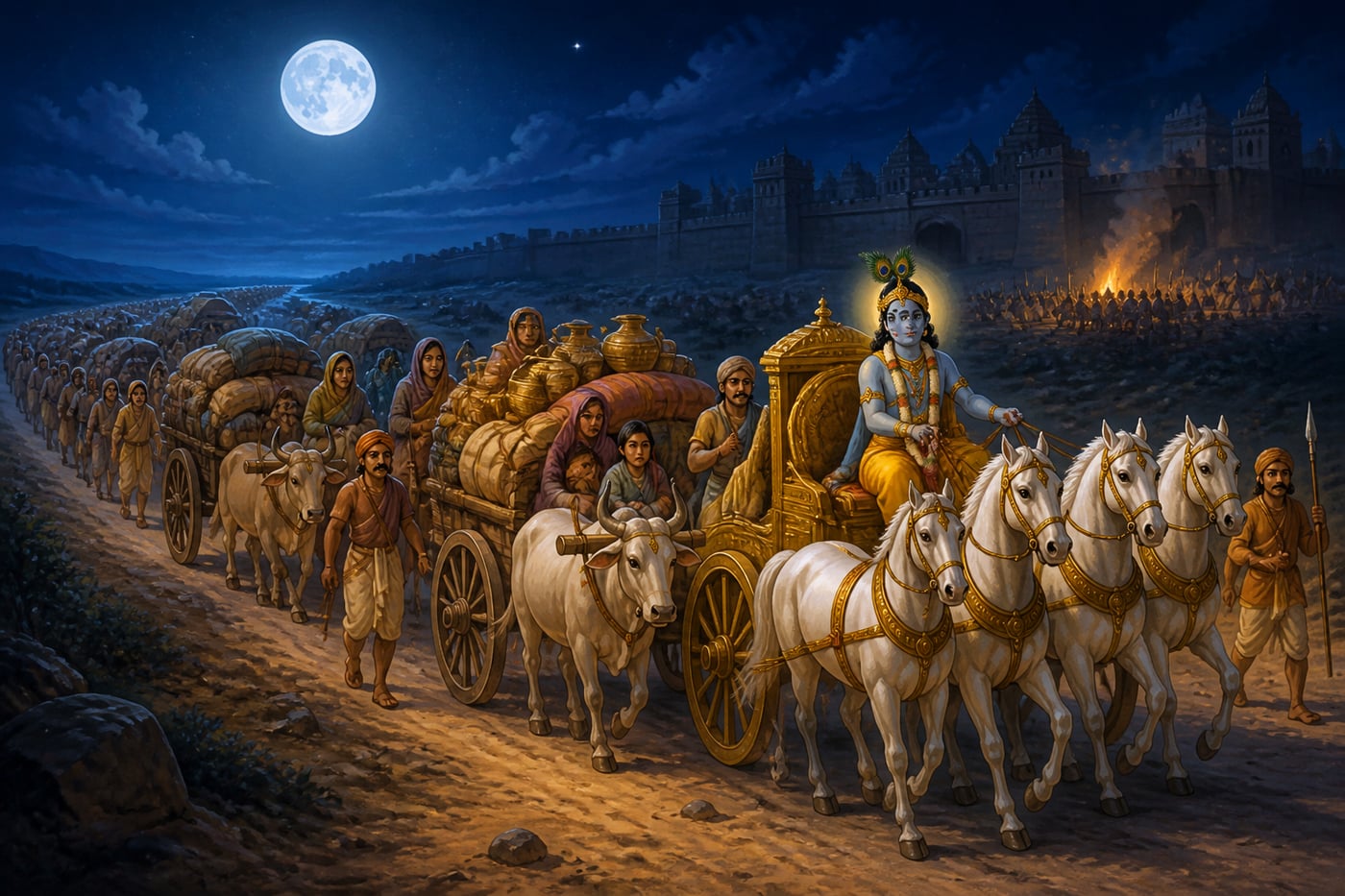
The Yadava migration leaving Mathura at midnight

Krishna made a decision that would define one of his most important epithets. During the eighteenth attack, as Jarasandha's armies approached yet again, Krishna ordered the complete evacuation of Mathura.

This was not flight in panic. It was planned, orderly, strategic relocation. Every Yadava family, every cow, every possession of value was organized for movement. The entire population left their ancestral home and traveled westward, toward the sea.

Jarasandha arrived to find an empty city. He claimed victory and returned to Magadha, satisfied. He did not pursue.

Krishna had won by losing, or rather, by refusing to play a game he could not win. He had traded a city for a people, recognizing that places can be rebuilt but communities, once destroyed, are lost forever.

Ranchhodrai: The One Who Fled

At Dwarka today, Krishna is worshipped as 'Ranchhodrai', literally, 'the one who left (chhod) the battlefield (ran/rann).' This might seem like an insult. In warrior cultures, fleeing battle is the ultimate dishonor.

But Dwarka's tradition transforms this apparent shame into wisdom. Ranchhodrai is not a coward but a strategist. He is the lord who knows when to fight and when fighting would destroy what he seeks to protect.

This epithet offers a profound teaching: true strength includes knowing when not to use strength. The ego demands that we never back down. Wisdom recognizes that some battles cannot be won, and fighting them destroys the very things we're trying to save.

Devotees at Dwarka pray to Ranchhodrai when they face situations where pride urges confrontation but wisdom counsels withdrawal. Krishna models the courage it takes to choose long-term preservation over short-term honor.

The Request to Vishwakarma

The Yadavas had escaped Jarasandha, but they were now a people without a home. They had traveled to the western coast, to land where the sea met the shore. But there was no city here, only waves and sand.

Krishna prayed to Vishwakarma, the divine architect of the gods. Vishwakarma had built the celestial cities of Indra and the palaces of the divine. He was the master builder whose work transcended mortal capability.

Vishwakarma agreed to help, but he set a condition: Krishna must request the sea to withdraw and provide land for construction. The sea, personified as the god Samudra, must consent to cede territory.

The Sea's Offering

Krishna approached the sea and made his request. The sea god, recognizing Krishna as Vishnu incarnate, agreed to withdraw. The waters pulled back, revealing twelve yojanas (roughly 100 square kilometers) of land, enough for a great city and its surrounding territory.

This land, reclaimed from the sea, would forever after be liminal, not quite earth, not quite water, belonging to both and neither. Dwarka would always be connected to the ocean, dependent on it, vulnerable to it. The sea had given the land, and one day, the sea would take it back.

But that tragedy lay far in the future. For now, the land was ready. Construction could begin.

The Night of Building

Vishwakarma raising the golden city of Dwarka overnight

Vishwakarma built Dwarka in a single night.

The texts describe a city of wonders: streets of crystal, buildings of gold and silver, palaces so tall they seemed to scrape the clouds. Gardens bloomed with flowers from all seasons. Fountains sprayed water that sparkled like diamonds. The city was organized in a perfect grid, with broad avenues and public squares.

Each Yadava family found a home prepared for them, designed to their needs. The royal palace for Krishna and his queens was the most magnificent of all, with 16,000 separate chambers (one for each of Krishna's rescued queens, according to later tradition).

When the sun rose, the Yadavas who had camped on the shore looked up to find themselves in a city of impossible beauty. The refugee community had become the residents of a capital that rivaled heaven itself.

Golden city of Dwarka glowing at sunrise from the sea

The Meaning of 'Dwarka'

The city's name carries multiple meanings:

'Dvar' means 'gate' or 'door.' Dwarka is 'the city of many gates', literally, a place of many entrances. This might refer to the actual architecture (a fortified city would have multiple controlled access points) or to the metaphorical truth that there are many gates to the divine.

'Dwar-ka' can also suggest 'the door to something', a gateway or threshold. Dwarka is traditionally considered a 'mokshapuri,' a city that grants liberation. The entire city is a door to spiritual freedom.

'Dvaravati' was another name for the city, emphasizing its quality as a gated, protected space, a refuge that could not be easily entered or attacked.

The Island Fortress

Dwarka was built as an island city, connected to the mainland by a bridge that could be raised or lowered. This was ancient urban planning for security: an island is naturally defensible, and a city that can cut its own bridge is nearly impossible to siege.

The city's location on the far western coast also provided strategic depth. Any army from the east (like Jarasandha's Magadha) would have to cross the entire subcontinent to reach Dwarka. By the time they arrived, the Yadavas would have ample warning and time to prepare.

Krishna had learned from Mathura's vulnerability. Dwarka was designed from the beginning to be impregnable, a place where his people could live without constant fear of the next attack.

Life in Dwarka

The Bhagavata Purana and other texts describe Dwarka as an ideal city:

Prosperity: Trade flourished from the maritime location. Dwarka became a center of commerce, with ships arriving from ports across the Indian Ocean.

Culture: Art, music, and learning thrived under Krishna's patronage. The city attracted scholars and artists from across the known world.

Justice: Krishna's rule was characterized by fairness. The Yadava council (sabha) discussed important matters; Krishna did not rule as a tyrant despite having the power to do so.

Devotion: Temples were built throughout the city. Though Krishna himself walked the streets, the citizens also worshipped him as the divine, a paradox that somehow resolved in lived experience.

For a generation, Dwarka was arguably the greatest city on earth, a golden capital that had risen from nothing in a single night and now stood as proof that new beginnings are always possible.

The Yadava Migration as Archetype

The Yadava migration from Mathura to Dwarka is one of ancient India's great stories of movement and resettlement. It offers several teachings:

Survival over territory: The Yadavas abandoned ancestral lands to preserve their community. Home is not a place but a people.

Divine assistance through crisis: At the moment of greatest need, Vishwakarma's intervention transformed disaster into opportunity. Help arrives when genuinely needed and humbly requested.

Leadership as protection: Krishna's decision to retreat was leadership in its truest form, sacrificing personal honor (the 'Ranchhodrai' label) to protect those who depended on him.

New beginnings require new approaches: Mathura was a landlocked city vulnerable to land attack. Dwarka was an island fortress oriented toward the sea. The migration enabled a complete reimagining of how the Yadavas would live.

Visiting Dwarka Today

Modern Dwarka sits on the site traditionally associated with Krishna's capital. The current Dwarkadhish temple dates to the 16th century, built on foundations that may be centuries older.

Pilgrims today arrive by road, rail, or air, a far cry from the arduous journeys of the past. But the experience of arriving at Dwarka still carries power. Here, at the edge of the land, where the sea stretches to the horizon, you stand where Krishna chose to build his refuge.

The sea that once withdrew for Vishwakarma now washes against the temple's seawalls. Archaeologists have discovered submerged structures offshore that may be remnants of the ancient city. The sea that gave the land did eventually reclaim it, but the memory, the worship, and the teaching endure.

The City's Message

Dwarka teaches that destruction is not the end. The Yadavas lost Mathura but gained something greater. Their crisis forced a migration that became a transformation.

The city also teaches the value of strategic thinking over emotional reaction. Krishna could have stayed and fought at Mathura until every Yadava was dead. Instead, he chose survival, relocation, and flourishing.

Most profoundly, Dwarka teaches that the divine can be found in new places, new forms, new beginnings. Krishna at Mathura and Krishna at Dwarka is the same Krishna, yet the different contexts reveal different aspects of his character. The playful cowherd of Vrindavan became the strategic king of Dwarka, and both are authentic expressions of the same divine personality.

When you face a crisis that seems to destroy everything you've known, remember Dwarka. The city that rose in a night from land the sea surrendered. The golden capital built for refugees. The place where running away became the highest wisdom.

Sometimes the door forward requires walking through the ruins of what was, toward what might yet be.

Case studies

Maritime Dwarka: Ancient Port and Trade Center

Archaeological evidence suggests that the Dwarka region was indeed a significant maritime center in ancient times. Underwater surveys have discovered submerged structures off the modern Dwarka coast that may date to 1500-3000 BCE. Ancient texts describe Dwarka as a trading city with ships arriving from distant lands. Coins, pottery, and anchors found in the region suggest extensive maritime commerce. The transformation of the Yadavas from landlocked herders to maritime traders reflects historical patterns of adaptation. Communities displaced to coastal areas often developed new economic orientations based on sea trade. Dwarka's founding myth may encode collective memory of such a transformation.

Krishna's founding of Dwarka embodies the dharmic principle of turning adversity into opportunity through righteous action. The Yadava migration from Mathura was not a random flight but a calculated move, what the tradition calls niti (strategic wisdom) combined with dharma (righteous purpose). The Bhagavata Purana describes Krishna consulting with Balarama and Yadava elders before deciding to move, demonstrating that wise leadership involves collective deliberation, not unilateral action. The choice of a coastal location was inspired: it leveraged geography for defense while opening maritime trade routes. This is the Krishna model of leadership. Do not fight every battle. Choose your ground wisely, build something new, and let the results speak for themselves.

The underwater archaeological surveys conducted by the National Institute of Oceanography between 1983 and 2005 discovered structural remains, anchors, and pottery at depths of 5 to 7 meters off the Dwarka coast. Carbon dating placed some artifacts between 1500 and 3000 BCE, broadly consistent with traditional dating of the Mahabharata era. The findings did not prove the Mahabharata happened exactly as described, but they confirmed that Dwarka was indeed a significant coastal settlement in the ancient period. The site was designated a protected area, and further surveys continue to reveal new structures beneath the waves.

Dwarka's historical development demonstrates that crisis can catalyze transformation. The Yadavas' displacement to the coast forced them to develop new skills and economic activities. What began as refugee resettlement became one of ancient India's great trading centers. Displacement, though painful, can open possibilities unavailable in original circumstances.

Refugee communities throughout history have replicated this pattern. The Huguenots displaced to England built the silk industry. Vietnamese refugees in the American Gulf Coast transformed the fishing economy. The Yadavas' pivot from land power to maritime trade mirrors what migration economists now call 'diaspora advantage,' where displacement forces innovation that voluntary settlers rarely achieve.

Marine archaeologists have identified over 500 stone anchors of various designs off the Dwarka coast, suggesting trade connections with Arabia, Africa, and Southeast Asia dating back over 3,000 years.

Strategic Retreat in Business

Consider a family business that has operated from the same location for generations. New competition, changing demographics, and infrastructure decline have made the location increasingly difficult. Every year, profits shrink despite harder work. The family faces a choice: continue fighting a losing battle out of pride and tradition, or 'flee' to a new location where growth is possible. Following the Ranchhodrai model, the family might: (1) Recognize that the battle cannot be won in the current location; (2) Identify a new 'Dwarka', a location better suited to future success; (3) Organize an orderly migration, bringing the community (employees, loyal customers) along; (4) Build something new rather than trying to recreate what was; (5) Reframe the 'retreat' as strategic repositioning.

Krishna is called Ranchhodrai, literally 'one who left the battlefield,' a name that lesser warriors would consider an insult. Yet the tradition celebrates rather than criticizes this strategic retreat. The Bhagavata Purana frames the move from Mathura to Dwarka not as cowardice but as the highest form of leadership: protecting your people by refusing ego-driven fights. The Gita's own teaching on action without attachment to results applies here. Krishna was not attached to the identity of 'conqueror of Mathura.' He was attached to the wellbeing of the Yadavas. When those two goals conflicted, he chose his people over his reputation. This is dharmic leadership at its most counterintuitive.

The family relocates their business to a growing suburb, investing their remaining capital in a modern facility. The old-timers resist, mourning the original location. But within two years, new foot traffic, lower rents, and proximity to a younger demographic revitalize the business. Revenue surpasses the old location's peak. The family patriarch, initially the strongest opponent of the move, becomes its biggest advocate. He frames the story not as retreat but as 'following Krishna to Dwarka,' a narrative that gives the difficult decision cultural dignity.

The Ranchhodrai principle applies whenever pride urges continued fighting but wisdom counsels withdrawal. In business, politics, and personal relationships, knowing when to exit a losing situation is often more valuable than persistence. Krishna's example gives permission to leave battles that cannot be won.

The Ranchhodrai principle appears in business strategy as 'strategic pivoting.' Netflix leaving DVD rentals, Apple abandoning the Newton, and countless startups killing their original product to pursue a better opportunity all follow this pattern. The stigma of 'running away' prevents many founders from making exits that would save their companies. Krishna's willingness to be called Ranchhodrai (one who fled the battlefield) reframes retreat as wisdom, not weakness.

Research by the Small Business Administration found that businesses that relocate proactively, before financial distress forces the move, have a 70% survival rate over 5 years compared to 30% for those that relocate under duress.

Living traditions

Dwarka today is both pilgrimage center and archaeological site. The National Institute of Oceanography has conducted multiple surveys of the underwater structures, and the ongoing research attracts international attention. The city represents the intersection of faith and science, believers see confirmation of tradition, while scientists see evidence of ancient maritime civilization. Both perspectives honor Dwarka's importance. The Ranchhodrai tradition also finds modern applications in business and personal development contexts, where Krishna's strategic thinking is studied as leadership philosophy.

Reflection

More in Dwarka: Krishna's Golden City

All lessons in Dwarka: Krishna's Golden City ยท Char Dham Yatra course