The Greater Dwarka Pilgrimage
Bet Dwarka, Nageshwar, and the complete sacred geography
Discover the complete Dwarka pilgrimage circuit - Bet Dwarka where Krishna actually resided, Nageshwar Jyotirlinga linking Krishna with Shiva worship, the separated Rukmini Temple and the curse that caused it, Gopi Talav where the gopis' tears became a pond, and Sudama Temple honoring divine friendship. Learn the Panch Tirtha of Dwarka and how to experience the full sacred geography.
Beyond the Main Temple
Pilgrims who visit only the Dwarkadhish Temple and consider their journey complete have missed the greater teaching. Dwarka is not a single point but a sacred landscape, a mandala of interconnected sites that together tell a complete story of Krishna's earthly life, his relationships, and his eternal presence.
The complete Dwarka pilgrimage takes devotees across water and land, through stories of love and friendship, from Vaishnava worship to a Shiva jyotirlinga, from the temple where Krishna is king to the places where he was husband, friend, and object of heartbroken longing. Each site adds a dimension to understanding the divine.
Bet Dwarka: The Original Residence
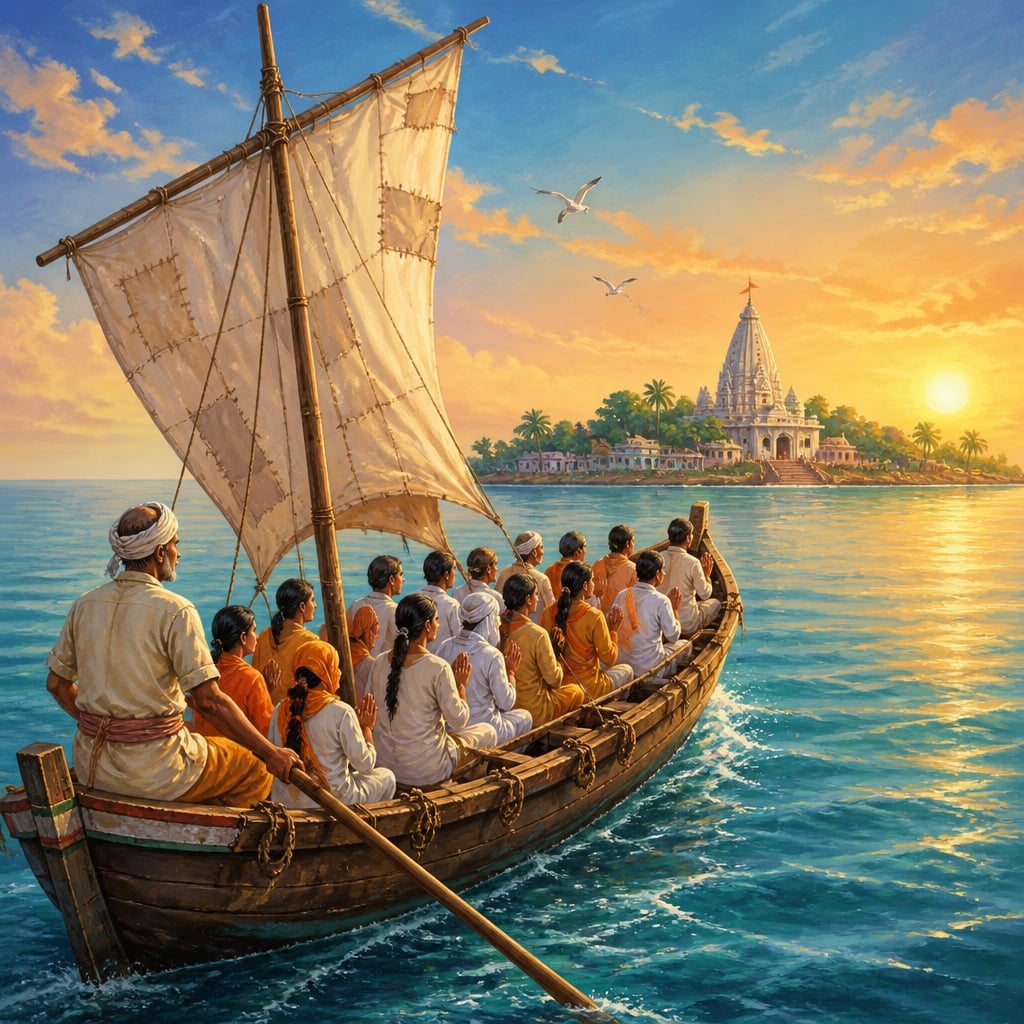
Approximately 30 kilometers from modern Dwarka, accessible only by boat from the port of Okha, lies Bet Dwarka, also called Shankhodhar. This island is where Krishna actually lived, according to tradition. The mainland temple marks the location of the public city; Bet Dwarka was the residential heart.
The boat journey itself is part of the pilgrimage. For twenty minutes, pilgrims cross the waters that once surrounded ancient Dwarka. Looking at the sea, they contemplate that beneath these waves lie the remains of the golden city, that they are traveling over history itself.
The Island's Sacred Sites
Bet Dwarka contains multiple ancient temples:
Dwarkadhish Temple of Bet Dwarka: Smaller and simpler than the mainland temple, but believed by many to mark the exact spot where Krishna lived. The deity here is ancient, its origins lost in time.
Hanuman Dandi Temple: Dedicated to Hanuman, connecting the Rama and Krishna narratives. Tradition says Hanuman, who served Rama faithfully, wished to see Vishnu's next avatar. Krishna granted him residence at Bet Dwarka.
Dandi Swami Math: An ancient monastic establishment that has maintained worship on the island for centuries.
Archaeological Significance
Underwater archaeological surveys around Bet Dwarka have revealed the most significant findings of the Dwarka research projects. Stone structures, anchors, pottery, and artifacts dating potentially to 1500-3000 BCE have been documented. The island appears to have been continuously inhabited since ancient times.
For believers, these findings confirm what tradition always knew: Bet Dwarka is ancient, sacred, and connected to Krishna's historical presence. For scholars, the findings indicate an important Bronze Age maritime center. Both perspectives honor the island's significance.
Nageshwar Jyotirlinga: Where Krishna and Shiva Meet
Approximately 17 kilometers from Dwarka stands the Nageshwar Temple, one of the twelve Jyotirlingas, the most sacred Shiva shrines in India. Its presence near a major Krishna pilgrimage site embodies a profound teaching: Vishnu and Shiva are not rivals but complementary aspects of the divine.

The temple enshrines a massive Shiva linga, and outside stands an 82-foot statue of Shiva in meditation, one of the tallest Shiva statues in the world.
The Legend of Nageshwar
The Shiva Purana tells how a demon named Daruka imprisoned a devout Shiva worshipper named Supriya. Despite her captivity, Supriya continued her worship, and her devotion converted other prisoners to Shiva bhakti. When Daruka tried to kill them, Shiva manifested as the Nageshwar Jyotirlinga and destroyed the demon.
The name 'Nageshwar' means 'Lord of Serpents', Shiva who wears the serpent Vasuki around his neck. The temple also has connections to the nagas (serpent beings) who figure prominently in both Krishna and Shiva mythology.
Theological Significance
That a Jyotirlinga stands within the Dwarka pilgrimage zone is not coincidence but design. The presence teaches:
- Non-sectarianism: A complete pilgrimage includes both Vishnu and Shiva
- Complementarity: The preserving principle (Vishnu) and the transforming principle (Shiva) work together
- Unity in diversity: Different paths lead to the same truth
Serious pilgrims to Dwarka include Nageshwar in their circuit, honoring both aspects of divinity.
Rukmini Temple: The Separated Queen
Two kilometers from the main Dwarkadhish Temple stands a temple that raises an obvious question: Why is Krishna's primary queen housed so far from her husband?
The answer involves the sage Durvasa, famous throughout Hindu mythology for his short temper and powerful curses.
The Story of Durvasa's Curse
Once, Sage Durvasa arrived at Dwarka as a guest. In ancient Dharma, a guest of Durvasa's stature required elaborate hospitality, and both Krishna and Rukmini undertook to serve him.
Durvasa requested that Krishna and Rukmini personally drive his chariot to a certain place. They agreed. Krishna pulled the chariot; Rukmini sat inside with the sage.
The journey was long and arduous. At one point, overcome by thirst, Rukmini asked Krishna for water. Krishna, ever attentive to his devotees, used his divine power to bring forth the Ganga from the earth so Rukmini could drink.
This act, though born of love, offended Durvasa. He had not been offered water first, a breach of guest protocol. In his rage, he cursed Rukmini: she would be separated from her husband.
The curse could not be revoked, but its force was mitigated. Rukmini would be separate from Krishna's temple, but her own temple would stand within sight. She would be near but not together, separated yet connected.
The Temple Today
The Rukmini Temple is smaller and less visited than Dwarkadhish, but devotees consider their pilgrimage incomplete without visiting both. The temple architecture is distinct, and the peaceful atmosphere contrasts with the busier main temple.
Inside, Rukmini sits in eternal waiting, close enough to see Krishna's spire, far enough to feel the curse's sting. Pilgrims who visit both temples symbolically reunite what the curse separated.
The Teaching
Rukmini's story carries a sobering lesson: even the queen of Dwarka, even the wife of God himself, faced consequences for a momentary lapse in protocol. The teaching is not that the curse was just (Durvasa's curses are famously excessive), but that actions have consequences even when intentions are good.
The separation also teaches something about love: it persists despite distance. Rukmini's devotion to Krishna is not diminished by the two kilometers between their temples. Love that depends on proximity is not yet mature; love that survives separation reveals its depth.
Gopi Talav: The Pond of Tears
When Krishna left Vrindavan for Mathura, never to return as a resident, the gopis (cowherd women) who loved him were devastated. Their grief became legendary, they neither forgot him nor stopped longing for him, even after learning of his kingship and marriages.
Tradition says that some gopis eventually traveled to Dwarka, hoping to see Krishna one more time. Their tears of longing and reunion created a pond, Gopi Talav, located about 20 kilometers from Dwarka.
The Salty Water
Gopi Talav's water is notably salty, unusual for a freshwater pond. Devotees attribute this to the gopis' tears of separation, which were so bitter with longing that they permanently changed the water's nature.
Science explains the salinity through the coastal geology. Faith sees the gopis' love made manifest in the very chemistry of the water. Perhaps both are true: the geology that produced the salt was the means by which devotional memory inscribed itself on the land.
The Yellow Soil
The clay around Gopi Talav has a distinctive yellow-golden color. Tradition says this is because the gopis, in their grief, covered themselves with yellow paste before meeting Krishna. When they bathed in the pond, the color transferred to the soil.
Pilgrims take small amounts of this clay as prasad, a tangible connection to the gopis' devotion. The yellow earth becomes a reminder that love leaves traces, not just in memory but in the physical world.
Theological Significance
Gopi Talav represents bhakti in its most intense form: love that cannot be satisfied by anything less than direct presence of the beloved, grief that transforms the landscape, longing that sanctifies ordinary geography.
For devotees practicing the path of love (bhakti yoga), the gopis are supreme exemplars. Their love for Krishna was not based on his power or his miracles but on direct personal relationship. The pond commemorates this teaching: the highest spirituality is not about knowledge or technique but about love so total that separation becomes physically unbearable.
Sudama Temple: Sacred Friendship

We encountered Sudama's story in the previous lesson, the poor Brahmin friend who visited Krishna with a handful of beaten rice and returned to find his poverty transformed. The Sudama Temple, located in modern Porbandar (about 100 km from Dwarka), commemorates this friendship.
The Temple and Its Teaching
The temple complex includes a small cell representing Sudama's humble dwelling and shrines showing various episodes from the Sudama-Krishna story. Unlike the grand Dwarkadhish Temple, the Sudama Temple is modest, appropriate for honoring a man whose virtue was simplicity.
Sudama's story is one of the most beloved in the Krishna tradition because it is so accessible. Most devotees will never be queens like Rukmini or divine cowherds like the gopis. But anyone can be a friend who shows up with whatever they have, trusting that sincerity matters more than material value.
Friendship as Spiritual Path
The inclusion of Sudama's shrine in the Dwarka pilgrimage circuit teaches that friendship (sakhya) is a valid path to the divine. The Bhagavata Purana describes multiple forms of relationship with God:
- Shanta: Peaceful reverence (as to a king)
- Dasya: Service (as servant to master)
- Sakhya: Friendship (as friend to friend)
- Vatsalya: Parental love (as parent to child)
- Madhurya: Romantic love (as lover to beloved)
Sudama exemplifies sakhya bhakti. He approaches Krishna not as worshipper to god but as friend to friend. His gift of beaten rice is not a ritual offering but a sharing between equals. Krishna's response, eating the rice with delight, reminiscing about shared student days, treats Sudama as a peer.
This teaching democratizes divine relationship. You don't need elaborate rituals or theological sophistication to approach Krishna. You need only the honesty to show up as you are, with whatever you have, trusting that friendship with the divine is possible.
The Panch Tirtha: Five Sacred Waters
The complete Dwarka pilgrimage traditionally includes bathing at five sacred water sites, the Panch Tirtha. These are:
- Gomti Sangam: Where the Gomti River meets the sea, near the main temple
- Chakra Tirtha: Associated with Vishnu's discus
- Panch Nada Tirtha: Confluence of five streams
- Samudra Narayana: The ocean itself as sacred water
- Gopi Talav: The pond of the gopis' tears
Bathing at all five waters completes a cycle of purification. Each water has different qualities and associations, together representing the complete spectrum of sacred waters available at Dwarka.
The Pilgrimage Circuit
Serious pilgrims organize their Dwarka yatra to include all major sites. A traditional sequence might be:
Day 1:
- Arrive Dwarka
- Bathe at Gomti Sangam
- Evening darshan at Dwarkadhish Temple
Day 2:
- Early morning Mangala Aarti at Dwarkadhish
- Visit Rukmini Temple
- Boat to Bet Dwarka (full day)
- Return for evening aarti
Day 3:
- Visit Nageshwar Jyotirlinga
- Gopi Talav
- Complete remaining Panch Tirtha bathing
Day 4:
- Final darshan at Dwarkadhish
- Optional: Journey to Porbandar for Sudama Temple
- Departure
This circuit transforms a temple visit into a comprehensive pilgrimage, engaging with multiple aspects of Krishna's life and legacy.
The Teaching of Sacred Geography
Why does the Dwarka pilgrimage spread across so many sites? Why not consolidate everything at one location?
The dispersed geography teaches something about the nature of sacred presence. Krishna's divinity is not contained in a single point but distributed across a landscape. His role as king is at the main temple; his daily life at Bet Dwarka; his relationship with Rukmini at her separate temple; his friendship with Sudama at Porbandar; even Shiva-Vishnu unity at Nageshwar.
By traveling between sites, pilgrims embody the truth that the divine cannot be reduced to a single location. Each site reveals something that the others don't. The complete understanding emerges only from the complete circuit.
This is also how life works. We don't understand anyone from a single encounter. We must see them in different contexts, different relationships, different moods. The Dwarka pilgrimage mimics this process: we see Krishna as king, husband, friend, and beloved across the sacred landscape, and from these multiple perspectives, a fuller picture emerges.
Modern Pilgrimage Practicalities
For contemporary pilgrims planning a Dwarka yatra:
Transportation: Dwarka is connected by rail (Dwarka station) and road (well-connected to Ahmedabad and Rajkot). The nearest airport is Jamnagar (137 km). Local transportation between sites is available by auto-rickshaw, taxi, or organized tour.
Accommodation: Options range from temple dharamshalas (simple, inexpensive, and proximate to the temple) to hotels of various categories. Booking in advance is advisable during major festivals.
Best Time: October to March offers pleasant weather. Avoid monsoon (July-September) when boat service to Bet Dwarka may be disrupted. Janmashtami brings huge crowds; visit then for the experience, or avoid if you prefer quieter darshan.
Duration: A minimum of two days is needed to visit the main sites. Three to four days allows a more contemplative pace.
Special Notes: Bet Dwarka boat service may be cancelled in rough weather. Have flexible plans. Also, non-Hindus may face restrictions at certain temples; inquire locally.
The Unfinished Pilgrimage
Every pilgrimage ends with departure, but the inner journey continues. Pilgrims return home carrying:
- Prasad: Blessed offerings from each temple
- Charanamrit: Sacred water from the temple
- Temple flag cloth: From Dwarkadhish's daily flag changes
- Gopi Talav clay: Yellow earth from the gopis' pond
These tangible souvenirs become focal points for continued devotion at home. The pilgrimage that cannot be physically repeated can be internally revisited through these objects.
More important than physical souvenirs is what the pilgrimage leaves in the pilgrim. Having walked where Krishna walked, bathed where his devotees bathed, and seen the multiple dimensions of his presence, something shifts. Dwarka becomes not just a place visited but a place carried within.
The Bhagavata Purana says that one who visits Dwarka with devotion and completes the circuit of sacred sites attains merit equivalent to performing many yajnas (elaborate Vedic rituals). But beyond merit, the pilgrim gains relationship, a connection to Krishna, to his story, to the land that holds his memory.
This relationship is the true purpose of pilgrimage. The sites are catalysts; the landscape is teacher. What endures is the transformed heart that returns home.
Conclusion: The Complete Dwarka
Dwarka is not one temple but many. Not one story but an anthology. Not one form of devotion but the entire spectrum, from the formal aarti at Dwarkadhish to the tear-salted water of Gopi Talav, from the cursed separation of Rukmini to the generous friendship of Sudama, from Vaishnava worship to Shaiva darshan at Nageshwar.
The pilgrimage that engages this fullness returns something that visiting a single site cannot: an understanding of divine presence as distributed, relational, and irreducible to any single form.
Krishna lived here. He ruled here. He loved here. He received his friend's humble gift here. He is worshipped here still, not in one place but across a landscape that has become, through accumulated devotion across millennia, a living mandala of the divine.
To complete the greater Dwarka pilgrimage is to walk this mandala, to become part of its pattern, and to carry its shape home in your heart.
Case studies
The Maritime Heritage of Bet Dwarka
Archaeological work at Bet Dwarka and the surrounding waters has revealed evidence of sophisticated maritime activity dating back millennia. Anchors of different designs suggest trade connections with multiple civilizations. Pottery sherds show influences from across the Indian Ocean trading network. Stone structures underwater indicate possible harbor facilities. The island's position made it ideal as a trading post, protected from open ocean but accessible to ships. The same geography that made it attractive for ancient traders made it suitable for Krishna's residential capital in tradition. Whether the archaeology confirms mythology or simply shows parallel patterns, the material evidence supports Dwarka's identity as a significant ancient maritime center. The Archaeological Survey of India and National Institute of Oceanography have conducted multiple surveys. Their findings, while subject to scholarly debate about precise dating and interpretation, consistently indicate ancient human activity at the site.
The Mahabharata describes Dwarka as a sophisticated maritime city with harbors, docks, and trading ships. For centuries, scholars dismissed these descriptions as poetic exaggeration. The archaeological evidence from Bet Dwarka suggests otherwise. Hindu tradition has always understood the ocean as both a physical and metaphysical space. Varuna, lord of the waters, governs cosmic order (rita) itself. Maritime trade in the dharmic worldview was not merely commerce but a form of cultural exchange governed by dharmic principles. The diverse anchor designs and pottery found at Bet Dwarka suggest a cosmopolitan port where multiple civilizations met, traded, and exchanged ideas, exactly as the texts describe.
Ongoing archaeological work at Bet Dwarka has uncovered pottery with inscriptions in multiple scripts, stone anchors of at least seven different designs suggesting trade connections across the Indian Ocean, and evidence of a sophisticated freshwater management system on the island. The site is now recognized as one of India's most important marine archaeological zones. A proposal to designate it as a UNESCO World Heritage site is under consideration. The findings have shifted academic consensus from dismissing Mahabharata geography as fiction to treating it as a valuable (if embellished) historical source.
Bet Dwarka demonstrates how mythology and archaeology can inform each other. The traditions preserved memory of a significant ancient site; modern science is revealing its material reality. Neither approach alone tells the complete story. The pilgrim who visits Bet Dwarka walks on ground that is both mythologically sacred and historically significant.
The interdisciplinary approach combining textual analysis with marine archaeology at Bet Dwarka is now a model for underwater heritage sites worldwide. Similar methods are being applied at Alexandria's submerged harbor, Pavlopetri off Greece, and Port Royal in Jamaica. The principle that mythology preserves geographical memory is gaining acceptance in academic archaeology, opening new research avenues at sites previously dismissed as 'merely legendary.'
Excavations at Bet Dwarka have unearthed pottery dating from 1600 BCE to the medieval period, along with seven distinct types of stone anchors, indicating continuous maritime activity spanning over 3,000 years at the site.
The Friendship Audit
Consider a successful professional who realizes they have many connections but few true friends. Their network is extensive but shallow, people they know for what they can provide, not for who they are. A crisis reveals this: when they need support beyond professional utility, few appear. Reflecting on the Sudama principle, this person might: (1) Identify relationships based on genuine affection rather than utility, these are seeds of true friendship; (2) Invest in these relationships without expectation of professional return; (3) Practice showing up with 'beaten rice', simple, sincere gestures rather than elaborate networking; (4) Recognize that true friends are those who valued them before success and would value them after failure; (5) Create contexts for genuine connection rather than strategic networking.
The Sudama-Krishna friendship is one of Hinduism's most beloved stories because it illustrates a radical idea: that love transcends hierarchy. Krishna, the king of Dwarka, washes the feet of Sudama, a poor Brahmin, and receives his humble gift of beaten rice (poha) with more joy than the finest royal tribute. The Bhagavata Purana makes clear that Krishna's response is not charity or pity but genuine delight in his friend's presence. Dharmic tradition teaches that true relationships are those where both parties see the atman (soul) in each other rather than the social mask. Sudama's poverty and Krishna's wealth are irrelevant because their friendship operates at a level where such distinctions do not exist.
The professional begins what they call a 'friendship audit,' inspired by the Sudama story. They ask themselves: who would I visit if I had nothing to offer professionally? Who would visit me? The honest answers are uncomfortable but clarifying. They begin investing time in the few genuine relationships they identify, accepting invitations they would previously have declined as 'not strategic,' and initiating contact without any agenda. Over time, a smaller but deeper circle forms. When a genuine crisis arrives, these are the people who show up, not with business solutions but with presence.
The Sudama story distinguishes true friendship from transactional relationships. Krishna received Sudama not because of what Sudama could offer but because of who Sudama was. Applying this principle helps identify and nurture genuine friendships amid professional networks.
In an era of transactional networking optimized by LinkedIn connections and mutual benefit calculations, the Sudama story's insistence on friendship beyond utility feels countercultural. Yet research consistently shows that the relationships people value most, and that contribute most to wellbeing, are precisely those that resist transactional framing. The 'friendship audit' is a practical tool for anyone who suspects their social circle has become a professional network.
The Sudama Setu (bridge) connecting Dwarka to Bet Dwarka is named after this friendship story. Over 5 lakh pilgrims cross it annually to visit the Sudama Temple, making it one of the few temples in India dedicated not to a deity but to the ideal of selfless friendship.
Living traditions
The greater Dwarka pilgrimage has been enhanced by modern transportation while maintaining traditional significance. Organized pilgrimage packages offer complete circuits including Bet Dwarka boat service, Nageshwar visit, and Gopi Talav. Gujarat Tourism promotes the route as a 'Krishna Circuit.' Archaeological findings at Bet Dwarka have increased interest among those seeking historical connections to mythology. The combination of faith and archaeology attracts diverse visitors, traditional devotees, history enthusiasts, and cultural tourists. The Nageshwar Jyotirlinga, as one of the twelve, draws Shiva devotees who may not otherwise visit Krishna sites, creating cross-sectarian pilgrimage patterns. The Sudama Temple in Porbandar, located in Gandhi's birthplace, combines pilgrimage with patriotic tourism. Overall, the greater Dwarka region functions as a pilgrimage ecosystem where different sites serve different devotional needs while together forming a complete sacred landscape.
- Panch Tirtha Snan: Ritual bathing at all five sacred waters of the Dwarka pilgrimage. Devout pilgrims bathe at each tirtha in prescribed sequence, often beginning at Gomti Sangam before dawn and completing the circuit over one or more days. Each bathing includes specific mantras and intentions.
- Bet Dwarka Boat Pilgrimage: The boat journey from Okha to Bet Dwarka is itself a pilgrimage practice. Pilgrims recite mantras during the crossing, contemplate the submerged city beneath them, and prepare mentally for darshan at Krishna's residential site.
- Gopi Talav Clay Collection: Pilgrims collect small amounts of the yellow clay from Gopi Talav's shores. This clay, colored by the gopis' paste according to tradition, is taken home as prasad and used in personal worship.
- Bet Dwarka Temple Complex: Multiple temples on the island including the ancient Dwarkadhish Temple of Bet Dwarka, Hanuman Dandi, and several smaller shrines. The island is believed to be Krishna's actual residential location.
- Sudama Temple, Porbandar: Temple commemorating Krishna's friend Sudama, located in the town traditionally considered Sudama's birthplace. The temple includes scenes from the Sudama-Krishna story and a replica of Sudama's humble dwelling.
- Nageshwar Jyotirlinga Temple: One of the twelve Jyotirlingas, housing a major Shiva linga and featuring an 82-foot Shiva statue. Represents the synthesis of Shaiva and Vaishnava worship within the Dwarka pilgrimage.
Reflection
- The gopis' tears were so intense that they transformed a pond's water into salt. What does it mean that emotional experience can leave physical traces in the world? Have you ever felt something so deeply that it seemed to change the environment around you?
- Sudama approached Krishna with nothing but beaten rice and genuine friendship. What are the 'beaten rice' offerings in your life, the simple, sincere gifts you might be ashamed to offer because they seem inadequate? What would change if you trusted that sincerity matters more than impressive offerings?
- The Dwarka pilgrimage includes both Krishna's Dwarkadhish Temple and Shiva's Nageshwar Jyotirlinga. What does this synthesis teach about sectarian divisions? Is the 'highest' truth one path or the recognition that multiple paths are valid?