Dwarkadhish Temple: The Jagat Mandir
Five stories reaching toward the heavens
Explore the magnificent Dwarkadhish temple - its five-story structure with 72 pillars, the 56-step Moksha entrance representing the 56 Yadava clans, the flag that changes five times daily, and the connection to Adi Shankaracharya's western math. Learn about the temple's multiple destructions and reconstructions throughout history, and how devotion rebuilt what violence destroyed.
The Temple Built on Krishna's Palace
Standing at the confluence of the Gomti River and the Arabian Sea, the Dwarkadhish Temple rises like a stone prayer into the sky. Its spire, called 'shikhar,' pierces the heavens at 51.8 meters, visible to ships approaching the coast, a beacon that has guided pilgrims for centuries.
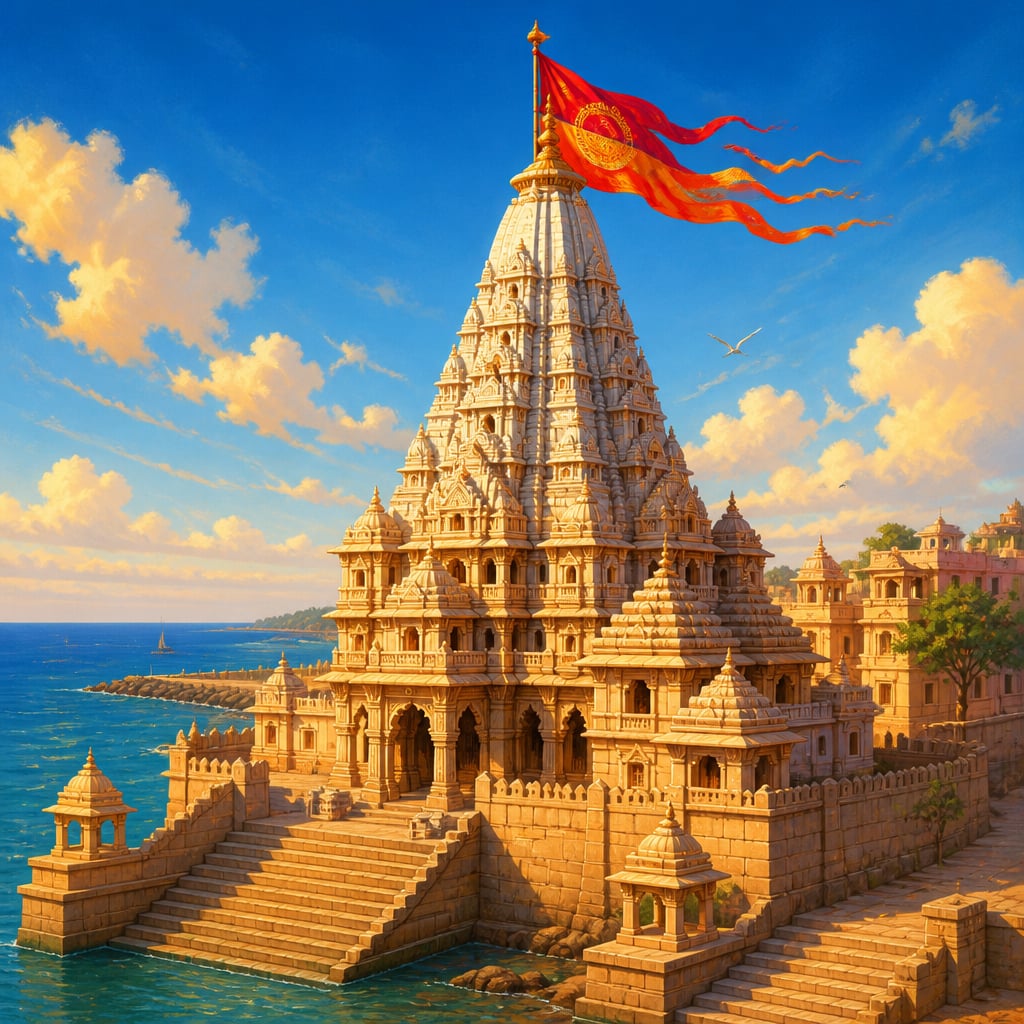
Tradition holds that this temple stands on the exact site of Hari Griha, Lord Krishna's personal residence in ancient Dwarka. The original structure, they say, was built by Krishna's great-grandson Vajranabha over 2,500 years ago, immediately after the city's submersion. Where his ancestor had lived as king, Vajranabha built a shrine for eternal worship.
Of that original temple, nothing visible remains. The structure has been destroyed and rebuilt so many times that layers of history lie compressed in its stones. Yet devotees believe that the sanctum sanctorum, the garbhagriha, occupies the precise spot where Krishna once held court, where Rukmini served him, where the sixteen thousand queens resided.
Architecture of Devotion
The temple that stands today is primarily a 15th-16th century reconstruction, built in the Chalukya style of architecture. But describing it requires numbers that become a form of meditation:
Five Stories (Panch Talla): The temple rises in five distinct levels, each representing a stage of spiritual ascent. Ground floor to sky, the devotee's gaze travels upward, following the natural direction of aspiration.
72 Pillars: The main hall rests on 72 intricately carved sandstone pillars, each unique. These pillars have supported the roof through earthquakes, invasions, and the slow erosion of sea salt in the air. The number 72 is significant in Hindu cosmology, there are 72,000 nadis (energy channels) in the subtle body.
The Shikhar: The main spire is constructed without using any iron, an engineering achievement that has allowed it to survive in the corrosive coastal environment for centuries. The temple's silhouette against sunset has become one of India's iconic images.
The 56 Steps: Moksha Dwara
To enter the temple, pilgrims must descend 56 steps to reach the main gate, called the Moksha Dwara, the Door of Liberation. This descent is deliberate symbolism: you go down to go up; you humble yourself to be elevated.
The 56 steps represent the 56 Yadava clans who migrated with Krishna from Mathura to Dwarka. Each step is a reminder that an entire community made this journey, not just a god, but a people. The pilgrimage to Dwarkadhish retraces the Yadava migration in miniature.
As you descend, the noise of the street fades. The steps create a threshold experience, you are literally leaving the ordinary world behind, entering sacred space through the same symbolic number that marked the original migration.
The Deity: Dwarkadhish
In the inner sanctum stands the murti of Dwarkadhish, Krishna as the Lord of Dwarka. This is not the playful child of Vrindavan or the charioteer of Kurukshetra. This is Krishna the King, shown with four arms holding his divine attributes:
- Shankha (Conch): The primordial sound that creates and dissolves universes
- Chakra (Discus): The wheel of time and dharma, the weapon that maintains cosmic order
- Gada (Mace): The power of knowledge that destroys ignorance
- Padma (Lotus): Purity and spiritual unfoldment, beauty that rises from mud
The image is made of shiny black stone, though the rich clothing and ornaments often obscure the material beneath. The deity is adorned differently for different darshans throughout the day, morning, noon, evening, and night each reveal a different aspect of the Lord.
The Flag That Never Rests

One of Dwarkadhish Temple's most distinctive features is its flag, the dhwaja, which changes five times every day. At dawn, noon, afternoon, evening, and night, priests climb the 52-meter spire to replace the massive triangular flag.
52 yards of cloth are used for each flag, representing the 52 weeks of the year. The flags bear different symbols and colors for different times: saffron for morning energy, other patterns for other hours. Old flags are given to devotees as prasad, blessed cloth that has flown over the Lord's residence.
Why change the flag so often? The constant renewal symbolizes that divine protection is not a static blessing but an ongoing relationship. God's grace must be continuously invoked, continuously received. The flag also serves a practical function, in the salt-laden coastal air, fabric deteriorates rapidly. Fresh flags ensure the temple always presents its best to the Lord.
The sight of the flag from miles away has traditionally told sailors they were approaching Dwarka. It has guided countless ships home.
Destruction and Resurrection
The history of Dwarkadhish Temple is a history of repeated destruction and determined rebuilding:
Mahmud of Ghazni (1026 CE): The Ghaznavid invader, fresh from destroying Somnath, is believed to have attacked Dwarka as well. The temple was damaged or destroyed.
Sultanate Period (13th-14th centuries): Multiple raids by various rulers caused damage. Each time, devotees rebuilt.
Muzaffar Shah I (1472 CE): The Gujarat Sultan's forces damaged the temple. Reconstruction followed.
Portuguese Period (16th century): Conflicts with Portuguese forces in Gujarat led to further damage.
Yet through all this destruction, worship never permanently ceased. Each generation rebuilt what the previous generation had lost. The temple standing today incorporates stones and sculptures salvaged from earlier destructions, making it a palimpsest of devotional persistence.
This pattern of destruction and rebuilding carries its own teaching: what matters is not the permanence of the structure but the permanence of the devotion that rebuilds it. Stones can be shattered; faith cannot.
Shankaracharya's Western Seat

In the 8th century CE, Adi Shankaracharya established four maths (monastic seats) at the four corners of India to protect and propagate Vedantic philosophy. The western math, Sharada Peetham, was established at Dwarka.
The current Shankaracharya of the West continues this lineage, residing at the math adjacent to the Dwarkadhish Temple. This institutional presence has provided continuity of scholarly tradition even when the temple itself faced destruction.
The establishment of the math transformed Dwarka from merely a pilgrimage site to a center of learning. The Shankaracharyas have provided leadership, resolved disputes, and maintained the philosophical traditions that give the pilgrimage its deeper meaning.
The Temple Day
Life at Dwarkadhish follows an elaborate daily schedule:
Mangala Aarti (Dawn): The day begins with the first aarti as the sun rises over the Arabian Sea. The deity is awakened with songs and bells.
Shringar Aarti (Morning): After ceremonial bathing and dressing of the deity, the morning aarti presents Krishna in his royal adornments.
Gwal Aarti (Mid-morning): A smaller ceremony mid-morning.
Rajbhog Aarti (Noon): The deity is offered the royal meal. After this, the temple closes for rest, even God takes an afternoon siesta in the heat.
Utthapan Aarti (Afternoon): The deity is awakened from rest.
Sandhya Aarti (Evening): The major evening ceremony as lamps are lit against gathering darkness.
Shayan Aarti (Night): The final aarti before the deity is ceremonially put to bed.
This schedule treats Krishna not as an inert image but as a living presence who eats, sleeps, is dressed and undressed, receives visitors at appointed times. The entire day becomes a meditation on service.
Gomti Ghat
Before entering the temple, pilgrims traditionally bathe at Gomti Ghat, where the Gomti River meets the sea. The Gomti here is a small river (not to be confused with the larger Gomti in Uttar Pradesh), and its confluence with the ocean creates a particularly sacred tirtha.
Five ghats line the riverbank near the temple:
- Chakra Tirtha
- Gomti Ghat
- Samudra Narayana
- Sangam Tirtha
- Panch Nada Tirtha
Bathing at these ghats before darshan is believed to prepare both body and mind for encountering the divine. The practice acknowledges that pilgrimage is physical, we must cleanse the vessel before filling it with sacred experience.
The Sudama Setu
Near the temple stands the Sudama Setu, a bridge commemorating Krishna's childhood friend Sudama (also called Kuchela). The story is beloved throughout India:
Sudama, a poor Brahmin, was Krishna's classmate in the ashram of Guru Sandipani. Years later, when Sudama's family faced extreme poverty, his wife urged him to approach his old friend, now the wealthy king of Dwarka.
Sudama brought the only gift he could afford, a handful of beaten rice (poha). Ashamed of his poverty, he tried to hide the gift. But Krishna, recognizing true friendship beyond wealth, grabbed the poha and ate it with delight, remembering their shared poverty in student days.
Krishna sent Sudama home without apparent response to his unspoken need. But when Sudama arrived at his village, he found a palace where his hut had stood, his family dressed in fine clothes, all poverty transformed.
The Sudama Setu reminds pilgrims that Krishna recognizes devotion regardless of its material value. The handful of rice from a sincere heart outweighs gold from the prideful. The bridge physically connects pilgrims to this teaching.
Pilgrimage Practice
Traditional Dwarkadhish darshan follows a specific sequence:
- Bathe at Gomti Ghat, Purify before approaching
- Descend the 56 steps, Enter through Moksha Dwara
- Circumambulate the temple, Parikrama builds anticipation
- Darshan of Dwarkadhish, The central encounter
- Visit subsidiary shrines, Devaki, Rukmini, and other deities have shrines within the complex
- Receive prasad, Take the blessed offerings
- Sit in the mandapa, Absorb the experience before leaving
Rushing through defeats the purpose. The architecture is designed for gradual approach, building spiritual intensity until the climactic moment of seeing the deity face-to-face.
The Living Temple
What makes Dwarkadhish remarkable is not its architecture alone, many Indian temples are more ornate, more ancient, more historically documented. What makes it remarkable is its unbroken living tradition.
For over two millennia, through invasions and reconstructions, through changing dynasties and political upheavals, the rhythm of worship has continued. The aarties that echo today are descendants of aarties that sounded when the temple was first built. The flames that illuminate the deity's face have been lit from flames that were lit from flames that stretch back beyond memory.
Every morning, the flag rises. Every evening, it changes. Every day, the deity is awakened, bathed, dressed, fed, rested, and put to bed. The temple breathes with a life that transcends any individual lifetime.
This is what it means to stand in a living temple: you become part of a practice that will continue after you leave, that existed before you arrived, that connects your brief presence to an unbroken chain of devotion.
The Jagat Mandir
The temple's alternate name, Jagat Mandir, the Temple of the World, expresses its universal significance. Though built at the western edge of India, it represents the center. Though dedicated to Krishna in his royal aspect, it welcomes all who seek the divine.
The Jagat Mandir stands where land meets sea, where the river meets the ocean, where the ancient city sank and the sacred memory rose. It marks a spot on earth where the distance between human and divine is said to be especially thin.
To visit Dwarkadhish is to add your footsteps to millions who have descended those 56 steps, to add your prayers to prayers that have echoed for centuries, to take your small place in a tradition that will continue for centuries more.
The five stories reach toward heaven. But the real ascent happens within.
Case studies
The Flag Tradition: 1,500 Years of Unbroken Practice
The five-times-daily flag changing at Dwarkadhish has continued uninterrupted for an estimated 1,500 years. This requires extraordinary logistical coordination: 52 yards of cloth per flag, five times daily, means approximately 95,000 yards of specially prepared fabric annually. The flags must be made to precise specifications, blessed before use, and distributed as prasad afterward. During various invasions and disruptions, maintaining this tradition required creative solutions. Temple records suggest that during periods when the main temple was damaged, the flag ceremony continued from temporary structures. The practice survived because it was considered essential to the temple's spiritual life, not an optional decoration but a requirement for the deity's proper worship. The economics of the flag tradition reveal how temples sustained communities. Weavers specialized in flag cloth, priests trained specifically for the climbing and ceremonial aspects, and distribution networks developed to handle the volume of prasad flags going to devotees across India.
The Dwarkadhish flag tradition embodies the dharmic concept of nitya karma, daily obligatory practice that sustains cosmic and social order. In Hindu theology, certain rituals must be performed without interruption because they maintain the connection between the human and divine realms. The five daily flag changes correspond to the five phases of the day recognized in temple worship (panchakala puja). Each flag represents a fresh invocation, a renewal of the deity's sovereignty over the temple precinct. The economic ecosystem that grew around this practice demonstrates a core principle: when spiritual practice is sincere and sustained, it naturally generates material support. The tradition does not separate sacred and economic. It weaves them together so tightly that sustaining one automatically sustains the other.
The flag tradition has survived invasions, earthquakes, tsunamis, and colonial disruption. During periods when the temple was damaged, the flag changing reportedly continued at temporary shrines. The weaving community that produces the flags has passed the craft through at least 30 generations, making it one of India's longest continuous artisan traditions. In recent decades, the tradition has adapted to modern materials where necessary while maintaining the essential ritual form. The economic model it created, where sacred practice sustains livelihoods and livelihoods sustain sacred practice, is now studied by scholars of sustainable religious economics.
The flag tradition demonstrates how spiritual practices can generate and sustain economic systems. The temple's needs created livelihoods; the livelihoods ensured the tradition continued. This mutual dependence between sacred practice and economic activity is a model for sustainable religious institutions.
Temple economies in India generate an estimated $40 billion annually, supporting millions of artisans, farmers, and service providers. The Dwarkadhish flag tradition's model, where sacred practice sustains livelihoods that in turn sustain the practice, is now studied by economists as a 'circular sacred economy.' It offers a template for heritage tourism that benefits local communities rather than extracting from them.
The Dwarkadhish temple uses approximately 95,000 yards of specially woven fabric annually for its five-times-daily flag ceremony. The flags are 52 yards each, and the tradition has run continuously for an estimated 1,500 years without a single documented interruption.
The Restoration Architect
Imagine a heritage architect tasked with restoring a historic religious building damaged by natural disaster. The building has been rebuilt multiple times over centuries, each reconstruction adding layers of history. The community wants the building restored to 'original condition', but which original? The first structure? The most historically significant reconstruction? The version most community members remember? Following the Dwarkadhish model, the architect might: (1) Recognize that 'authenticity' in a living religious structure is not about frozen historical accuracy but about continuity of sacred function; (2) Incorporate salvageable elements from the damaged structure, honoring the building's accumulated sanctity; (3) Use traditional techniques and materials where possible, maintaining craft knowledge; (4) Accept that this restoration, like previous ones, will become part of the building's history rather than erasing it; (5) Consult the community about which elements are spiritually essential versus architecturally optional.
The Shilpa Shastras, India's ancient architectural treatises, address the problem of restoration directly. They distinguish between jirnoddharana (renovation of the old) and nava nirmana (new construction). Renovation is preferred because the accumulated sanctity of a site, built through centuries of worship, lives in the walls and stones. This concept of 'accumulated sacred energy' means that even damaged original material is spiritually more valuable than perfect new material. The architect's dilemma of which 'original' to restore echoes the Ship of Theseus paradox, but dharmic tradition resolves it differently. The continuity that matters is not material but functional: has worship continued? If yes, then every layer of rebuilding is authentic.
The architect chooses a layered approach: stabilize all existing structural elements regardless of era, restore the most significant historical features to their documented appearance, and clearly mark new interventions with a different stone finish so future scholars can distinguish periods. The community initially wanted a pristine 'original' but came to appreciate the visible history. The restored temple tells its own story through its layers. Visitors can see where the 12th-century foundation meets the 16th-century walls and the 21st-century reinforcement. Each layer is honest, and the whole is more compelling than any single period reconstruction would have been.
Dwarkadhish's history of destruction and rebuilding offers a model for religious heritage conservation. The temple's value lies not in architectural purity but in unbroken sacred function. Each restoration that maintains worship adds to rather than diminishes the structure's significance.
Heritage conservation today faces the same question Dwarkadhish's restorers answered: does authenticity reside in original materials or in continuous sacred function? The Venice Charter (1964) prioritized material preservation, but practitioners working with living temples increasingly side with the Dwarkadhish model. A temple rebuilt six times but never closed is more authentic than a perfectly preserved ruin where no one worships.
The Dwarkadhish temple has been destroyed and rebuilt at least 6 times in recorded history. The current structure incorporates elements from at least 4 different construction periods spanning the 15th to 20th centuries, all layered atop foundations dating to the 12th century or earlier.
Living traditions
Dwarkadhish Temple today draws over 2 million visitors annually, making it one of India's major pilgrimage destinations. The temple trust manages extensive charitable operations including free meals (prasadam), dharamshalas for pilgrims, educational institutions, and healthcare facilities. The temple's architecture has been documented by the Archaeological Survey of India and serves as an important example of western Indian temple architecture. The adjacent Shankaracharya math continues to produce Sanskrit scholarship and provide religious guidance. For many Gujaratis worldwide, a visit to Dwarkadhish remains a essential life pilgrimage, with diaspora communities organizing group trips to maintain connection to their sacred geography.
- Panchkosi Parikrama: A circumambulation of the five sacred zones around Dwarka, covering approximately 84 kilometers. Serious pilgrims complete this over several days, visiting all the important sites associated with Krishna's Dwarka. The route includes Bet Dwarka, Nageshwar, Gopi Talav, and other sites.
- Gomti Snan (Ritual Bathing): Before temple darshan, pilgrims bathe at Gomti Ghat where the Gomti River meets the Arabian Sea. The confluence (sangam) of river and ocean is considered especially purifying. Many pilgrims perform this at dawn, timing their bath with the temple's first aarti.
- Sharada Peetham (Western Math): One of the four primary maths established by Adi Shankaracharya in the 8th century. The Shankaracharya of the West continues to oversee religious affairs from this seat. The math maintains Sanskrit learning traditions and provides spiritual leadership for the region.
- Rukmini Temple: Dedicated to Krishna's primary queen. The temple's separation from the main shrine is explained by the story of Durvasa's curse (covered in the next lesson). Pilgrims traditionally visit both temples to complete their Dwarka darshan.
Reflection
- The temple has been destroyed and rebuilt multiple times, yet devotees believe its essential sanctity continues unbroken. What makes a sacred space sacred, the physical structure, the continuous worship, the accumulated devotion, or something else? What implications does this have for your understanding of sacred objects and places?
- The 56 steps through Moksha Dvara require physical descent before spiritual ascent, you go down to go up. Where in your life do you resist the humbling that precedes elevation? What would it mean to embrace going down as the path to going up?
- The flag changes five times daily because divine protection is understood as continuous relationship, not one-time event. How does this reframe your understanding of spiritual practice, not as achieving a state to maintain, but as continuous renewal of connection?