Vibhuti: The Gita's Gift
Excellence everywhere
In the final teaching, Krishna reveals he is present in all excellence - the courage of the brave, the wisdom of the wise, the beauty of nature. The Gita ends with an invitation: surrender your doubts and act with faith. This wisdom belongs to you.
The Gita's Gift: Excellence Everywhere, Wisdom Forever
Seeing the Divine in Everything
After teaching Arjuna about the Self, action, devotion, and the qualities of character, Krishna reveals something breathtaking in Chapter 10. He is not merely a teacher standing in a chariot. He is present in everything excellent, everything powerful, everything beautiful.
"Of letters, I am the letter A. Of compound words, I am the dvandva. I am imperishable time. I am the creator facing all directions."
This isn't ego speaking, it's an invitation to see differently. Krishna continues:
"Among horses, know me as Ucchaishravas. Among elephants, Airavata. Among humans, the king. Among weapons, the thunderbolt. Among cows, Kamadhenu. Among serpents, Vasuki."
What is he saying? Wherever you see excellence, beauty, power, or glory, there is the divine. Not just in temples. Not just in scripture. In the swiftness of the horse, the majesty of the elephant, the leadership of the king, the power of lightning.
The Vibhuti Teaching
"Vibhuti" means divine glory, manifestation, or excellence. This chapter (Vibhuti Yoga) teaches us to see the sacred not separate from the world but shining through it.
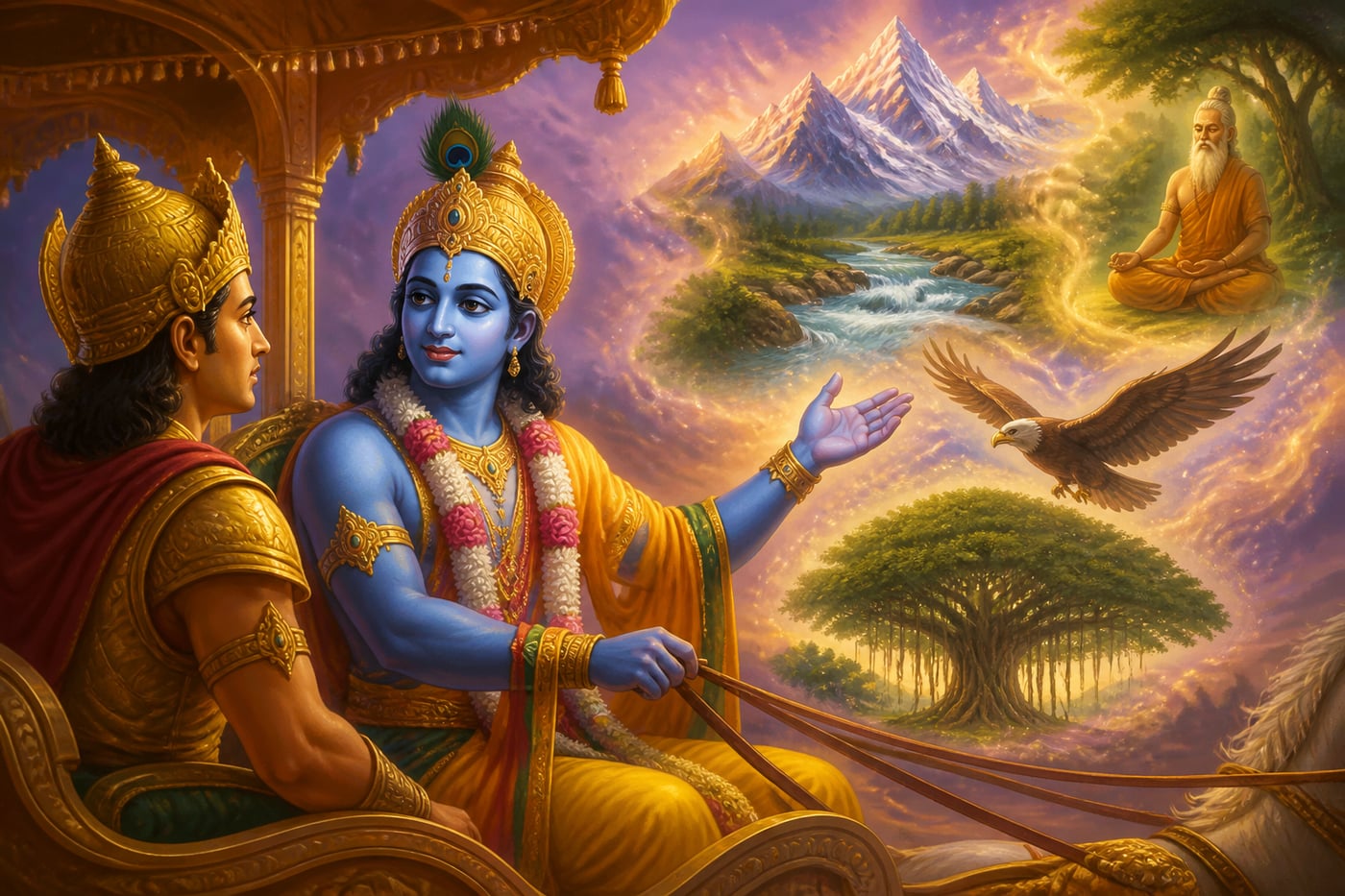
Krishna says: "Whatever is glorious, prosperous, or powerful, know that to spring from a spark of my splendor."
This transforms how we see everything:
- The scientist making a breakthrough? Vibhuti.
- The athlete at the peak of performance? Vibhuti.
- The artist creating something new? Vibhuti.
- The parent showing unconditional love? Vibhuti.
- The sunset painting the sky? Vibhuti.
The divine isn't hiding from us. It's everywhere, in everything excellent. Our job is to learn to see.

The Final Chapter: Everything Comes Together
Chapter 18, the final chapter, is called Moksha Sanyasa Yoga, the yoga of liberation through surrender. Here, Krishna brings all his teachings together.
He reviews the three gunas and how they affect knowledge, action, and understanding. He discusses duty (svadharma) and why following your own nature, even imperfectly, is better than imitating someone else's path perfectly.
And then comes the most intimate part of the entire Gita, Krishna's final words to his friend.
The Great Secret
Krishna says: "I shall tell you the greatest secret of all, because you are dear to me."
After eighteen chapters of philosophy, psychology, and practical guidance, what is this ultimate secret?
"Fix your mind on me. Be devoted to me. Sacrifice to me. Bow to me. Thus absorbed in me, surely you will come to me."
But Krishna immediately adds something crucial, he won't force anyone:
"Thus I have taught you wisdom more secret than any mystery. Reflect on it fully. Then do as you wish."
"Do as you wish." After all this teaching, Krishna respects Arjuna's freedom. The choice remains with the seeker.
Surrender and Action
The Gita's conclusion isn't passivity. It's not "give up and let God handle everything." Krishna's final instruction is about inner surrender combined with outer action:
"Abandoning all dharmas, take refuge in me alone. I shall liberate you from all sins, do not grieve."
"Abandoning all dharmas" doesn't mean abandoning all duties. It means releasing the anxiety about getting it perfectly right, the ego that thinks "I am the doer," the fear that you might fail.
Take refuge in the highest. Then act.
This is the Gita's synthesis: Knowledge to understand. Devotion to orient. Action to engage. All three, working together.
The Chariot Scene Concludes
Sanjaya, the narrator who has been describing this scene to the blind king Dhritarashtra, concludes with wonder:
"Wherever there is Krishna, the Lord of Yoga, wherever there is Arjuna, the wielder of the bow, there is fortune, victory, prosperity, and firm righteousness. This is my conviction."
The chariot still stands between the armies. The battle still awaits. But everything has changed. Arjuna has moved from despair to clarity, from confusion to conviction, from "I will not fight" to full readiness to act.

What changed? Not the circumstances. The circumstances remain exactly the same. What changed was Arjuna, his understanding, his orientation, his relationship to action and outcome.
The Gita's Gift to You
This course has covered the Gita's major teachings:
From Chapter 1: The acknowledgment that crisis can be a doorway to wisdom. Arjuna's despair opened him to receive teaching.
From Chapter 2: The indestructible Self beyond the body. Emotional steadiness (sthitaprajna) that comes from this knowledge.
From Chapter 3-5: Karma Yoga, acting without attachment to results. Work as worship. The secret of finding freedom while engaged in the world.
From Chapter 6-8: The discipline of meditation. The mind as friend and enemy. The power of consistent focus.
From Chapter 9-12: Devotion as the simplest path. The cosmic vision. The qualities of the true devotee.
From Chapter 13-17: The field and the knower. The three gunas and their role in everything. Divine versus demonic tendencies. The power of faith.
From Chapter 18: Everything integrated. Action-knowledge-devotion as one path. Surrender that enables right action.
Living the Gita
The Gita was never meant to be just studied, it was meant to be lived. Its setting on a battlefield reminds us that wisdom must face the test of real challenges.
You will face your own Kurukshetras. Moments when doing the right thing seems impossible. When you're pulled in multiple directions. When the easy path and the right path diverge.
In those moments, the Gita offers:
- Perspective: Remember who you are beyond the immediate situation.
- Framework: Understand the gunas operating in you. Choose the sattvic response.
- Practice: Act without obsessing about outcomes. Do your best and release.
- Refuge: Know that you're not alone. The wisdom that guided Arjuna is available to you.
The Universal Invitation
The Gita belongs to no one religion. It speaks to any seeker, anywhere, in any era. Its core message is timeless:
You are more than your body and circumstances. Action done with the right spirit is liberating. Devotion to something higher transforms everything. The divine is present in all excellence, learn to see.
Krishna's final promise stands for all time:
"Those who study this sacred dialogue between us, by them I shall be worshipped through the sacrifice of knowledge. And those who listen with faith, free from malice, they too shall be liberated and reach the happy worlds of the righteous."
The Gita doesn't demand perfect understanding. It asks only for openness: "Listen with faith, free from malice." Begin there. The rest unfolds.
The chariot still stands between two armies. The battle still awaits. But the warrior now sees with new eyes, acts from a different place, and carries within him the teaching that will guide seekers for thousands of years to come.
The Gita has been given. What will you do with it?
Case studies
Tagore's Universal Vision: Seeing Vibhuti Everywhere
Rabindranath Tagore (1861-1941) grew up immersed in the spiritual traditions of Bengal but refused to be limited by any single tradition. He saw divine beauty (vibhuti) in the songs of Bengali villagers, in the poetry of Persian mystics, in the spirituality of Christian devotees, in the philosophy of Japanese aesthetics, and in the simple play of children. When he wrote Gitanjali, the collection that would win the Nobel Prize in Literature, he drew from this universal vision. His school, Shantiniketan, was founded on the principle that education should recognize excellence wherever it appears, in science, art, nature, and human relationship. When asked his religion, he would say he belonged to the 'religion of man', the recognition of the divine in human creativity and connection.
Tagore embodied the Vibhuti Yoga teaching: 'Whatever is glorious, prosperous, or powerful, know that to spring from a spark of my splendor.' Where others saw boundaries between religions, cultures, and disciplines, Tagore saw variations of the same divine expression. His poem 'Where the Mind is Without Fear' envisions a world where 'knowledge is free' and the mind is 'led forward into ever-widening thought and action', essentially, a world that recognizes vibhuti everywhere. His criticism wasn't that people worshipped wrongly but that they worshipped too narrowly, missing the divine manifesting in unfamiliar forms.
Tagore became the first non-European Nobel laureate in literature. His songs became national anthems for two countries (India and Bangladesh). Shantiniketan grew into Visva-Bharati University, still dedicated to his vision of universal learning. But the deeper outcome was in consciousness: Tagore showed that you could be deeply rooted in one tradition while genuinely open to all others. His vision of vibhuti wasn't abstract philosophy, it was lived poetry, education, and relationship.
The vibhuti teaching isn't about labeling some things sacred and others profane. It's about developing eyes that see excellence as divine wherever it appears. Tagore didn't abandon his Bengali heritage to become 'universal', he went so deeply into his own tradition that he found the universal within it. This is the Gita's invitation: see the divine spark in all excellence, and the boundaries we've drawn begin to look very small.
In a polarized world where identity groups compete for moral authority, Tagore's universalism offers a powerful alternative. Appreciating excellence across cultures, disciplines, and traditions is not relativism. It is the recognition that the divine spark manifests in infinite forms. This perspective dissolves tribalism without erasing cultural roots.
Rabindranath Tagore (1861-1941) became the first non-European Nobel laureate in 1913 for Gitanjali. He composed over 2,230 songs (Rabindra Sangeet), two of which became national anthems: 'Jana Gana Mana' for India (adopted 1950) and 'Amar Shonar Bangla' for Bangladesh (adopted 1972). Visva-Bharati University, which he founded in 1921 at Shantiniketan, continues to operate as a central university with over 6,000 students.
The Integration: Maya's Year with the Gita
Maya was 30 when her life fell apart simultaneously: her startup failed, her relationship ended, and her father was diagnosed with a serious illness. A friend gave her the Bhagavad Gita, suggesting it might help. Maya was skeptical, she considered herself 'spiritual but not religious', but desperate enough to try anything. Over the next year, she didn't just read the Gita; she lived it, chapter by chapter, teaching by teaching, discovering that this ancient text spoke directly to her modern crisis.
Maya's journey through the Gita mirrored Arjuna's. In her initial despair (Chapter 1-2), she learned that she was more than her circumstances, the Self that watched her suffering wasn't destroyed by it. When she needed to act despite uncertainty (Chapters 3-5), karma yoga taught her to do her best without obsessing about outcomes. She couldn't control whether her father recovered or her next venture succeeded, but she could control how she showed up. When her mind spiraled (Chapters 6-8), she learned meditation, not as escape but as training in equanimity. When she felt alone (Chapters 9-12), bhakti showed her that surrendering to something larger than herself brought peace. When her character was tested (Chapters 13-17), she learned to recognize which gunas were operating and choose sattvic responses. And in the integration (Chapter 18), she found what Arjuna found: not answers to every question, but the clarity to act anyway.
By year's end, Maya's external circumstances weren't magically fixed. Her father's illness was managed but not cured. Her new venture was still uncertain. She hadn't found another relationship. But Maya herself had transformed. She faced each day from a different place, not the desperate reactivity of a year ago but a steadiness that surprised her. She had learned to see setbacks as part of the path (vibhuti in disguise), to act without anxiety about results, to surrender without giving up. The Gita hadn't solved her problems. It had changed her relationship to having problems.
The Gita's teachings aren't meant to be understood intellectually and filed away. They're meant to be applied to actual challenges, one by one, until they become how you see and act. Maya's story shows that the text works, not by removing difficulties but by transforming our relationship to them. The chariot still stands between the armies. The battle still awaits. But the warrior has been changed. This is the Gita's gift: not a different world, but different eyes and a different heart to meet the world you have.
Integrating philosophical or spiritual insight into daily life is the central challenge for anyone who reads, studies, or practices wisdom traditions. The gap between understanding a teaching intellectually and living it under pressure is where the real work happens. Maya's story mirrors the experience of anyone who has tried to apply ancient wisdom to modern chaos: it works, but only through sustained, honest engagement over time.
A 2021 study published in the Journal of Religion and Health found that individuals who engaged with a single spiritual text consistently over 12 months reported 31% lower perceived stress and 28% higher scores on psychological resilience measures. Research at the University of Pennsylvania showed that applying philosophical frameworks to real-life challenges, rather than reading them passively, activated prefrontal cortex regions associated with executive function 2.4 times more strongly.
Living traditions
The Bhagavad Gita has become required reading in many Indian schools and is increasingly studied in Western universities. Management schools use it to teach leadership and ethics. Psychologists reference it for its insights into motivation and mental discipline. The Gita's influence extends far beyond religious practice: it shapes business ethics, political philosophy, and personal development worldwide. Its teachings on action without attachment, on seeing the divine in all excellence, and on integrating knowledge, devotion, and action remain as relevant today as when Krishna spoke them to Arjuna.
- Jyotisar, Kurukshetra: The sacred spot where Krishna is believed to have delivered the Gita to Arjuna. An ancient banyan tree marks the location where the chariot stood. A marble chariot with Krishna and Arjuna has been installed. The site is the most important pilgrimage for Gita devotees.
- Gita Press: The world's largest publisher and printer of Hindu texts. Since 1923, Gita Press has distributed over 410 million copies of the Gita and related texts at heavily subsidized prices, making the teaching accessible to millions. Visitors can see the printing operations and browse the bookshop.
Reflection
- Where in your life do you see vibhuti, excellence that could be recognized as a spark of the divine? How might recognizing more vibhuti change your daily experience?
- What does it mean to 'abandon all dharmas' and 'take refuge' while still acting fully in the world? How is this different from either giving up or trying harder?
- The Gita ends with Krishna saying 'do as you wish.' After all that teaching, why does he preserve Arjuna's freedom? What does this say about the nature of spiritual guidance?