Shraddha: Faith Makes the Person
How belief shapes action
What you believe about yourself and the world shapes how you act. Krishna explains three types of faith - sattvic, rajasic, and tamasic - and how our beliefs influence everything from what we eat to how we worship to what we pursue in life.
Faith Makes the Person: You Become What You Believe
The Question of Faith
Arjuna begins Chapter 17 with a curious question. He's noticed that people worship differently, some follow scripture, others follow their own inclinations. What's the status of faith that doesn't match the traditional rules?
Krishna's answer transforms our understanding of faith entirely. He doesn't say "Only one way is correct." Instead, he reveals something profound: your faith is determined by your nature, and in turn, your faith shapes your nature.
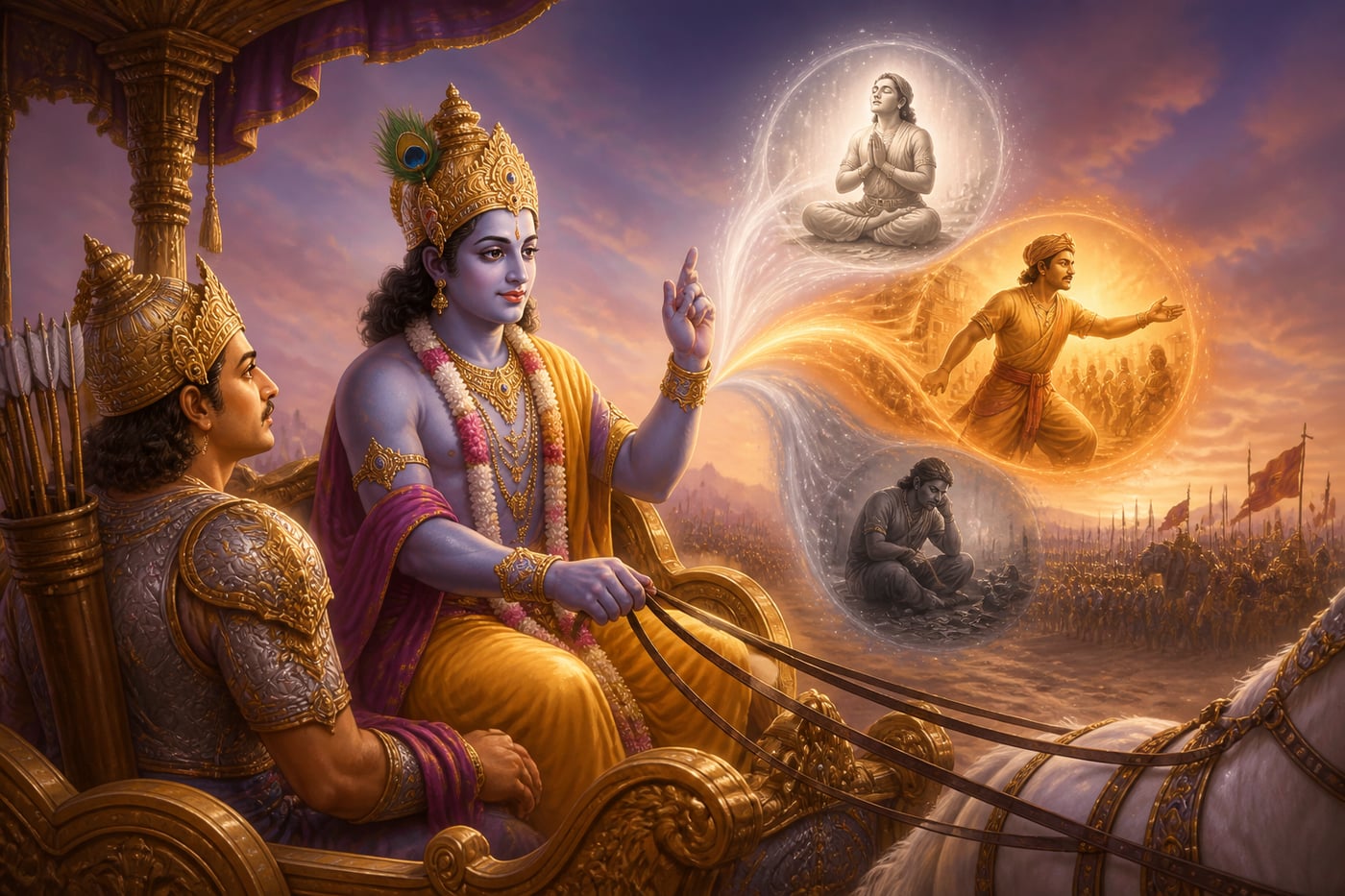
"The faith of each person, O Bharata, conforms to their own nature. A person is made of faith, whatever their faith, that indeed they are."
This is revolutionary. Krishna is saying: You are your faith. What you believe about yourself, about life, about what matters, this isn't just an opinion you hold. It's the lens through which you experience everything, and it actively creates who you become.
The Three Types of Faith
Just as everything else can be understood through the three gunas, faith too comes in three flavors:
Sattvic Faith is directed toward truth, knowledge, and the highest. Those with sattvic faith worship what is pure, clear, and elevating. They're drawn to teachers who embody wisdom, to practices that develop character, to goals that serve the greater good. Their faith says: "There is meaning. Growth is possible. Truth is worth pursuing."
Rajasic Faith is directed toward power, success, and acquisition. Those with rajasic faith worship what brings results, deities who grant boons, practices that promise worldly rewards. Their faith says: "Achievement is everything. Success validates me. More is better." It's not false faith, but it's limited. It keeps them running on the wheel.
Tamasic Faith is directed toward the dark, the destructive, the degraded. Those with tamasic faith may worship spirits of harm, may be drawn to nihilistic beliefs, may have faith in nothing at all (which is itself a kind of faith). Their faith says: "Nothing matters. There are no consequences. Whatever feels good in the moment is enough."
Notice that all three types have faith. The question isn't whether you believe, but what you believe and how that shapes your life.
Faith Shapes Everything
Krishna applies this three-fold analysis to multiple aspects of life, showing how faith expresses itself:
In Food: Those with sattvic faith prefer foods that increase life, vitality, strength, health, happiness, fresh, light, nourishing, natural. Those with rajasic faith prefer foods that are bitter, sour, salty, hot, sharp, stimulating but ultimately agitating. Those with tamasic faith prefer foods that are stale, tasteless, putrid, leftover, foods that dull the mind and body.
In Sacrifice/Practice: Sattvic practice is done for the practice itself, without desire for reward, with focused attention. Rajasic practice is done for show, for results, or with expectation of praise. Tamasic practice is done without proper attention, carelessly, without genuine commitment.
In Giving: Sattvic giving happens when it's the right thing to do, to the right recipient, with no expectation of return. Rajasic giving happens with strings attached, expecting gratitude, recognition, or future favors. Tamasic giving is given disrespectfully, to the wrong recipients, or at inappropriate times.
In Austerity: Sattvic austerity of body, speech, and mind is practiced with faith and balance, not for show but for genuine development. Rajasic austerity is practiced for reputation, honor, or admiration, impressive but unstable. Tamasic austerity is practiced through self-torture or with the intent to harm others, mistaking pain for progress.
The Power of "Om Tat Sat"

Krishna introduces a powerful three-word mantra that represents the highest reality: "Om Tat Sat."
Om has been the eternal sound symbolizing ultimate truth since the Vedas.
Tat means "That", pointing beyond all names and forms to the absolute.
Sat means "Truth" or "Being", reality itself, as opposed to illusion.
These three words are invoked at the beginning of sacred actions, sacrifices, and austerities. They serve as a reminder: whatever we do, we do in connection with something larger than our small selves.
"With the utterance of 'Tat,' without seeking reward, acts of sacrifice, austerity, and charity are performed by seekers of liberation."
The purpose isn't magical, it's psychological and spiritual. By invoking the absolute, we loosen our grip on ego and results. We remind ourselves why we're really doing this.
Why Faith Matters So Much
Your faith is like the operating system of your life. It runs in the background, shaping how you interpret every experience:
If you believe "people are fundamentally selfish," you'll interpret kindness as manipulation, find evidence for selfishness everywhere, and eventually become more self-protective yourself, which others will interpret as selfishness, confirming their beliefs about you.
If you believe "growth is always possible," you'll interpret setbacks as learning opportunities, seek out challenges, and gradually develop abilities that justify your faith.
If you believe "nothing I do matters," you'll find yourself unable to commit to anything, drifting through life, confirming that indeed, nothing matters.
Faith creates feedback loops. We find evidence for what we believe, and that evidence strengthens the belief. This can trap us in downward spirals, or lift us in upward ones.
Examining Your Own Faith
The Gita invites self-examination: What is your actual operating faith? Not what you say you believe, but what your actions reveal you believe?
Look at how you spend your time. That reveals what you truly value.
Look at what you worry about. That reveals what you truly fear.
Look at what you pursue. That reveals what you truly believe will bring fulfillment.
Often we discover a gap between professed faith and lived faith. We might say we believe in spiritual growth, but spend all our energy pursuing material success. We might say we believe in compassion, but treat service workers with impatience.
This isn't hypocrisy (or not just hypocrisy), it's often unconscious. We inherit beliefs from family and culture. We absorb beliefs from media and peers. We may not even know what we believe until we examine our lives.
Upgrading Your Faith
Here's the empowering part: faith can be changed. You're not stuck with the operating system you were born with.
The first step is awareness, seeing what you actually believe. The second is questioning, is this belief serving me? Is it true? The third is practice, deliberately acting from a new belief until it becomes your actual faith.
Krishna's teaching suggests a direction: move from tamasic faith toward rajasic, from rajasic toward sattvic, and ultimately beyond all three toward the absolute (Om Tat Sat).
This doesn't happen overnight. Faith runs deep. But every choice either reinforces old patterns or creates new ones. Every time you choose to act from sattvic faith, even when it doesn't come naturally, you're reprogramming your operating system.
Faith and Freedom
The Gita's ultimate message about faith is liberating. You are not merely a victim of your conditioning. You have the capacity to examine your beliefs, to test them against reality, to upgrade them consciously.
This is what makes humans different from animals. A tiger can't question whether hunting is the right way to live. A bee can't wonder if there's more to life than the hive. But you can step back, look at the faith you've been living by, and ask: Is this the faith I want to hold? Is this taking me where I want to go?
Krishna's teaching doesn't impose a particular faith. It invites awareness of faith itself. From that awareness, choice becomes possible. And from choice, transformation.
You are your faith, not the faith you profess, but the faith you live. The Gita invites you to discover what you truly believe, and to consciously choose the beliefs that serve your highest nature.
Case studies
Vivekananda's Faith in India: Belief That Moved Mountains
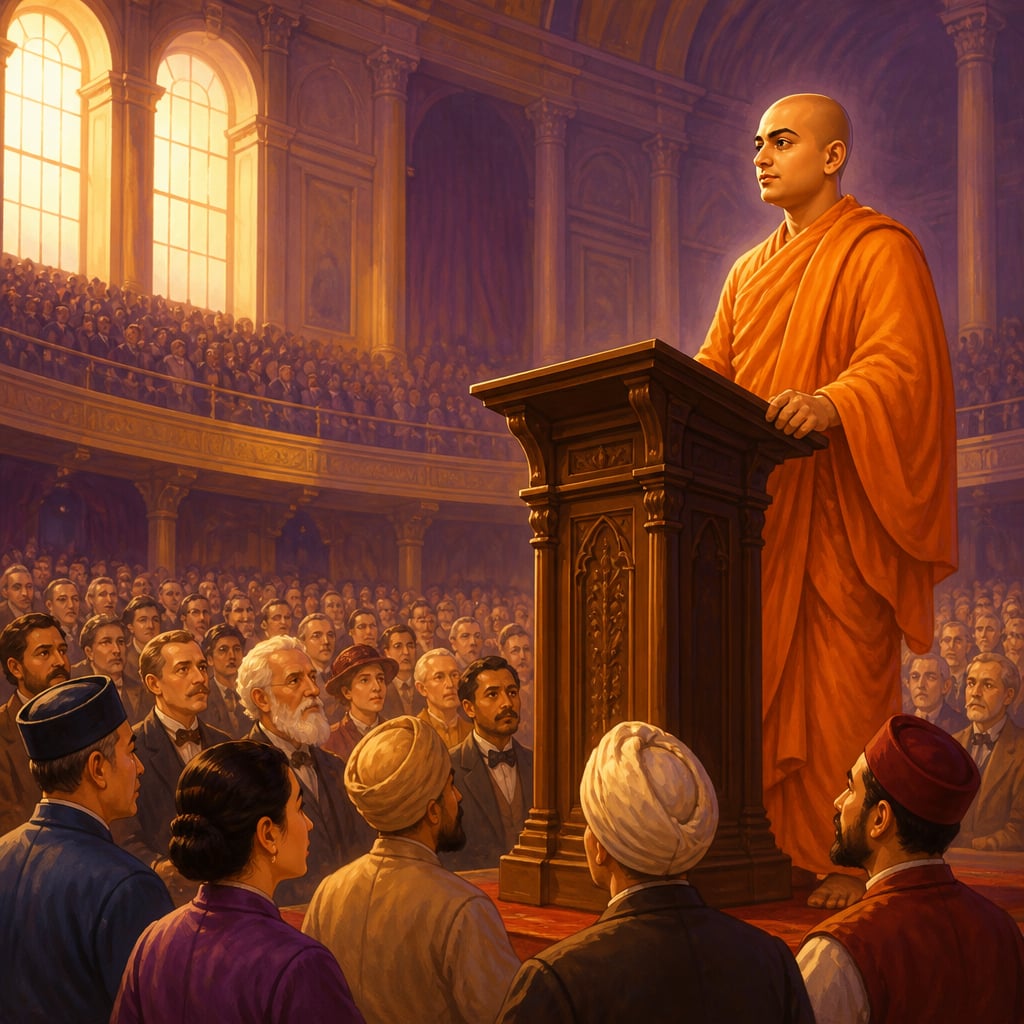
In 1893, a young, unknown monk from India arrived in Chicago for the Parliament of the World's Religions. Swami Vivekananda had no invitation, no money, and no contacts. He spent nights in railway cars and on the streets. Many would have given up. But Vivekananda carried an unshakeable shraddha, not just in himself, but in India's spiritual message for the world. He believed, with every fiber of his being, that the ancient wisdom of his land could address the spiritual crisis of modernity. When he finally spoke at the Parliament, beginning with 'Sisters and Brothers of America,' he electrified the audience. But more remarkable than his oratory was the decades of work that followed, building institutions, inspiring millions, transforming how the world saw India and how India saw itself.
Vivekananda's life demonstrates sattvic shraddha in its purest form. His faith wasn't in personal success or recognition (that would be rajasic) but in truth itself, the truth of Vedantic wisdom and India's potential to share it. This faith didn't come from external validation; it preceded and created that validation. Notice how his shraddha shaped his perception: where others saw a backward, colonized nation, he saw a spiritual superpower temporarily obscured. Where others saw poverty and illiteracy, he saw potential waiting to be awakened. His faith wasn't blind, he was painfully aware of India's problems, but it was directed toward what could be rather than trapped in what was.
Vivekananda died at 39, having accomplished more than most do in multiple lifetimes. The Ramakrishna Mission he founded continues his work across the globe. His vision of India contributed to the independence movement and shaped modern Indian identity. But the deepest outcome was in the minds he touched. Countless people, hearing him, discovered that they too could hold sattvic faith, in their own potential, in truth, in the possibility of transformation. His shraddha became contagious.
Faith creates reality, not through magical thinking but through shaping perception and action. Vivekananda didn't wish India into greatness; he saw the greatness already present and worked tirelessly to manifest it. Sattvic shraddha isn't naive optimism, it's the deep conviction that truth and goodness are real, worth pursuing, and ultimately triumphant. This conviction generates the energy to keep working even when external evidence seems discouraging.
In an era of cynicism and institutional distrust, sattvic faith, the conviction that meaningful work matters and truth eventually prevails, is increasingly rare and increasingly valuable. Entrepreneurs, teachers, activists, and artists who sustain effort through years of uncertain results are drawing on the same quality Vivekananda embodied. Deep conviction is not the same as blind optimism. It is the foundation that sustains action when results are not yet visible.
Swami Vivekananda's address at the Parliament of the World's Religions on September 11, 1893, began with 'Sisters and Brothers of America,' receiving a two-minute standing ovation from 7,000 attendees. He died on July 4, 1902, at age 39. The Ramakrishna Mission he founded in 1897 now operates 205 centers across 23 countries, running 15 hospitals, 112 dispensaries, and 625 educational institutions.
Rahul's Career Crossroads: Three Types of Faith
Rahul was 28, working at a well-paying corporate job he found meaningless. Every Sunday evening, dread filled him. His real passion was environmental education, teaching children to understand and protect nature. He'd done volunteer work and felt alive in ways his corporate job never touched. The opportunity came: a position at an environmental nonprofit. The pay was 60% of his current salary. His parents were horrified. 'You'll regret this,' his father said. 'This is irresponsible,' his mother added. His girlfriend asked, 'What about our plans?' Friends called it a 'midlife crisis at 28.' Rahul found himself paralyzed, hearing three voices in his head, each representing a different kind of faith.
The three voices Rahul heard map directly onto the three types of shraddha. The tamasic voice said: 'Nothing really matters anyway. Stay where you are. Change is too hard. You'll probably fail at the new job too.' It counseled inaction and despair. The rajasic voice said: 'The only smart move is to maximize income. Success means money and status. What will people think if you take a pay cut? You need to keep climbing.' It defined faith in terms of external achievement. The sattvic voice said: 'What is true? What is your dharma? What contribution can you make that only you can make? Trust that following your genuine path will work out, even if you can't see how.' It pointed toward meaning over security, growth over comfort.
Rahul took the environmental education job. The first year was hard, financial adjustment, family disappointment, moments of doubt. But something happened that surprised him: he started succeeding in ways he never had before. The passion he brought made him exceptional. Within three years, he was leading programs, speaking at conferences, making impact he never could have made in his corporate role. His income eventually exceeded his old salary. More importantly, Sunday evenings no longer filled him with dread. He had discovered that sattvic faith, while scary to act on, connects you to energy and ability that fear-based or status-based faith cannot access.
We usually have multiple faiths operating simultaneously, the question is which one we act from. Tamasic faith counsels staying stuck; rajasic faith counsels chasing external markers; sattvic faith counsels following truth and growth. All three may 'make sense' from their perspective. The choice reveals and creates who we are. Rahul's story shows that acting from sattvic shraddha, while initially frightening, often unlocks abilities and opportunities that fear-based choices never could.
Career dissatisfaction affects nearly half the global workforce, yet most people default to tamasic or rajasic responses: either staying stuck out of fear, or chasing the next title and salary bump hoping it will feel different. The sattvic alternative, aligning work with genuine values and accepting the uncertainty that comes with it, is gaining recognition in career coaching as the path most likely to produce lasting fulfillment.
A 2020 Deloitte Global Millennial Survey found that 49% of millennials who had the choice would quit their jobs within two years, citing lack of purpose as the primary reason. Research published in the Journal of Positive Psychology (2019) showed that individuals who made values-aligned career transitions reported 38% higher psychological well-being after 2 years, despite an average initial salary decrease of 15 to 25%.
Living traditions
The teaching on shraddha has influenced modern Indian psychology and self-help movements. 'Believe and you can achieve' formulations derive from this teaching, though often stripped of nuance. Corporate India increasingly incorporates shraddha concepts in leadership training. The connection between belief and performance is now standard in sports psychology, with athletes taught to cultivate sattvic faith in their ability. The three types of faith provide a framework for understanding motivation in education, therapy, and organizational behavior.
- Ramakrishna Mission Headquarters: Founded by Swami Vivekananda, this is the headquarters of the organization that embodies sattvic shraddha in action. The temple uniquely incorporates Hindu, Christian, and Islamic architectural elements, reflecting Vivekananda's faith in the unity of all religions. Study programs explore the Gita's teaching on shraddha.
- Kashi Vishwanath Temple: One of the holiest sites in Hinduism, where 'Om Tat Sat' is constantly invoked. The temple atmosphere embodies the concentration of shraddha, millions of believers over thousands of years have directed their faith here, creating a palpable sense of the sacred.
Reflection
- What does your behavior, how you spend time, what you worry about, what you pursue, reveal about your actual operating faith?
- What does it mean that 'a person is made of faith'? How can faith be who you ARE rather than something you HAVE?
- If everyone is 'made of faith' and faith shapes reality, is there any objective truth, or is everything relative to one's faith?