Sampada: Light and Shadow
Divine and demonic tendencies
Krishna lists qualities that lead to freedom (divine) and bondage (demonic). But here's the key: these aren't about good vs bad people - everyone has both tendencies. The question is which we choose to feed.
Light and Shadow: The Tendencies Within Us
Two Paths, One Person
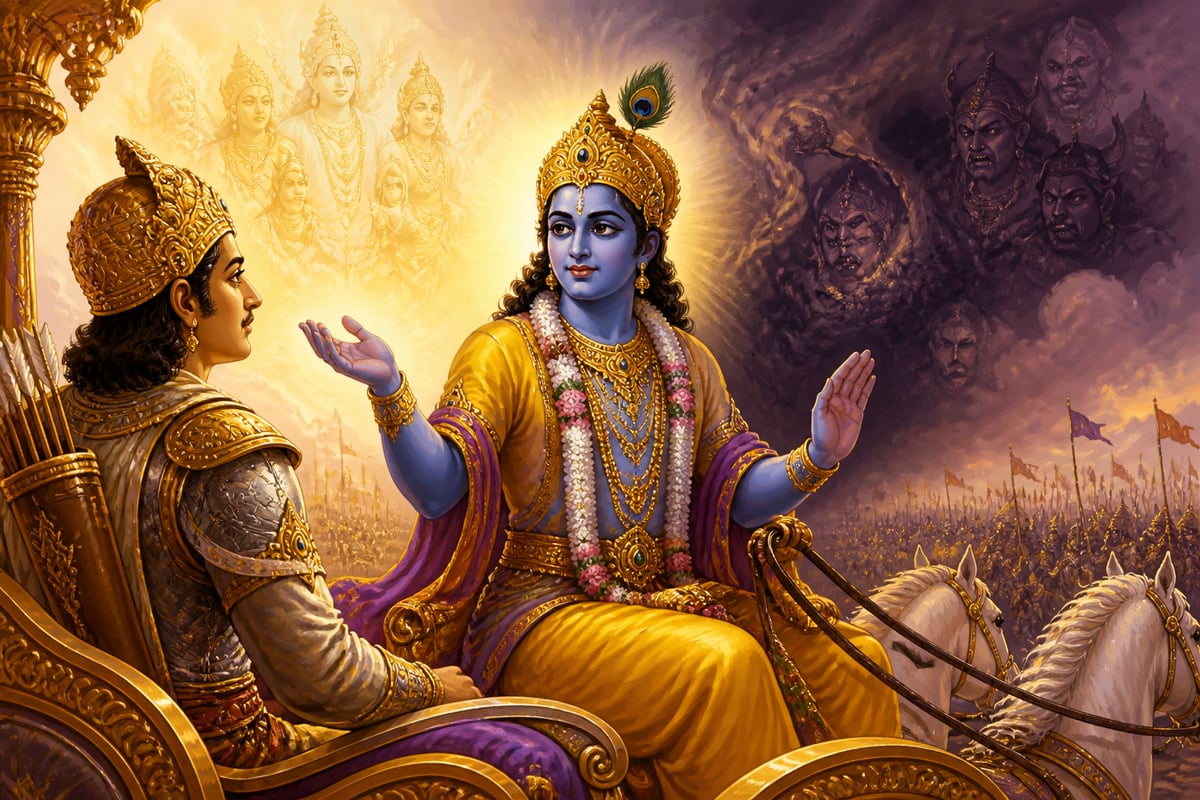
Krishna begins Chapter 16 with a dramatic contrast. He lists two sets of qualities, one leading to freedom, one leading to bondage. But before you think this is about labeling people as "good" or "evil," listen carefully to what he says.
"The divine qualities lead to liberation, Arjuna. The demonic qualities lead to bondage. Do not grieve, you are born with divine destiny."
The teaching isn't about dividing humanity into saints and sinners. It's about recognizing tendencies, forces that pull us in different directions. Everyone has both. The question is: which do we strengthen?
The Twenty-Six Divine Qualities
Krishna lists twenty-six qualities that constitute "daivi sampada", the divine inheritance:
Fearlessness heads the list. Not recklessness, but the courage that comes from inner security. The person who knows their true Self has nothing fundamental to lose.
Purity of heart follows, clarity of intention, freedom from hidden agendas. What you see is what you get.
Steadfastness in knowledge and yoga, commitment to growth, not as occasional inspiration but as daily practice.
Charity, giving freely, without calculating return.
Self-control, not suppression, but mastery. The ability to choose your response rather than react automatically.
Sacrifice, study, austerity, the willingness to give up lesser pleasures for greater goods.
The list continues: non-violence, truthfulness, freedom from anger, renunciation, peacefulness, compassion for all beings, freedom from greed, gentleness, modesty, absence of fickleness...
Vigor, forgiveness, fortitude, cleanliness, freedom from malice, freedom from pride complete the picture.
Notice what's included. These aren't supernatural powers or mystical experiences. They're character qualities anyone can develop. They're also not about withdrawing from life, vigor and fortitude are there alongside gentleness and peace.
The Demonic Qualities
The asuric (demonic) qualities are fewer but potent:
Hypocrisy, pretending to be what you're not.
Arrogance, believing you're better than others, that rules don't apply to you.
Pride, anger, harshness, ignorance, the cluster that feeds on itself.
Krishna describes the asuric mindset: "The world is without truth, without foundation, without God. It arises from desire alone."
The demonic view is that there's no meaning, no order, no consequences beyond what you can see. Therefore, grab what you can. Power is the only reality. Manipulation is just smart strategy.
"Bound by a hundred cords of hope, given over to desire and anger, they strive to accumulate wealth by unjust means for the gratification of their desires."
The tragedy Krishna describes isn't supernatural punishment. It's the natural result of these tendencies: "Deluded birth after birth, they never reach me, and thus sink to the lowest state."
The Three Gates of Destruction
Krishna identifies three qualities as particularly dangerous, the "triple gate of hell":

Kama (Desire/Lust), not ordinary preferences, but the desperate craving that says "I must have this or I'll be miserable."
Krodha (Anger), the rage that arises when desire is frustrated. "How dare this obstacle exist!"
Lobha (Greed), the drive to accumulate beyond all reasonable need, the hoarding impulse that's never satisfied.
These three feed each other. Desire frustrated becomes anger. Anger justified becomes greed ("I'll take what I deserve since no one gives it to me"). Greed intensifies desire. The spiral deepens.
"Therefore," Krishna advises, "one should abandon these three. Freed from these gates of darkness, one practices what is beneficial for the soul and thus reaches the highest goal."
This Isn't About Labeling People
Here's where many readers go wrong. They use these categories to judge others: "He's so asuric!" "She's clearly divine."
But the teaching is for self-examination, not other-condemnation. Krishna is talking to Arjuna about Arjuna's own tendencies. The question isn't "Who around me is demonic?" but "Which tendencies am I feeding in myself?"
In fact, the truly divine person doesn't go around labeling others as demonic. That would violate several qualities on the divine list: freedom from pride, freedom from malice, compassion for all beings.
Everyone Has Both
The most honest reading of this chapter recognizes that everyone carries both inheritances. There are moments when you act from fearlessness and compassion. There are moments when you act from anger and greed.
The person who says "I have only divine qualities" is displaying the demonic quality of self-delusion. The person who despairs "I have only demonic qualities" is missing the point that tendencies can be transformed.
The Gita's psychology is developmental. You're not fixed in a category. What you practice, you strengthen. What you neglect, you weaken. Every choice is a vote for which direction you'll go.
Recognizing the Tendencies
How do you know which tendency is operating? Some signs:
Divine tendencies feel like:
- Expansion, openness, connection
- "What's best for everyone?"
- Willingness to be wrong
- Calm even in difficulty
- Acting from fullness rather than lack
Demonic tendencies feel like:
- Contraction, defensiveness, separation
- "What can I get?"
- Certainty that you're right
- Reactivity, especially anger
- Acting from fear or craving
The body often knows before the mind. Divine actions feel lighter afterward; demonic actions leave a heaviness, even if they "succeed."
The Courage to Choose
The deepest teaching here is about choice. Krishna doesn't say "You were born divine or demonic, deal with it." He says "These are tendencies. Strengthen the ones that lead to freedom."
This requires honesty. You have to see your own demonic tendencies without defending them. That's uncomfortable.
It also requires compassion, for yourself. Everyone struggles. The fact that anger arose doesn't make you evil. It makes you human. The question is what you do next.
And it requires practice. The divine qualities are called "sampada", wealth, inheritance. But like any inheritance, they need to be claimed and cultivated. Fearlessness grows through facing fears. Compassion grows through practicing compassion. These aren't permanent traits you either have or don't; they're muscles that strengthen with use.
The Battlefield Within
Arjuna stands on a literal battlefield, but the Gita's deeper message is about the inner battle. The armies arrayed against each other, Pandavas and Kauravas, dharma and adharma, exist within every human heart.
Every day brings choices: Truth or convenient lie? Kindness or irritation? Generosity or hoarding? Courage or cowardice? These aren't dramatic one-time decisions but small moments that accumulate into character.
Krishna's teaching gives us a map. It names the tendencies so we can recognize them. It shows where each path leads. And it promises that the divine inheritance is always available, waiting to be claimed by anyone willing to practice.
The Gita doesn't divide humanity into good and evil. It shows every human the good and evil within themselves, and invites the choice toward light.
Case studies
Vibhishana's Choice: Dharma Over Dynasty
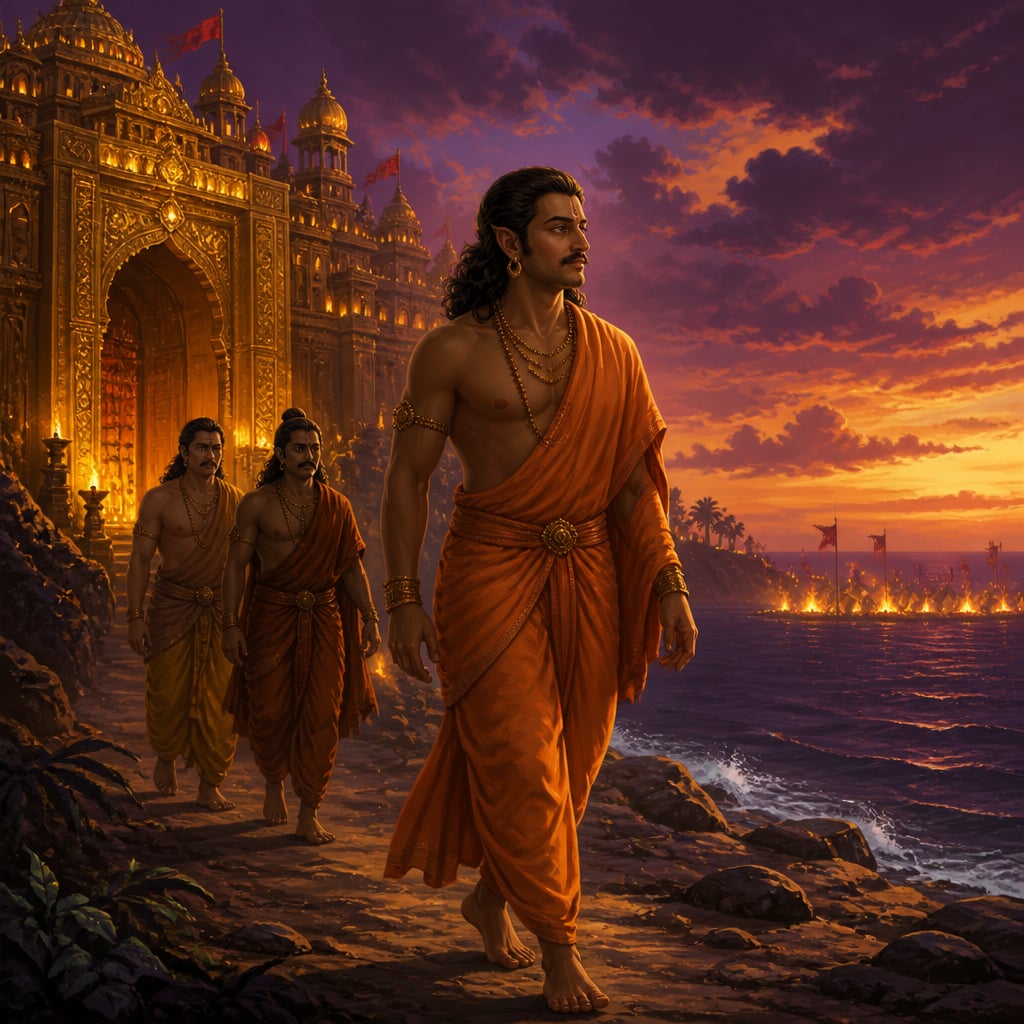
In the Ramayana, Vibhishana was the younger brother of Ravana, the king of Lanka. Unlike his brother, Vibhishana was drawn to dharma, truth, and righteousness. When Ravana abducted Sita and war with Rama became inevitable, Vibhishana faced an impossible choice. He repeatedly counseled Ravana to return Sita and avoid destruction. 'Brother,' he said, 'what you have done is adharma. Return the lady honorably. No good can come from this path.' Ravana responded with rage, calling Vibhishana a traitor and ordering him out of Lanka. Vibhishana then made the stunning decision to leave his family, his homeland, and his royal status to join Rama's side.
Vibhishana's story perfectly illustrates the Gita's teaching on divine versus demonic qualities. He possessed the daivi sampada: fearlessness (to speak truth to power), truthfulness (acknowledging his brother's wrong), compassion (concern for the consequences to Lanka), and renunciation (giving up his position for dharma). Ravana embodied asuri sampada: arrogance (believing he was beyond consequences), anger (at being challenged), and the trio of kama-krodha-lobha that drove his actions. Vibhishana's choice wasn't about personal benefit, joining the 'winning side.' When he left Lanka, Rama's army of monkeys seemed no match for Ravana's might. His choice was about alignment with dharma, regardless of outcome.
After the war, Rama crowned Vibhishana as the righteous king of Lanka. But the deeper outcome was inner: Vibhishana could live with himself. He hadn't been complicit in adharma. Tradition honors him not as a traitor but as an exemplar of the principle that dharma transcends family and nation. His name has become synonymous with moral courage in Indian culture.
Sometimes the divine path requires leaving what's familiar and comfortable. Recognizing demonic tendencies in our environment, even in people we love, doesn't mean hating them. It means being clear about what we will and won't participate in. Vibhishana never stopped loving his brother. He simply couldn't be part of his brother's adharma.
Leaving a toxic workplace, distancing from a destructive friendship, or setting boundaries with family members who enable harmful behavior all mirror Vibhishana's choice. The hardest part is not recognizing the dysfunction. It is accepting that love for someone does not require participation in their destructive patterns. You can care for people without enabling them.
The Ramayana recounts that Vibhishana counseled Ravana three times to return Sita before defecting to Rama's side. In the Valmiki Ramayana (Yuddha Kanda), Vibhishana's strategic intelligence about Lanka's defenses proved critical to Rama's victory. After the war, Rama crowned Vibhishana king of Lanka, establishing a dharmic rule that multiple Puranic texts describe as lasting for an entire yuga cycle.
The Whistleblower's Dilemma: Priya's Choice
Priya, a mid-level manager at a pharmaceutical company, discovered that her company was burying clinical trial data showing dangerous side effects of a popular drug. Senior leadership knew but chose to continue selling because the drug was highly profitable. The affected patients were mostly in developing countries with weak regulatory oversight. Priya faced a choice: stay silent and keep her well-paying job (she had student loans and aging parents to support), quietly leave and let someone else deal with it, or blow the whistle knowing it could destroy her career in the industry. Her colleagues who knew hinted she should 'not be naive' and 'think about her future.' Her boss suggested her concerns were 'overblown' and that she was 'not seeing the full picture.'
Priya's dilemma maps directly onto the Gita's framework. The pressure to stay silent activated asuric tendencies: fear (of job loss, career damage), lobha (protecting her income), and the temptation toward dambha (hypocrisy, appearing ethical while knowing about harm). The path of speaking out required daivi qualities: abhaya (fearlessness), satya (truthfulness), and daya (compassion for unknown patients). The colleagues advising silence weren't evil, they were caught in the same asuric pull. The Gita's teaching isn't that such choices are easy but that they reveal and strengthen character. Every moment of staying silent would strengthen the asuric tendencies; every step toward truth would strengthen the daivi ones.
Priya documented everything carefully and contacted a journalist specializing in pharmaceutical investigations. The story broke six months later. The company faced massive fines and recalls. Priya was blacklisted by several companies in the industry but eventually found work with a regulatory agency. More importantly, she could look at herself in the mirror. The patients in those developing countries, thousands of them, were spared continued harm. Years later, Priya said the hardest part wasn't the career consequences but the initial decision. Once she chose, everything became clearer.
The divine and demonic tendencies aren't just philosophical categories, they're live options in our professional and personal lives. 'Playing it safe' often means feeding the asuric qualities of fear and self-protection. The daivi path isn't guaranteed to succeed materially, but it preserves something more valuable: integrity. Notice: Priya didn't act from anger or desire for revenge. She acted from compassion and truthfulness. That's how you know the action is daivi rather than just differently asuric.
Whistleblower protections exist in many countries, yet the personal cost of reporting corporate wrongdoing remains enormous. The pattern in every whistleblower story is the same: a moment arrives when staying silent requires actively betraying your own values. The daivi-asuri framework helps clarify that moment. When safety demands dishonesty, the path of integrity is the path of courage.
The National Whistleblower Center reports that whistleblower cases have recovered over $75 billion in fraud since 1986 under the U.S. False Claims Act. A 2020 study in the Journal of Business Ethics found that 84% of pharmaceutical whistleblowers experienced significant personal cost, yet their disclosures prevented an estimated 22,000 adverse patient events. India enacted the Whistleblowers Protection Act in 2014.
Living traditions
The daivi-asuri framework is taught in leadership programs across India, including at IIMs. The 'triple gate' teaching (kama-krodha-lobha) is referenced in anger management and addiction recovery programs. Dussehra celebrations increasingly emphasize the inner meaning, burning one's own negativities rather than just enjoying the spectacle. Corporate ethics trainings cite Vibhishana as an ancient example of whistleblower courage.
- Vibhishana Temple, Kelaniya: One of the few temples dedicated to Vibhishana, honoring him not as a traitor but as an exemplar of dharma over dynasty. The site commemorates his moral courage in choosing righteousness over family loyalty to adharma.
- Rishikesh Gita Bhawan: A center dedicated to Gita study, with special programs exploring the psychology of Chapter 16. The ashram environment supports the cultivation of sattvic qualities discussed in the text.
Reflection
- Looking at the list of divine qualities, which three are strongest in you? Which three do you most need to develop?
- Why does Krishna name hypocrisy (dambha) first among the demonic qualities? What makes pretending to be what you're not so destructive?
- If everyone has both divine and demonic tendencies, what makes someone predominantly one or the other? Is it nature, choice, circumstance, or something else?