Triguna: The Three Qualities

Sattva, Rajas, Tamas in daily life

Everything in nature - including our moods, food choices, and actions - can be understood through three qualities: sattva (clarity), rajas (activity), and tamas (inertia). Understanding these helps us make better choices about how we live.

The Three Qualities: Understanding What Drives Us

The Hidden Forces Behind Everything

Imagine you could see invisible threads running through everything, your morning mood, the food you crave, the music you choose, even the way you study. According to the Gita, these threads exist, and they're called the three gunas.

Krishna tells Arjuna something remarkable: all of nature, including human nature, is woven from three fundamental qualities. Understanding these three strands helps us understand ourselves, and gives us power to change.
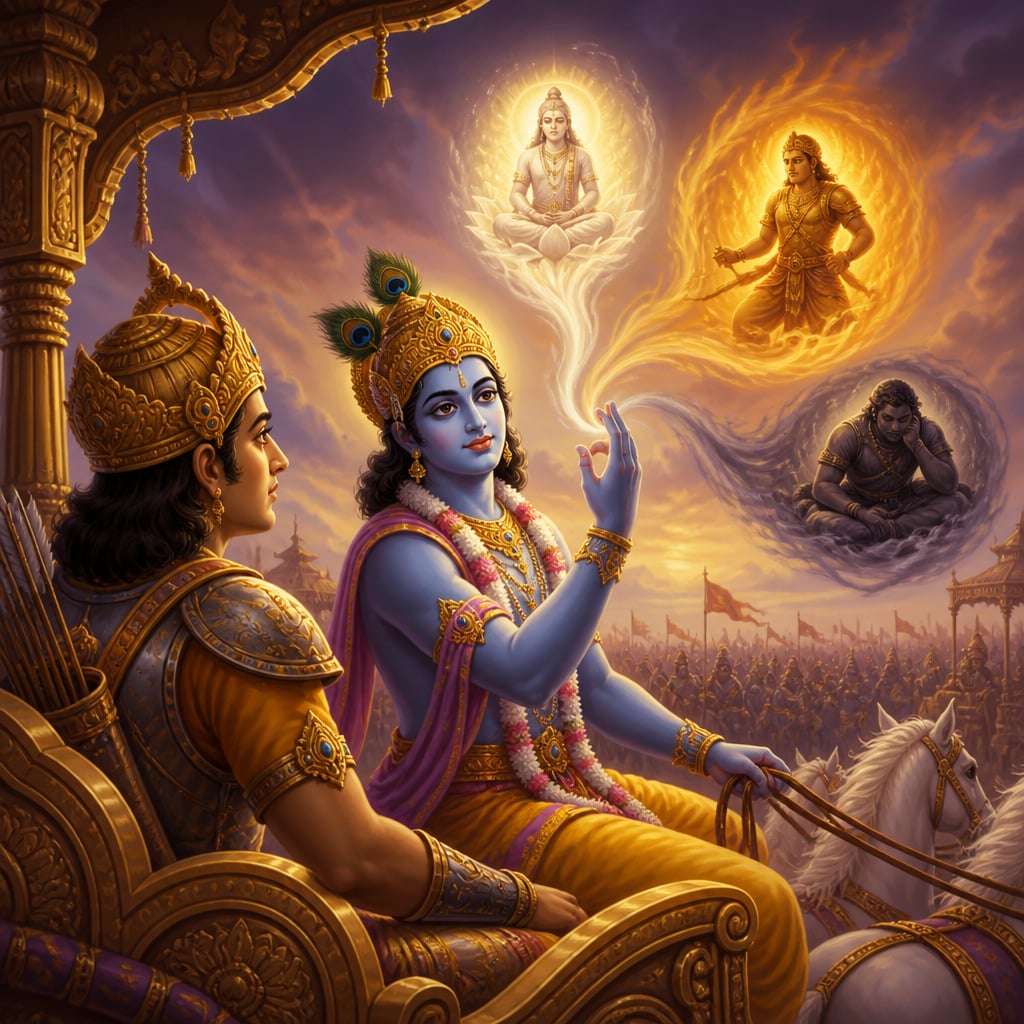
Krishna teaching Arjuna the three gunas from the chariot

What Are the Three Gunas?

Allegory of the three gunas as sattvic sage, rajasic warrior, and tamasic figure

Think of the gunas like three colors that mix in different proportions to create every shade of human experience:

Sattva is like clear light. It's the quality of clarity, balance, and understanding. When sattva dominates, you feel calm, focused, and at peace. You can think clearly. You want to learn, to help others, to do what's right. A sattvic morning feels like waking up refreshed, ready to engage with the day.

Rajas is like fire. It's the quality of activity, passion, and restlessness. When rajas dominates, you're energized but also agitated. You want to achieve, acquire, compete. A rajasic state drives you to action, but also to anxiety. You might study hard, but you're checking your phone every five minutes.

Tamas is like darkness or fog. It's the quality of inertia, dullness, and confusion. When tamas dominates, you feel heavy, unmotivated, unclear. You know you should get up, but you can't. You scroll through social media without really seeing anything. The world feels dim.

The Surprising Truth: All Three Bind Us

Here's what surprises most people: Krishna says all three gunas are binding. Not just tamas and rajas, even sattva.

"Sattva binds through attachment to happiness," Krishna explains. "Rajas binds through attachment to action. Tamas binds through heedlessness."

Think about this. Someone in a sattvic state might become attached to their clarity, their spiritual progress, their feeling of being a "good person." They might look down on others who struggle. Even the best quality becomes a trap when we cling to it.

The goal isn't to maximize sattva forever. It's to eventually transcend all three, to become what Krishna calls "gunatita," one who has gone beyond the qualities.

Recognizing the Gunas in Daily Life

The gunas aren't abstract philosophy, they're completely practical. Once you learn to recognize them, you see them everywhere:

In Food: Sattvic food is fresh, light, nourishing, fruits, vegetables, whole grains. Rajasic food is spicy, stimulating, rich, it energizes but can agitate. Tamasic food is stale, processed, heavy, it dulls the mind. Notice how different foods affect your energy and clarity.

In Entertainment: Sattvic entertainment uplifts and enlightens. Rajasic entertainment excites and stimulates. Tamasic entertainment numbs and wastes time. What do you reach for when you're bored?

In Study: A sattvic study session is focused and productive. A rajasic study session is scattered, you're doing five things at once, worried about results. A tamasic study session is barely awake, you've read the same paragraph three times.

In Relationships: Sattvic relationships are peaceful, supportive, growth-oriented. Rajasic relationships are passionate but dramatic, full of conflict and intensity. Tamasic relationships are stuck, going nowhere, characterized by avoidance.

The Ladder: From Tamas Through Rajas to Sattva

Here's practical wisdom: if you're stuck in tamas, you can't jump directly to sattva. You need rajas first.

If you're feeling dull and unmotivated, don't expect yourself to suddenly feel peaceful and clear. First, get moving. Put on energetic music. Go for a walk. Do something, anything. Use rajas to climb out of tamas.

Once you're active and engaged, then you can begin to settle into sattva. Slow down, focus, find your center. The journey is tamas โ†’ rajas โ†’ sattva โ†’ beyond.

Signs of Each Guna's Dominance

Krishna gives Arjuna clear signs to recognize which guna is dominant:

When sattva is strong:

When rajas is strong:

When tamas is strong:

The Person Beyond the Gunas

Arjuna asks the obvious question: "How do I recognize someone who has transcended the gunas? How do they behave?"

Krishna's answer is beautiful in its simplicity. The gunatita:

The serene gunatita sage who watches the play of qualities without identification

This doesn't mean they don't feel. It means they're no longer pushed and pulled by the gunas like a puppet. They watch the gunas operate, knowing "the gunas act among the gunas," while their true Self remains unmoved.

Why This Matters for You

Understanding the gunas gives you a diagnostic tool for your own life. When you're struggling, you can ask: "Which guna is dominating right now?"

If it's tamas: You need activation. Move, engage, do something physical.

If it's rajas: You need calming. Slow down, focus, stop multitasking.

If it's sattva: Enjoy it, but don't cling. Use the clarity for growth.

The gunas are constantly shifting. Morning might be sattvic, afternoon rajasic, evening tamasic. Certain foods, activities, and people shift the balance. Once you see this, you have choice, not to eliminate any guna entirely, but to consciously cultivate what serves you.


The Gita's teaching on the gunas isn't about judging yourself or others. It's about understanding the forces at play, and gradually, patiently, learning to work with them rather than being controlled by them.

Case studies

Chanakya's Strategic Mind: Mastering All Three Gunas

In the 4th century BCE, the young Brahmin Chanakya witnessed the humiliation of his king by the powerful Nanda dynasty. Rather than reacting with immediate rajasic fury or collapsing into tamasic despair, Chanakya embarked on a decades-long plan to establish dharmic governance in India. He identified and trained Chandragupta Maurya, built alliances, gathered intelligence, and waited for the right moment. His Arthashastra reveals a mind that understood exactly when to employ which quality, tamasic patience during the long years of preparation, rajasic energy during the campaign of conquest, and sattvic wisdom in designing a just administrative system.

Chanakya exemplifies conscious guna management. He didn't try to be always sattvic, he recognized that different situations require different qualities. When facing the entrenched Nanda power, he needed the dark patience of tamas (waiting, gathering strength in obscurity). When launching the revolution, he needed the fire of rajas (decisive action, mobilizing armies). When building the new state, he needed the clarity of sattva (just laws, wise governance). The Gita's teaching isn't about eliminating rajas and tamas but about deploying all three consciously rather than being controlled by them.

Chanakya's strategy succeeded where rajasic aggression alone would have failed. The Mauryan Empire he helped establish became the largest in Indian history, unified the subcontinent, and laid the foundations for classical Indian civilization. His Arthashastra remains studied today as a masterwork of practical wisdom.

Mastery of the gunas doesn't mean being always calm and sattvic. It means knowing which quality serves which purpose, and being able to consciously choose rather than react. Sometimes you need fire; sometimes you need patience; sometimes you need clarity. Wisdom is knowing which, and when.

Leadership development programs increasingly teach situational leadership, recognizing that different challenges require different energies. The best leaders are not always calm or always intense. They read the situation and respond appropriately. Understanding your own energy patterns and learning to shift between modes deliberately is one of the most practical applications of the guna framework.

The Maurya Empire founded under Chanakya's guidance (c. 321 BCE) expanded to cover 5 million square kilometers, with a standing army of 600,000 infantry, 30,000 cavalry, and 9,000 war elephants according to Greek accounts. Chanakya's Arthashastra describes 6 types of strategic alliances and 4 methods of statecraft (sama, dana, bheda, danda), demonstrating systematic application of different energies for different situations.

Aarav's Energy Cycles: A Student's Discovery

Aarav, a Class 10 student, was struggling with his board exam preparation. His mornings felt impossibly heavy, he'd set his alarm for 5 AM to study, then hit snooze until 8. Afternoons were different: he'd sit down to study but find himself checking his phone constantly, starting multiple chapters without finishing any, feeling restless and anxious. Only in the late evening, sometimes, did he find a calm focus where learning actually happened. His parents were frustrated; his teachers said he wasn't trying hard enough. Aarav felt like a failure who just couldn't discipline himself.

When Aarav learned about the three gunas, everything clicked. His heavy mornings were tamas dominant, and fighting tamas directly was exhausting and ineffective. His scattered afternoons were rajas dominant, activity without direction. His occasional evening clarity was sattva. Instead of forcing a 5 AM sattvic study session onto a tamasic body, Aarav needed a different strategy: use physical activity to transition from tamas to rajas, then let rajas settle into sattva. The Gita's teaching gave him a map for his own energy.

Aarav redesigned his routine. Mornings started with a brisk walk or some jumping jacks, using rajasic activity to overcome tamasic inertia. He saved his most demanding subjects for the natural sattvic window in late evening. Afternoons, when rajas was high, he did active work: practice problems, flashcard review, subjects requiring quick thinking. Within weeks, his productivity doubled. More importantly, he stopped feeling like there was something wrong with him, he was just working with his nature rather than against it.

Understanding the gunas transforms self-criticism into self-understanding. You're not lazy when tamas dominates, you're experiencing a natural quality that needs to be worked with, not fought. Success comes from recognizing which guna is present and responding appropriately: activity for tamas, focus for rajas, appreciation for sattva.

Chronobiology research validates what the guna framework described centuries ago: human energy fluctuates in predictable cycles. Working with these rhythms rather than fighting them is now a core principle in productivity science. Scheduling demanding cognitive work during peak alertness and routine tasks during natural dips is not laziness. It is intelligent self-management.

Chronobiology research published in Science (2017) confirmed that the human body follows 90-minute ultradian cycles of alertness and fatigue throughout the day. A 2019 study in Learning and Instruction found that students who scheduled study sessions to match their peak cognitive hours (typically 10 AM to 12 PM for analytical tasks) scored 15% higher on exams. Morning exercise of just 15 minutes was shown to raise alertness hormones by 23% for the subsequent 3 hours.

Living traditions

The triguna framework has become fundamental to modern yoga teacher training worldwide. Ayurvedic medicine uses it in diagnosis and treatment planning. Corporate wellness programs in India increasingly incorporate guna-based approaches. The vocabulary has entered everyday Hindi, calling someone 'tamasic' or praising 'sattvic food' is common. Silicon Valley's interest in Vedic wisdom has brought the guna concept into discussions of productivity and well-being.

Reflection

More in Qualities and Character

All lessons in Qualities and Character ยท The Bhagavad Gita course