Temple Employment

The Divine Workforce

Temples weren't just places of worship, they were medieval India's largest employers. From priests and musicians to sculptors and security guards, temples created livelihoods for thousands of specialized workers. Today, Tirumala Tirupati Devasthanams alone employs over 30,000 people, more than many Fortune 500 companies. This lesson explores how temples built India's first large-scale institutional employment systems.

The Organization That Never Closes
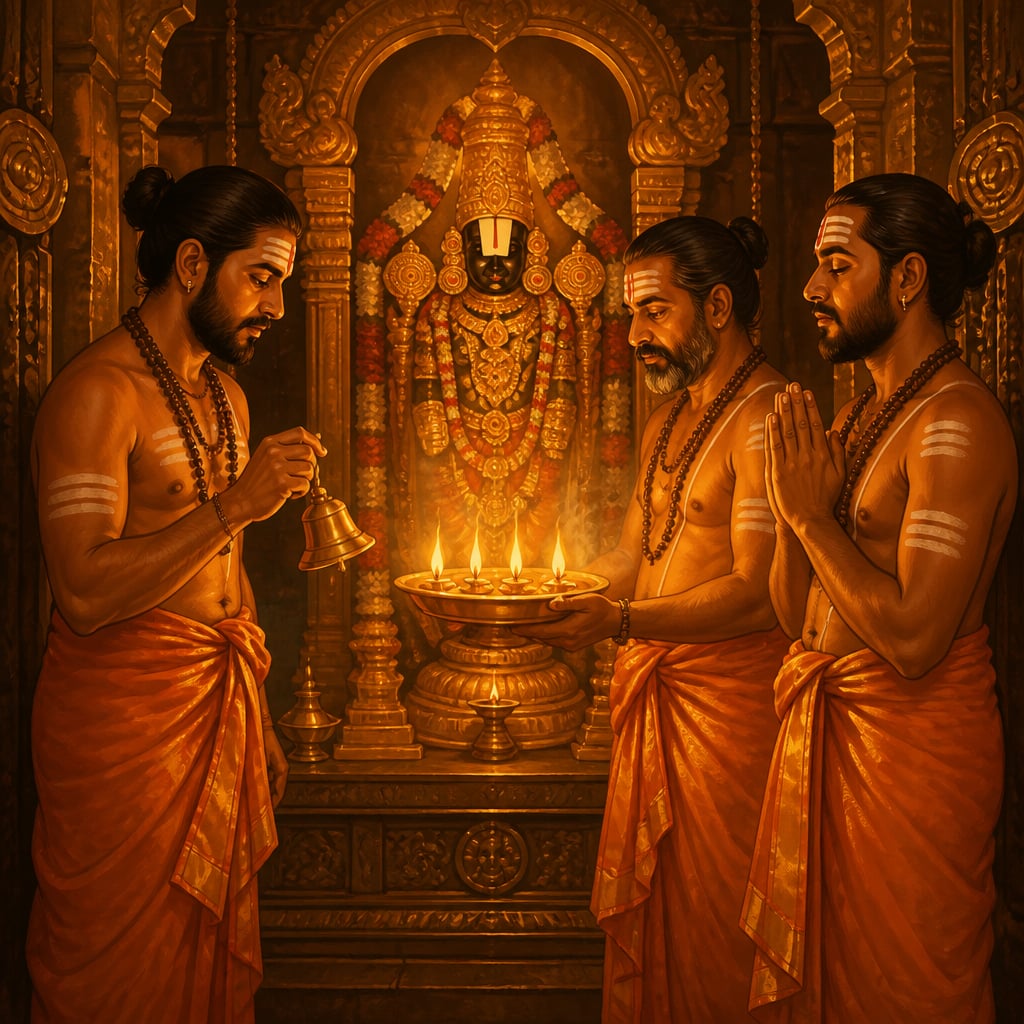
TTD priests performing Suprabhata Seva at the Tirumala inner sanctum

At 2:30 AM, while most of India sleeps, over 500 employees of Tirumala Tirupati Devasthanams are already at work.

In the sanctum, priests prepare for Suprabhata Seva, the deity's morning awakening ritual. In the kitchens, cooks have been stirring massive cauldrons for hours, preparing the laddus and prasadam that 70,000 pilgrims will receive today. Security personnel monitor the queue halls where devotees wait patiently. Cleaning crews complete their night shift, ensuring the temple gleams for dawn darshan.

This is a 24/7 operation that has run continuously for over a thousand years.

TTD's workforce of 30,000+ employees makes it one of India's largest single-site employers, bigger than many corporate campuses. Add contractors, vendors, and the informal economy that clusters around the temple, and the number approaches 100,000 livelihoods. The Tirumala hills are not just a pilgrimage destination; they're an employment ecosystem.

But this isn't modern innovation. Temple employment at this scale has medieval roots. Chola-era inscriptions record temples with 600+ staff members, priests, musicians, dancers, sculptors, guards, accountants, gardeners, lamp-lighters. Understanding how temples became employers reveals something fundamental about Indian economic history.

Why Temples Created Jobs

Temples needed workers for the same reason any complex institution does: specialized tasks require specialized skills.

Ritual Requirements

Hindu temple worship isn't simple. A major temple conducts dozens of daily rituals (puja), each requiring trained priests who know specific mantras, procedures, and timings. The Tirumala temple performs 21 sevas daily, each requiring multiple archakas. The Jagannath Temple in Puri has 36 categories of sevayats (service providers), from cooks to flower-makers. This ritual complexity created demand for trained religious professionals.

Arts and Culture

Worship in Hindu tradition integrates all arts: music to accompany rituals, dance as offering to the deity, sculpture and painting for the temple's beauty. Major temples became conservatories, preserving and transmitting classical arts across generations. The Bharatanatyam you see on stages today evolved in temples; Carnatic music was composed for temple worship; bronze-casting reached its heights creating processional deities.

"कला देवार्पणं परम्।" "Art is the supreme offering to the divine."

This principle made temples the primary employers of artists for millennia. Where else would a classical dancer, a bronze-caster, or a temple architect find steady patronage?

Administrative Complexity

Managing devadana lands, collecting rents, maintaining accounts, adjudicating disputes, temples needed administrators. The Brihadeshwara Temple inscriptions record accountants (karana), land surveyors (bhumidarshaka), record-keepers (nibandha), and overseers (adhikari). These weren't casual positions; they were professional roles with defined responsibilities, often hereditary, passed through families for generations.

Infrastructure Maintenance

Temples are architectural marvels requiring constant upkeep. Stone walls need repair, gopurams need painting, tanks need desilting, gardens need tending. The maintenance workforce at major temples rivaled small construction companies. Chola inscriptions mention specialized crews for each task: masons, painters, metalworkers, carpenters, each with defined duties and compensation.

The Chola Model: 600+ Temple Employees

The Brihadeshwara Temple at Thanjavur, built by Rajaraja Chola I (c. 1010 CE), offers the most detailed picture of medieval temple employment. Its wall inscriptions record:

Priestly Staff:

Musicians and Performers:

Support Staff:

Chola sculptors carving a granite Vishnu in the temple workshop

Artisan Specialists:

Category Number Primary Functions
Priests 100+ Daily and festival rituals
Musicians/Performers 150+ Accompaniment, devotional programs
Support Staff 200+ Cleaning, security, maintenance
Artisans 50+ Sculpture, metalwork, painting
Administration 50+ Records, accounts, land management
Total 600+ Complete temple operations

This was systematic institutional employment, not informal labor but defined roles with specified compensation, hereditary rights, and clear duties.

Global Perspectives: Religious Employment Compared

How did Indian temple employment compare with religious institutions elsewhere?

Medieval European Cathedrals and Monasteries

Gothic cathedrals like Notre-Dame employed hundreds during construction but far fewer for ongoing operations. Benedictine monasteries were largely self-sufficient, with monks performing most tasks themselves. The Catholic model emphasized religious vocation over paid employment, monks worked as spiritual practice, not for wages.

Key Difference: Indian temples created professional employment; European monasteries created religious vocations. A Chola temple musician was a paid specialist; a Benedictine monk doing similar work saw it as prayer.

Islamic Waqf Institutions

Major mosques employed staff, muezzins, imams, caretakers, but at smaller scales than Hindu temples. The elaborate ritual requirements that drove Indian temple employment (multiple daily pujas, festival processions, continuous music) had no parallel in Islamic worship. Ottoman külliye (mosque-centered complexes) came closest, employing staff for attached schools, hospitals, and kitchens.

Key Difference: Indian temple employment was driven by ritual complexity; Islamic religious employment was driven by educational and charitable functions attached to mosques.

Buddhist Monastery Employment

Large Buddhist monasteries in ancient India (like Nalanda) employed significant staff, cooks, cleaners, administrators, but monks themselves were forbidden from handling money or owning property. The monastery operated as a community, not an employer.

Institution Employment Scale Primary Driver Compensation Model
Hindu Temple 600+ (major) Ritual complexity, arts Wages, land grants, hereditary rights
Gothic Cathedral 50-100 Seasonal construction, minimal operations Wages, clerical appointments
Islamic Mosque 20-50 Calls to prayer, teaching, maintenance Waqf income, state support
Buddhist Monastery Community-based Renunciation model Community support, not wages

The Comparative Insight:

Hindu temples were unique in treating divine service as professional employment deserving systematic compensation. This created India's first institutional labor markets, specialized skills, defined roles, negotiated terms, hereditary transmission of positions.

Temples as Patrons of Classical Arts

The temple's role as employer had a profound cultural consequence: it preserved and transmitted India's classical arts.

Bharatanatyam and Classical Dance

A Bharatanatyam dancer performing in a South Indian temple hall

The dance form now called Bharatanatyam evolved in temple settings over centuries. Temple dancers performed as offerings to the deity, developing the intricate footwork, expressive gestures, and narrative capabilities that characterize the art. When classical dance faced decline in the colonial period, it was revived in the 20th century by artists who drew on temple traditions.

Today, Bharatanatyam is performed globally, taught in academies worldwide, and recognized as one of humanity's great dance traditions. Its survival owes directly to centuries of temple patronage that provided dancers with livelihood and purpose.

Carnatic Music

South India's classical music tradition developed primarily through temple patronage. The greatest Carnatic composers, Tyagaraja, Muthuswami Dikshitar, Syama Sastri (the 'Trinity'), composed for temple worship. Temple musicians needed vast repertoires for daily rituals and annual festivals; this demand drove composition and performance innovation.

The nagaswaram and tavil ensemble that accompanies temple processions, the veena recitals in temple halls, the devotional songs (kirtanas) that structure worship, all evolved through temple employment of musicians.

Sculpture and Bronze-Casting

India's tradition of bronze sculpture, the dancing Nataraja, the serene Vishnu, the fierce Durga, developed to create processional deities for temple festivals. Chola bronzes, considered among humanity's greatest artistic achievements, were made by sthapatis (temple sculptors) employed by temple establishments.

These artisans weren't casual laborers but hereditary specialists whose families transmitted techniques across generations. The temple provided steady demand that allowed skills to compound over centuries.

Modern Resonance: TTD as Mega-Employer

Tirumala Tirupati Devasthanams today demonstrates temple employment at industrial scale:

Workforce Composition (2024):

Modern HR Practices: TTD runs one of India's most complex HR operations:

The Scale Challenge: Managing 30,000 employees serving 70,000+ daily visitors requires systems. TTD operates canteens, housing colonies, transportation networks, and welfare programs for its workforce. Employees live in TTD-provided housing on the Tirumala hills; children attend TTD schools; families use TTD hospitals.

This is a company town run by a deity, employment that encompasses entire lives, not just working hours.

Your Turn

Next time you visit a temple, look past the sanctum to the human infrastructure. The priest performing your puja is part of a lineage, his role perhaps defined in inscriptions centuries old. The musician accompanying the aarti may be continuing traditions his ancestors established. The security guard managing the queue is part of an employment system older than most corporations.

Temples created something remarkable: institutions that employed thousands while preserving arts, providing services, and maintaining complex operations across centuries. Modern organizations obsess over 'corporate culture' and 'employee engagement'; temples achieved both through sacred purpose.

The question for today: Can modern employers learn from temple employment? Is purpose more powerful than pay in building lasting organizations? India's temple workforce suggests the answer might be yes.

In our next lesson, we'll explore one of the temple's most impressive operations: Annadana, the logistics of feeding thousands of pilgrims daily, a feat of kitchen management that would humble any restaurant chain.

Management theorist Daniel Pink's 'Drive' (2009) argues that purpose, autonomy, and mastery motivate workers more than money alone. McKinsey research shows purpose-driven companies outperform peers on financial metrics. These 'discoveries' describe what temples understood millennia ago: meaningful work generates engagement that pay alone cannot.

Temple employment embedded purpose structurally, serving the deity was the job itself, not a side benefit. Modern companies struggle to create meaning; temples made meaning the core activity. The gap between 'what you do' and 'why it matters' was eliminated.

TTD's employee turnover among permanent staff is among the lowest in India's service sector. Workers stay for decades despite salaries comparable to (not exceeding) private alternatives. Purpose supplements pay.

Peter Drucker observed that knowledge workers' skills are an organization's true assets. Yet modern companies often treat employees as costs, not investments. The 'gig economy' fragments knowledge across contract workers. Temple employment took the opposite approach: secure tenure for masters, hereditary transmission, institutional investment in skill development.

Temple employment spanned generations, not just careers but dynasties of expertise. A sthapati's son learned from childhood, absorbing tacit knowledge that can't be documented. Modern organizations lose institutional knowledge with every departure; temples accumulated it for centuries.

The bronze-casting tradition of Swamimalai (Tamil Nadu) traces continuous lineage to Chola-era temple sculptors, 1,000+ years of accumulated technique. No corporation has comparable knowledge continuity.

Key terms

Archaka
Temple priest who performs daily worship (puja) and rituals. Archakas are trained specialists who know the specific mantras, procedures, and timing for their temple's deity. In major temples, archaka positions are often hereditary.
Sthapati
Master temple architect who designs and supervises temple construction. Sthapatis follow Vastu Shastra and Agama texts for temple design, leading teams of sculptors, masons, and craftsmen. The title implies both artistic mastery and managerial authority.
Vādaka / Uvachchar
Temple musician who performs during rituals, festivals, and processions. Temple musicians specialize in devotional genres and ritual accompaniment rather than concert performance.
Sevāyat
Hereditary temple servant with defined service duties. At major temples like Jagannath Puri, sevayats hold inherited rights to perform specific services, from cooking to dressing the deity, passed through families for generations.

Verses

देवकार्यं प्रधानं च पूजकस्य च जीवनम्। द्वयमेकं समायुक्तं धर्मार्थौ साधयेद् बुधः॥

devakāryaṃ pradhānaṃ ca pūjakasya ca jīvanam | dvayamekaṃ samāyuktaṃ dharmārthau sādhayet budhaḥ ||

Divine service and the priest's livelihood are combined as one; the wise one achieves both dharma and artha together.

This verse articulates what modern management calls 'purpose-driven employment': work that serves both organizational mission and employee welfare. Temple employment combined intrinsic motivation (divine service) with extrinsic rewards (livelihood), creating engagement that pure salary could never match.

Agama Shastra, Karanagama, Kriya Pada (Based on traditional Tamil translations)

ஐம்பத்தேழு உவச்சர்களுக்கு நெல் குடி

aimpatteḻu uvaccarkaḷukku nel kuṭi

Fifty-seven musicians shall receive their rice allocation.

Payment in kind (rice) rather than cash reflects medieval monetary conditions but also created stability: food grains held value regardless of currency fluctuations. Temple workers had food security even in economic turmoil. Modern organizations provide health insurance; medieval temples provided rice rations, both are stability mechanisms.

Brihadeshwara Temple Inscription, Thanjavur, Rajaraja I period, c. 1010 CE (South Indian Inscriptions, Vol. 2)

स्थपतिश्च प्रधानः स्यात् शिल्पिनां सर्वकर्मणि। तस्य वृत्तिर्विधातव्या राज्ञा वा देवकोशतः॥

sthapatiśca pradhānaḥ syāt śilpināṃ sarvakarmaṇi | tasya vṛttirvidhātavyā rājñā vā devakośataḥ ||

The chief architect leads all artisan work; his livelihood should be provided by the king or from the temple treasury.

This verse addresses what economists call 'human capital investment': skilled artisans represent accumulated knowledge that takes generations to develop. By mandating ongoing support for sthapatis, temple traditions ensured skill transmission. Modern companies struggle with knowledge retention; medieval temples solved it through perpetual employment.

Silpa Prakasha, Orissan Temple Architecture Manual (Based on Alice Boner translation)

Key figures

Kunjaramallan Rajaraja Perunthachan

Chief architect (Sthapati) of the Brihadeshwara Temple, Thanjavur · c. 1000-1010 CE

Rukmini Devi Arundale

Pioneer of Bharatanatyam revival; founder of Kalakshetra · 1904-1986 CE

Pope Julius II

Pope who commissioned the Sistine Chapel ceiling and St. Peter's Basilica; 'The Warrior Pope' and great patron of Renaissance art · 1443-1513 CE

Case studies

TTD's 30,000 Employees: Managing India's Largest Temple Workforce

Tirumala Tirupati Devasthanams (TTD) employs over 30,000 workers, priests, cooks, security, administration, medical staff, teachers, making it one of India's largest single-location employers. These employees serve 70,000+ daily visitors across a 24/7 operation that never closes. Managing this workforce presents unique challenges: - **Scale**: More employees than many corporations, but with religious rather than profit objectives - **Diversity**: From Sanskrit-educated priests to security guards to IT staff, spanning traditional and modern roles - **Heritage**: Some archaka families have served for generations; new hires must integrate with traditional structures - **Accountability**: As a religious trust, TTD faces public scrutiny different from private companies

TTD's employment challenge is fundamentally dharmic: how do you run a modern organization while honoring traditional obligations? Conventional HR would prioritize efficiency, metrics, and standardization. Dharmic management adds layers: respect for hereditary service families, integration of ritual requirements with operational needs, balance between religious purpose and professional management. The temple isn't trying to maximize profit, it's trying to serve the Lord and His devotees. This different 'bottom line' shapes every HR decision.

TTD has developed hybrid management approaches: 1. **Dual Career Tracks**: Hereditary archakas follow traditional training and succession; administrative staff follow modern recruitment and promotion 2. **Performance + Purpose**: Employees are evaluated on service metrics (wait times, prasadam quality) but also on devotional attitude, performance reviews include soft factors 3. **Comprehensive Benefits**: Beyond salary, TTD provides housing, education for children, healthcare, and retirement support, echoing temple traditions of total institutional care 4. **Modern Systems**: Digital HR, biometric attendance, professional training programs, contemporary tools serving traditional ends The result: one of India's most stable large workforces, with employee satisfaction scores exceeding private sector benchmarks despite lower pay scales.

Purpose can substitute for pay, up to a point. TTD proves that meaningful work, comprehensive care, and connection to something sacred can attract and retain talent even without top-tier compensation. Modern employers obsess over perks; TTD offers something deeper: participation in an eternal institution.

Companies like Patagonia, ISRO, and Teach For India demonstrate that purpose-driven compensation attracts talent that mercenary pay cannot. TTD's 95% retention rate in a country averaging 15-20% annual attrition proves that meaning is a compensation multiplier, not a substitute for fair wages.

TTD's permanent employee retention exceeds 95% over 5-year periods, among the highest in India's service sector. For comparison, India's IT sector averages 15-20% annual attrition.

Kalakshetra: Reviving Temple Arts in Modern Institutions

By the early 20th century, India's classical arts faced extinction. Colonial attitudes, social reform movements, and economic disruption had severed artists from traditional patronage. Bharatanatyam survived primarily in memory; Carnatic music had limited institutional support; temple sculpture had few commissions. In 1936, Rukmini Devi Arundale founded Kalakshetra ('Temple of Art') in Chennai, an institution explicitly designed to recreate temple patronage functions in modern form. Her vision: provide artists with stable livelihood, train new generations, preserve traditional knowledge, and present classical arts to contemporary audiences.

Rukmini Devi faced a dharmic challenge: how do you preserve sacred arts when temples can no longer support them? Her solution was institutional translation, creating a secular organization that performed temple functions without temple structure. Kalakshetra employed artists full-time (like temple musicians), trained students in gurukula tradition (like temple apprenticeships), and created performance contexts (like temple festivals). The dharmic insight: institutions serve functions; when one institutional form fails, the function can migrate to new forms while preserving essence.

Kalakshetra became the model for classical arts institutions across India: 1. **Stable Employment**: Full-time positions for artists, providing the security that temple patronage once offered 2. **Knowledge Transmission**: Residential training recreating guru-shishya relationships in institutional context 3. **Performance Platform**: Annual festivals and regular programs providing what temple festivals once did, occasions for arts practice 4. **Global Reach**: Kalakshetra-trained artists now perform worldwide, teaching in academies across continents Bharatanatyam's global presence today, performed on stages from New York to Tokyo, traces directly to Rukmini Devi's institutional innovation.

When traditional institutions fail, their functions can be preserved in new forms. Temple patronage of arts didn't die; it migrated to academies, universities, and cultural organizations. The key insight: separate the function (artist support) from the form (temple employment), and preserve the function even if the form changes.

The global creative economy faces a similar patronage crisis today. As AI threatens traditional creative jobs, the Kalakshetra model of institutional preservation, adapting art forms to new economic structures without losing their essence, offers lessons for how societies can protect cultural production.

India now has over 500 degree-granting institutions for classical arts, functions that temples performed for millennia, now distributed across academic institutions. The employment ecosystem has changed; the arts endure.

Historical context

1000-1200 CE (Chola period) and 20th century revival

Temple employment reached its peak during the Chola dynasty, when major temples functioned as economic anchors for their regions. The temple wasn't just a religious institution but an employer, landlord, banker, and cultural patron. This multi-function model declined under colonial rule as temples lost revenue sources and social reformers critiqued some traditional practices. Post-independence, major temple trusts have revived institutional employment at scales that now exceed medieval precedents.

European religious institutions (churches, monasteries) employed staff but at smaller scales and with different compensation models. The Islamic waqf system created employment through attached institutions (madrassas, hospitals) rather than the mosque itself. Buddhist monasteries operated on community rather than employment models. Hindu temples' combination of ritual complexity, arts patronage, and continuous operation created unique employment demands that no other religious tradition matched.

The Jagannath Temple at Puri has 36 categories of sevayats (hereditary servants) with over 20,000 individuals holding rights, possibly the world's largest continuous hereditary employment system.

Temple employment demonstrates that religious institutions can function as major employers providing stable livelihoods, preserving specialized skills, and maintaining cultural traditions across centuries. As modern societies struggle with employment precarity and skill preservation, the temple model offers alternative paradigms worth understanding.

Living traditions

Temple employment's legacy extends beyond active temple workers. The classical arts now taught in universities, the bronze-casting traditions still practiced in workshops, the architectural knowledge maintained by sthapati lineages, all trace to temple patronage. Modern institutions (Kalakshetra, Central Universities, Lalit Kala Akademi) have assumed functions temples once performed. The employment has migrated; the traditions survive.

Reflection

More in Temple Economics: Sacred Wealth Management

All lessons in Temple Economics: Sacred Wealth Management · Banking & Finance Heritage of Bharat course