Festival Economics
When Commerce Meets Devotion
Temple festivals were ancient India's trade fairs. The Kumbh Mela draws 200+ million pilgrims, generating billions in economic activity. Puri's Rath Yatra transforms a city's economy for weeks. Thrissur Pooram showcases competitive temple spending that rivals corporate marketing budgets. This lesson explores how worship and commerce have intertwined for millennia in India's festival economy.
The City That Appears and Vanishes
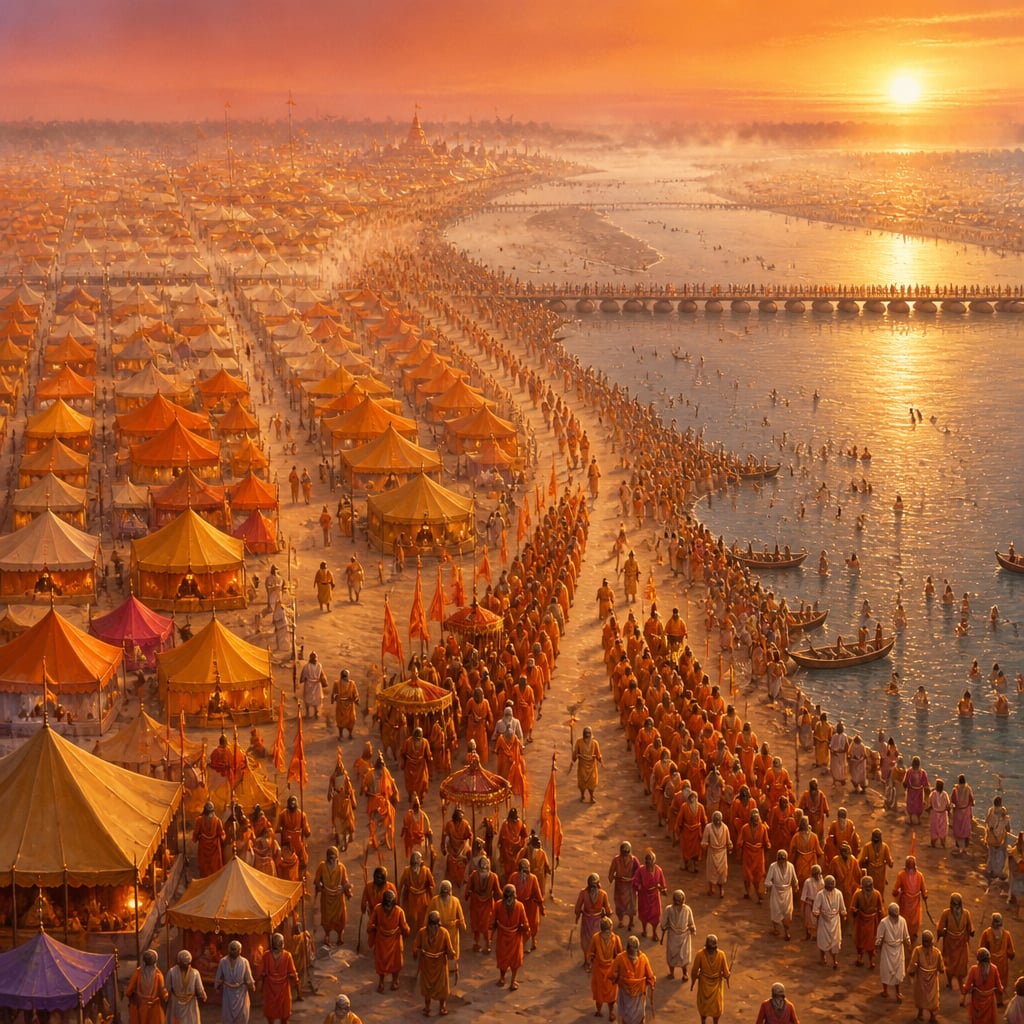
In early 2025, on the banks of the Ganga at Prayagraj, a city will rise from nothing.
Over 30 square kilometers of tents, roads, hospitals, police stations, and markets will appear in weeks. It will have its own water system, electricity grid, and sanitation infrastructure. For 55 days, this temporary city will host more visitors than most countries see in a year, an estimated 40+ crore (400+ million) pilgrims for the Maha Kumbh Mela.
Then, just as quickly, it will vanish. The tents will be dismantled, the roads removed, the land returned to the Ganga's floodplain.
This has happened every 12 years for at least 2,000 years.
The Kumbh Mela is the world's largest temporary gathering, and one of its oldest continuous economic events. But it's only the grandest example of something that defined Indian economic life for millennia: the temple festival as commercial engine.
Why Festivals Created Economies
In ancient and medieval India, transportation was expensive, communication slow, and markets scattered. How did merchants find buyers? How did buyers find variety? How did remote artisans reach distant customers?
The answer: follow the gods.
Temple festivals drew crowds, guaranteed, predictable crowds arriving on fixed dates. Where crowds gathered, merchants followed. Where merchants gathered, more crowds came. The feedback loop created economic events far larger than any secular market could generate.
The Festival Economic Logic:
Religious timing creates coordination: Everyone knows when Rath Yatra happens. No advertising needed, the calendar is the marketing.
Sacred obligation drives attendance: Pilgrimage isn't optional for the devout. The 'customer base' is guaranteed.
Trust networks lower transaction costs: At a temple festival, you're among fellow devotees. The social bonds of shared religion reduce fraud and enable credit.
Infrastructure follows demand: Temples invest in roads, rest houses, wells, and kitchens that merchants can use.
"यत्र योगेश्वरः कृष्णो यत्र पार्थो धनुर्धरः। तत्र श्रीर्विजयो भूतिर्ध्रुवा नीतिर्मतिर्मम॥"
"Where there is Krishna and Arjuna, there is prosperity, victory, wealth, and steady wisdom." , Bhagavad Gita 18.78
The principle applies to festivals: where the divine presence is celebrated, prosperity follows.
Kumbh Mela: The World's Largest Temporary Economy
The Kumbh Mela occurs in four-city rotation (Prayagraj, Haridwar, Nashik, Ujjain), with the Maha Kumbh at Prayagraj every 12 years. The 2019 Kumbh drew an estimated 240 million pilgrims over 49 days, more than the populations of most countries.
The Numbers (2019 Kumbh):
| Metric | Scale |
|---|---|
| Total visitors | 240+ million |
| Peak single day | 50 million (Mauni Amavasya) |
| Temporary city area | 3,200 hectares |
| Temporary bridges built | 22 pontoon bridges |
| Toilets installed | 122,000 |
| Electricity connections | 40,000+ |
| Total economic impact | Rs. 1.2+ lakh crore ($15+ billion) |
The Economic Ecosystem:
The Kumbh isn't just pilgrimage, it's a massive marketplace:
- Tent and lodging operators: From basic dharamshalas to luxury 'glamping'
- Food vendors: Thousands of stalls serving regional cuisines
- Religious goods sellers: Puja items, images, sacred threads, holy water containers
- Handicraft merchants: Artisans from across India selling directly to customers
- Transport services: Boats, rickshaws, buses, guides
- Healthcare providers: Temporary hospitals, traditional medicine practitioners
- Entertainment: Music, storytelling, discourse (pravachan)
For many small traders, Kumbh income funds the entire year. The festival creates economic opportunity at a scale no government program matches.
Historical Roots:
The Kumbh has been documented since at least the 7th century CE (Xuanzang's accounts), but likely dates much earlier. Chinese pilgrim records describe the 'great gathering' with merchants from across India. The medieval Kumbh was where South Indian spices met Central Asian horses, where Bengali textiles found Rajasthani buyers. It was India's ancient expo.
Puri Rath Yatra: City as Festival
Unlike the temporary Kumbh, Puri's Rath Yatra transforms a permanent city. Every June-July, the sleepy temple town becomes one of India's most crowded places.
The Rath Yatra Economic Pattern:

The festival centers on the massive chariot procession of Lord Jagannath, but the economic activity extends weeks before and after:
- Pre-festival: Chariot construction employs hundreds; materials purchased across Odisha
- Festival week: 1-2 million pilgrims in a city of 200,000; every home becomes a hotel
- Post-festival: Extended markets, return purchases, craft sales
The Local Economy:
Puri's entire economic calendar revolves around Rath Yatra:
- Hotel rates multiply 5-10x during the festival
- Restaurants stock for a year's worth of business in two weeks
- Handicraft shops earn the majority of annual revenue
- Property prices reflect proximity to the chariot route
The Ripple Effects:
Rath Yatra's economics extend far beyond Puri:
- Transportation: Indian Railways runs hundreds of special trains
- State revenue: Odisha tourism peaks; hotel taxes surge
- Media: National television coverage promotes Puri year-round
- Diaspora connection: NRIs return; foreign tourists arrive
The festival has shaped Puri's urban form: wide streets to accommodate chariots, rest houses for pilgrims, a permanent market infrastructure. Religion designed the city.
Thrissur Pooram: Competitive Temple Economics
Kerala's Thrissur Pooram offers a different model: temple festivals as competitive spectacle.

Every April-May, two temples (Paramekkavu and Thiruvambadi) stage a ritualized competition before the Vadakkunnathan Temple. The 'competition' isn't religious, it's ostentatious display. Which temple has more decorated elephants? Whose fireworks are more spectacular? Whose percussion ensemble plays longer?
The Economics of Spectacle:
Pooram spending is extraordinary:
- 30+ caparisoned elephants (rental: Rs. 1-2 lakh per elephant per day)
- Gold ornaments for elephants (lakhs in insurance costs alone)
- Fireworks display lasting 3+ hours (Rs. 2-3 crore per temple)
- Percussion ensemble (Panchavadyam) of 200+ musicians
Total spending per temple exceeds Rs. 5-10 crore annually, comparable to corporate marketing budgets.
Who Pays?
Pooram is funded by devotee contributions, but the giving is competitive:
- Families compete for the honor of sponsoring elephants
- Businesses donate for prestige and visibility
- NRIs contribute to ancestral temple's victory
- The community's status is tied to its temple's performance
The Competitive Dynamic:
Thrissur Pooram illustrates a broader principle: temple festivals generate spending through social competition. Donors give not just for spiritual merit but for community standing. The festival becomes a venue for status display, and that display drives enormous economic activity.
Global Perspectives: Religious Gatherings and Economies
Are Indian temple festivals unique? Comparison reveals both parallels and distinctions.
The Hajj (Mecca, Saudi Arabia)
The annual Islamic pilgrimage draws 2-3 million Muslims to Mecca. Saudi Arabia has invested $100+ billion in Hajj infrastructure. The pilgrimage generates significant economic activity, but it's contained within a single city, managed by a single state, and strictly limited in numbers.
Key Difference: Hajj is controlled; Kumbh is organic. Saudi Arabia caps Hajj attendance; Kumbh grows without limit. The economic models differ: Hajj is administered; Kumbh emerges.
Carnival in Rio de Janeiro
Rio's Carnival draws millions, generates billions, and transforms the city. Like Indian festivals, it combines spectacle, commerce, and social competition (samba school rivalries parallel temple competitions).
Key Difference: Carnival is secular; Indian festivals are sacred. The economic activity is similar, but the motivation differs: pleasure versus merit. Carnival's 'season' is weeks; major temple festivals have driven commerce for millennia.
Christmas in Western Economies
Christmas generates enormous commercial activity, approximately 20% of US retail sales occur in November-December. Like temple festivals, it combines religious significance with commercial intensity.
Key Difference: Christmas commerce is increasingly detached from religious observance; temple festival commerce remains integrated with worship. You can shop for Christmas without attending church; Kumbh commerce requires pilgrimage.
| Festival | Attendance | Economic Impact | Duration | Commercial Integration |
|---|---|---|---|---|
| Kumbh Mela | 200M+ | $15B+ | 49-55 days | Fully integrated |
| Hajj | 2-3M (capped) | $12B+ | 5 days | Controlled |
| Rio Carnival | 5M+ | $2B+ | 1 week | Separate but adjacent |
| Christmas (US) | N/A | $900B+ | 6 weeks | Largely secular |
Modern Resonance: Religious Tourism's GDP Impact
Today, religious tourism is among India's largest economic sectors, and growing faster than leisure tourism.
The Numbers:
- Annual religious tourists: 300+ crore (3+ billion) domestic trips
- Religious tourism GDP contribution: 2-3% of India's GDP
- Varanasi annual pilgrims: 6+ crore (60+ million)
- Tirupati annual visitors: 3+ crore (30+ million)
- Char Dham visitors: 2+ crore annually (and growing rapidly)
State Economies:
Religious tourism dominates certain state economies:
- Uttar Pradesh: Varanasi, Prayagraj, Mathura, Ayodhya drive tourism
- Uttarakhand: Char Dham pilgrimage is the primary tourism product
- Tamil Nadu: Temple circuit (Madurai, Rameswaram, Thanjavur) rivals beaches
- Odisha: Puri anchors the tourism economy
The Growth Trajectory:
Post-COVID religious tourism has surged:
- Ayodhya Ram Mandir opening (2024): Projected 5+ crore annual visitors
- Kashi Vishwanath Corridor completion: Varanasi footfall up 3x
- IRCTC Bharat Gaurav trains: Dedicated religious tourism packages
- State investments: Rs. 10,000+ crore in temple infrastructure across states
Religious tourism is no longer traditional pilgrimage alone, it's a modern industry with hotels, packages, apps, and marketing.
Your Turn
Next time you attend a temple festival, notice the commerce. The prasadam seller, the flower vendor, the souvenir shop, the food stall, each represents an economic relationship stretching back centuries. The merchant families might have served these festivals for generations.
The festival economy shows something economics textbooks often miss: markets don't just emerge from self-interest. They emerge from shared meaning. The Kumbh isn't a market that happens to be religious; it's a religious event that generates a market. The meaning comes first; the commerce follows.
As India develops, festival economics is scaling, not shrinking. The Maha Kumbh 2025 will be the largest Kumbh in history. Ayodhya is becoming a new pilgrimage mega-destination. Religious tourism infrastructure is receiving unprecedented investment.
The ancient pattern continues: where the gods are honored, prosperity follows.
In our next lesson, we'll explore Temple Tanks and Irrigation, how temples managed water infrastructure that sustained agriculture across regions.
Standard economics assumes markets form around utility maximization, people trade because they want things. Behavioral economics (Kahneman, Thaler) shows that meaning and context shape economic behavior. Temple festivals take this further: the entire market exists because of shared religious meaning. No meaning, no market.
Temple festivals demonstrate market formation at scales Western theory struggles to explain. Why do 200 million people gather at Kumbh? Not utility maximization, the 'utility' of bathing in the Ganga is identical to bathing anywhere. The gathering happens because of shared belief in merit multiplication. Meaning is the infrastructure on which the market builds.
The Kumbh Mela has no advertising budget, no marketing department, no sales force. Yet it draws more participants than any commercial event in history. The 'marketing' is religious meaning accumulated over millennia, the most effective brand-building possible.
Economists study coordination problems: how do dispersed actors align their behavior? Solutions include institutions, contracts, and focal points (Schelling). The religious calendar is the ultimate focal point, it coordinates millions without central authority. Black Friday, holiday shopping seasons, and fiscal year-ends are secular echoes of this ancient coordination mechanism.
The Hindu calendar provides coordination across domains: astrological (muhurtas for business), agricultural (planting/harvest festivals), and commercial (fair dates). This integrated calendar aligned activity in ways secular scheduling cannot. Modern businesses still reference Hindu calendar, factory openings on auspicious days, year-beginning sales on Dhanteras.
Gold sales in India spike 300%+ during Dhanteras/Diwali, more than Black Friday's impact on US retail. The religious calendar coordinates consumer behavior more effectively than any marketing campaign.
Key terms
- Tīrtha
- Sacred crossing or pilgrimage site, a place where the boundary between earthly and divine realms is thin. Tirthas are destinations for pilgrimage, typically associated with rivers, temples, or sacred events. Major tirthas like Prayagraj, Varanasi, and Haridwar have been pilgrimage destinations for millennia.
- Melā
- A gathering or fair, typically combining religious observance with commercial activity. Melas range from local temple fairs to massive events like Kumbh. The term captures the Indian integration of worship and commerce, the mela is both pilgrimage and marketplace.
- Yātrā
- A procession or pilgrimage journey, both the physical travel to a sacred site and the ceremonial procession of deities during festivals. Yatra emphasizes movement: gods going out to meet devotees, devotees traveling to meet gods.
- Pūram
- Malayalam term for temple festivals, particularly the grand competitive festivals of Kerala where temples display wealth, sponsor elaborate processions, and compete for community prestige. Poorams combine religious celebration with status competition.
Verses
यत्र योगेश्वरः कृष्णो यत्र पार्थो धनुर्धरः। तत्र श्रीर्विजयो भूतिर्ध्रुवा नीतिर्मतिर्मम॥
yatra yogeśvaraḥ kṛṣṇo yatra pārtho dhanurdharaḥ | tatra śrīr vijayo bhūtir dhruvā nītir matir mama ||
Where there is Krishna, the Lord of Yoga, and Arjuna, the wielder of the bow, there, surely, are prosperity, victory, glory, and righteousness. This is my conviction.
The verse articulates the 'temple economics' thesis: prosperity isn't opposed to spirituality but generated by it. Festival economies demonstrate this empirically, the largest economic gatherings in Indian history (Kumbh) are religious. The Gita suggests this isn't coincidence but principle: where dharma and divinity meet, material abundance follows.
Bhagavad Gita, Chapter 18, Verse 78 (Based on Swami Chinmayananda translation)
तीर्थे स्नाने च दाने च जपे होमे सुरार्चने। फलं कोटिगुणं प्राहुर्दिवसे पुण्यसंयुते॥
tīrthe snāne ca dāne ca jape home surārcane | phalaṃ koṭiguṇaṃ prāhur divase puṇyasaṃyute ||
Bathing, giving, chanting, performing fire ritual, and worshipping at a sacred site on an auspicious day, the merit, they say, multiplies ten million-fold.
The 'merit multiplier' creates what economists call 'coordination benefits.' If bathing at Kumbh generates 10 million times the merit of bathing at home, the rational devotee will travel regardless of cost. This belief creates perfectly inelastic demand, pilgrims will come whatever the price. Merchants can rely on guaranteed crowds; infrastructure investments have predictable returns.
Skanda Purana, Kashi Khanda (Traditional Sanskrit text)
केवलाघो भवति केवलादी
kevalāgho bhavati kevalādī
He who eats alone, eats only sin.
The Vedic injunction against 'eating alone' creates economic incentives for redistribution. Festival times see spikes in charitable giving, prasadam distribution, and community feasting. This isn't just cultural practice, it's economically rational within the merit framework. Giving during festivals generates maximum spiritual returns; keeping generates spiritual loss.
Rig Veda, 10.117.6 (Based on Griffith translation)
Key figures
Adi Shankaracharya
Philosopher-reformer who established the four mathas and systematized Hindu pilgrimage geography · c. 788-820 CE
Yogi Adityanath
Chief Minister of Uttar Pradesh; major investor in religious tourism infrastructure · Contemporary (born 1972)
Max Weber
German sociologist; author of 'The Protestant Ethic and the Spirit of Capitalism' · 1864-1920 CE
Case studies
Maha Kumbh 2025: Building a Temporary Megacity
The Maha Kumbh Mela 2025 at Prayagraj (January 13 - February 26) is projected to be the largest human gathering in history. The Uttar Pradesh government expects 40-45 crore (400-450 million) pilgrims over 45 days. The infrastructure challenge is staggering: - **Site**: 4,000+ hectares (larger than many cities) - **Investment**: Rs. 5,000+ crore in temporary infrastructure - **Facilities**: 150,000+ toilets, 65,000+ lights, 25+ pontoon bridges - **Security**: 50,000+ personnel - **Healthcare**: 100+ temporary hospitals - **Sanitation**: Real-time Ganga water quality monitoring All of this must be built, operated for 45 days, then dismantled, leaving minimal environmental trace.
The Kumbh infrastructure is dharmic economics in action: 1. **Service orientation**: The investment isn't for profit but for enabling dharmic activity (pilgrimage bathing) 2. **Universal access**: Infrastructure serves all, sadhu and CEO, Indian and foreigner, without discrimination 3. **Temporary by design**: Unlike permanent development, Kumbh infrastructure minimizes lasting environmental impact 4. **Trust-based operation**: Despite minimal formal contracts, thousands of service providers organize reliably Conventional infrastructure economics focuses on permanent returns. Kumbh economics accepts that the 'return' is merit, for pilgrims and for the state that enables their pilgrimage.
Previous Kumbh Melas demonstrate the model works: - **2019 Kumbh**: 240 million pilgrims, zero stampedes, successful sanitation (Open Defecation Free certification) - **Economic impact**: Rs. 1.2+ lakh crore generated across UP and India - **Employment**: 600,000+ temporary jobs created - **Technology**: Real-time crowd monitoring, digital lost-and-found, AI-assisted security The 2025 Maha Kumbh is scaling further: larger area, more infrastructure, enhanced technology. It represents the world's most ambitious temporary city project, and it happens because of religious meaning.
Scale follows meaning. The Kumbh's logistical achievement rivals any Olympics or World Cup, but it happens with a fraction of the budget because voluntary participation, shared purpose, and distributed organization substitute for centralized control. Purpose is the most powerful coordination mechanism.
Music festivals like Glastonbury, sporting events like the FIFA World Cup, and tech conferences like CES all struggle with logistics for crowds a fraction of Kumbh's size. The distributed, purpose-driven coordination model that Kumbh demonstrates is being studied by urban planners and event managers worldwide.
The 2019 Kumbh's per-pilgrim infrastructure cost was approximately Rs. 500-600, far lower than comparable per-attendee costs at major global events. Shared purpose reduces transaction costs and enables efficiency that bureaucratic organization cannot match.
Religious Tourism's GDP Impact: India's Hidden Economic Engine
Religious tourism is one of India's largest economic sectors, yet it's often overlooked in development planning. The numbers are striking: **Annual Religious Tourism:** - Domestic religious trips: 300+ crore (3+ billion) - Compared to: Leisure tourism ~200 crore trips - Religious tourism share: 60%+ of all domestic tourism **Major Destination Economics:** | Site | Annual Visitors | Economic Impact | |------|----------------|----------------| | Tirupati | 3+ crore | Rs. 3,000+ crore | | Varanasi | 6+ crore | Rs. 5,000+ crore | | Puri | 1.5+ crore | Rs. 1,500+ crore | | Shirdi | 2+ crore | Rs. 2,000+ crore | **Total GDP contribution**: Religious tourism contributes an estimated 2-3% of India's GDP, comparable to agriculture in some states.
Religious tourism's economic impact follows dharmic patterns: 1. **Distribution, not concentration**: Unlike beach resorts or metro hotels, religious sites spread across India, distributing economic benefits to small towns and rural areas 2. **Repeat visitors**: Pilgrims return annually or more; loyalty far exceeds leisure tourism 3. **Low-cost access**: Temple towns offer budget accommodation; religious tourism is accessible to all income levels 4. **Spending diversity**: Pilgrims spend on prasadam, donations, religious goods, local products, money circulates locally rather than flowing to international hotel chains Conventional tourism development chases luxury visitors. Religious tourism development serves mass pilgrimage with distributed benefits.
Post-2020, religious tourism has become explicit policy: - **Ayodhya development**: Rs. 1+ lakh crore projected investment following Ram Mandir - **Kashi Vishwanath Corridor**: Rs. 800+ crore investment, 3x visitor increase - **Char Dham Highway**: Rs. 12,000+ crore road project for pilgrimage circuit - **PRASAD Scheme**: Central government funding for pilgrimage infrastructure - **IRCTC Bharat Gaurav**: Dedicated religious tourism train packages States now compete for religious tourism investment, recognizing its economic multiplier effects.
Religious tourism is economic development that works with Indian cultural patterns rather than against them. Development that leverages existing pilgrimage behavior achieves broader distribution and deeper local impact than imported tourism models. The temple economy isn't a relic, it's a development strategy.
Religious tourism generates more economic value in India than the IT services export sector, yet receives a fraction of the policy attention. As countries like Saudi Arabia (Hajj infrastructure), Israel, and Italy invest heavily in pilgrimage-linked development, India's religious tourism potential remains vastly underleveraged.
Post-Ram Mandir inauguration (January 2024), Ayodhya visitor numbers increased from ~30,000 daily to 300,000+ daily, a 10x increase. Hotel capacity is expanding from 2,000 rooms to projected 50,000+ rooms. A single temple event is creating a new city-scale economy.
Historical context
Ancient to present (continuous tradition)
Festival economics has been central to Indian commerce for millennia. Medieval trade routes organized around pilgrimage circuits. Guild records show merchants timing inventory purchases for festival demand. The Mughal emperors, despite Islamic faith, protected Hindu festivals for their economic importance. British colonial records document the commercial significance of melas even as administrators struggled to manage them. Post-independence, festival economics has scaled dramatically with improved transportation, media coverage, and rising incomes.
No other civilization developed festival economics at comparable scale. The Hajj is strictly managed; European medieval fairs were local; Chinese temple fairs were regional. Only India created all-subcontinent pilgrimage circuits generating economy-scale commercial activity. The Kumbh Mela draws more participants than any event in recorded history, religious or secular.
The 2019 Kumbh Mela's 240 million visitors exceeded the population of Brazil (212M) and the combined attendance of every Olympic Games ever held. No other event in human history approaches this scale.
Understanding festival economics matters because it represents an alternative model of development, organic, distributed, meaning-driven. As India invests billions in religious tourism infrastructure, the ancient pattern of prosperity following pilgrimage is becoming explicit policy. Festival economics isn't history; it's development strategy.
Living traditions
Festival economics has become explicit government policy. The Ministry of Tourism's PRASAD scheme funds pilgrimage infrastructure. States compete for temple tourism investment. Religious festivals are integrated into development planning. The ancient pattern, build a temple, prosperity follows, is now articulated in spreadsheets and policy documents. The tradition hasn't been preserved in amber; it's been modernized, scaled, and made explicit.
- Festival Timing for Business: Indian businesses still time major activities, launches, openings, investments, to religious calendar. Dhanteras/Diwali is the peak retail season; Akshaya Tritiya drives gold purchases; Navratri/Durga Puja transforms eastern India's economy. The practice continues because it works: shared timing creates coordination that marketing alone cannot achieve.
- Festival Donations: Giving peaks during festivals when merit multiplies. Temples, charities, and religious institutions plan annual budgets around festival receipts. The practice creates reliable, cyclical funding, temples know donations will surge during specific weeks, enabling planning that year-round giving doesn't allow.
- Maha Kumbh 2025
- Puri Rath Yatra
- Thrissur Pooram
- Prayag Sangam (Kumbh Mela site): The confluence where Ganga, Yamuna, and mythical Saraswati meet; site of the world's largest gatherings, the Kumbh Mela drawing up to 240 million pilgrims in 2019
- Ram Mandir: The 2024 inauguration has transformed Ayodhya into a mega-pilgrimage destination, demonstrating how temple economics can reshape entire cities in the modern era
Reflection
- The Kumbh Mela demonstrates that shared meaning can coordinate millions without central control. Modern economics often assumes coordination requires markets, contracts, or government. What other examples can you think of where shared meaning coordinates behavior more effectively than formal mechanisms? What does this suggest about the role of meaning in economic life?
- If you were developing a region economically, would you invest in temple/religious tourism or conventional leisure tourism? What are the tradeoffs? Religious tourism offers repeat visitors, distributed benefits, and cultural alignment, but may not attract high-spending international tourists. How would you evaluate this choice for a specific location?