Temple as Bank
Sacred Deposits and Divine Loans
Long before modern banks existed, Indian temples functioned as sophisticated financial institutions, accepting deposits, lending at interest, and managing wealth across centuries. From Tirupati's unbroken 1,000-year financial records to Somnath's legendary treasury that attracted Mahmud of Ghazni, this lesson reveals how temples built the infrastructure of trust that powered India's prosperity.
The Deposit That Outlasted Empires
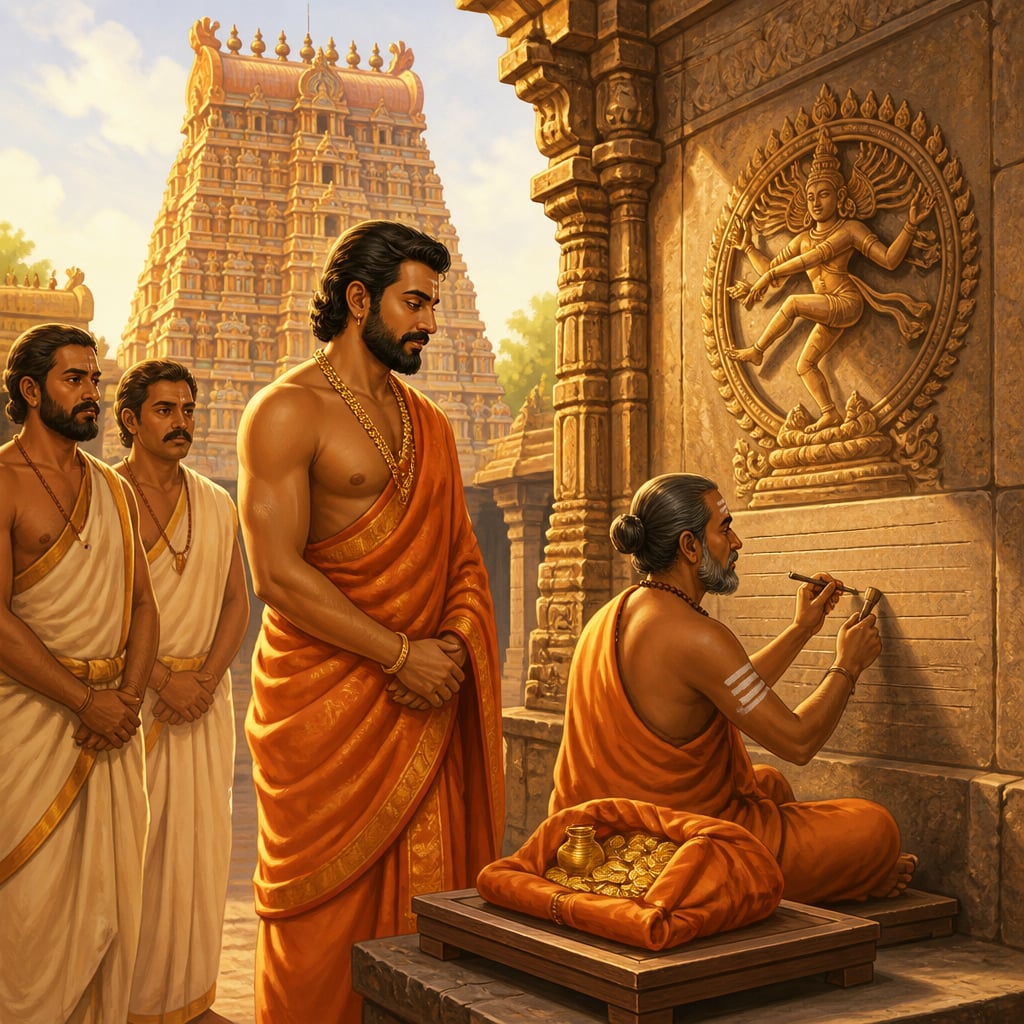
In 1230 CE, a merchant named Vira Pandya stood before the Nataraja Temple in Chidambaram, South India. He was about to do something his family had done for generations: deposit his trading profits with the temple.
The priests recorded his deposit in stone, literally. The inscription still exists today, carved into the temple wall: 120 gold coins (niskas), deposited at 12.5% annual interest, with the proceeds to fund a perpetual lamp before the dancing Shiva.
Vira Pandya's great-great-grandson never had to worry about inheritance disputes. The temple's stone records were more permanent than any paper contract. Eight centuries later, that lamp still burns.
This wasn't unusual. Across India, temples weren't just places of worship, they were the most trusted financial institutions in the ancient world. And understanding why reveals something profound about how India built its legendary wealth.
Why Temples Became Banks
Imagine ancient India: thousands of kingdoms, each with its own coins, its own laws, its own risks. A merchant in Gujarat might trade with partners in Bengal, Burma, and Arabia. How do you store wealth safely when any king might fall, any city might burn?
The answer emerged organically: deposit it with the gods.
Temples offered what no king could guarantee:
Permanence. Dynasties rose and fell, but temples endured. The Tirumala temple at Tirupati has been operating continuously for over 1,000 years. The Jagannath Temple at Puri has survived multiple invasions. Temples were built to last forever, and so was the wealth entrusted to them.
Sanctity. Stealing from a temple wasn't just theft, it was sacrilege. The Dharmasutras prescribed terrifying punishments for temple robbery:
"देवस्वं हृतवान् यस्तु स याति नरकं ध्रुवम्।" "He who steals the deity's property surely goes to hell." , Yajnavalkya Smriti, 2.270
This spiritual sanction created security that no army could match. Even Mahmud of Ghazni, who famously looted Somnath in 1026 CE, had to justify his raid as religious duty, tacit acknowledgment of the special protection temples normally enjoyed.
Institutional Memory. Temple priests maintained meticulous records across generations. While merchant families might lose documents in fires or floods, temple inscriptions survived in stone. The Pallava and Chola temples of Tamil Nadu have inscriptions detailing deposits made 1,200 years ago, complete with interest rates, terms, and beneficiary names.
The Mechanics of Temple Banking
How did temple banking actually work? The inscriptions reveal a sophisticated system:
Deposit Types:
- Nandavana-vritti: Principal deposited, interest used for temple gardens
- Arcana-vritti: Returns fund daily worship rituals
- Anna-dana-vritti: Interest provides free meals for pilgrims
- Deepa-vritti: Funds perpetual lamps (like Vira Pandya's)
Interest Rates: Temple inscriptions record rates from 12.5% to 15% annually, remarkably consistent across centuries and regions. This standardization suggests an informal "central bank" function: temples helped stabilize interest rates across fragmented markets.
| Deposit Type | Typical Rate | Use of Returns |
|---|---|---|
| Perpetual lamp | 12.5% | Oil, wicks, maintenance |
| Daily puja | 15% | Flowers, incense, priest fees |
| Festival sponsorship | 12.5% | Annual celebration costs |
| Feeding pilgrims | 15% | Rice, dal, cooking expenses |
Lending Practices: Temples also lent money, to farmers for seeds, to merchants for inventory, to villages for irrigation projects. A remarkable inscription from the Thanjavur Brihadeshwara Temple records loans to 87 different villages for agricultural improvement. The temple was essentially running a rural development bank in 1015 CE.
Global Perspectives: How the World's Religions Handled Money
Were Indian temples unique? Let's compare with two other religious banking systems.
The Medici and the Catholic Church (1397-1494)
Cosimo de' Medici built Europe's most powerful bank by solving a theological problem: the Church banned usury (interest-bearing loans). The Medici solution? Call it "compensation for risk" instead of interest. They became the Pope's bankers, financing crusades and cathedrals.
But there was a crucial difference. The Medici partnered with the Church; they didn't become it. When the Medici fell from power in 1494, their bank collapsed. Indian temples, by contrast, were themselves the financial institution. No separation meant no vulnerability.
| Aspect | Medici Bank | Indian Temple |
|---|---|---|
| Relationship to religion | Partner/financier | Is the institution |
| Legal basis | Contracts, papal favor | Dharmic obligation |
| Survived founders? | No (collapsed 1494) | Yes (1,000+ years) |
| Interest rates | Hidden ("risk compensation") | Openly stated |
The Vatican Bank (Founded 1942)
The modern Vatican Bank (IOR) manages roughly $5 billion in assets. Impressive, until you compare it to Tirumala Tirupati Devasthanams (TTD), which manages over $18 billion and feeds 100,000 people daily. The Vatican struggled with transparency scandals in the 2010s; TTD publishes annual reports online.
The difference isn't just scale, it's model. The Vatican Bank serves the Church's global operations. Indian temples serve their communities directly: feeding pilgrims, funding festivals, maintaining infrastructure. Temple banking was always for the devotees, not just from them.
Somnath: When Temple Wealth Becomes Target
No discussion of temple banking is complete without Somnath, and its most infamous visitor.
By 1026 CE, the Somnath temple in Gujarat had accumulated centuries of donations. Merchants from Arabia, Persia, and Southeast Asia deposited wealth there. The temple's treasury was legendary: jeweled idols, gold vessels, donated properties across western India.

Mahmud of Ghazni saw this differently. His raid on Somnath was partly ideological, but overwhelmingly economic, historians estimate he extracted wealth equivalent to $17 billion in today's terms.
Yet here's what's remarkable: within decades, the temple was rebuilt. Donations resumed. The financial infrastructure reconstituted. Somnath was destroyed and rebuilt at least six times over eight centuries, each time regenerating its wealth.
Why? Because temple banking wasn't just about the physical treasury, it was about the network of trust. Donors kept giving because they trusted the institution's permanence. Even destruction couldn't kill that trust.
Modern Resonance: TTD and ISKCON
Today, temple finance is bigger than ever.
Tirumala Tirupati Devasthanams (TTD) manages the world's richest temple, and one of its most sophisticated religious trusts. In 2024, TTD's corpus exceeds Rs. 18,000 crore ($2.2 billion in liquid assets alone, not counting properties and gold). It employs over 30,000 people, feeds 100,000 pilgrims daily, and runs educational institutions, hospitals, and housing projects.

TTD's gold monetization scheme, depositing devotee-donated gold with banks for interest income, directly continues the ancient practice of productive temple assets. The scheme has mobilized over 7,000 kg of gold, generating returns that fund charitable programs.
ISKCON (International Society for Krishna Consciousness) represents a different model: the modern temple-as-global-corporation. Founded in 1966, ISKCON now operates 650+ temples worldwide with estimated assets exceeding $1 billion. Their financial model combines ancient principles (donations, prasadam distribution, festival economics) with modern corporate governance: audited accounts, professional management, transparent reporting.
Karl Marx famously called religion "the opium of the people." But Indian temple economics suggests a different metaphor: religion as infrastructure, financial, social, and spiritual, that communities build on for millennia.
Your Turn
Next time you visit a temple, look beyond the rituals. Notice the donation counters, the prasadam distribution, the maintained gardens and buildings. You're seeing an institution that has managed wealth continuously for longer than most nations have existed.
The Vira Pandyas of today still exist, people who trust temples with their most precious resources. Whether they're depositing for spiritual merit or investing in temple trusts, they're participating in a financial tradition older than banking itself.
Ask yourself: What makes an institution trustworthy across centuries? The temples suggest an answer: embed finance in something people care about more than money.
In our next lesson, we'll explore Devadana, the land donation system that made temples into medieval India's largest landholders and most powerful economic engines.
Modern endowment funds (Harvard, Yale) operate on similar principles: preserve principal, spend only returns. John Maynard Keynes managed Cambridge's endowment using exactly these principles. But Western perpetuities emerged in medieval Europe and formalized in the 19th century; Indian temples had operated perpetuities for over a millennium earlier.
Temple perpetuities had stronger enforcement: spiritual sanctions backed temporal rules. A university trustee who mismanages funds faces legal consequences; a temple administrator faced eternal damnation. This created incentive alignment that modern governance struggles to replicate.
The oldest continuously operating endowment in history is likely the perpetual lamp funds at Chidambaram Temple, established in inscriptions from the 10th century CE, still operating after 1,100+ years. Harvard's endowment, by comparison, was founded in 1649.
Francis Fukuyama's 'Trust: The Social Virtues and the Creation of Prosperity' (1995) argues that high-trust societies grow richer because transaction costs are lower. But Fukuyama focuses on secular trust; he misses the Indian innovation of sacred trust, embedding economic relationships in transcendent meaning.
Secular contracts require enforcement, courts, police, lawyers. Sacred obligations self-enforce through conscience and community. Indian temple banking minimized transaction costs by making breach spiritually unthinkable, not just legally punishable.
Temple inscriptions record thousands of deposits over centuries with virtually no recorded defaults. Modern banking, with all its legal infrastructure, experiences default rates of 2-10% on loans. The spiritual enforcement mechanism was more effective than legal enforcement.
Key terms
- Devasva
- Literally 'property of the deity', all wealth, land, and assets belonging to a temple. Devasva was considered the personal property of the enshrined god, not the temple administration, giving it unique legal and spiritual protection.
- Nikshepa
- A deposit, specifically money or valuables entrusted to another party for safekeeping or investment. In temple context, nikshepa referred to deposits made with the temple, typically at interest.
- Vritti
- Literally 'livelihood' or 'means of support', in temple finance, vritti referred to endowments whose returns funded specific ongoing activities like lamps, worship, or feeding pilgrims.
- Devasthanam
- Literally 'abode of the deity', refers to the temple as an institution including its administration, properties, and financial operations. Today, major temple trusts like TTD (Tirumala Tirupati Devasthanams) preserve this term in their official names.
Verses
देवस्वं हृतवान् यस्तु स याति नरकं ध्रुवम्। ब्राह्मणस्वं च हृत्वा तु कुम्भीपाके पचिष्यति॥
devasvaṃ hṛtavān yastu sa yāti narakaṃ dhruvam | brāhmaṇasvaṃ ca hṛtvā tu kumbhīpāke paciṣyati ||
He who steals the deity's wealth surely descends to hell; he who takes a brahmin's property will boil in the cauldron of torment.
Ancient India solved the 'trust problem' in banking through spiritual deterrence. When theft of deposits means eternal damnation, depositors feel secure. This created the stable expectations necessary for long-term financial relationships, exactly what modern banking achieves through regulation and deposit insurance.
Yajnavalkya Smriti, Vyavahara Adhyaya, 2.270 (Based on Ganganath Jha translation)
देवद्रव्यं न हर्तव्यं न भोक्तव्यं कदाचन। देवद्रव्यापहारी तु रौरवं नरकं व्रजेत्॥
devadravyaṃ na hartavyaṃ na bhoktavyaṃ kadācana | devadravyāpahārī tu rauravaṃ narakaṃ vrajet ||
The deity's wealth must never be taken, never be consumed. The temple thief descends to Raurava, the hell of eternal suffering.
The dual prohibition, 'neither taken nor enjoyed', addresses both external theft and internal corruption. Temple administrators were bound by the same spiritual sanctions as outside thieves. This solved the principal-agent problem that bedevils modern financial institutions: how do you ensure managers act in depositors' interest? Ancient India's answer: make betrayal a sin, not just a crime.
Agni Purana, Chapter 211 (Based on Manmatha Nath Dutt translation)
இந்நாள் முதல் ஆசந்திரார்க்கம் (நிலைத்த) அட்டை
innāḷ mutal ācantirārkkam (nilaititta) aṭṭai
From this day, as long as the sun and moon endure, let this endowment stand.
Modern finance struggles with 'perpetuities', infinite-duration instruments are theoretically valued but practically difficult to structure. Ancient Indian temples solved this through the 'chandraditya' (moon-sun) formula: donations were explicitly designed to last forever. This created the longest-lasting financial instruments in human history, some still operating after 1,000+ years.
Chidambaram Temple Inscription, Rajendra Chola I period, c. 1030 CE (South Indian Inscriptions, Vol. 3)
Key figures
Rajendra Chola I
Chola Emperor who expanded temple banking to an unprecedented scale, funding military campaigns through temple networks · 1014-1044 CE
A.V. Dharma Reddy
Former Chairman of Tirumala Tirupati Devasthanams who modernized temple financial management · Contemporary (TTD Chairman, 2019-2021)
Cosimo de' Medici
Founder of the Medici Bank, the most powerful financial institution in Renaissance Europe; key partner of the Catholic Church · 1389-1464 CE
Case studies
TTD's Gold Monetization: Ancient Practice Meets Modern Markets
By 2015, Tirumala Tirupati Devasthanams faced an unusual problem: it held over 9,000 kg of gold donated by devotees over centuries, worth approximately Rs. 45,000 crore. This gold sat in vaults, generating no returns, a violation of the ancient vritti principle that temple assets should be productive. When the Modi government launched the Gold Monetization Scheme in 2015, TTD saw an opportunity. They could deposit gold with banks, earn interest, and use returns to fund charitable programs, exactly what temple donors had intended for centuries. But the decision was controversial. Some devotees argued that donated gold was sacred and shouldn't be 'lent' to secular banks. Others worried about security and recovery. TTD's trustees had to balance ancient precedent with modern opportunity.
From a dharmic economics perspective, idle gold violates the fundamental principle of temple finance. The Dharmasutras are clear: temple wealth should generate ongoing benefit (vritti), not sit unused. The Chola-era inscriptions explicitly describe depositing gold at interest to fund perpetual activities. Conventional financial logic would focus on risk-return tradeoffs. Dharmic analysis goes further: it asks whether the *purpose* of the donation is being fulfilled. Devotees gave gold for divine service, not vault storage. Gold monetization aligns with donor intent in a way that hoarding does not.
TTD deposited over 7,000 kg of gold with RBI and public sector banks, earning approximately 2.5% annual interest. This generates roughly Rs. 150-200 crore annually, enough to fund significant charitable expansion while keeping the gold secure and recoverable. The theological controversy faded when people understood the historical precedent: this wasn't innovation but restoration. TTD was doing what temples had done for a thousand years, just with banks instead of local shroffs.
Ancient principles can solve modern problems. TTD's 'innovation' was actually reconnection with tradition. When facing complex decisions, sometimes the answer isn't finding new solutions, it's rediscovering old ones.
India's households hold an estimated 25,000 tonnes of gold, worth over $1.5 trillion, mostly sitting idle. TTD's monetization model offers a template for unlocking this wealth productively while respecting the cultural and religious significance of gold ownership.
TTD's deposited gold of 7,000+ kg represents approximately 2% of India's annual gold imports. A single temple trust's monetization initiative has macroeconomic significance.
Somnath: The Temple That Wouldn't Die
In 1026 CE, Mahmud of Ghazni's army broke down the gates of Somnath, one of India's wealthiest temples. What he found astonished his chroniclers: a treasury accumulated over centuries of devotee deposits and merchant offerings. Historians estimate the plunder's value at over $17 billion in today's terms. Mahmud's raid should have ended Somnath. He destroyed the temple, killed the defenders, and carried away everything of value. By conventional logic, the temple's financial operations were finished. Yet within decades, Somnath was rebuilt. Donations resumed. The temple's financial apparatus reconstituted. Over the following centuries, Somnath would be destroyed and rebuilt at least six more times, each time regenerating its wealth and function.
Conventional economics would predict that repeated destruction would permanently deplete temple resources. Rational donors should learn that Somnath is a risky investment and deposit elsewhere. Dharmic economics explains what actually happened: Somnath's value wasn't in its treasury but in its *meaning*. Donors gave to participate in something eternal, a spiritual transaction that physical destruction couldn't touch. Each rebuilding actually *increased* Somnath's symbolic value, making it an even more powerful destination for devotional giving.
Modern Somnath, rebuilt in 1951 with Sardar Patel's personal involvement, is once again a major pilgrimage center managing substantial resources. The Somnath Trust today oversees properties, charitable operations, and a museum preserving the temple's history of resilience. The pattern, destruction, rebuilding, prosperity, repeated because the underlying trust network remained intact even when physical infrastructure was destroyed.
True institutional resilience comes from meaning, not money. Somnath survived because it represented something donors cared about more than financial returns. The modern equivalent: mission-driven organizations can rebuild from catastrophe; purely commercial enterprises often can't. Values are the most durable form of capital.
Mission-driven organizations like Wikipedia, Linux Foundation, and public universities demonstrate the same Somnath principle: institutions anchored in purpose attract sustained voluntary support that profit-driven competitors cannot replicate. Donor-funded resilience consistently outlasts shareholder-funded efficiency.
Somnath was destroyed and rebuilt at least 6 times between 1026 and 1706 CE, yet each time reconstituted its economic function within decades. No secular financial institution in history has demonstrated comparable resilience.
Historical context
1000-1300 CE (Chola and early medieval period)
The Chola period (c. 850-1280 CE) represents the golden age of temple banking in South India. Temple inscriptions from this era record the most sophisticated financial operations: standardized interest rates, lending to villages, deposit insurance through perpetual endowments. The Brihadeshwara Temple at Thanjavur functioned as a regional central bank, setting interest rates that other temples followed. Meanwhile, Gujarat's Somnath accumulated wealth from maritime trade networks spanning the Arabian Sea. This was peak temple finance, before Sultanate and later Mughal governance introduced different models.
While Indian temples ran perpetual endowments and complex lending operations, European finance was primitive by comparison. The Knights Templar (founded 1119 CE) pioneered European credit transfer but were destroyed by 1312. The Medici Bank (founded 1397) would eventually rival temple sophistication but lasted only a century. Chinese temple finance existed but operated under tighter state control. Indian temples were unique in combining religious authority, financial sophistication, and institutional independence.
Inscriptions from the Thanjavur Brihadeshwara Temple record loans to 87 different villages for agricultural improvement (c. 1015 CE), essentially a rural development bank operating 1,000 years before microfinance was 'invented.'
Understanding temple banking reveals that India wasn't just wealthy, it had sophisticated financial institutions that solved problems (perpetuity, trust, decentralized credit) that modern finance still struggles with. This history matters because it shows indigenous innovation, not just imported ideas.
Living traditions
Temple trusts collectively manage assets rivaling major corporations. TTD alone employs more people than many Fortune 500 companies. The 2011 discovery of Rs. 1 lakh crore+ treasure at Padmanabhaswamy Temple revealed that temple banking's legacy isn't just historical, it's literally still in the vaults. ISKCON's 650+ temples worldwide demonstrate that the temple finance model can globalize. The ancient pattern, devotees depositing wealth for divine service, temples managing assets productively, returns funding community benefit, operates today at scales the Cholas never imagined.
- Hundi Donation: Depositing offerings in temple hundis continues the nikshepa tradition. At Tirupati, the main hundi collects Rs. 3-4 crore daily, anonymous deposits that become devasva (deity's property). The practice is unchanged from medieval inscriptions; only the amounts have grown.
- Perpetual Lamp Sponsorship: Many temples still offer 'nithya deepam' (perpetual lamp) sponsorship, pay once, the lamp burns forever. This is exactly the deepa-vritti system of Chola inscriptions. At major temples, you're participating in a 1,000-year-old financial instrument.
- Tirumala Tirupati Temple Complex
- Brihadeshwara Temple
- Somnath Temple
- Tirumala Tirupati Devasthanams: The world's richest temple, receiving over Rs. 3,000 crore annually; the living embodiment of temple banking with sophisticated asset management, gold loans, and deposit schemes
- Padmanabhaswamy Temple: Temple where Rs. 1 lakh crore+ treasure was discovered in 2011; demonstrates that temple banking's wealth accumulation continues across centuries, with assets untouched for generations
Reflection
- The temple banking system succeeded because people believed their actions mattered eternally, stealing from the deity meant hell, generous giving meant divine merit. In a more secular age, what can create comparable commitment to institutional integrity? Is eternal accountability replaceable, or does its decline explain modern institutional failures?
- If you had Rs. 10 lakhs to donate, would you give it to a temple trust like TTD, a secular charity, or a financial endowment like a university fund? What would influence your choice? What does your answer reveal about your intuitions regarding institutional trustworthiness?