Tank and Irrigation

Temple Water Management

Temples didn't just worship water, they managed it. The Chola tanks of Tamil Nadu, the Kakatiya cascade systems of Telangana, and the magnificent stepwells of Gujarat represent centuries of temple-funded water infrastructure. These weren't just reservoirs, they were economic engines powering agriculture across regions. This lesson explores how sacred water management sustained India's prosperity.

The Dam That Fed an Empire
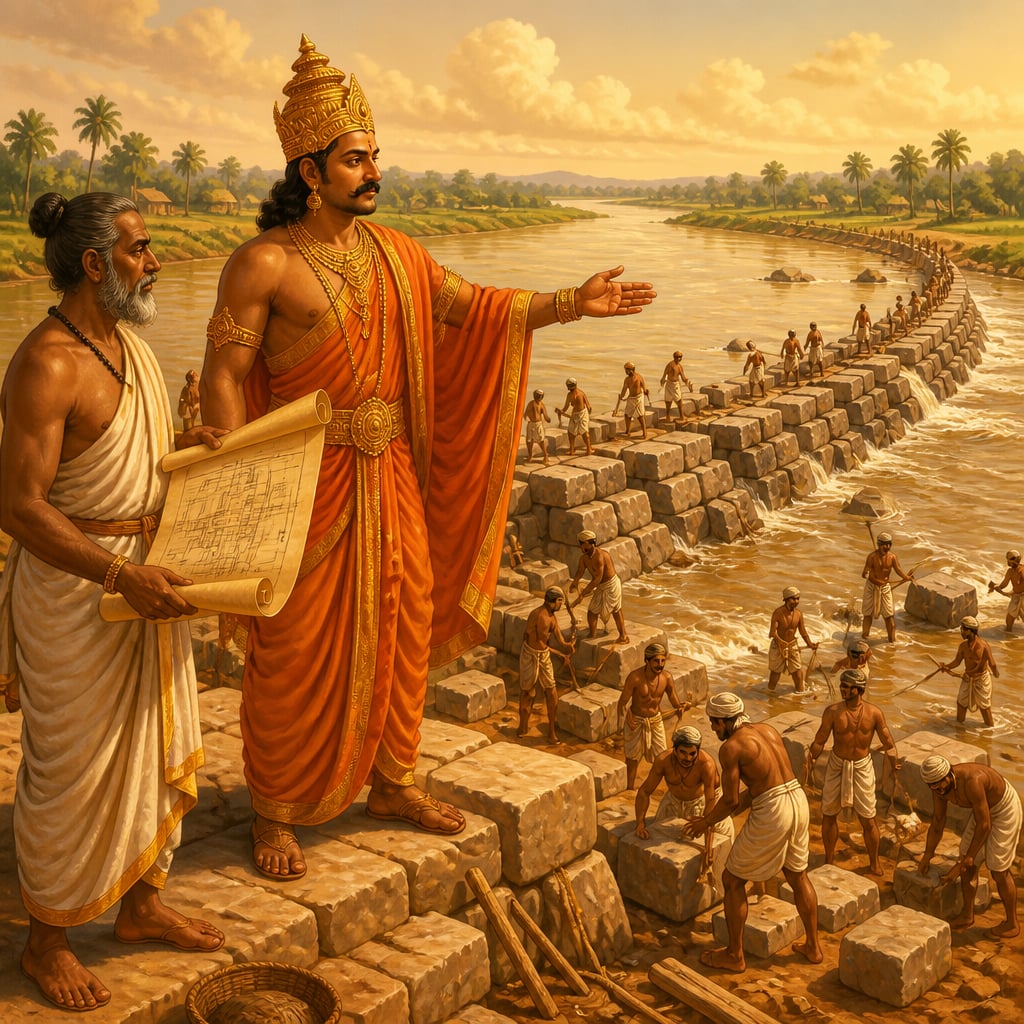
King Karikala overseeing the building of the Kallanai dam on the Kaveri

In the 2nd century CE, the Chola king Karikala stood before the Kaveri River and faced a problem that every Indian ruler understood: water.

The monsoons came for four months; his people needed water for twelve. The Kaveri's floods could devastate; its flow could nourish. How do you tame a river?

Karikala's answer still stands 1,900 years later: the Kallanai, or Grand Anicut, one of the oldest water-diversion structures in the world still in use. A stone dam across the Kaveri, it diverts water into an intricate network of channels that irrigate the Thanjavur delta, transforming it into India's rice bowl.

But here's what makes the Kallanai remarkable beyond engineering: it was maintained for centuries not by state bureaucracies but by temple networks. The channels (vaikals) ran through devadana lands. Temple authorities managed water distribution. The dam's maintenance was funded by religious endowments.

Water and worship were inseparable in Indian economic thought. Understanding why reveals how temples became the infrastructure backbone of pre-modern India.

The Economics of Sacred Water

Why did temples manage water? Three interconnected reasons:

1. Water Is Life (Jala = Jivana)

In Hindu philosophy, water is sacred, the source of life, the purifier of sins, the essential element. Rivers are goddesses; tanks are sacred spaces. This reverence translated into investment: building tanks was merit-generating, like building temples. Donors endowed water infrastructure alongside temple buildings.

"गङ्गे च यमुने चैव गोदावरि सरस्वति। नर्मदे सिन्धु कावेरि जलेऽस्मिन् सन्निधिं कुरु॥"

"O Ganga, Yamuna, Godavari, Saraswati, Narmada, Sindhu, Kaveri, be present in this water." , Traditional water invocation

Every temple tank contained, symbolically, all sacred rivers. Bathing in a temple tank wasn't just hygiene, it was pilgrimage.

2. Temples Had the Resources

Water infrastructure is expensive. Tanks require construction, channels need maintenance, dams demand repair. Only institutions with substantial, reliable income could sustain such investment. Temples, with their devadana lands and donation flows, had precisely this: perpetual resources for perpetual infrastructure.

3. Temples Had the Legitimacy

Water distribution creates conflict. Who gets water when there isn't enough? Whose fields are irrigated first? Kings could impose solutions by force, but force breeds resentment. Temples could adjudicate as divine intermediaries, their decisions carried spiritual authority that secular courts lacked.

Tamil Nadu: The Temple Tank System

Tamil Nadu has over 39,000 tanks (kulams, eris), more water bodies per area than almost anywhere on Earth. Many trace to temple construction.

The System Architecture:

Chola-era water management was sophisticated:

  1. River diversion (anicut/dam): Capture water from major rivers
  2. Main channels (nadhi, vaikai): Carry water across regions
  3. Distribution tanks (eri): Store water for irrigation and drinking
  4. Temple tanks (kulam, teppakulam): Sacred reservoirs at temple complexes

Temple-Tank Integration:

Temple tanks weren't isolated ponds, they were nodes in regional water networks:

Function Temple Role
Construction Royal patrons built tanks as religious merit; temples received endowments for maintenance
Maintenance Temple authorities managed desilting, embankment repair, channel clearing
Distribution Temple officials allocated water among devadana villages
Conflict Resolution Temple assemblies adjudicated water disputes
Revenue Collection Water cess collected through temple land administration

The Thanjavur Example:

A Chola temple tank releasing water through a sluice to paddy fields

The Brihadeshwara Temple (Thanjavur) sat at the center of an irrigation network:

The temple wasn't just a worship center, it was a water utility.

Telangana: The Kakatiya Cascade

The Kakatiyas (c. 1083-1323 CE) created perhaps history's most sophisticated pre-modern irrigation system: the cascade tank network.

The Cascade Principle:

Rather than isolated tanks, the Kakatiyas built chains:

  1. Upper tank captures rainfall/stream water
  2. Overflow channel leads to lower tank
  3. That tank's overflow feeds the next
  4. The chain continues through valleys

Each tank served its immediate area; overflow benefited the next. Nothing was wasted.

The Scale:

Temple Integration:

Major tanks were endowed to temples:

The Kakatiyas donated tanks as devadana, the land AND the water AND the management rights all transferred to temples. This bundled endowment created self-sustaining systems: the land's revenue maintained the tank that irrigated the land.

Gujarat: The Stepwell Temples

Gujarat's stepwells (vav) represent a different integration: the water infrastructure itself becomes the temple.

The Stepwell Concept:

In arid Gujarat, the water table drops during dry seasons. Simple wells couldn't reach water year-round. The solution: excavate deep, stepped structures descending to the water table. As water drops, users descend the steps.

The Temple Integration:

Stepwells weren't just functional, they were sacred spaces:

The Rani ki Vav stepwell descending in carved levels at Patan

The Economic Logic:

Stepwells combined multiple functions:

Function Economic Value
Water supply Drinking water, irrigation, livestock
Temperature control Cool refuge in hot months (energy savings)
Social gathering Meeting space, marketplace, community center
Religious merit Temple donations, ritual bathing, pilgrimage
Status display Architectural patronage showed donor's wealth

The sacred framing made construction merit-generating; the multiple functions ensured sustained maintenance.

Global Perspectives: Water, Religion, and Infrastructure

Did other civilizations integrate religious institutions with water management?

Islamic Qanat Systems

Islamic civilization developed extensive water infrastructure, including the qanat (underground channels). However, qanats were typically state or private property, not mosque-administered. Islamic waqf sometimes funded water infrastructure, but the integration was less direct than Hindu temple-tank systems.

Roman Aqueducts

Roman aqueducts were engineering marvels, but they were state infrastructure, not religious. Temples might receive water, but didn't manage distribution. The Romans separated sacred and hydraulic.

Balinese Subak

Bali's subak system offers the closest parallel: rice paddies irrigated by water temples that manage distribution through religious authority. Each subak is associated with a water temple whose priests coordinate irrigation schedules. The system was recognized by UNESCO for its integration of sacred and hydraulic management.

System Religious Integration Management Authority Scale
Tamil Nadu Tanks Temple-centered Temple assemblies Regional
Kakatiya Cascade Temple endowments Temple trustees Sub-regional
Gujarat Stepwells Water structure = temple Temple authorities Local
Balinese Subak Water temple network Temple priests Valley-level
Islamic Qanat Occasional waqf funding State/private Variable
Roman Aqueducts None State Urban

The Comparative Insight:

India and Bali developed unusually tight integration of water management with religious authority. The common factor: wet-rice agriculture requiring coordinated irrigation in monsoon climates. Where water determines everything, entrusting its management to legitimate, perpetual institutions makes sense.

Colonial Disruption and Decline

British colonial rule disrupted temple water management, not through intentional destruction but through institutional transformation.

What Changed:

  1. Land Revenue Systems: Zamindari and Ryotwari systems separated land rights from temple administration. Devadana lands became taxable property; their revenues no longer automatically funded tank maintenance.

  2. Irrigation Departments: British engineers built large dams and canals, but also created bureaucracies that displaced traditional management. State irrigation departments didn't have temple relationships with farming communities.

  3. Temple Regulation: Religious endowment acts placed temples under state oversight. Temple trustees lost autonomy to manage water resources.

  4. Neglect: Without clear responsibility, thousands of tanks silted, embankments breached, channels blocked. The integrated system fragmented.

The Statistics:

By independence (1947):

The infrastructure survived; the institutions that maintained it did not.

Modern Resonance: Mission Kakatiya

Telangana's Mission Kakatiya represents the most ambitious attempt to revive temple-era water infrastructure.

The Program:

Launched in 2015, Mission Kakatiya aims to restore 46,000+ tanks across Telangana, many originally built by the Kakatiyas 800 years ago.

Investment: Rs. 20,000+ crore (approximately $2.5 billion)

Activities:

Results (by 2024):

The Temple Connection:

Mission Kakatiya isn't explicitly religious, but it restores systems that temples built and managed. Many restored tanks are adjacent to temples. Community involvement echoes traditional management, villages participate in restoration, then maintain tanks through collective action.

The program demonstrates that temple-era infrastructure, properly maintained, remains viable 800 years later. The engineering was sound; only the institutional framework had broken.

Your Turn

Next time you see a temple tank, the large rectangular water body in front of South Indian temples, consider what it represents. That tank wasn't decorative. It was part of an irrigation network, a drinking water source, a bathing facility, and a sacred space. The steps descending into the water weren't just architectural, they provided access as water levels dropped through dry seasons.

The temple's role as water manager explains why temples became central to Indian economic life. Control water, control agriculture. Control agriculture, control prosperity. Temples didn't just bless the harvest; they enabled it.

As India faces water crises, depleting groundwater, erratic monsoons, growing demand, traditional systems offer lessons. Distributed storage (tanks) beats centralized storage (large dams) for resilience. Community management beats bureaucratic management for maintenance. Sacred framing beats utilitarian framing for sustained investment.

The temple tank system didn't fail because of engineering flaws. It failed because institutions were disrupted. Reviving water security may require reviving institutional integration, not necessarily religious, but similarly perpetual, legitimate, and community-embedded.

In our final lesson, we'll explore Relevance in 2026 and Beyond, how temple economics offers models for modern India's development challenges.

Public goods provision through religious incentives

Economists struggle with public goods: everyone benefits, but no one wants to pay. Conventional solutions include taxation, privatization, or fee structures. The Indian approach added a third option: frame public goods as spiritual goods. Donors compete to fund infrastructure because merit flows to builders. Adam Smith's 'invisible hand' guides self-interest to public benefit; the 'invisible karma' does the same through spiritual incentives.

Merit-based funding avoids the free-rider problem. Tax-funded infrastructure suffers when citizens evade; privately-funded infrastructure excludes the poor. Merit-funded infrastructure attracts wealthy donors seeking spiritual returns while providing universal access. The poor benefit without paying; the rich pay while believing they benefit more.

Tamil Nadu's 39,000 tanks, mostly built through private religious donations over centuries, represent more distributed water storage than most government programs achieve. Merit motivation built infrastructure at scales state programs rarely match.

Elinor Ostrom's Nobel-winning work on commons governance showed that communities can manage shared resources without privatization or state control, if they have legitimate institutions for rule-making and enforcement. Temple water management is precisely what Ostrom described: community governance based on legitimate authority rather than coercive power.

Temple legitimacy came from divine association, decisions were backed by spiritual authority that secular courts lacked. Farmers accepted temple water allocation not because enforcement was strong but because defiance carried spiritual cost. Legitimacy reduced enforcement costs, making community water management viable at scale.

Key terms

Taḍāga / Eri
An irrigation tank or reservoir, a constructed water body for storing rainwater or diverted river flow. In Tamil Nadu, 'eri' specifically refers to the widespread tank systems that provide agricultural irrigation, drinking water, and groundwater recharge.
Vāpī / Vāv
A stepwell, a deep excavated well with stepped sides allowing users to descend to the water level. Stepwells are characteristic of Gujarat and Rajasthan, where deep water tables require elaborate access structures. Many are architecturally magnificent, combining water access with temple functions.
Aṇai / Aṇikaṭṭu
A dam or weir for diverting river water into irrigation channels. The Grand Anicut (Kallanai) on the Kaveri is history's oldest water-diversion structure still in use, a Tamil word for what became an engineering landmark.
Kaṭṭā / Cheruvu
Telugu terms for earthen-bund tanks common in Telangana and Andhra Pradesh. 'Katta' refers to the embankment; 'cheruvu' to the tank itself. The Kakatiya cascade system comprised thousands of interconnected cheruvus.

Verses

वापीकूपतडागानां प्रतिष्ठा च दशांशदा। सर्वतीर्थफलं तस्य पुनः पुनरुपाश्रयात्॥

vāpīkūpataḍāgānāṃ pratiṣṭhā ca daśāṃśadā | sarvatīrthaphalaṃ tasya punaḥ punarupāśrayāt ||

He who constructs wells, ponds, or tanks receives one-tenth of the merit of visiting all pilgrimages, and this merit multiplies each time the water is used.

The verse creates an extraordinary investment proposition: build once, earn merit forever. Unlike most donations (consumed immediately), water infrastructure 'compounds' spiritually. This theological framing made tank construction attractive to wealthy donors seeking maximum merit per rupee. The result: massive private investment in public infrastructure.

Varaha Purana, Chapter 165 (Traditional Sanskrit text)

सेतुबन्धश्च राज्ञो धर्मः

setubandhaśca rājño dharmaḥ

Building dams and water works is the dharma of kings.

By declaring dam-building 'dharma,' Kautilya solved the public goods problem. Kings might skip infrastructure to fund armies or palaces. Framing irrigation as spiritual duty created accountability: a king who neglected water infrastructure lost legitimacy. Religious obligation enforced good economic policy.

Arthashastra, Book 2, Chapter 1 (R.P. Kangle translation)

तडागं देवगृहस्य प्राग्भागे वा दक्षिणे वा कार्यम्

taḍāgaṃ devagṛhasya prāgbhāge vā dakṣiṇe vā kāryam

The tank should be constructed in front of or to the south of the temple.

By including tanks in temple specifications, the Silpa Shastras created bundled infrastructure investment. A patron commissioning a temple automatically funded water infrastructure. This bundling expanded water storage across India with every temple built. Religious investment drove public infrastructure without requiring separate policy decisions.

Manasara, Chapter 33 (Temple Tank Construction) (Traditional Silpa Shastra text)

Key figures

Karikala Chola

Chola king who built the Kallanai (Grand Anicut), the oldest water-diversion structure still in use · c. 2nd century CE

K. Chandrashekar Rao

Chief Minister of Telangana who launched Mission Kakatiya to restore ancient tank systems · Contemporary (born 1954)

Karl Wittfogel

German-American historian; author of 'Oriental Despotism: A Comparative Study of Total Power' · 1896-1988 CE

Case studies

Mission Kakatiya: Restoring 46,000 Ancient Tanks

When Telangana became a separate state in 2014, it inherited a water crisis: groundwater depleted, tanks silted, irrigation inadequate. The obvious solutions were new dams and canal systems, expensive, slow, environmentally controversial. Chief Minister K. Chandrashekar Rao chose a different path: Mission Kakatiya, launched in 2015, would restore the ancient tank network. **The Challenge:** - 46,000+ tanks in various stages of disrepair - Silted beds reducing storage capacity by 50-70% - Breached embankments losing stored water - Blocked channels disconnecting cascade systems - Encroachment on tank beds and feeder areas **The Investment:** - Rs. 20,000+ crore over multiple phases - Target: restore all tanks to original capacity

Mission Kakatiya embodies several dharmic principles: 1. **Honoring inheritance**: The Kakatiyas built infrastructure for future generations; restoration honors that trust 2. **Distributed benefit**: Tank restoration benefits small farmers across thousands of villages, not just canal-head areas near big dams 3. **Community involvement**: Villagers participate in restoration, reviving traditions of collective tank maintenance 4. **Sustainability**: Tank systems recharge groundwater, restore ecology, and require less energy than pumped irrigation Conventional development would build new; dharmic development honors and restores what ancestors created.

By 2024, Mission Kakatiya has achieved: - **Tanks restored**: 30,000+ of 46,000 target - **Storage capacity**: Increased by 30-40% in restored tanks - **Groundwater**: Significant recharge observed; wells in restored-tank areas show higher levels - **Irrigation**: Millions of additional acres brought under irrigation - **Employment**: Millions of person-days of work generated - **Ecology**: Wetland ecosystems restored; bird populations increased The program demonstrates that traditional infrastructure, properly maintained, can solve modern problems at lower cost than new construction.

Restoration can be more effective than replacement. Mission Kakatiya restored 800-year-old systems at a fraction of new-dam costs, with faster implementation, broader distribution, and better environmental outcomes. The dharmic insight: inherited infrastructure represents accumulated wisdom. Honor it before abandoning it.

Climate adaptation planners worldwide are rediscovering traditional water management systems. From the acequia irrigation channels in New Mexico to qanat systems in Iran, restoring ancient water infrastructure consistently delivers better cost-benefit ratios than building new systems from scratch.

Mission Kakatiya's per-acre irrigation cost is estimated at Rs. 20,000-30,000, compared to Rs. 2-3 lakh per acre for new dam irrigation. Traditional systems, restored, deliver water at 1/10th the cost of modern alternatives.

Historical context

2nd century CE to present (Karikala Chola to Mission Kakatiya)

Water management defined Indian agricultural history. The Indus Valley civilization built sophisticated drainage; Mauryan India had state irrigation departments; Chola and Kakatiya periods perfected temple-managed tank systems. British colonialism disrupted these systems by centralizing authority and neglecting traditional maintenance. Post-independence, large dam projects (Bhakra, Hirakud) dominated water policy, while traditional tanks deteriorated. Only recently has tank restoration emerged as a development strategy, with Mission Kakatiya as the largest example.

India's temple-tank system represents a distinctive model of water governance: religious institutions managing distributed infrastructure. Egypt had centralized state control of Nile irrigation. China's imperial water bureaucracies were state-dominated. Rome built aqueducts as state projects. Only Bali's subak system shows similar integration of religious authority with water management. India's model was simultaneously more distributed (thousands of independent temples) and more resilient (surviving political upheaval through religious continuity).

The Kallanai (Grand Anicut) has operated for approximately 1,900 years without major reconstruction. The dam's design, low height, stone construction, minimal interference with river flow, proved optimal for the site. Modern engineering has added regulators but retained Karikala's basic structure.

As India faces water crises, traditional systems offer alternatives to mega-projects. Tank restoration is cheaper, faster, and more distributed than dam construction. Community management is more sustainable than bureaucratic control. Understanding temple water systems isn't just history, it's development strategy for water-scarce regions.

Living traditions

Temple water management principles are being rediscovered. Mission Kakatiya explicitly references Kakatiya heritage. Tamil Nadu's tank restoration programs invoke Chola traditions. Urban watershed groups advocate temple tank revival for groundwater recharge. The Indian approach, distributed storage, community management, sacred framing, offers alternatives to centralized dam-and-canal systems that dominate modern water policy.

Reflection

More in Temple Economics: Sacred Wealth Management

All lessons in Temple Economics: Sacred Wealth Management · Banking & Finance Heritage of Bharat course