Your Neighbor is Your Enemy
Ari - The Natural Rival
Why does proximity breed conflict? Explore the concept of Ari - the natural enemy - and understand the structural forces that turn neighbors into rivals, regardless of personal feelings or diplomatic intentions.
The River That Divided Two Kings
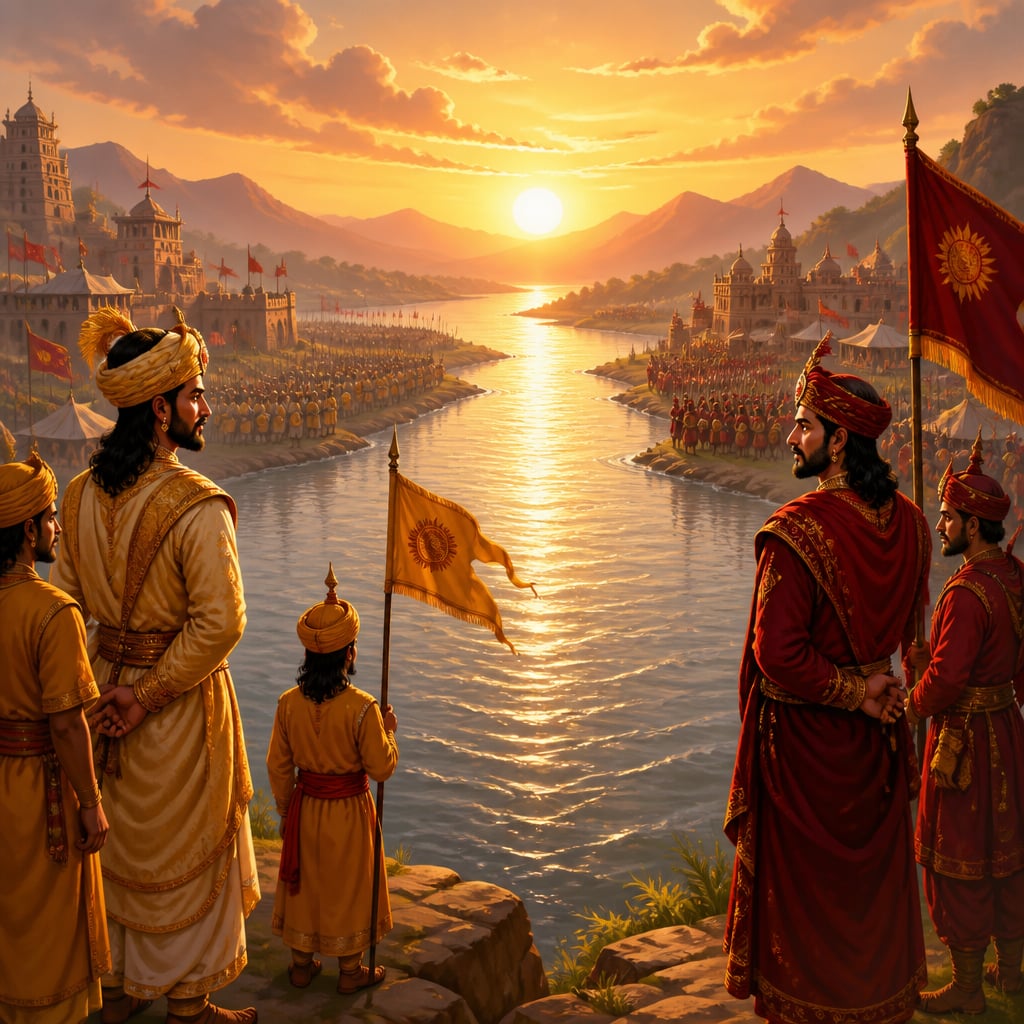
The Ganga flowed between them, silver in the morning light. On the northern bank, King Prasenjit of Kosala watched his neighbor's army drilling on the southern shore. On the southern bank, King Ajatashatru of Magadha watched Kosala's army doing the same.
Neither king had wronged the other. No insult had been exchanged, no treaty broken. Yet both spent fortunes maintaining armies along that river, both lost sleep calculating the other's intentions, and both knew that someday, despite shared language, shared gods, shared ancestry, they would likely fight.
This was the sixth century BCE, and two of India's mightiest kingdoms demonstrated what Kautilya would later codify into principle: "Yo vijigīṣoḥ pārśve rājā sa ariḥ", the king at your border is your enemy.
Not because he hates you. Because he's there.
The Geometry of Rivalry
Why does sharing a border make neighbors into rivals? Kautilya identified three forces that operate automatically, regardless of anyone's intentions.
The Border Problem. Where exactly does your kingdom end? Rivers shift course. Mountain passes serve both sides. Villages straddle boundaries. Forests span unclear lines. Every ambiguity is a potential dispute, and borders are nothing but ambiguities strung together.
Resource Competition. You and your neighbor want the same things: control of trade routes, access to rivers, influence over buffer states, the allegiance of talented people. These aren't infinite, your gain often means their loss.
The Security Spiral. Here's the deepest problem: your defense looks like their threat. When you build walls and train soldiers, you're protecting yourself. But your neighbor sees preparation for attack. So they build up too. Which makes you more nervous. And so the spiral begins.
Prasenjit and Ajatashatru weren't paranoid. They were responding rationally to structural incentives that neither created and neither could escape.
The Three Kinds of Enemy
Kautilya distinguished between different flavors of enmity, each requiring different handling.
The Prakrti-Ari, the natural enemy, is your basic neighbor. You're rivals by position, not by choice. These relationships can be managed. Trade agreements help. Clear treaties reduce friction. Cultural exchanges humanize each side. The structural tension never disappears, but it can be contained.
The Sahaja-Ari, the hereditary enemy, is far more dangerous. When generations have fought, when grievances compound across centuries, when cultural memory holds ancient wounds, you face something harder to transform. Past conflicts poison present negotiations. Domestic politics reward hostility. Conciliation looks like betrayal.
The Krtrima-Ari, the created enemy, is manufactured through circumstance. A state that wasn't threatening becomes so through alliance with your existing enemies, sudden expansion, or new leadership with aggressive intent.
You Are Someone's Enemy
Kautilya's most uncomfortable insight: you are someone else's Ari.
From across the Ganga, Ajatashatru saw Prasenjit exactly as Prasenjit saw him, a potential threat, a competitor, an obstacle. Neither was wrong. Each occupied the same structural position in the other's Mandala.
This insight transforms strategy. Your neighbor's hostility isn't irrational, it reflects their position, just as yours reflects your own. Their defensive measures mirror yours. Their alliances against you follow the same logic you use against them.
Understanding this doesn't make you friends. But it helps you predict behavior and avoid miscalculation.
Strength as Peace

Kautilya never advocated fighting every neighbor. He advocated something harder: seeing clearly and preparing accordingly.
"The weak," he wrote, "are prey to the strong." This wasn't cynicism, it was observation. A kingdom strong enough that attacking it seems costly is a kingdom that preserves peace through deterrence. Your neighbor who knows you can defend yourself is less likely to test you.
This is why Chandragupta, following Kautilya's guidance, maintained formidable armies even after unifying most of India. Not because he wanted war, but because visible strength prevented it.
The Modern Ari
The principle travels far beyond ancient kingdoms.
In 2010, Apple and Samsung were partners, Samsung supplied components for iPhones. Then Samsung launched its Galaxy smartphones. Suddenly they were neighbors in the same market, fighting for the same customers. Within two years, they were locked in patent wars across four continents.
Neither company changed its character. Their positions changed. They became structural rivals, Ari to each other, the moment they competed for the same territory.
The same dynamic plays out in careers. Colleagues at your level, competing for the same promotion? Structural rivals, regardless of personal friendship. People in other departments? Potential allies, they face different pressures. This isn't cynicism. It's recognizing that position shapes incentive, and incentive shapes behavior.
Managing What Cannot Be Eliminated
Kautilya's wisdom lies not in declaring all neighbors enemies, but in teaching how to manage inescapable tensions.
Active diplomacy contains friction. Regular communication prevents misunderstanding. Trade relationships create mutual benefit. Clear agreements reduce ambiguity. These don't eliminate structural rivalry, they prevent it from escalating.
Strategic patience recognizes that circumstances change. Neighbors who seem threatening today may face internal problems tomorrow, other enemies next year, leadership transitions that shift priorities. Time is a strategic resource.
The Mitra option, cultivating your neighbor's neighbor as an ally, creates pressure from multiple directions. It shows you're not isolated. It may encourage your neighbor toward accommodation rather than confrontation.
Freedom Through Clear Sight
Why does this matter for freedom?
Because a kingdom that misreads its neighborhood, trusting neighbors who have structural incentives to betray, ignoring threats until too late, loses its independence. It becomes a pawn rather than a player.
Kosala eventually fell to Magadha. Not because Prasenjit was foolish, but because the structural realities Kautilya described proved inescapable. The question was never whether conflict would come, but whether either kingdom would be prepared when it did.
Kautilya's teaching isn't a counsel of paranoia. It's an invitation to see clearly: recognize that your neighbor faces the same pressures you do, that their rivalry reflects position rather than malice, and that realistic assessment of these dynamics is the foundation of both security and genuine peace.
Depersonalization of Conflict - Separating structural competition from personal animosity to enable rational strategic response.
Graham Allison's 'Essence of Decision' (1971) distinguished between rational actor models and organizational behavior, showing how systemic factors drive outcomes independently of personal attitudes. Robert Jervis's 'security dilemma' (1978) explained how defensive actions appear offensive, creating spiral dynamics without malicious intent. Both echo Kautilya's insight that position creates behavior. However, Kautilya went further, not just explaining conflict's structural sources but prescribing how to navigate them without emotional contamination.
Western strategic thought often frames competition moralistically, good vs. evil, freedom vs. tyranny. Kautilya's amoral analysis frees strategists from this trap. By recognizing that neighbors are enemies by position (not character), he enables: (1) Competition without hatred, (2) Temporary alliances with former enemies when circumstances shift, (3) Realistic assessment unclouded by moral judgment. This psychological discipline, treating structural rivals as impersonal forces like weather, represents profound strategic maturity.
Shivaji's relationship with Adil Shah of Bijapur exemplifies depersonalized rivalry. Initially serving under the Sultanate, Shivaji recognized structural inevitability: as Maratha power grew, collision with Bijapur became certain, not from religious or personal hatred but from competing territorial claims in the Konkan and Western Ghats. Shivaji fought Bijapur forces fiercely when necessary but negotiated pragmatically when circumstances permitted, never allowing emotion to override strategic calculation. This discipline enabled the Maratha Empire's rise.
Deterrence Through Capability - Preventing conflict by maintaining sufficient strength that aggression appears more costly than accommodation.
Thomas Schelling's 'Arms and Influence' (1966) formalized deterrence theory during the Cold War, showing how capability signals prevent conflict. NATO's doctrine of 'peace through strength' operationalized this principle. However, Kautilya anticipated both insights millennia earlier, recognizing that strength prevents war more reliably than treaties. Where modern deterrence theory focuses on nuclear weapons, Kautilya's principle applies across all competitive domains, economic, diplomatic, informational, not just military.
Verses
यो विजिगीषोः पार्श्वे राजा स अरिः।
yo vijigīṣoḥ pārśve rājā sa ariḥ |
The king who is situated at the border of the conqueror is his enemy.
This foundational sutra establishes that enmity is structural, not personal. The neighbor is the enemy not because of any wrongdoing but because of position.
Book 6, Chapter 2, Verse 17 (R.P. Kangle)
बलवता शत्रुणा संधिः दुर्बलेन विग्रहः।
balavatā śatruṇā saṃdhiḥ durbalena vigrahaḥ |
Make peace with the powerful enemy; be hostile to the weak one.
This apparently cynical sutra contains practical wisdom. Fighting powerful enemies is costly and risky.
Book 7, Chapter 1, Verse 5 (R. Shamasastry)
प्रकृत्यमित्रं सहजारिं च विचारयेत्।
prakṛty-amitraṃ sahajāriṃ ca vicārayet |
One should carefully analyze both the natural enemy and the hereditary enemy.
Not all enemies are the same. Natural enemies (by position) can potentially be converted to neutrality or even alliance through changed circumstances.
Book 6, Chapter 2, Verse 24 (L.N. Rangarajan)
Case studies
India-Pakistan: The Sahajāri Dynamic
Since partition in 1947, India and Pakistan have fought multiple wars and maintained persistent tensions. Despite shared culture, language, and history, the two nations have been unable to achieve lasting peace. Each defensive measure by one side is perceived as offensive by the other.
This represents a sahajāri (hereditary enemy) relationship. Partition created both structural rivalry (neighboring states competing for Kashmir, water, and regional influence) and deep historical grievances (partition violence, subsequent wars). The security dilemma operates intensely - India's military buildup appears threatening to Pakistan; Pakistan's nuclear program appears threatening to India.
Decades of tension with occasional attempts at peace that have repeatedly broken down. Neither side has found a way to overcome the combination of structural and historical enmity. Economic interdependence remains limited, reducing one potential path to normalization.
Sahajāri relationships are extremely difficult to transform because they combine structural rivalry with accumulated grievances. Managing such relationships requires addressing both dimensions - changed structures and historical reconciliation - simultaneously.
The India-Pakistan dynamic mirrors rivalries between neighboring tech platforms like Uber and Lyft, or Coca-Cola and Pepsi. Proximity forces direct competition for the same customers, talent, and mindshare. In business, the most intense rivalries are almost always between companies occupying the same niche, not those separated by distance or category.
India and Pakistan have spent an estimated $70 billion on defense against each other since 1947. The two nations share a 3,323 km border that requires constant military deployment on both sides.
Historical context
c. 4th century BCE
Ancient India's political geography created constant neighbor rivalry. The Gangetic plain's wealth made it a prize, with kingdoms competing for fertile land, trade routes, and strategic positions. The Mahajanapada period (16 great realms) was characterized by endless inter-state warfare.
Understanding structural enmity was essential for survival in ancient India. Kingdoms that ignored neighboring threats were conquered. Those that understood the Ari dynamic could prepare defenses, build alliances, and sometimes convert enemies to friends through changed circumstances.
Reflection
- Think of a rivalry in your life - professional, personal, or otherwise. To what extent is this rivalry structural (created by competing for the same things) versus personal (rooted in specific grievances)? How might this distinction change how you approach the relationship?
- Kautilya suggests that neighbors are natural enemies due to structural pressures. Does this view leave room for genuine peace between neighboring states, or does it condemn neighbors to permanent tension? What would genuine peace require?