The Twelve-King System
Complete Mandala Framework
Beyond simple enemies and friends lies a sophisticated system of twelve strategic positions. Master the complete Mandala framework to understand all the players in your strategic environment - from the enemy's ally to the neutral mediator to the distant king who might intervene unexpectedly.
The Game That Defeated Napoleon
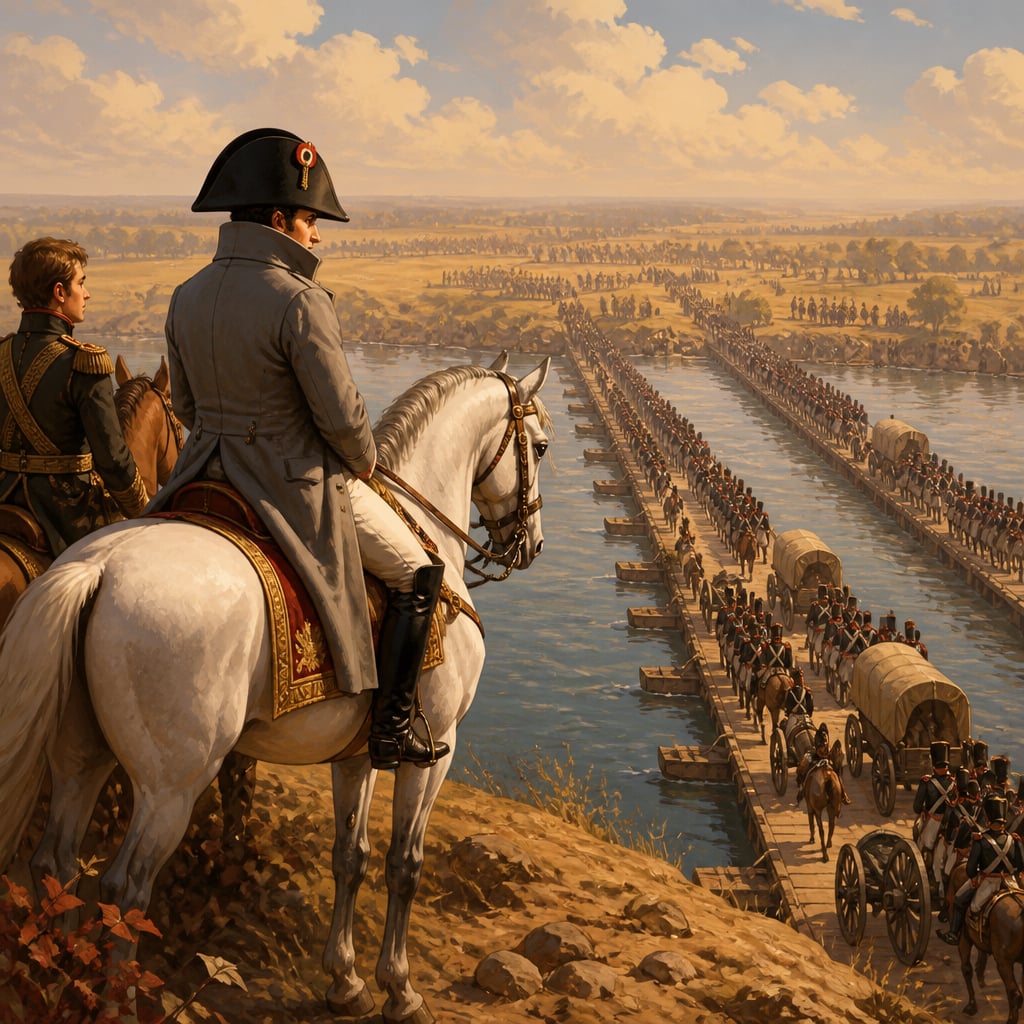
In June 1812, Napoleon Bonaparte crossed into Russia with 600,000 soldiers, the largest army Europe had ever seen. He focused entirely on one goal: defeat the Russian army ahead of him.
What he forgot was behind.
As his forces pushed deeper into Russia, his supply lines stretched across hundreds of miles of hostile territory. Russian partisans, what Kautilya would call the Parshnigraha, the rearward enemy, attacked convoys, burned warehouses, and cut communications. By December, Napoleon was fleeing west with fewer than 100,000 survivors.
The greatest military genius of his age had violated a principle Kautilya codified two thousand years earlier: "Pārṣṇigrahaṃ vinā na yāyāt", never march forward without securing the rear.
Beyond Simple Friends and Enemies
The basic Mandala teaches that neighbors are enemies and neighbors' neighbors are friends. But reality is messier. Kautilya mapped twelve distinct positions surrounding any ruler, each requiring different handling.
This isn't academic complexity. It's survival. Napoleon understood his front but forgot his rear. Countless strategists have ignored neutral powers that later proved decisive. The twelve-king system prevents such blindness.
The Complete Circle
Imagine yourself at the center, the Vijigishu, the one who seeks victory. Around you, Kautilya arranges twelve positions in three concentric rings.
The Inner Ring contains your immediate relationships. The Ari is your neighboring enemy. The Mitra is your natural ally on his far side. The Ari-mitra is your enemy's friend, someone who supports your rival.
The Middle Ring extends the web. The Mitra-mitra is your friend's friend. The Parshnigraha is the enemy at your back, someone who might strike while you're engaged forward. The Akranda is the friend at your back, your rear protection.
The Outer Ring holds the wildcards. The Madhyama is the neutral power between you and your enemy, a potential swing vote. The Udasina is the distant, powerful, indifferent king, someone who might intervene if the stakes rise high enough.
Why the Rear Matters

Kautilya returns obsessively to rear security. The Parshnigraha, literally "the heel-seizer", represents one of strategy's deadliest traps.
Think about it. You're focused forward, engaged with your primary enemy, committed to your offensive. Your attention, your resources, your best troops, all directed at the challenge ahead. That's when the Parshnigraha strikes.
Napoleon's rearward enemy was the Russian countryside itself, the partisans, the burned supply depots, the endless hostile terrain. He had no Akranda to watch his back.
Contrast this with Chandragupta Maurya. Before moving against the Nandas, he secured his rear through the treaty with Seleucus. His northwestern border was safe. He could focus forward with confidence. The difference between Chandragupta's empire and Napoleon's disaster was rear security.
The Power of Neutrals
Equally dangerous is ignoring the neutrals.
The Madhyama, the middle king, occupies the space between you and your enemy. In modern terms, this might be a buffer state, a swing voter, an uncommitted stakeholder. Their choice can tip the balance.
The Udasina, the indifferent king, is even more mysterious. This is the distant power with no immediate stake in your conflict. They seem irrelevant. But circumstances change. The indifferent can become decisive.
In 1941, Japan calculated that the United States was an Udasina, powerful but uninvolved in Asian affairs. Pearl Harbor transformed America from indifferent king to mortal enemy. Japan had miscounted the Mandala.
Mapping Modern Situations
The framework travels far beyond ancient warfare.
In business, your direct competitors are Ari. Your partners are Mitra. But who's your Parshnigraha? Perhaps a startup in an adjacent market that might pivot into your space. Perhaps a supplier who might integrate forward. Perhaps internal dysfunction that could undermine you while you're focused on the market.
And your Udasina? Maybe a tech giant that currently ignores your niche. Maybe a regulatory body that hasn't noticed your industry. The indifferent powers are dangerous precisely because you don't see them coming.
In careers, colleagues at your level are Ari. Allies in other departments are Mitra. But what about the senior leader who barely knows you exist? They're an Udasina, potentially decisive when promotion time comes, yet invisible in your daily calculations.
The Test of Comprehensive Thinking
Before any major move, Kautilya would have you map all twelve positions:
- Who is my direct enemy? How strong?
- Who is my natural ally? How reliable?
- Who supports my enemy? Can they be neutralized?
- Who threatens from behind? Is my rear secure?
- Who watches my back? Have I cultivated them?
- Who sits in the middle? Which way do they lean?
- Who seems indifferent? What might engage them?
This discipline prevents tunnel vision. Napoleon saw the Russian army; he didn't see the Russian winter, the partisans, the stretched supply lines. He had brilliant tactical vision and terrible strategic mapping.
The Mauryan Example

When Chandragupta built his empire, he didn't just defeat enemies. He managed all twelve positions.
The Nandas were his Ari, defeated in direct confrontation. The frontier tribes were his Mitra, allied against the common enemy. The Greek successor states began as Ari but became Udasina through the Seleucid treaty, neutralized, no longer a threat.
His Akranda relationships secured his rear. His diplomatic cultivation of the Madhyama kingdoms prevented them from joining his enemies. His awareness of distant Udasina powers kept him from overextension.
The result was India's first great empire. Not through superior force alone, but through superior positioning, all twelve positions accounted for, none forgotten.
Your Twelve Kings
The principle applies wherever you navigate complexity.
Before your next major initiative, draw your own Mandala. Place yourself at the center. Map each position honestly. Who directly opposes you? Who naturally supports you? What threatens from directions you're not watching? Who seems uninvolved but might become crucial?
The twelve-king system doesn't guarantee success. But it prevents the kind of strategic blindness that destroyed Napoleon, that dooms companies focused on competitors while disruption emerges from the side, that ruins careers while political forces move unseen.
"Dvādaśa rājāno maṇḍalam," wrote Kautilya. Twelve kings make the circle.
Know all twelve, or be surprised by those you forgot.
Rear security is the foundation of offensive capability. Without it, ambition becomes vulnerability.
Sun Tzu emphasized securing ground before advancing: 'The general who advances without coveting fame and retreats without fearing disgrace seeks only to protect his people and serve his sovereign.' Clausewitz noted that extending supply lines creates vulnerability. Modern game theory recognizes the two-front dilemma. Kautilya's innovation was systematic categorization - the Parshnigraha and Akranda positions explicitly map rear threats and protections.
Western strategists identified the principle; Kautilya provided the framework. The twelve-king system explicitly maps rear positions, ensuring they're never forgotten in forward-focused planning. This systematic attention prevents the oversight that destroyed Napoleon's Grande Armée and countless other campaigns.
Chandragupta Maurya's 305 BCE treaty with Seleucus Nicator exemplifies the principle. Before consolidating his Indian empire, Chandragupta secured his northwestern flank through diplomacy and marriage alliance. This transformed a potential Parshnigraha (Seleucid threat) into an Akranda (secure rear), enabling him to focus on internal consolidation without fear of Greek invasion. The result was forty years of Mauryan stability.
Uncommitted parties hold disproportionate influence in contested environments. Winning neutrals often matters more than defeating enemies.
Kissinger's diplomacy emphasized 'triangulation' - managing relationships with both China and the Soviet Union to prevent their alliance. Game theory's concept of 'kingmakers' recognizes that swing votes determine outcomes. Kautilya preceded these by two millennia, explicitly categorizing types of neutrals and prescribing cultivation strategies. Where Western thought treats neutral management as tactical, Kautilya builds it into the structural framework.
Verses
द्वादश राजानो मण्डलम्।
dvādaśa rājāno maṇḍalam |
Twelve kings constitute the mandala (circle of states).
This sutra establishes the complete framework. Strategic analysis isn't just about your immediate enemy and friend - it encompasses twelve distinct positions, each with its own significance.
Book 6, Chapter 2, Verse 19-24 (R.P. Kangle)
पार्ष्णिग्रहं विना न यायात्।
pārṣṇigrahaṃ vinā na yāyāt |
One should not march [forward] without [securing against] the rear enemy.
This tactical sutra has strategic depth. Never expose yourself by focusing entirely forward.
Book 7, Chapter 13, Verse 25 (R. Shamasastry)
मध्यमोदासीनौ मित्रार्थमुपसेवेत।
madhyam-odāsīnau mitrārtham upaseveta |
The middle king and the indifferent king should be cultivated for alliance purposes.
Neutrals matter. The Madhyama and Udasina represent opportunities - powers who might tip the balance if properly engaged.
Book 7, Chapter 18, Verse 3 (L.N. Rangarajan)
Case studies
Napoleon's Russian Campaign: Ignoring the Rear
In 1812, Napoleon invaded Russia with the largest army Europe had ever seen. He focused entirely on defeating the Russian army (his ari) while neglecting rear security. As his supply lines stretched across hostile territory, Russian forces and partisans (parshnigraha) attacked from behind. The campaign ended in catastrophic defeat.
Napoleon violated Kautilya's fundamental principle: never march forward without securing the rear. He had no effective akranda (rearward friend) in Russia. His extended supply lines became vulnerable to parshnigraha attacks. His focus on the forward enemy blinded him to rear threats. The twelve-king framework would have highlighted these vulnerabilities.
Of approximately 600,000 soldiers who entered Russia, fewer than 100,000 returned. Napoleon's empire never recovered. The campaign that was supposed to secure his eastern flank instead destroyed his power.
Forward focus without rear security is fatal. The twelve-king system's emphasis on parshnigraha and akranda addresses this exact vulnerability. Comprehensive analysis prevents the tunnel vision that destroyed Napoleon's army.
Startups frequently collapse not because of front-line competition but because of neglected rear vulnerabilities: cash burn, team burnout, regulatory blind spots. Companies like WeWork and Theranos focused entirely on forward growth while ignoring structural weaknesses behind them. Comprehensive strategic awareness, not just forward momentum, determines survival.
Napoleon's Grande Armee lost approximately 500,000 soldiers in Russia, with fewer than 100,000 returning. Roughly 80% of casualties came from disease, starvation, and cold rather than combat.
Historical context
c. 4th century BCE
Ancient India's political complexity required sophisticated strategic frameworks. With multiple kingdoms of varying size, tribal territories, and external threats, rulers had to manage relationships in all directions simultaneously. The twelve-king system emerged from this complex reality.
The twelve-king system enabled Mauryan success. By managing relationships comprehensively - not just with immediate enemies and friends but across all twelve positions - the Mauryans created strategic stability that supported their imperial achievement.
Reflection
- Think of a complex situation you're navigating - professional, personal, or otherwise. Can you identify all twelve positions? Who is your ari, your mitra, your parshnigraha, your akranda, your madhyama, your udasina? What does this mapping reveal?
- The twelve-king system implies that every significant situation has multiple stakeholders with complex interrelationships. Is this added complexity helpful for decision-making, or does it risk paralysis through over-analysis?