The Circle of Kings

Rajamandala Introduction

Discover Kautilya's revolutionary framework for understanding geopolitics - the Mandala theory. Learn how the position of states relative to each other creates predictable patterns of alliance and rivalry that transcend ideology and personality.

A Map Drawn in Torchlight
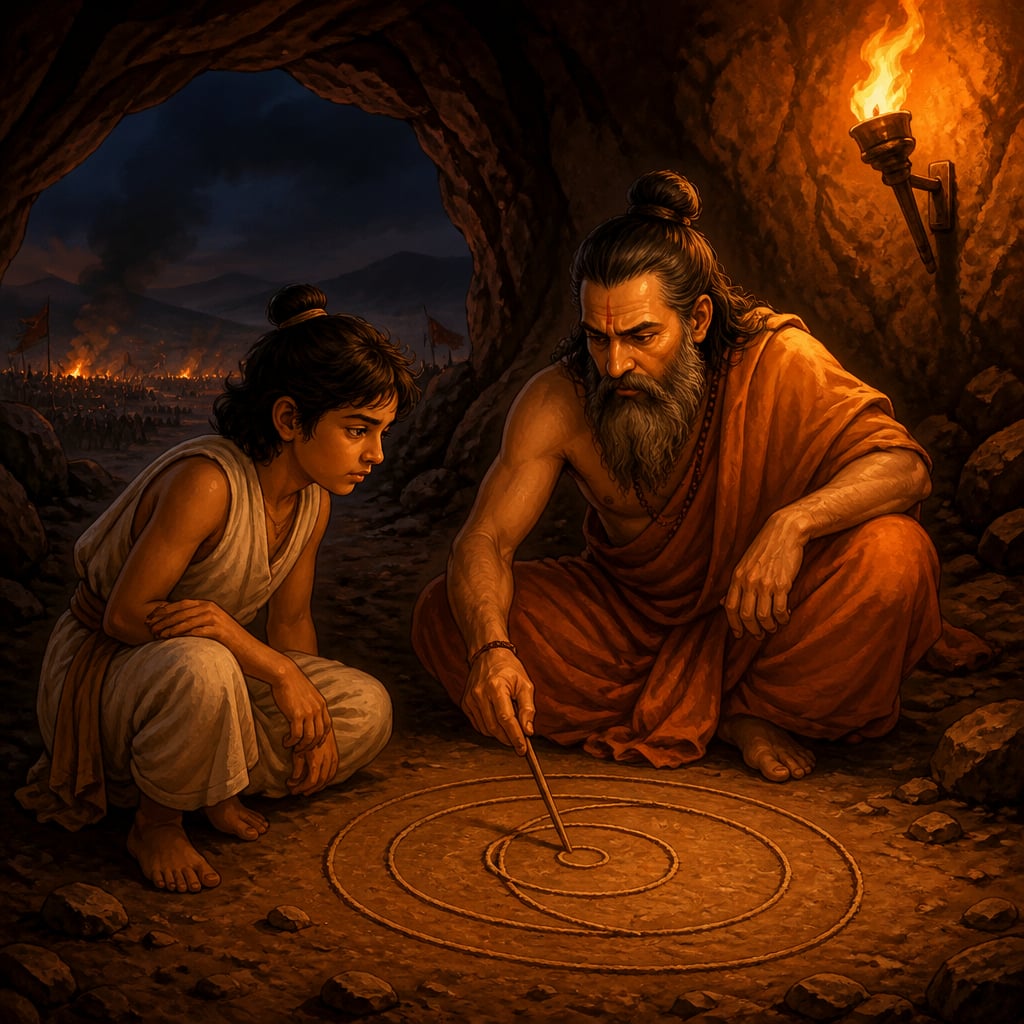
Kautilya tracing dust circles for young Chandragupta in a Takshashila cave

The young prince Chandragupta stood in the flickering torchlight of a cave near Takshashila, watching his teacher trace circles in the dust. Outside, Alexander's armies had just swept through the Punjab, leaving chaos in their wake. Inside, Kautilya, the Brahmin scholar who would become history's greatest strategist, was teaching a lesson that would reshape the subcontinent.

"Look," Kautilya said, drawing a small circle. "This is you. Now watch." He drew another circle touching the first. "This is your neighbor. And here, " a third circle on the opposite side ", is his neighbor."

"Who is your friend?" he asked.

Chandragupta hesitated. "The one who likes me?"

Kautilya shook his head, a thin smile crossing his weathered face. "The one who shares your enemy. Ari-mitrayoḥ prakṛti-maṇḍalaṃ vijigīṣoḥ, the circle of enemies and allies is the natural mandala of any ruler. Position creates alliance, not sentiment."

This was the birth of the Mandala theory, perhaps the world's first systematic framework for understanding who will be your friend, who your foe, and why.

The Geometry of Rivalry

Kautilya's insight was deceptively simple: geography creates destiny. Your neighbor isn't your rival because he dislikes you, he's your rival because you compete for the same space, the same trade routes, the same fertile valleys. His expansion means your contraction. His strength means your relative weakness.

But your neighbor's neighbor? He faces the same threat you do. When your neighbor grows powerful, you both feel the pressure. When your neighbor threatens war, his other border becomes his vulnerability.

This explains alliances that puzzle historians. Why did Catholic France ally with the Ottoman Empire against Catholic Spain? Why did America and the Soviet Union, bitter ideological enemies, unite against Nazi Germany? Why do rival tech companies in one market become partners in another?

The answer lies in the Mandala: your enemy's enemy is your natural friend.

The Twelve Kings

Kautilya didn't stop at simple circles. He mapped an entire constellation of relationships surrounding any ruler, the Vijigishu (the one who seeks victory) at the center.

Picture it: You sit at the center of your own universe. Immediately around you stand your neighbors, your Ari (natural enemies). Beyond them, your neighbors' neighbors, your Mitra (natural friends). And beyond them? More circles, twelve positions in all, each with predictable behaviors based on where they sit.

The brilliance lies in the prediction. You don't need to know what a foreign king thinks or feels. You need to know where he sits. "Position," Kautilya taught Chandragupta, "predicts behavior more reliably than promises."

A Theory Proven in Fire

Chandragupta and Seleucus sealing the Mauryan-Seleucid treaty

Chandragupta would test this theory against the mightiest powers of his age. When he moved against the vast Nanda Empire, with its army of 200,000 infantry, 20,000 cavalry, and 3,000 war elephants, he didn't attack directly. He read the Mandala.

The Nandas had enemies. Kingdoms they'd conquered, tribes they'd humiliated, vassals chafing under tribute. These weren't Chandragupta's natural allies by culture or creed, some were traditional enemies of his own clan. But they shared a common enemy, and that made them friends.

One by one, he built his coalition. The Greek successor states in the northwest, still reeling from Alexander's death? They had their own problems, perfect neutrality. The frontier tribes? They hated the Nandas more than they distrusted Chandragupta.

When he finally struck, the Nanda Empire faced not one enemy but many, their strategic position crumbling as the Mandala had predicted.

The Modern Mandala

The framework Kautilya sketched in that cave travels far beyond ancient kingdoms. Consider a startup entering a market dominated by a giant. Who are its natural allies? Not other startups in the same space, they're neighbors, competing for the same customers and investors. But companies in adjacent markets who share the giant as an enemy? That's a Mandala alliance waiting to happen.

Or consider your own career. Colleagues at your level, competing for the same promotion? Structural rivals, regardless of how friendly the relationship seems. But people in other departments, other companies, facing the same industry pressures? Natural allies.

Satya Nadella understood this when he took over Microsoft in 2014. Rather than fighting every competitor, he asked: who shares our enemies? The result: partnerships with former rivals like Salesforce and Linux, united against common threats.

Freedom Through Clarity

What does ancient geopolitics have to do with freedom? Everything.

A kingdom that misreads its Mandala, trusting neighbors who have structural incentives to betray it, ignoring distant powers who could help, loses its independence. It becomes a pawn rather than a player, reacting to events rather than shaping them.

The same applies to individuals. Strategic clarity protects your autonomy. Naivety invites exploitation. When you understand why people behave as they do, not from malice but from position, you can build real alliances based on shared interests, not wishful thinking.

Kautilya never promised that the Mandala would make enemies into friends. He promised something better: that it would help you see clearly. And in strategy, as in life, clear sight is the foundation of freedom.

Your Turn

Back in that cave near Takshashila, Kautilya gave Chandragupta one final instruction before they began their campaign: "Before you move a single soldier, map the complete Mandala. Know who will ally, who will oppose, who will watch and wait. Victory belongs to those who see the whole board."

The same instruction applies to you. Before your next major decision, a career move, a business strategy, even a difficult family situation, draw your own Mandala. Who occupies your border? Who sits beyond them? Where do interests align?

The circle of kings follows patterns. Those who see them gain the power to navigate them.

Comprehensive Strategic Assessment - Understanding the full constellation of actors, interests, and relationships before taking action.

Sun Tzu emphasized 'know yourself and know your enemy' but focused primarily on dyadic relationships. Clausewitz analyzed the trinity of people, army, and government but within a single conflict. Kautilya's innovation was systematic multi-actor analysis, recognizing that every move occurs within a web of relationships extending far beyond the immediate adversary. Modern game theory and network analysis formalize what Kautilya intuited: outcomes depend on the entire system, not just bilateral relationships.

Kautilya's Mandala provides a structured framework for comprehensive assessment that Western strategists developed only recently. Where Machiavelli offered maxims and Sun Tzu provided principles, Kautilya gave a systematic topology, twelve distinct positions with predictable behaviors. This prevents the strategic myopia that destroyed Napoleon (who saw only his forward enemy) and enables the foresight that built empires.

Chandragupta's campaign against the Nanda Empire exemplifies comprehensive mapping. Before engaging, he surveyed the complete mandala: identified regional kingdoms threatened by Nanda expansion (natural allies), assessed Greek successor states in the northwest (potential rear threat requiring neutralization), evaluated tribal confederations (could tip either way), and mapped internal Nanda factions (exploitable weaknesses). When he finally moved, every position was accounted for, resulting in victory against a militarily superior foe.

Structural Realism - The theory that strategic behavior is primarily determined by systemic position rather than internal characteristics or ideological preferences.

Kenneth Waltz's structural realism (1979) and John Mearsheimer's offensive realism (2001) rediscovered Kautilya's insight two millennia later. Thucydides observed that 'the strong do what they can and the weak suffer what they must,' but didn't systematize how position creates incentive. Machiavelli understood power dynamics but focused on princely virtue. Only in the late 20th century did Western IR theory formally recognize what Kautilya codified: anarchic systems create predictable behaviors based on relative position, not just capabilities or intentions.

Verses

अरिमित्रयोः प्रकृतिमण्डलं विजिगीषोः।

ari-mitrayoḥ prakṛti-maṇḍalaṃ vijigīṣoḥ |

The circle of enemies and allies constitutes the natural mandala of the would-be conqueror.

This sutra establishes the fundamental principle: every ruler exists within a natural pattern of allies and enemies. This pattern isn't arbitrary - it emerges from geographic and strategic position.

Book 6, Chapter 2, Verse 13-14 (R.P. Kangle)

समग्रमण्डलं विजिगीषुः पश्येत्।

samagra-maṇḍalaṃ vijigīṣuḥ paśyet |

The would-be conqueror should perceive the complete mandala.

Strategic thinking requires seeing the whole system, not just immediate neighbors. Your enemy's enemy, your ally's ally, distant powers who might intervene - all must be understood.

Book 6, Chapter 2, Verse 15 (R. Shamasastry)

यः स्वपार्श्वे विजिगीषोः तस्य स अरिः।

yaḥ sva-pārśve vijigīṣoḥ tasya sa ariḥ |

He who is situated at the border of the conqueror is his enemy.

This is the foundational principle of the Mandala: proximity creates rivalry. Not because neighbors are inherently bad, but because they compete for the same space, resources, and influence.

Book 6, Chapter 2, Verse 17 (L.N. Rangarajan)

Case studies

Cold War Mandala: US-China Rapprochement

In 1972, the United States - a capitalist democracy - formed a strategic partnership with Communist China against the Soviet Union. This alignment seemed to violate ideological logic entirely. Both nations were communist; both had been American enemies. Yet the alliance held for decades.

The Mandala explains this perfectly. The Soviet Union was the 'neighbor' threatening both the US (in Europe) and China (along their massive shared border). Despite ideological differences, the US and China were natural 'mitra' - their shared enemy's enemy. Geographic position trumped ideology.

The US-China alignment fundamentally shifted Cold War dynamics. The Soviet Union faced threats on two fronts and eventually collapsed. Meanwhile, China's opening to the West began its economic transformation.

Structural interests create alliances that pure ideology cannot explain. Wise strategists look past surface-level differences to identify shared strategic concerns. The enemy of my enemy remains a potential friend, regardless of other disagreements.

Tech companies today form alliances along the same positional logic. Google and Samsung partner on Android despite competing in hardware, because both face Apple as a shared structural rival. In geopolitics, India's growing ties with the US follow the same Mandala pattern: a shared concern about China's rise aligns their interests despite decades of distance.

The US-China rapprochement created a $750 billion bilateral trade relationship by 2020. Two ideological rivals became each other's largest trading partners within 40 years of their 1972 alignment.

Historical context

c. 4th century BCE

The Indian subcontinent in Kautilya's time was a complex patchwork of kingdoms, republics, and tribal territories. The Nanda Empire dominated the Gangetic plain, while Greek successor states controlled the northwest. This fragmented landscape made the Mandala framework essential for navigating competing powers.

The Mandala theory emerged from the practical challenge of unifying India against both internal fragmentation and external invasion. Kautilya needed a framework to identify who could be allied with, who must be defeated, and who could be neutralized. The theory he developed proved immediately applicable.

Reflection

More in Mandala Theory

All lessons in Mandala Theory · Arthashastra: Art of Strategy course