Mapping Your Strategic Environment

Practical Application

Transform theory into practice. Learn a systematic method for mapping your own mandala - identifying your ari, mitra, and all twelve positions in your real situation, assessing each player's strength and inclination, and using this analysis to guide strategic decisions.

The Merchant Who Saw Clearly
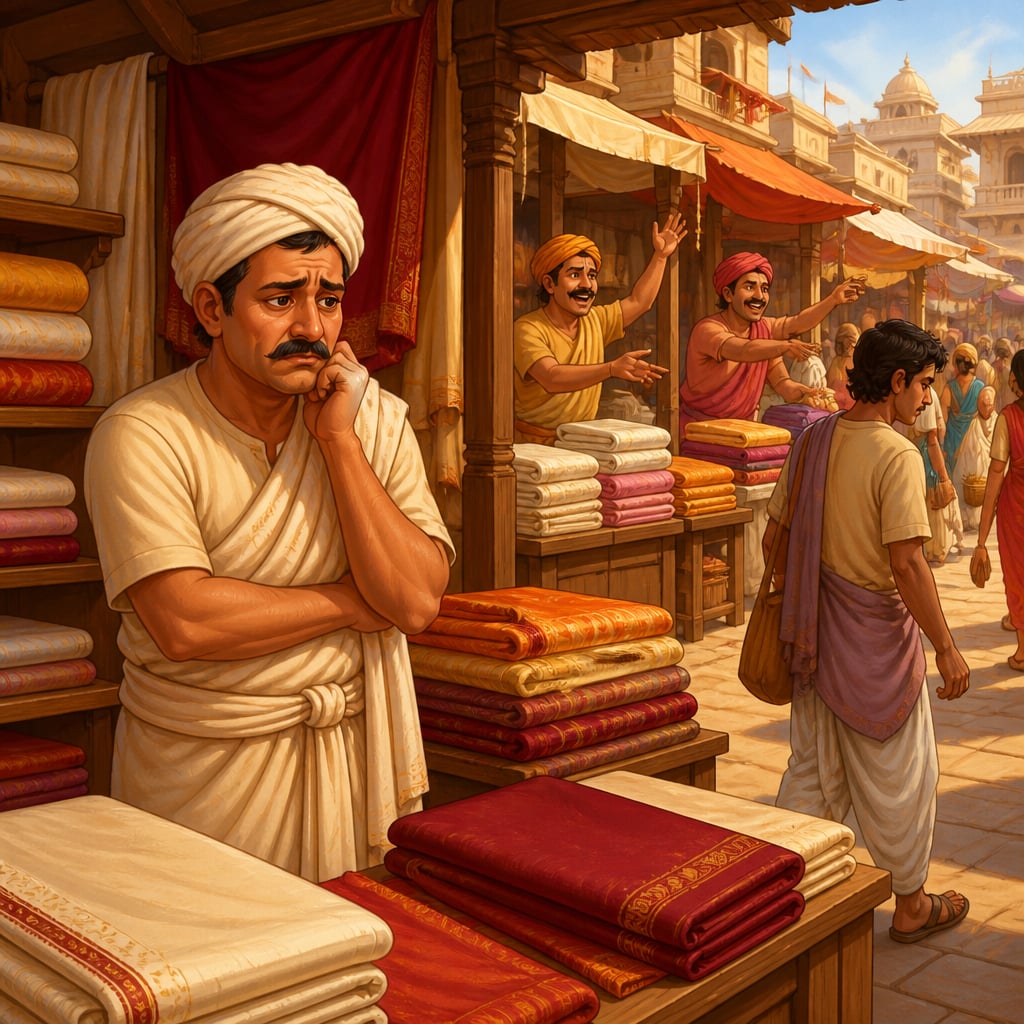
Cloth merchant Devadatta facing ruin at his Pataliputra stall

In the crowded markets of Pataliputra, a cloth merchant named Devadatta faced ruin. His two nearest competitors had begun undercutting his prices, his suppliers were demanding faster payment, and a wealthy trader from Varanasi was rumored to be opening a shop on the same street.

Devadatta sought counsel from an old advisor who had once served in the Mauryan court. The advisor didn't offer sympathy. He asked a simple question: "Have you mapped your mandala?"

"I sell cloth," Devadatta protested. "I'm not a king."

"Every merchant is king of his own enterprise," the advisor replied. "And every enterprise exists within a circle of rivals and allies. Until you see clearly who stands where, you're fighting blind."

That night, Devadatta did something he'd never done before. He drew circles on a palm leaf, placing himself at the center. What emerged changed everything.

The Practical Method

Kautilya didn't develop the Mandala as abstract philosophy. He created a practical tool for analysis, what we'd today call a strategic assessment framework. In the Arthashastra, he insists:

"षाड्गुण्यसमुद्देशः पूर्वं कर्तव्यः" "The survey of the strategic situation should be done first."

Before action comes understanding. Before movement comes mapping. This section transforms the Mandala from concept to practice.

Step One: Know Yourself

Devadatta's advisor began with a pointed question: "Who are you in this situation?"

Every strategic analysis starts with the Vijigishu, the aspiring victor at the center. But most people skip this step, assuming they know themselves. They don't.

Ask yourself:

Devadatta realized he'd been vague about his own position. He wanted to "succeed," but what did that mean? Survive the year? Dominate the market? Sell the business honorably? Each goal implied different strategies.

Step Two: Identify Your Ari

The merchant identified his nearest competitors as obvious rivals. But his advisor pushed deeper: "Who actually threatens what you want?"

The two local competitors fought for the same customers, but their threat was limited. The Varanasi trader, with his capital and connections, could fundamentally change the market structure. He was the primary Ari.

Ramesh Gupta faced exactly this situation when building his pharmaceutical distribution business in 1990s India. "Everyone focused on the competitors they could see," he later recalled. "The real threat was a multinational that hadn't entered India yet. I spent two years preparing for a rival most people didn't know existed."

Your Ari isn't whoever annoys you most. It's whoever most threatens your core objectives, often someone you haven't been watching.

Step Three: Find Your Mitra

Here came Devadatta's breakthrough. His advisor asked: "Who else is threatened by your Ari?"

The two local competitors weren't just rivals, they were also potential allies. They feared the Varanasi trader too. Beyond them, the local weavers' guild had their own reasons to resist wealthy outsiders who might bypass them for distant suppliers.

"Your enemy's enemy," the advisor reminded him, "is your natural friend."

This principle operates everywhere. When Google and Microsoft, fierce competitors in many markets, both supported certain data portability standards, they were acting as Mitra against a common threat from walled-garden platforms. Position creates alignment that sentiment cannot.

Step Four: Map the Extended Network

The Mandala doesn't stop at immediate neighbors. Devadatta traced outward:

The Ari's network:

His own potential network:

The rear positions:

The neutrals:

Step Five: Assess Each Position

Kautilya emphasizes balābala-jñāna, knowledge of strengths and weaknesses, as essential before action. For each position, assess:

Capability: What can they actually do? Don't assume, investigate.

Intention: What do they want? This predicts behavior better than promises.

Reliability: How have they acted under pressure before?

Trajectory: Are they growing stronger or weaker? The future differs from today.

Devadatta discovered that his most feared competitor was actually overextended, strong appearance, weak foundation. The Varanasi trader, by contrast, had deeper resources than rumored. This inverted his priorities.

The Modern Application

Consider Priya Mehta, a product manager at a technology company navigating a potential promotion. Her mapping revealed:

This mapping didn't guarantee success. But it transformed vague anxiety into clear analysis. Priya knew where to invest energy and what to watch.

Common Mapping Errors

Experience reveals patterns of failure:

Seeing only two categories. The world isn't just friends and enemies. Neutrals, rear positions, and extended networks matter enormously. The Mandala has twelve positions for a reason.

Confusing personal and positional. Your friend might occupy the Ari position. Your enemy might share your interests. Kautilya separates structural analysis from sentiment, so should you.

Static thinking. Positions shift. Today's enemy becomes tomorrow's ally. Update continuously.

Wishful assessment. Hope is not a strategy. Assess capabilities and intentions honestly, not hopefully.

Devadatta's Resolution

Devadatta drawing his strategic mandala by lamplight at home

Armed with his map, Devadatta acted strategically rather than reactively.

He approached his local competitors not as rivals but as partners against the common threat. Together, they negotiated with the weavers' guild for preferential supply terms. He secured his warehouse lease before it became a vulnerability. He cultivated the market headman with small favors before he needed large ones.

When the Varanasi trader finally arrived, he found not a fragmented market of isolated competitors but a coordinated network of local interests. His capital advantage couldn't overcome their positional unity.

"I didn't become more powerful," Devadatta later reflected. "I just finally saw the power I already had, and the power others would share if I invited them."

Your Turn

Kautilya's instruction applies to you: "The survey of the strategic situation should be done first."

Before your next significant decision, a career move, a business initiative, a difficult negotiation, draw your own Mandala. Place yourself at the center. Identify your Ari, your Mitra, your rear threats and protections, your neutrals.

You may discover, as Devadatta did, that the situation looks different once mapped. Threats may prove less formidable. Allies may emerge where you saw only strangers. Vulnerabilities may become visible before they become crises.

The map doesn't make the territory easier. But it ensures you're not walking blind.

Diagnosis before prescription. Understanding before action. The quality of strategic decisions depends entirely on the quality of strategic assessment.

Management consultants practice 'situation analysis' before recommendations. Military doctrine requires intelligence assessment before operations. OODA loops (Observe-Orient-Decide-Act) prioritize observation and orientation. Richard Rumelt's 'Good Strategy/Bad Strategy' emphasizes diagnosis as the first step. Kautilya preceded all of this, making systematic assessment the foundation of the entire Arthashastra framework - not a preliminary step but the essential discipline.

Where Western frameworks treat assessment as a phase, Kautilya builds it into the structure. The Mandala system itself is an assessment tool - twelve positions to identify, capabilities to evaluate, relationships to map. This systematic approach prevents the hasty judgment that leads to strategic disaster. Napoleon at Waterloo, Japan before Pearl Harbor, countless businesses launching without market understanding - all violated the principle Kautilya codified.

Before the Third Battle of Panipat (1761), the Maratha commander Sadashivrao Bhau failed to properly assess his strategic position. He advanced far from his base without securing supply lines, underestimated Afghan cavalry capabilities, and misread neutral powers' intentions. The resulting defeat killed perhaps 100,000 Marathas and ended their imperial ambitions. Had Bhau practiced Kautilyan samuddeśa - mapping supply vulnerabilities, assessing enemy capabilities honestly, cultivating neutrals - the outcome might have differed.

Strategic success requires brutal honesty about capabilities. Hope is not capability. Aspiration is not strength. Only accurate assessment of what you and others can actually do enables realistic strategy.

Clausewitz emphasized accurate assessment of forces. Sun Tzu taught 'know yourself and your enemy.' Modern strategy uses SWOT analysis (Strengths, Weaknesses, Opportunities, Threats). Behavioral economics identifies optimism bias and overconfidence as persistent human failings. Kautilya's balābala framework addresses these universal challenges - demanding rigorous, honest assessment as the prerequisite to action. Where Western thought identifies the problem, Kautilya made the solution systematic.

Verses

षाड्गुण्यसमुद्देशः पूर्वं कर्तव्यः।

ṣāḍguṇya-samuddeśaḥ pūrvaṃ kartavyaḥ |

The survey of the sixfold policy should be done first.

Before acting, understand your environment. The strategic survey - mapping your position and relationships - must precede policy decisions.

Book 6, Chapter 2, Verse 1 (R.P. Kangle)

बलाबलज्ञानमेव कार्यारम्भे।

balābala-jñānam eva kāryārambhe |

Knowledge of strengths and weaknesses is essential at the beginning of any action.

Assessment precedes action. You must know your capabilities and limitations, as well as those of others, before initiating strategic moves.

Book 7, Chapter 1, Verse 2 (R. Shamasastry)

प्रकृतीनां च अवस्थाः परीक्षेत।

prakṛtīnāṃ ca avasthāḥ parīkṣeta |

One should examine the conditions of all the constituent elements.

Strategic analysis must be comprehensive. Don't examine only the obvious players; assess all elements that affect your position.

Book 7, Chapter 5, Verse 1 (L.N. Rangarajan)

Case studies

Amazon's Strategic Mapping

In the early 2000s, Amazon faced competition from both traditional retailers (Walmart, Barnes & Noble) and emerging tech companies. Jeff Bezos systematically mapped the competitive environment, identifying where to compete, where to partner, and where to stay neutral - building the platform strategy that made Amazon dominant.

Bezos exemplified systematic mapping. He identified primary ari (direct competitors like eBay), potential mitra (publishers and vendors who shared interest in reaching customers), madhyama (neutral parties who might join the platform), and threats from multiple directions. His mapping wasn't static - it evolved as the environment changed.

Amazon's platform strategy converted potential enemies into ecosystem participants. By mapping systematically and acting on that analysis, Bezos built a dominant position that competitors struggle to challenge.

Systematic strategic mapping enables sophisticated positioning. By understanding all players - not just direct competitors - Amazon found ways to coopt rather than just compete, building advantages that simple competitor analysis would have missed.

Platforms like Airbnb and Uber succeeded by mapping entire ecosystems of stakeholders rather than focusing solely on direct competitors. Airbnb mapped hotels, regulators, property owners, and travelers as interconnected actors. The companies that dominate today are the ones that understood the full board, not just the player sitting across from them.

Amazon's marketplace now hosts over 9.7 million sellers globally, turning potential competitors into platform participants. Third-party sellers account for roughly 60% of all items sold on Amazon.

Historical context

c. 4th century BCE

Ancient Indian statecraft required systematic analysis due to political complexity. The subcontinent's many kingdoms, shifting alliances, and external threats demanded rigorous assessment methods. The mapping techniques that emerged from this environment proved sophisticated enough to impress Greek observers.

The Mauryan Empire's success depended on superior strategic assessment. Chandragupta and Kautilya consistently outmaneuvered opponents through clearer understanding of the strategic environment. This wasn't luck but method - and the method can be learned.

Reflection

More in Mandala Theory

All lessons in Mandala Theory · Arthashastra: Art of Strategy course